Slow Cal, Melting in Malibu Is a Map You Don’t Need to Read
The first time you hear Slow Cal, Melting in Malibu — the new instrumental record from RRAI, released through Ringtone Records 26 — you…
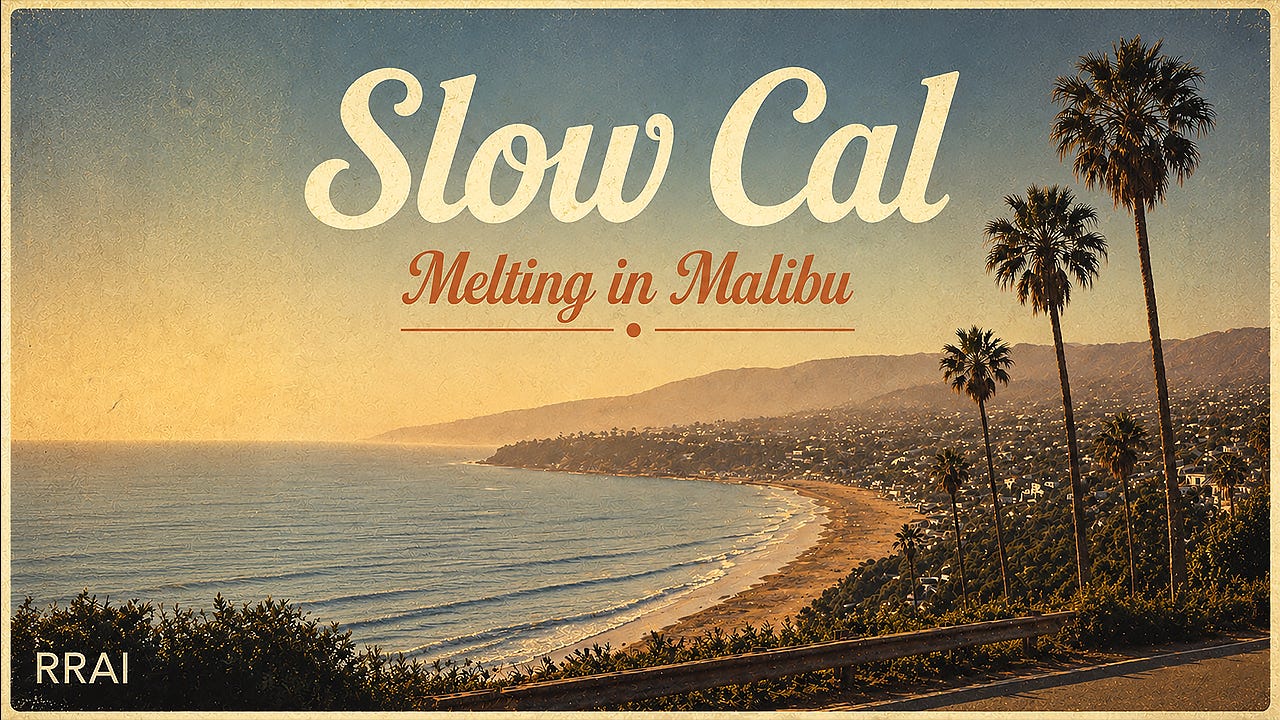
Slow Cal, Melting in Malibu
Slow Cal, Melting in Malibu Is a Map You Don’t Need to Read
The first time you hear Slow Cal, Melting in Malibu — the new instrumental record from RRAI, released through Ringtone Records 26 — you should be in a car. Not driving, necessarily. Just sitting. Maybe parked somewhere on Pacific Coast Highway with the windows down, or in a rental in a Santa Monica lot, waiting for someone to call you back. The album works best in that kind of suspended state, the kind of state where California always seems to be happening to you, gently, without your input.
That’s a strange thing to say about a record. Albums don’t usually come with instructions. But this one is structured like a drive — a slow, deliberate one, with the windows cracked and the radio tuned to itself.
A Coastline You Can Hear
What RRAI has built across these nineteen tracks is, in a sense, a map. Not of streets or landmarks, but of light, water, and the small hours of an evening. The tracklist reads like a field notebook: “Slow Tide,” “Evening Waves 2,” “Ocean Motion,” “Pacific Breeze,” “Sunset Drive,” “Beach Walk,” “Pacific Weekend,” “Sunset Reflections,” “No Shirt No Shoes No Problem,” “Coastline Mist,” “Malibu Color,” “Slow Cal, Malibu,” “Palm Tree Shadows,” “Night Fish,” “I’m California Dreaming,” “Victory at Sea,” “Malibu Night Life,” “Catalina Sailing,” and “Beach House in June.”
The titles do what lyrics would have done, but with a kind of hush. They tell you where you are. They tell you what time it is. They tell you whether to be still or to move.
That is the trick of the record, and it is a hard trick to pull off. Place-based instrumental music is easy to under-do — just stick a pad under a wave sample and call it ambient — and very easy to overdo, in the manner of the “Cinematic Pacific Vibes” overload that buries the listener in hokum. RRAI threads that needle. The pieces move with the unhurried grace of a long drive on Highway 1, and they breathe in the way the coast breathes — in and out, in and out, in a rhythm older than any of us.
The Architecture of an Afternoon
The first movement of the album belongs to the water. “Slow Tide” arrives with the patient weight of an incoming swell, and “Evening Waves 2” extends the thought, as though the record wants you to settle into the idea that you are not going anywhere soon. By the time “Ocean Motion” and “Pacific Breeze” have done their work, you are in the water. Or you are at the water. The distinction begins to matter less.
Then comes the turn toward land. “Sunset Drive” is, for my money, the most cinematic cut on the record — the kind of track that wants to be scored over a long drone shot of a convertible moving past cliffs. “Beach Walk” slows the pace to a stroll. “Pacific Weekend” introduces a faintly more social mood, the kind of music that could play from a boardwalk speaker or a Venice apartment balcony. And “Sunset Reflections” closes out the early evening with something that feels almost private, a piece of music for the moment just before you go inside.
The Long Evening
As the album moves into its second half, the temperature drops — figuratively, not literally. California after dark is its own country. “No Shirt No Shoes No Problem” leans into the easy, sun-soft humor of the place, the kind of joke that only works if you have spent enough time in the sand to mean it. “Coastline Mist” brings the marine layer in off the Pacific, that strange cold fog that sometimes rolls up the beaches in June. “Malibu Color” — the title alone does most of the work — sounds the way the album looks when the highway lights begin to take over from the sun.
And then comes “Slow Cal, Malibu,” the title track. It is the centerpiece of the record, and it sits at the heart of the album’s central question: what does it sound like to be a place without having to say its name? The track answers it softly. It doesn’t shout. It doesn’t insist. It just persists, the way a coast does.
“Palm Tree Shadows” makes the same case in a different key, the slow sway of fronds on a strip-mall breeze. “Night Fish” is what you’d want playing on a pier at two in the morning, when the only company is the halogens and the slap of small waves under the dock. “I’m California Dreaming” is wry, affectionate, and a little tired — the kind of song that knows the cliché and is fond of it anyway.
The Ocean at the End
The album’s final stretch is the part I keep returning to. “Victory at Sea” — a title borrowed from an older, more martial tradition — gets used here in a sun-warped, almost lazy way. It is the music of a boat that isn’t going anywhere in particular, and the Pacific doing what the Pacific does. “Malibu Night Life” sounds like a hotel bar at the edge of the water, all low lamps and the soft clatter of glasses being set down too carefully. “Catalina Sailing” pulls the eye outward, across the channel, toward the island, the kind of cut you put on when the windows are down and the crosswind smells like kelp.
And then “Beach House in June.” The last track. The longest emotional beat on the record. It is a piece of music for the moment when you wake up in a house you don’t quite own, the door open, the curtain moving in a wind that smells like salt, and you don’t need to be anywhere for a long time. The album ends there, in that almost-too-quiet place, and it doesn’t feel like an ending. It feels like a pause. The kind of pause that, if you are lucky, becomes a morning.
A Record About a Place, Made Without Words
The thing I keep coming back to, after multiple listens, is how completely Slow Cal, Melting in Malibuaccomplishes its work without a single sung line. There is no voice to anchor it. There is no hook to hang a memory on. There is only the record, and the coast it keeps returning to, and the way it gives both of them a slightly longer shadow than they had before.
This is what a place-based album is supposed to do. It isn’t supposed to advertise a location. It isn’t supposed to sell you on a lifestyle. It is supposed to do what the best coastal records have always done: hand you the room temperature, the wind direction, and the time of day, and then trust you to make the rest of it up.
RRAI, working through Ringtone Records 26, has made that kind of record. I don’t know what California will sound like ten years from now, but I know what it sounds like this summer. It sounds like this.
Vizualizer:
Youtube:
Streaming:
Spotify:
https://open.spotify.com/album/0NMk1legsWFmsih7YBIiPq?si=-x7v-vXrQbaFrYUJlX-lBQ
iTunes:
https://music.apple.com/us/album/slow-cal-melting-in-malibu/6766361272
Amazon:
메타데이터
- post_id
- edd58eeb16db
- slug
- slow-cal-melting-in-malibu-is-a-map-you-dont-need-to-read-edd58eeb16db
- url
- https://medium.com/@bricesalek/slow-cal-melting-in-malibu-is-a-map-you-dont-need-to-read-edd58eeb16db
- canonical_url
- https://medium.com/@bricesalek/slow-cal-melting-in-malibu-is-a-map-you-dont-need-to-read-edd58eeb16db
- author_url
- https://medium.com/@bricesalek
- status
- ok
- fetched_at
- 2026-06-10 18:55:46





