Camel Case vs Pascal Case vs Kebab Case vs Snake Case 🤔
Camel Case vs Pascal Case vs Kebab Case vs Snake Case 🤔
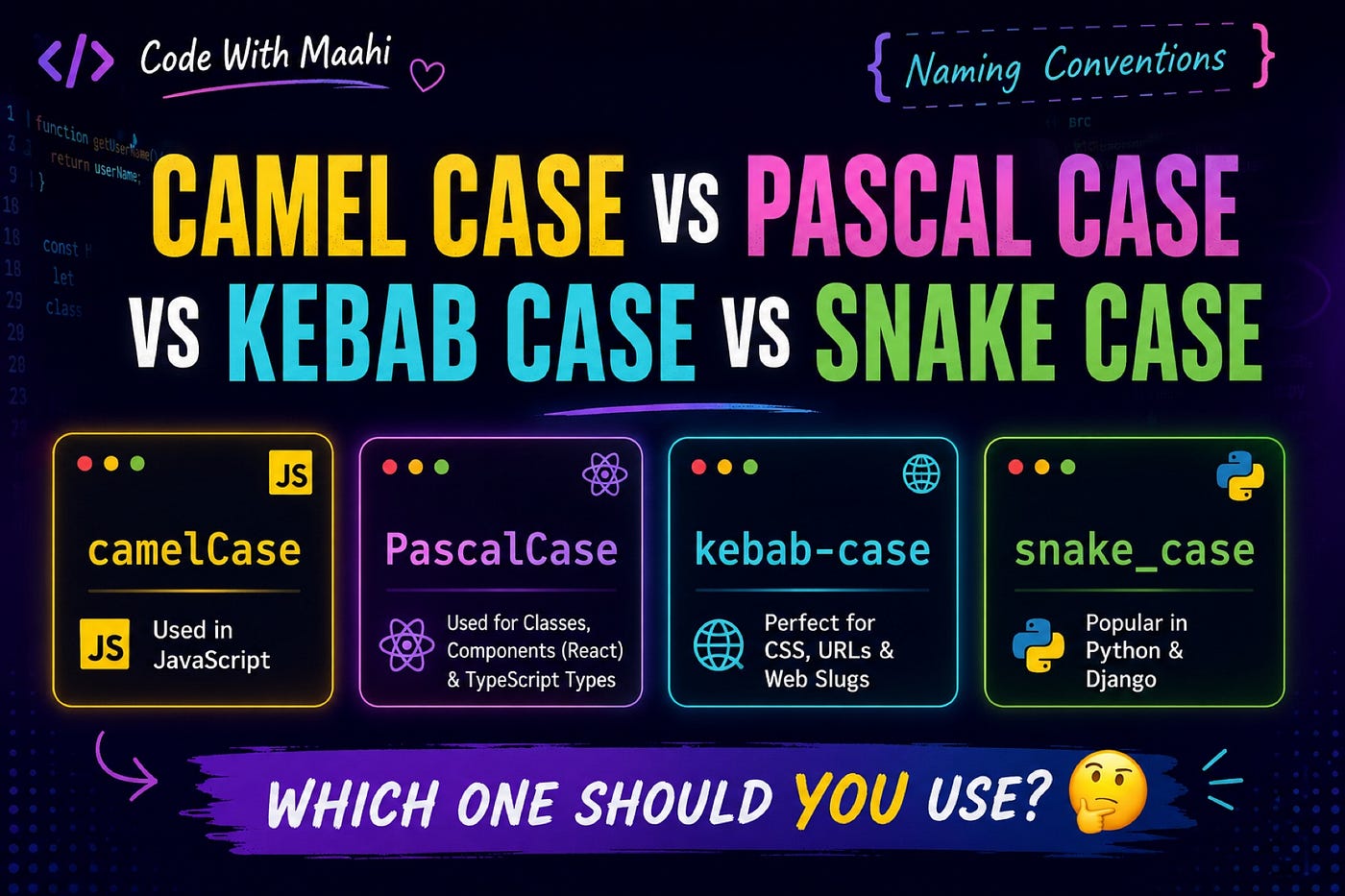
When writing code, naming conventions play a crucial role in readability, maintainability, and consistency. Among the most widely used naming styles are Camel Case, Pascal Case, Kebab Case, and Snake Case.
In this post, we’ll break down each naming convention, show examples, and explain where and when to use them effectively across different languages and contexts.
🐪 1. Camel Case (camelCase)
Camel Case starts with a lowercase letter, and each subsequent word begins with an uppercase letter.
let firstName = "Mahipal";
let totalAmount = 100;
🧠 Why it’s called Camel Case?
Because the capital letters resemble humps on a camel 🐪.
✅ Where to Use
Camel Case is commonly used for:
- Variables
- Function names
- Object keys
🌍 Common Languages
- JavaScript
- Java
- TypeScript
- C#
- Swift
✔ Best Practices
Use camelCase when:
- Writing variables and functions
- Following JavaScript conventions (very important in frontend)
🅿️ 2. Pascal Case (PascalCase)
Pascal Case is similar to Camel Case, except the first letter is also capitalized.
class UserProfile {}
public string FirstName { get; set; }
``
Where to Use
Pascal Case is mostly used for:
- Class names
- Constructors
- Interfaces
- Types
Common Languages
- C#
- Java
- TypeScript
- Python (for classes)
- C++
Best Practices
Use PascalCase when:
- Naming classes, types, or components
- Following OOP conventions
🐍 3. Snake Case (snake_case)
Snake Case separates words using underscores (_) and uses lowercase letters.
first_name = "Mahipal"
total_amount = 100
Why “Snake”?
The underscores resemble a snake slithering along 🐍.
Where to Use
Snake Case is commonly used for:
- Variables
- Functions
- File names
Common Languages
- Python (standard convention)
- Ruby
- PHP (sometimes)
Best Practices
Use snake_case when:
- Working in Python projects
- Writing scripts or backend services
🌮 4. Kebab Case (kebab-case)
Kebab Case uses hyphens (-) to separate words and all letters are lowercase.
<div class="user-profile"></div>
``
Why “Kebab”?
Because the words are “skewered” with hyphens like kebabs 🍢.
Where to Use
Kebab Case is used for:
- File names
- URLs
- CSS class names
Common Technologies
- HTML / CSS
- Angular (file naming)
- URLs (SEO-friendly paths)
Important Note
Kebab-case cannot be used in most programming languages for variables because - is treated as a minus operator.
Best Practices
Use kebab-case when:
- Creating URLs or file names
- Writing CSS classes
🏁 Final Thoughts
Choosing the right naming convention isn’t just about style — it improves:
- ✅ Readability
- ✅ Code consistency
- ✅ Team collaboration
👉 Golden Rule: Follow the conventions of the language and framework you are using.
메타데이터
- post_id
- eddbfcb089da
- slug
- camel-case-vs-pascal-case-vs-kebab-case-vs-snake-case-eddbfcb089da
- url
- https://medium.com/@mschoudhary81/camel-case-vs-pascal-case-vs-kebab-case-vs-snake-case-eddbfcb089da
- canonical_url
- https://medium.com/@mschoudhary81/camel-case-vs-pascal-case-vs-kebab-case-vs-snake-case-eddbfcb089da
- author_url
- https://medium.com/@mschoudhary81
- status
- ok
- fetched_at
- 2026-07-28 01:54:09





