Discourses from the Typhoon’s Eye №12 — When the Earworm Sings
A bell rings. The room is still. Yet somewhere inside your skull, a jukebox flips on by itself. Many sitters expect thoughts to arrive as…
Discourses from the Typhoon’s Eye №12 — When the Earworm Sings
A bell rings. The room is still. Yet somewhere inside your skull, a jukebox flips on by itself. Many sitters expect thoughts to arrive as words or images. But sometimes the mind prefers melody.
A chorus loops. A hook repeats. A half-remembered song refuses to leave the zendo.
This discourse addresses a common question from sincere practitioners of shikantaza: What are we meant to do when the mind won’t stop singing?
Student: Sometimes, when I go to sit, I keep hearing a song in my head on a loop. Others mention a looping thought or thought pattern. What can we do to make these “earworms” silent?
Teacher: Ah… The mind’s little troubadour refuses to leave the zendo. Listen carefully, friend.
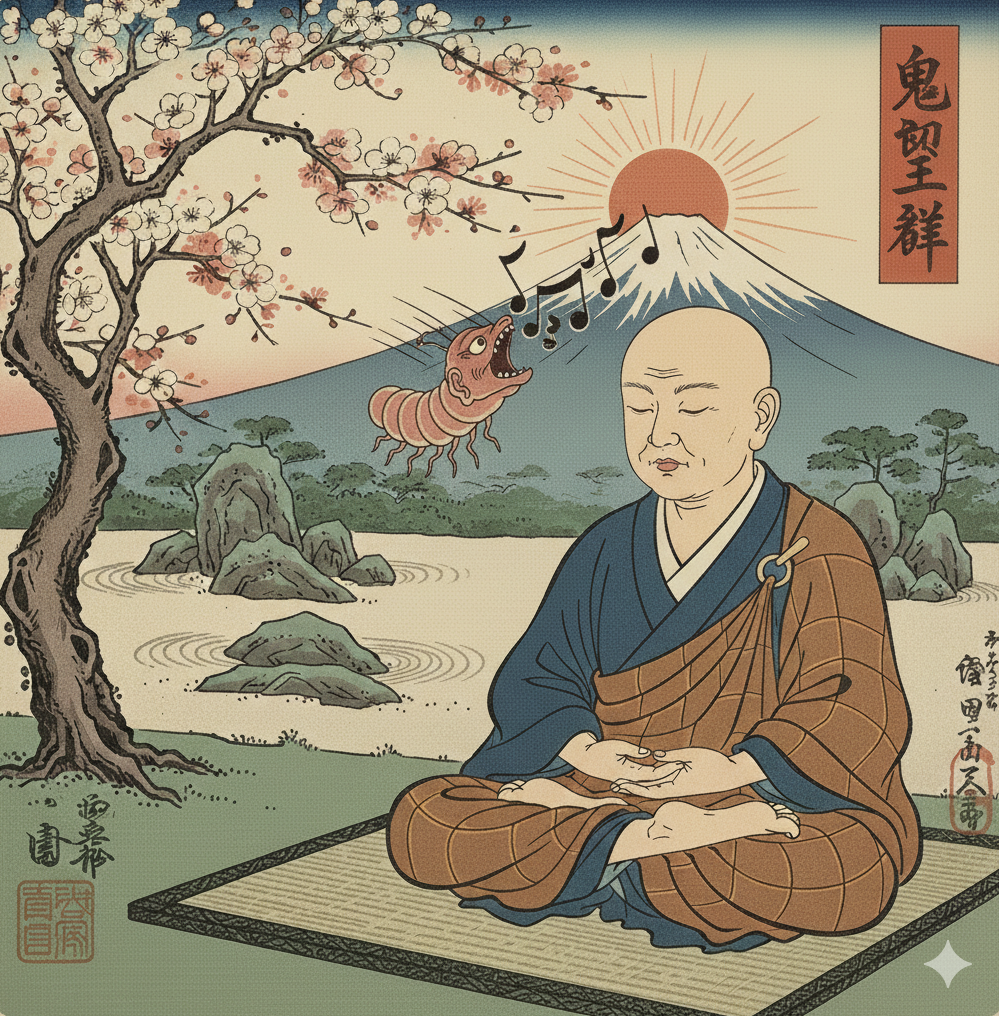
An “earworm” is not different from a thought. It only feels stronger because rhythm and memory like to hold hands.
If you try to silence it, you feed it. If you argue with it, you give it a stage. If you worry about it, you invite an encore.
So what do we do?
First, see it clearly:
This is not music happening. This is memory replaying itself. Soundless sound. No singer. No audience.
Next, follow the practice.
Do not push the song out. Do not sing along. Do not analyze why this song.
Instead:
Sit upright. Feel the weight of the body on the cushion. Let the breath breathe itself.
And — this is key — let the song be part of the room.
The hum of the refrigerator. The bird outside. The ringing in the ears. The tune in the head.
No special treatment.
When you notice you are inside the song, gently return to the body. When you notice you are listening to the song, let listening soften.
Soon, you may notice something curious:
The song does not loop perfectly. It fades. It skips. It dissolves into fragments.
That is impermanence showing itself.
And if it does not stop?
Good.
Then your practice is sitting with music, not against it.
Shikantaza is not silence-training. It is non-interference training. A mind that can sit with a looping song can sit with grief, craving, pain, or fear.
Eventually, the song grows tired. Songs always do. But even if it stays, you are not trapped inside it… unless you believe you must fix it.
So the old fool says:
Let the band play. Do not dance. Do not boo. Just sit.
And in time, you may discover:
The deepest silence is not the absence of sound, but the absence of resistance.
Now… Sit!
So what about you, fellow practitioners of the Way of Just Sitting? 😉
When the mind sings on its own, can you let it pass through the room without asking it to leave?
Gasshō 😊🙏🪷
메타데이터
- post_id
- ede415e381e7
- slug
- discourses-from-the-typhoons-eye-12-when-the-earworm-sings-ede415e381e7
- url
- https://medium.com/@ryudo.anju/discourses-from-the-typhoons-eye-12-when-the-earworm-sings-ede415e381e7
- canonical_url
- https://medium.com/@ryudo.anju/discourses-from-the-typhoons-eye-12-when-the-earworm-sings-ede415e381e7
- author_url
- https://medium.com/@ryudo.anju
- status
- ok
- fetched_at
- 2026-06-23 17:05:31