Every red squiggle under your typos was one engineer’s idea. He just died, unnamed.
For three decades it has flagged the world's misspellings as they happen, and the man who first drew it into Microsoft Word is gone
Every red squiggle under your typos was one engineer’s idea. He just died, unnamed.
For three decades it has flagged the world’s misspellings as they happen, and the man who first drew it into Microsoft Word is gone
Photo by Benoît Deschasaux on Unsplash
Look at almost any screen where someone is typing. Sooner or later, a red line appears under a word. You have seen it more times than you could ever count. You have never once wondered who drew it.
It is, very plausibly, the most-seen piece of user interface ever shipped. It lives in Word and in Google Docs, in every text box on the web, in your phone’s keyboard, in the comment field where you are about to be wrong on the internet. Red under a misspelling, green under bad grammar. It appears the instant you slip, it asks nothing of you, and it has quietly corrected more human writing than every copy editor who has ever lived, put together.
Someone had to draw the first one. We happen to know exactly who. His name was Tony Krueger, he spent years at Microsoft building Word, and word of his death reached the rest of us the way these things now do — a single blog post, passed around for a day by the people who understood what it meant, and missed entirely by the billions who use his work every time they type.
The Most-Seen Line in Software
Nobody held a vote on this. No standards committee declared that a red wavy underline would be the universal sign for you made a mistake and a green one for check your grammar. There was no launch event. The squiggle simply arrived, spread from one program to all of them, and became part of the background grammar of using a computer — as unremarked-on as the blinking cursor or the little spinning wheel that means wait.
That is the strange thing about the deepest infrastructure. It is not the stuff with logos. It is the stuff that has dissolved so completely into the experience that you no longer perceive it as a thing that was designed, by a person, who had to decide exactly how it should behave.
The red squiggle is one of those. Billions of people trust it, reflexively, dozens of times a day. Almost none of them could tell you it was ever invented, let alone by whom.
Before Him, Spelling Was Something You Scheduled
For most of the history of writing, catching a misspelling was a person’s job, done after the fact, in red ink.
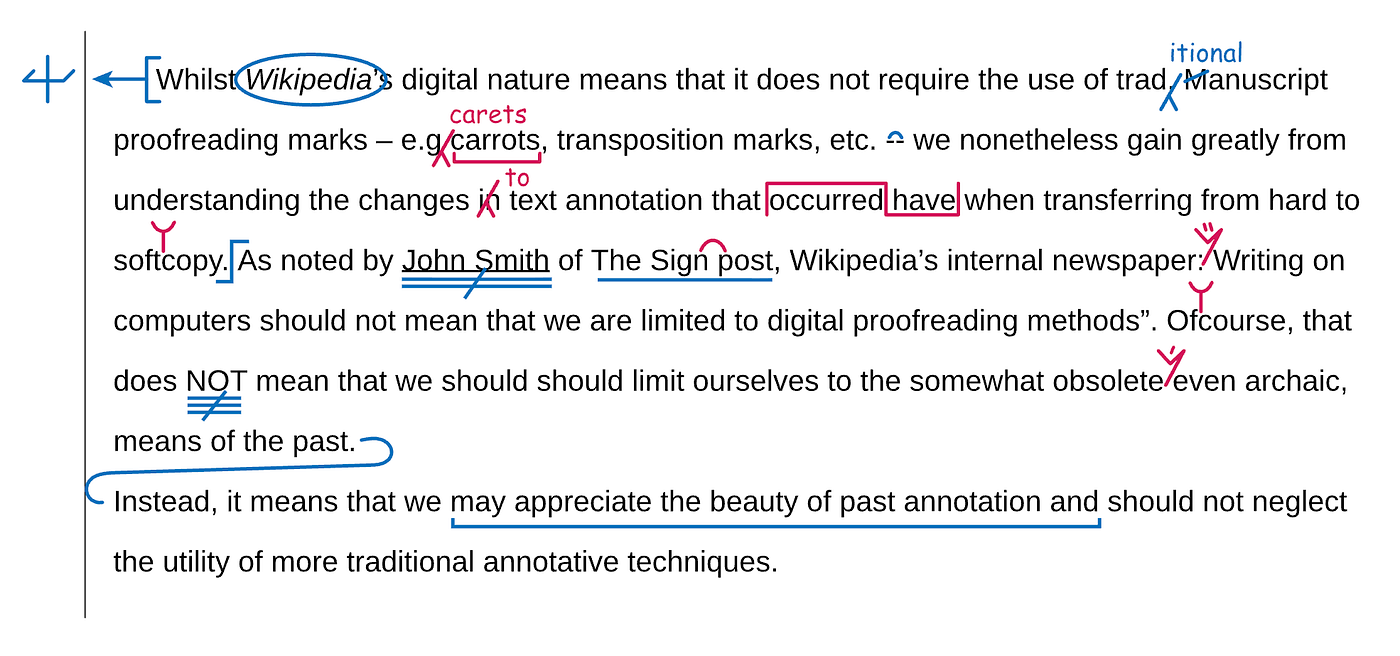
Proofreader’s marks (ISO 5776) — the hand-drawn, after-the-fact correction system that the real-time squiggle absorbed into the act of typing itself. Isochrone, CC BY-SA 4.0, via Wikimedia Commons.
The first computer spell checkers kept that same shape: correction as a separate event, performed on a finished document. In early versions of Microsoft Word, spell check was a thing you ran. You wrote, then you invoked it, then you sat and waited while the program marched through your text and halted you at every suspect word, one at a time, each one demanding a decision before it would move on.
Even the improved, automatic version had a fatal manner. It ran as a blocking operation — it would, in Raymond Chen’s memory of it, decide that now would be a good time to spell-check the whole document at the precise moment you wanted to save and leave, and make you wait for it to finish. So people did the rational thing. They turned it off. A feature that interrupts you to help you is a feature you eventually learn to resent.
The Man Who Shipped More Words Than Anyone
His name was Tony Krueger, and he may hold a record no one competes for: most versions of Microsoft Word shipped by a single human being.
He worked on Word 1.0, then 1.1, then 2.0. He worked on Word for OS/2 and Word for Mac. He came back for Word 6.0 and stayed for years past it. If you used Word at almost any point across two decades, some of what you were using had passed through his hands.
He was not the famous kind of engineer. He was the load-bearing kind — the one who is simply there, release after release, holding a thing together while the industry’s attention moves on to whatever is new.
His most important change was tiny to describe and bottomless in its effect: he made the spell checker get out of your way. Instead of a process you launched and waited on, it slipped into the background and watched while you typed.
When it found something wrong, it did not stop you, did not pop up, did not demand anything. It drew a red squiggle under the word and let you keep going. Later, a green one for grammar. The interruption became an offer. You decided when, or whether, to care.
That inversion — from the tool runs you to the tool waits for you — is one of the quietly great interface decisions in the history of personal software. And almost no one knows it was a decision at all.
“The Red and Green Squiggles!? I Love the Red and Green Squiggles!”
There is one story that captures how strange it is to have built something this invisible and this universal.

Penn Jillette. Photo by Michael Willems, CC BY-SA 3.0, via Wikimedia Commons.
Krueger was a fan of Penn & Teller. A colleague who went to one of their shows hung around afterward to get a photo signed for him, and explained that his friend Tony had worked on the red and green squiggles in Word. Penn Jillette, in the stentorian voice that fills a theater whether he means it to or not, boomed back: “The red and green squiggles!? I love the red and green squiggles!” Teller, characteristically, concurred in silence.
It is a small, warm thing, but notice what is actually happening in it. A world-famous performer adores a feature with such force that he shouts about it — and has no idea he is one degree of separation from the person who made it. The squiggle was beloved and anonymous at the same time, which is the exact condition Krueger spent his career in. (The feature is famous enough to have a cameo in pop culture: “Weird Al” Yankovic’s Word Crimes video flashes the Word red squiggles for a beat. Even there, the squiggle is the star and its author is nowhere.)
He Once Reverse-Engineered a Whole Game Just to Move It
The squiggle was the work that touched the most people, but it was not the only quietly absurd feat on his record.
When Microsoft wanted to put the puzzle game Chip’s Challenge into the Windows Entertainment Pack, Krueger did not have the source code. So he reverse-engineered the MS-DOS version — worked out, from the outside, how the program behaved — and reimplemented it for Windows. The original game was Chuck Sommerville’s, built for the Atari Lynx in 1989; the artwork for the port was Ed Halley’s; the whole thing was done in a single summer. It is the kind of task most engineers would call impossible and a few would call a vacation. Krueger just did it, the way he seems to have done everything: without fuss, and without anyone outside the room ever finding out.
Was He Really the First?
Honesty matters in a story like this, so here is the asterisk. Krueger did not invent the very idea of checking spelling in the background. That credit goes further back — Sector Software’s Spellbound, released in 1987, already did interactive checking while you worked. If you want the absolute first, it is not him.
But “first” and “the one everyone got” are different achievements, and the second is usually the one that changes the world. By Word 95, in 1995, Microsoft Word was running on an enormous share of the desktops on Earth, and the squiggle Krueger drew into it rode along to all of them. The distance between inventing something and shipping it to everyone is the distance between a footnote and a habit the whole world shares. He did the second thing. He is the reason the squiggle is not a clever idea in an old manual but a reflex in your hands.
The Assistant That Never Tried to Write for You
I write for a living, and I lean on a pipeline of language models to do it — I am, in the most literal sense, a person who has automated parts of writing. So I have been sitting with why Krueger’s little red line moves me more than any of the loud tools I actually use.
It is this. The squiggle is the most successful writing assistant in history, and it succeeded precisely because it never once tried to write for you. It does exactly one thing: it points. Here. Look at this. You might be wrong. Then it stops, and the next move is yours.
It made an entire planet of people better at spelling without ever taking the pen out of their hands, without a subscription, without a brand, without a personality, without asking to be thanked. For thirty years it has been the rare piece of software that helps you and then gets out of the chair.
That is a design ethic, and it is one we are busy forgetting. The tools I build, and most of the tools being built right now, are racing in the other direction — toward writing the whole sentence, the whole email, the whole essay, toward doing the thing instead of pointing at it. Some of that is real progress. But the red squiggle is a quiet argument that the highest form of assistance might be the most restrained one: the kind that respects that the work, and the judgment, and the credit, were supposed to stay with the human.
Tony Krueger built that argument into machines all over the world and then disappeared back into the background he came from. The next time a red line catches one of your mistakes, you will not think of him — that was always the deal. But you could, just once, let the squiggle do its job, fix the word yourself, and know that a person decided it should happen exactly that gently. He’d have liked that better than the credit.
References
- Raymond Chen, “In memory of the man who put red and green squiggles under words,” The Old New Thing, Microsoft (June 22, 2026) — https://devblogs.microsoft.com/oldnewthing/20260622-00/?p=112451
- Michael Tsai, “Tony Krueger, RIP” (roundup of tributes) — https://mjtsai.com/blog/2026/06/25/tony-krueger-rip/
- “Spell checker,” Wikipedia (background/interactive checking; Spellbound, 1987; Microsoft Word since Word 95) — https://en.wikipedia.org/wiki/Spell_checker
- “Chip’s Challenge,” Wikipedia (Tony Krueger reverse-engineered the MS-DOS version for the Windows port; Chuck Sommerville, Atari Lynx, 1989) — https://en.wikipedia.org/wiki/Chip%27s_Challenge
- Hacker News discussion, “In memory of the man who put red and green squiggles under words” — https://news.ycombinator.com/item?id=48648959
메타데이터
- post_id
- edf1eee5285e
- slug
- every-red-squiggle-under-your-typos-was-one-engineers-idea-he-just-died-unnamed-edf1eee5285e
- url
- https://medium.com/programmers-career/every-red-squiggle-under-your-typos-was-one-engineers-idea-he-just-died-unnamed-edf1eee5285e
- canonical_url
- https://medium.com/programmers-career/every-red-squiggle-under-your-typos-was-one-engineers-idea-he-just-died-unnamed-edf1eee5285e
- author_url
- https://medium.com/@wesley-wei
- status
- ok
- fetched_at
- 2026-07-09 08:02:55