Amritsari Chole Bhature: The Sunday Brunch Every Indian Home Should Master
Walk down Lawrence Road in Amritsar on a Sunday morning and you’ll smell it before you see it.
Amritsari Chole Bhature: The Sunday Brunch Every Indian Home Should Master
Walk down Lawrence Road in Amritsar on a Sunday morning and you’ll smell it before you see it.
Hot oil.
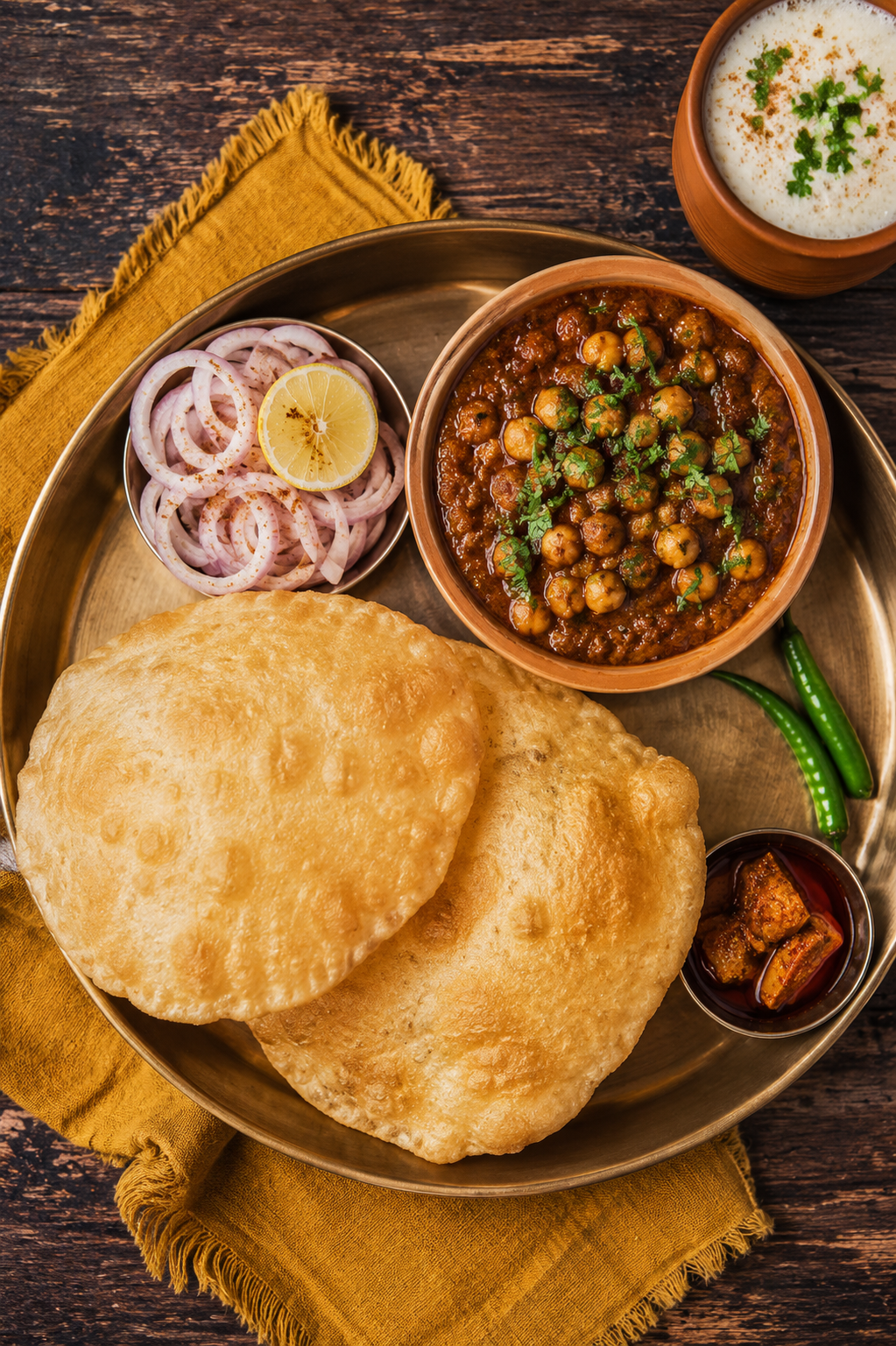
Freshly fried bhature ballooning into golden pillows.
Dark, fragrant chole simmering in giant iron kadhais.
Sharp onions piled beside lemon wedges.
Green chillies waiting for the brave.
And somewhere nearby, a tall steel glass of lassi sweating in the Punjab heat.
It’s the kind of breakfast that makes people stand in line without complaining.
The kind that turns a simple Sunday into an event.
Most of us have eaten chole bhature at roadside stalls, wedding buffets, office outings, and family gatherings. Yet surprisingly few home cooks make it regularly.
Partly because bhature feels intimidating.
Partly because restaurant chole seems impossible to replicate.
And partly because delivery apps have convinced us that some dishes belong outside the home.
They don’t.
Amritsari Chole Bhature is absolutely achievable in a home kitchen.
You don’t need a dhaba tandoor.
You don’t need a thirty-year-old kadai seasoned by generations of cooks.
You just need to understand what makes the Amritsari version different.
Once you do, Sunday brunch becomes a lot more interesting.
Why Amritsari Chole Is Darker Than Your Home Version
One of the first things people notice about authentic Amritsari chole is the colour.
It’s darker.
Richer.
Almost mahogany.
Many home versions stay bright orange or red.
That’s because restaurants use a few tricks.
The most common is brewing the chickpeas with tea bags.
Tea doesn’t dramatically change flavour, but it deepens colour beautifully.
Some cooks add dried amla while boiling.
Others swear by iron cookware, which gradually darkens the gravy during cooking.
None of these tricks are mandatory.
But together they create the signature appearance people associate with Punjabi dhabas.
The bigger secret, however, isn’t colour.
It’s patience.
The darker look often comes from a longer cooking process, where onions, tomatoes, and spices are allowed to develop properly.
That’s where the real flavour lives.
The Bhature Dough: Puff Starts Here
Every great chole bhature plate is really two recipes.
And bhature deserves as much attention as the curry.
Home cooks often get trapped in debates:
Yeast?
Curd?
Eno?
Baking powder?
The truth is simpler than most internet arguments.
All of these methods can work.
What matters more is fermentation and resting.
A dough rested for two to three hours will outperform a rushed dough regardless of the leavening agent.
During that rest period, gluten relaxes.
Air pockets develop.
Texture improves.
The result is bhature that puff beautifully instead of becoming dense and chewy.
Think of the leavening as the assistant.
The resting time is the star.
When rolling, avoid making them too thin.
A little thickness helps create the dramatic balloon effect everyone wants.
The Masala Stack That Creates Real Punjabi Flavour
Many chole recipes taste flat because the spice profile is incomplete.
Authentic Amritsari chole builds flavour in layers.
The foundation starts with onions, tomatoes, ginger, and garlic.
Then comes the spice stack.
Coriander.
Cumin.
Red chilli.
Turmeric.
But what separates good chole from unforgettable chole are the supporting players.
Anardana
Dried pomegranate seeds add a gentle tang that cuts through the richness.
Kasuri Methi
Crushed between your palms before adding.
This tiny step releases oils and aroma.
Chole Masala
A quality chole masala blend provides depth and complexity.
You can make your own, but a trusted store-bought blend works perfectly well for most home cooks.
The goal isn’t to use more spices.
It’s to use the right ones at the right time.
Frying Without Fear
Deep frying scares many people.
Fortunately, bhature is surprisingly forgiving.
The biggest mistake?
Oil that’s too cool.
When the oil isn’t hot enough, bhature absorb excess oil before they can puff.
An easy test:
Drop a tiny pinch of dough into the oil.
If it rises to the surface within about four seconds, you’re ready.
If it sinks and sits there, wait longer.
If it browns instantly, lower the heat.
Once the bhatura enters the oil, gently press the top using a slotted spoon.
This classic dhaba technique encourages steam formation and helps create that dramatic balloon shape.
Don’t panic if the first one isn’t perfect.
Even restaurant cooks don’t judge a batch by the first bhatura.
The second and third usually tell the real story.
The Small Details That Make It Feel Like Amritsar
Most people focus entirely on the chole.
But brunch memories are built from details.
The onions.
The lemon.
The chillies.
The pickle.
The lassi.
A proper Amritsari plate feels complete because every element has a purpose.
Thinly sliced onions add crunch.
Fresh lemon brightens the richness.
Green chillies provide heat.
Achar contributes acidity.
Lassi cools everything down.
Together they transform the meal from delicious to memorable.
It’s the same principle behind a restaurant experience.
The main dish matters.
The supporting cast matters too.
What Else Belongs On This Weekend Table?
Sunday cooking often becomes a family event.
If you’re building a larger Punjabi-style spread, there are plenty of directions to explore.
For a meatier Punjabi cousin, try Chana Dal Gosht:
https://fullmeals.com/recipe/chana-dal-gosht-authentic-bawarchi-style
On weekdays, when deep frying feels ambitious, this 2-ingredient roti is the everyday answer:
https://fullmeals.com/recipe/2-ingredient-roti-indian-flatbread
And if you love this weekend-brunch format, the Mumbai Pav Bhaji is the next project:
https://fullmeals.com/recipe/pav-bhaji-mumbai-street-style
Each delivers the same sense of occasion in a different way.
The First Batch Doesn’t Need To Be Perfect
Here’s something worth remembering.
Every cook who now makes incredible chole bhature has made bad chole bhature.
Flat bhature.
Over-spiced chole.
Undercooked chickpeas.
Oil that’s too hot.
Oil that’s too cold.
That’s part of learning the dish.
What matters is getting close enough that your kitchen starts smelling like a Punjabi dhaba.
Because once that happens, you’ll keep improving.
And before long, Sunday brunch stops being something you order.
It becomes something you make.
That’s when the recipe becomes part of your household’s own traditions.
The Sunday Ritual Is Worth Keeping
In a world of food delivery apps, instant meals, and endless takeout options, dishes like Amritsari Chole Bhature remind us why some recipes survive generation after generation.
Not because they’re convenient.
Because they’re worth gathering around.
This weekend, give it a try.
Get the complete ingredient list, exact measurements, and printable recipe here:
https://fullmeals.com/recipe/amritsari-chole-bhature
And if your hands are covered in flour while cooking, having recipes saved offline helps. I usually keep mine in the Sweet’N’Spicy app (iOS and Android), where the Fullmeals collection is easy to access without hopping between browser tabs.
메타데이터
- post_id
- edf835bfc79b
- slug
- amritsari-chole-bhature-the-sunday-brunch-every-indian-home-should-master-edf835bfc79b
- url
- https://medium.com/@sweetnspicy/amritsari-chole-bhature-the-sunday-brunch-every-indian-home-should-master-edf835bfc79b
- canonical_url
- https://medium.com/@sweetnspicy/amritsari-chole-bhature-the-sunday-brunch-every-indian-home-should-master-edf835bfc79b
- author_url
- https://medium.com/@sweetnspicy
- status
- ok
- fetched_at
- 2026-07-24 03:33:04