Recognizing the Development of Asian American Literature
By Seo Young Bai, Minju Kim, and Sally Pan
Recognizing the Development of Asian American Literature
By Seo Young Bai, Minju Kim, and Sally Pan
Our project began with the idea of exploring how we could represent ourselves through data while focusing on our cultural and ethnic backgrounds. We decided to concentrate on Asian Americans since our group consists of members who identify as both Asian and American, coming from different parts of Asia.
We expected that finding a dataset documenting both Asia and America would be challenging since we were not sure whether there would be such a dataset. Fortunately, we came across one related to Asian American literature, which captures the diversity of ethnicities and the development of literature. While this dataset cannot fully represent the entirety of Asian Americans, it offers a valuable opportunity to explore an important aspect of the broader landscape, Asian American literature. By examining this data, we can gain insight into the ways Asian American authors have contributed to and shaped American literature.
The dataset we have chosen is *The Canon of Asian American Literature* curated by Long Le-Khac, which contains bibliographic records of Asian American literature along with biographical information of the authors. Our goal is to analyze the period of time during which the largest amount of Asian American literature was published. Identifying which genres of Asian American literature are prominent is also important, as Asian American literary studies encompass a wide range of genres, beyond traditional definitions of literature. Additionally, we had a plan to examine which authors have published the most literary works and how the publication patterns of each ethnic group among authors have evolved. Our project builds upon these foundations by using R-based computational methods and Data wrapper for visualization to further explore the dataset’s temporal, ethnic, and genre-based dynamics.
Dataset
We found the dataset on the Post45 data repository, where a thorough description can be found (https://data.post45.org/posts/asian-american-literature/). It was collected over nine years by Long Le-Khac. The author has published a dataset containing citations of Asian American literary works, accompanied by two supplementary datasets. One provides a biography of unique authors and the other offers a bibliography of unique texts, both referencing the main dataset.
The data was collected using the Modern Language Association’s international bibliography. The texts that scholars have recognized as Asian American literature were selected from this bibliography. Some texts mentioned in articles from top journals, such as Amerasia Journal and The Journal of Asian American Studies, were also covered, as publishing in those journals indicates an association with Asian American literature. The author then extracted titles from these scholarly sources and used publicly accessible information for manually adding metadata. The dataset contains 1,886 observations and 30 features, including about 800 authors and 1,000 texts of Asian American literature.
Ethical Concerns & Limitations
The original biographical documentation of the dataset mentions ethical considerations. Although this data is open to the public under the CC BY 4.0 reuse license, it includes sensitive demographic and biographical information such as birth year, ethnicity, birth nation, and personal immigration history. We also understand that categories of gender, race, and ethnicity are contextual and this aspect requires us to be mindful and pay careful attention to handling this data responsibly and appropriately.
The main dataset harboured several challenges during our analysis and visualizations. Many cells were either empty or contained multiple values. Some rows were duplicates containing publications with the same titles and authors. We addressed these issues by drawing on all three datasets during our initial analyses. At first, we attempted to remove duplicate rows manually, but this was impractical given the main dataset’s 1,886 rows and the number of cells requiring review.
When analyzing the dataset about unique authors, we encountered a few complications with our original question to analyze the patterns of which ethnic groups published the most during specific periods. In the end, we ultimately used all three datasets, choosing the most appropriate one for each analysis based on its objectives.
Another challenge arose. The publication years span a wide range from 1606 to 2022, and many years include only one or two titles. Our initial plan was to determine the most prominent genres during the years with the highest publication counts, determining that this sparse distribution makes it difficult to visualize genre or ethnic group trends across individual years. However, the distribution of ethnic groups and genres during peak years differed little from the distribution across the entire periods; we chose instead to present an overall view of patterns from 1606 to 2022.
Findings & Discussion
To explore when Asian American literature was published the most and how the overall publication patterns have changed over time, we started by cleaning the publication year data and plotting the number of unique titles by year. Once we visualized the data, it became much easier to notice how uneven the publication timeline is and how much it changes depending on the historical period.
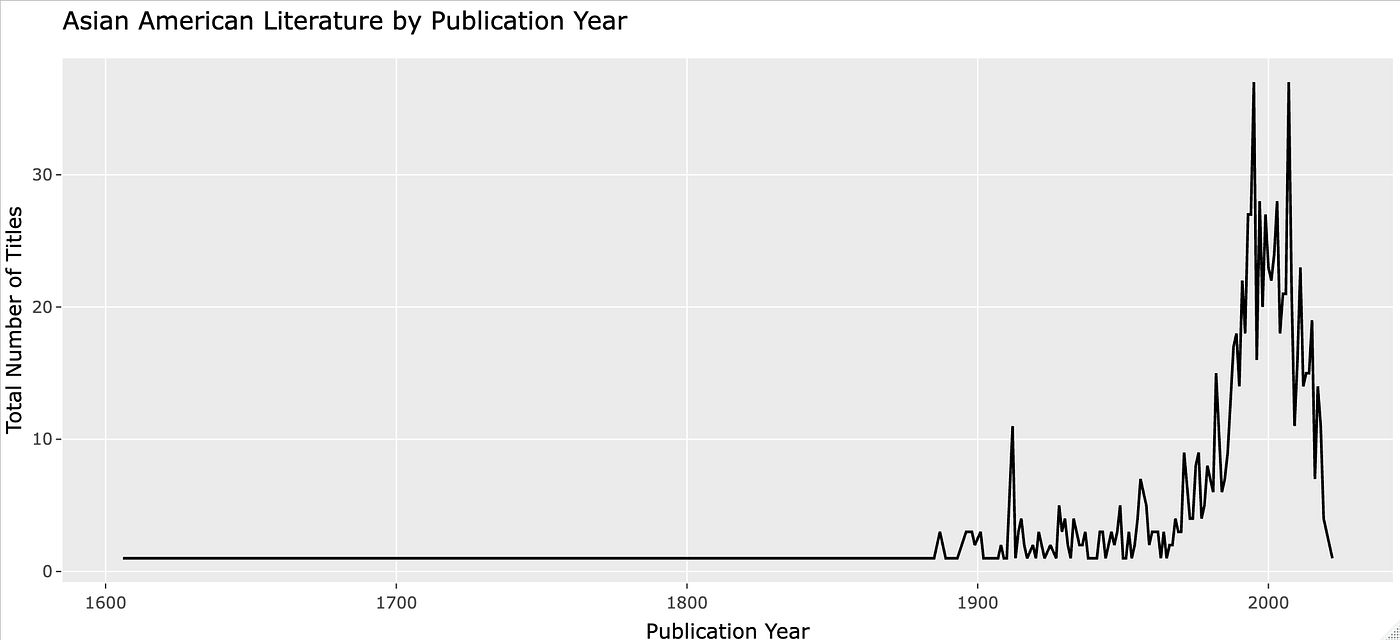
When looking at the earlier part of the graph, especially anything before the late 1800s, there are almost no recorded publications at all. This long flat line suggests that although Asian immigrants were present in the United States during certain periods, their literary work either wasn’t widely circulated, wasn’t preserved, or simply wasn’t recognized and included in mainstream literary spaces. Even as the line starts to rise slightly around the early 1900s, the numbers remain very small and inconsistent. From roughly the 1910s through the 1960s, the graph shows only occasional small spikes, which indicates that Asian American writers were producing work, but their overall visibility and representation were still limited. A noticeable shift began in the 1970s and 1980s. During this time, the line starts to move upward more steadily. This may reflect social and political changes, as these decades include movements for civil rights, growing Asian American identity, and more opportunities for marginalized authors to publish. Although the growth during this period is not dramatic, it marks the beginning of a more stable upward trend.
The most dramatic change, however, occurs from the 1990s onward. The number of unique titles increases very quickly, and the steep rise in the graph shows how rapidly Asian American literature expanded during this period. The early 2000s stand out the most in the dataset. This is where the highest peaks appear, with several years showing more than twenty or even thirty unique published titles. Based on the graph, the early twenty-first century is clearly the period with the greatest number of Asian American literary works. After these peaks, the graph shows some decline in the most recent years, though that could partially be due to incomplete cataloging of recent publications or delays in the dataset.
Overall, the publication pattern shifts from almost no activity in the earlier centuries, to slow and irregular growth in the early and mid twentieth century, and finally to a dramatic expansion in the late twentieth century and early 2000s. This long-term change suggests increasing opportunities for Asian American authors, greater recognition of their work, and a growing interest in preserving and documenting Asian American literature. It also reflects the broader social and cultural visibility of Asian American communities over time.
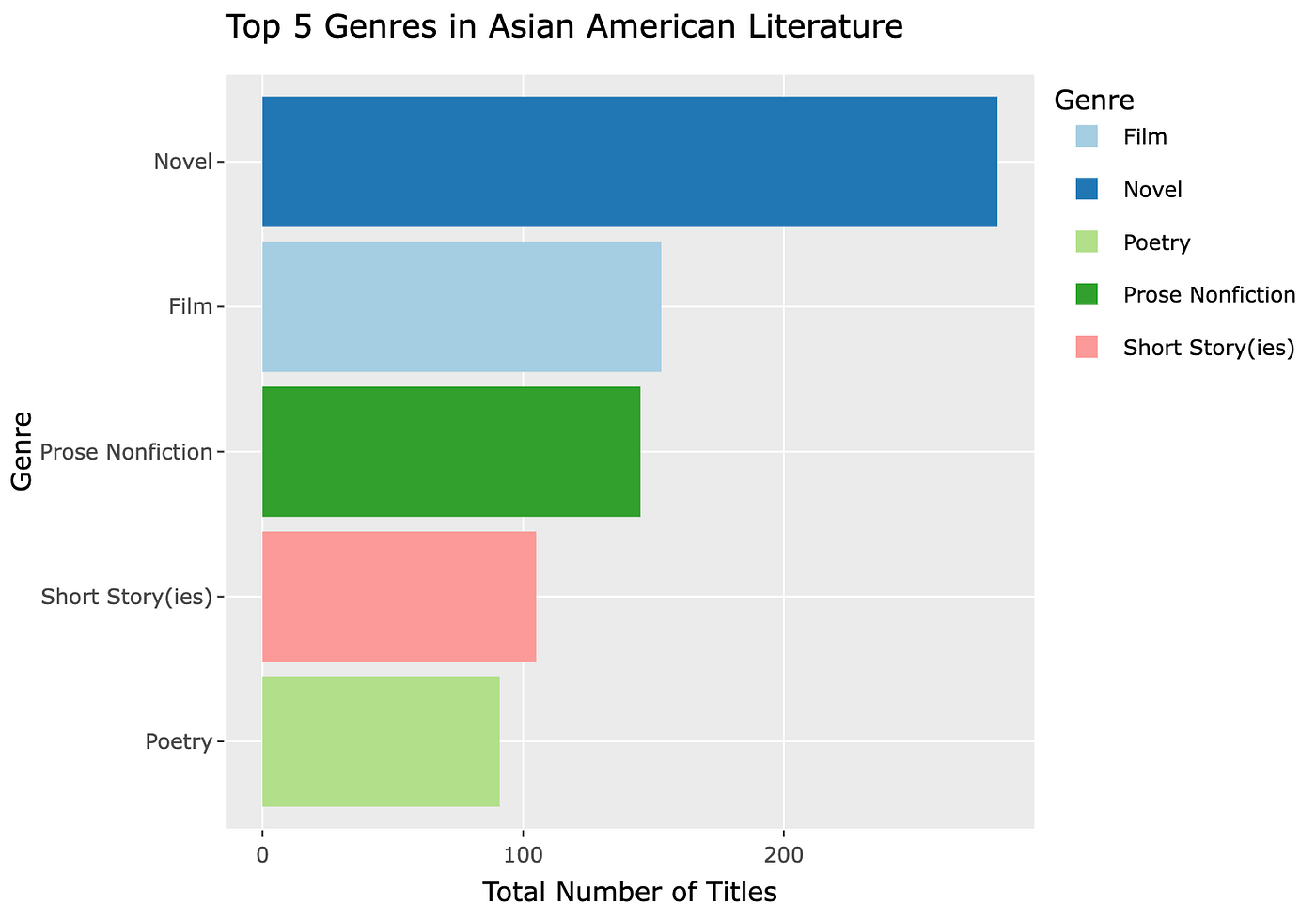
We identified which genres were the most prominent among these titles of Asian American literature. Using the unique title dataset, we grouped works by genre and identified the top 5 categories: novel, film, prose nonfiction, short story(ies), and poetry. Novels ranked first with 282 titles, followed by 153 films and 145 prose nonfiction. Poetry, with 91 titles, ranked fifth, only slightly behind short story(ies) at 105 titles. It is also important to note that this dataset encompasses a wide range of genres within Asian American literary studies, beyond traditional definitions of literature, including film, television, online video, and social media. Notably, film emerges as the second most prominent genre, which is situated outside traditional literary definitions. This suggests that Asian American literary works have expanded through both conventional and more broadly defined genres.
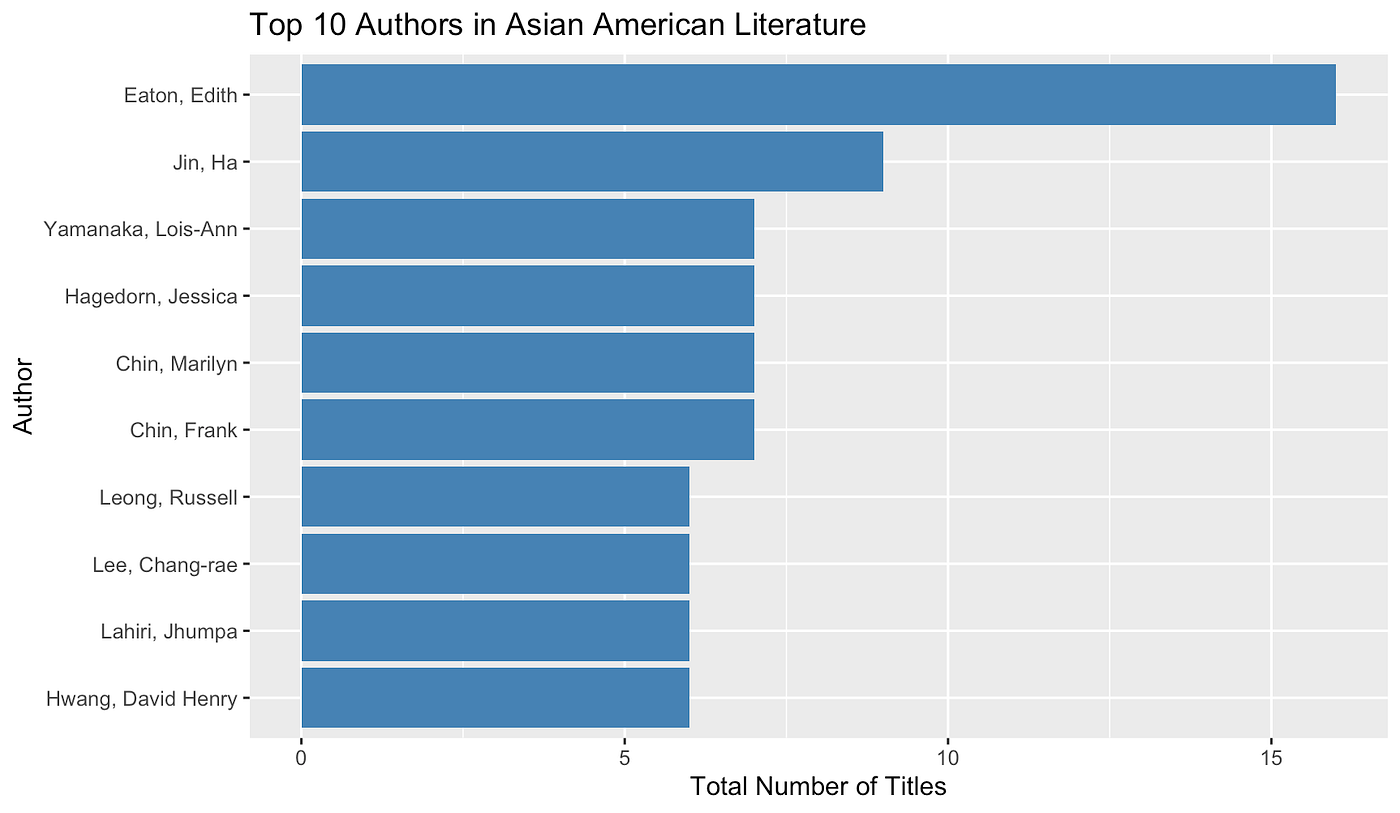
To identify which authors have contributed the most titles to Asian American literature, we grouped the dataset by author and counted how many unique works each author published. The bar chart highlights the top 10 most productive authors in the dataset.
From the graph, Edith Eaton stands out clearly as the most prolific author, with more than 15 titles recorded. Her output is noticeably higher than anyone else on the list, which shows how significant her contributions were to early Asian American writing. Following her is Ha Jin, who has published around 10 works. Authors such as Lois-Ann Yamanaka, Jessica Hagedorn, Marilyn Chin, and Frank Chin also appear near the top, each with roughly seven to eight titles. Although the overall numbers drop slightly after the first few authors, the chart shows a consistent group of writers who have each published multiple influential works. Writers like Russell Leong, Chang-rae Lee, Jhumpa Lahiri, and David Henry Hwang have between five and seven titles, placing them among the major contributors to Asian American literature as well.
Looking at this distribution helps us understand that Asian American literary production is shaped by both early foundational writers, such as Edith Eaton, and more contemporary authors who continue to expand the field. These authors represent a range of ethnic backgrounds, literary styles, and time periods, which adds to the diversity and richness of Asian American literature overall.
We chose to analyze the dataset highlighting unique authors in Asian American literature. This dataset highlights unique authors who have been involved with the publication of Asian American literature. The data presented information about the authors such as names, ethnicity, birth nation, gender, birth year, and other personal information. Unfortunately, this dataset does not include any publication information about their works. In this section, we decided to analyze which ethnic groups were the most prominent in Asian American literature.
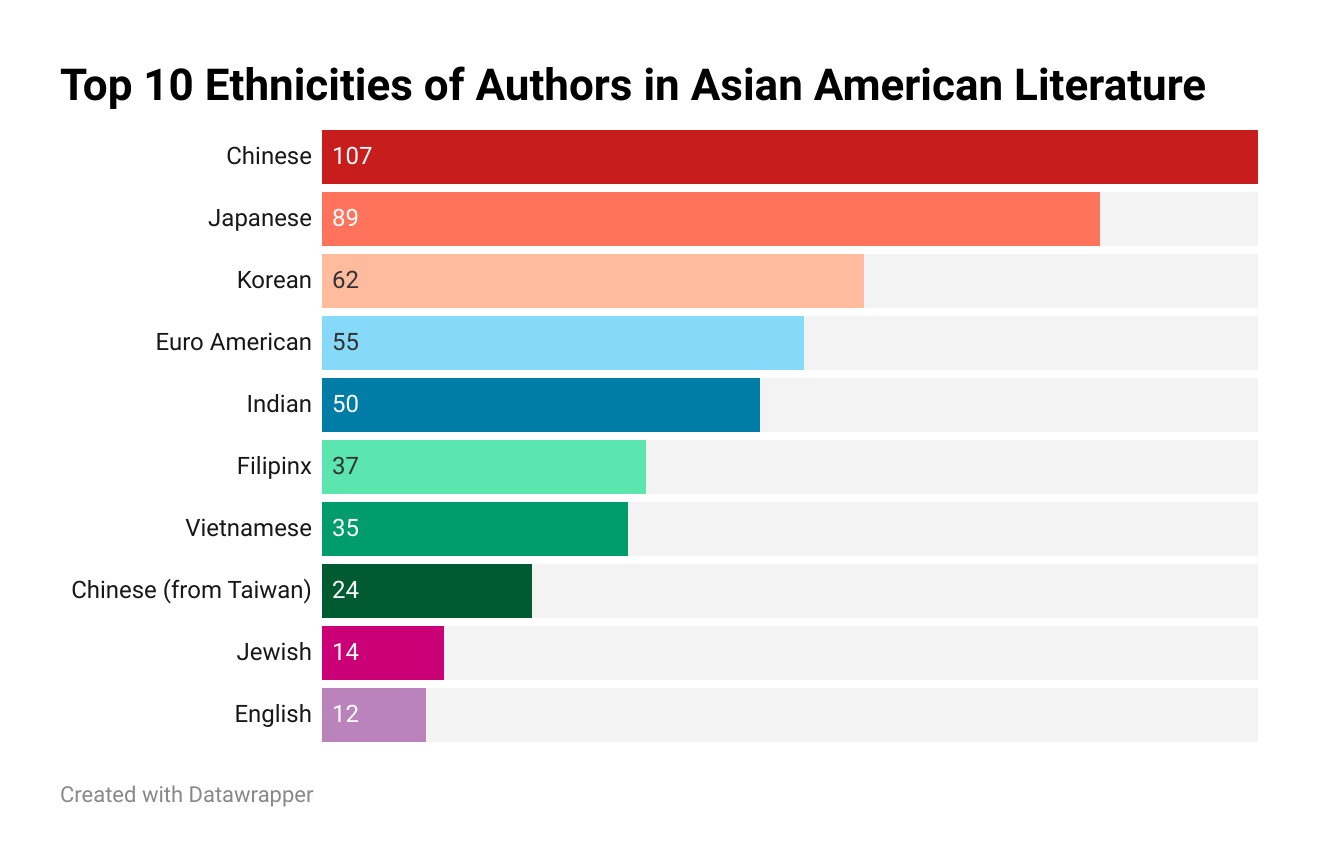
We discovered these top 10 ethnic groups were involved in the authorship of Asian American literature: Chinese, Japanese, Korean, Euro American, Indian, Filipinx, Vietnamese, Chinese (from Taiwan), Jewish, and English. The total number of authors represented in the dataset was 783. The ethnic group with the most unique authors in the dataset was discovered to be Chinese with 107 authors represented. In the dataset, there were also about 95 unique authors that had a blank cell in the ethnicity column which led to some complications while creating the data visualization. Since those 95 authors all had a blank cell, we had to manually remove that row since it would take up the 2nd entry in the top 10 ethnic groups data frame. If we didn’t remove that blank row, the data visualization would not accurately reflect the number of authors that fit in the top 10 positions. When briefly examining this chart, it was intriguing to see ethnic groups such as Euro American and English appear since the data was supposed to be centered on Asian American literature. However, when crossreferencing between the Unique Authors and Unique Texts datasets, it can be observed that some of the authors included are multiracial between Asian, White, and many others. At first glance, one might be confused by these data points and why it is included, but after examining the datasets further, it makes sense that some authors are of mixed descent. Overall, this author’s information in this dataset may be used in tandem with the other two to make a variety of analyses.
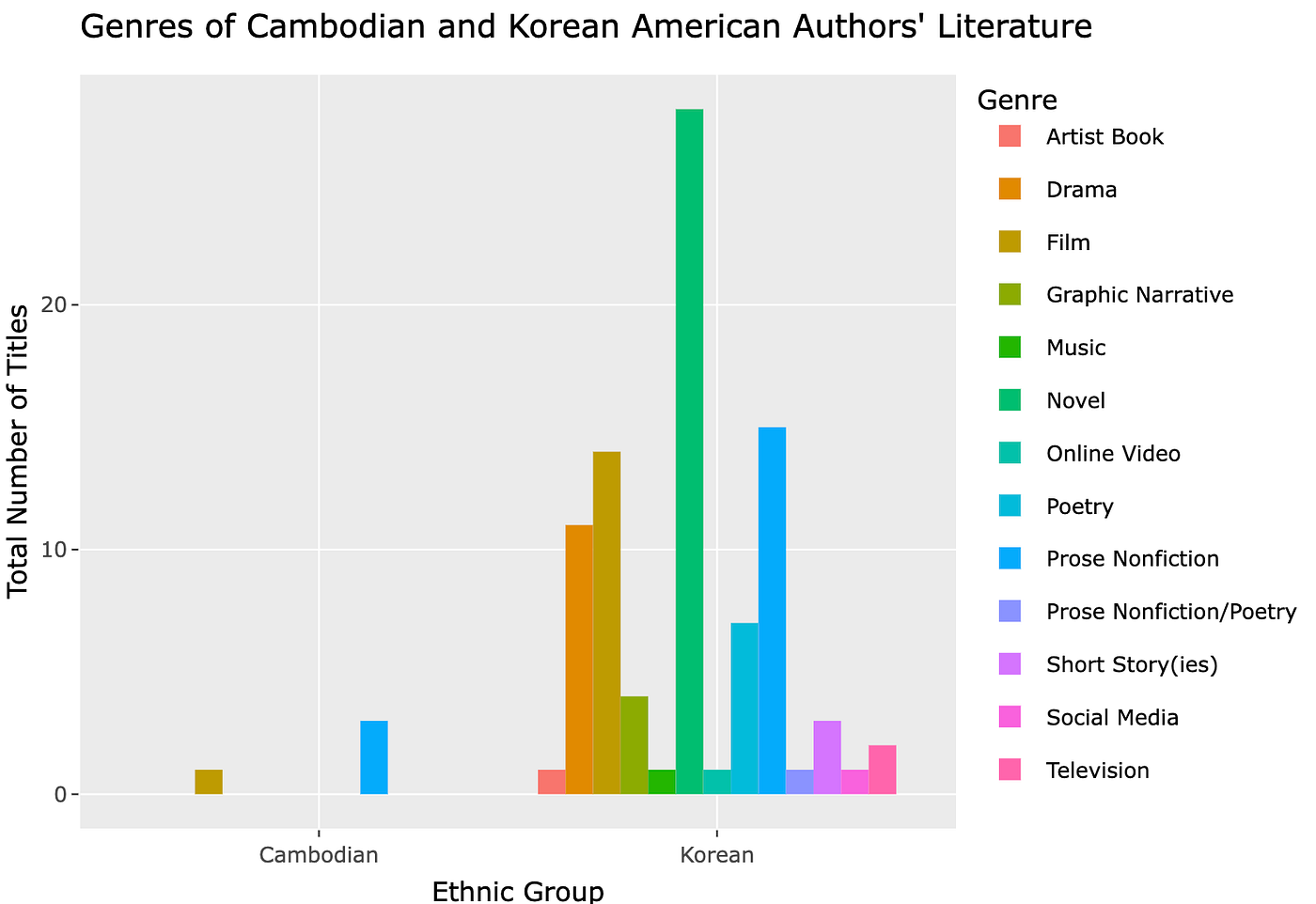
After analyzing the evolution of titles and the authors’ ethnic groups, we zoomed into specific points of the charts to connect the genres of the titles and the ethnic backgrounds of the authors. We decided to focus on our team’s ethnic backgrounds, Cambodian and Korean. From one of the previous data visualizations, we can observe that one of the top 10 ethnicities involved in Asian American literature publications are Koreans; however, Cambodians are not within that chart. When analyzing the genres that each of these ethnic groups produced, this data visualization could be considered. As this analysis could not be done using the unique title or unique author datasets, we returned to the original dataset. We grouped this dataset by genre, ethnic group, author, and title to identify unique works. A few rows were removed manually caused by repeated authors or missing genre and title information.
Cambodian American authors published literary works in only two genres — three prose nonfiction and one film; these correspond to the overall distribution’s second and third most prominent genres. Korean American authored works were distributed across thirteen genres, notably novel, prose nonfiction, film, drama, and poetry. Novels, with 28 titles, remained the most prominent genre, consistent with the overall trend. Prose nonfiction, films, and poetry also appeared among the top five. Drama emerged as a significant genre for Korean American authored titles despite not appearing in the overall top five, and short story(ies), ranked fourth overall, appeared only seventh in the Korean American subset. It was interesting to discover that both Cambodian and Korean American genre distribution largely mirrored the broader patterns, though each group showed distinct differences. Additionally, although only one Cambodian author produced work in film, it is notable that film appears across both ethnic groups. This indicated that both groups’ film is gaining greater recognition and is becoming a driving force in the evolution of the field.
Conclusion & Future Work
From our analyses of Long Le-Khac’s dataset, The Canon of Asian American Literature, we were able to utilize RStudio to gather information and create data visualizations about the development of Asian American literature. We discovered how years of publication of these works spanned across the years 1606 to 2022, with the 1980s to 2020s having the most publications. As we looked more closely at the publication timeline, we noticed that the 1980s marked the beginning of a steady rise in Asian American literary works. The increase became much more noticeable in the 1990s, when the number of titles started climbing much faster. The early 2000s stand out the most in our graph, with several years reaching over twenty or even thirty unique publications. This made the early twenty-first century the most active period for Asian American literary production in our dataset. From our analyses, we were able to figure out that the Chinese are in the lead of the top 10 ethnicities of authors that were contributing to the development of Asian American literature. Within Asian American literature, we discovered that the top 5 genres include novels, film, prose nonfiction, short stories, and poetry. As a result, we were also able to find out which genres were most popular in our own team’s ethnic groups. We were also able to see what sort of genres our own team member’s ethnic group has published. All these different analyses have allowed us to delve deeper into our culture and heritage to see how far Asian American literature has progressed.
There is a vast range of ethnic groups represented in this dataset, and our group delved into only a few questions that could be answered. As time progresses, more works are being published, and awareness of Asian American literature also increases. It also includes additional information, such as authors’ education levels, publishers, and award histories, that we did not explore. This dataset could be useful in future research to analyze the history and development of Asian American literature. Some additional questions that could be delved into are: Which publishers are most involved in publishing Asian American literature? What patterns do historical events have in relation to the number of works being published at certain times? Which works and authors have won the most awards, and what criteria do the awards require?
Citation:
Le-Khac, Long. 2025. “The Canon of Asian American Literature.” Edited by Alexander Manshel, J.D. Porter, and Melanie Walsh. Post45 Data Collective, August. https://doi.org/10.18737/092211
메타데이터
- post_id
- ee0801cf5fd2
- slug
- recognizing-the-development-of-asian-american-literature-ee0801cf5fd2
- url
- https://medium.com/@span8/recognizing-the-development-of-asian-american-literature-ee0801cf5fd2
- canonical_url
- https://medium.com/@span8/recognizing-the-development-of-asian-american-literature-ee0801cf5fd2
- author_url
- https://medium.com/@span8
- status
- ok
- fetched_at
- 2026-06-14 11:28:49