tax collectors, outcasts, and us
hold the door open
tax collectors, outcasts, and us
hold the door open
Are there any jobs, any professions you would avoid, despite whatever good pay they provide? How about coal mining? This hasn’t always been true, but it pays well, although there are the obvious health hazards. What about nuclear power reactor operator? Again, it affords a lofty salary, but it carries an overwhelming level of responsibility.
Come to think of it, that might be why Homer Simpson was the perfect guy for the job.

Let’s consider Matthew the tax collector — a person whose profession was contrary to the Torah. His very lifestyle was “non-kosher.” Why was that?
As part of supporting the hated Romans, tax collectors paid them a fee to work in a certain region. They were considered traitors to their own people. After clearing the necessary contribution, they could demand excessively high payments and pocket the money as profit. So, there’s the high salary!
As you might suppose, this system led to corruption and extortion. Their opulence and wealth only added to the bitterness they were shown.
Thus was Matthew.
In chapter 9 verse 10, we see Jesus having dinner with tax collectors — and dear Lord — with those “sinners.” That was a catch-all term referring to undesirables, including the poor women trapped in a life of prostitution. All of them were considered to be the bottom of the barrel.
However, there’s one thing we can say on the upside of that dinner party. No tax collectors would need to embarrassingly clear their throats when asked, “So what do you do?”
No big surprise, Jesus’ calling of Matthew and his fraternization with outcasts didn’t go over very well. His disciples weren’t exactly fond of that blankety-blank tax collector!
Perhaps an obvious question comes in verse 11. “When the Pharisees saw this, they said to his disciples, ‘Why does your teacher eat with tax collectors and sinners?’” To be honest, we don’t know how the Pharisees come into the picture.
But back to the question and to the Pharisees themselves.
There is a TV show I really like, The Chosen. This very scene is portrayed in season 1, episode 8, “I am He.” In this account, a couple of Pharisees just happen to walk by the house when they hear voices inside. (So that would answer how they show up on the scene.) They are stunned when they see Jesus as a guest. They utter their profound disgust, which should not be unexpected.
The Pharisees are concerned (in their minds, rightly) about guilt by association. They worry about being defiled. They worry about “catching” something, something that would necessitate purification. Maybe they’re afraid of cooties. Given their dealings with Jesus, they are easily painted as bad guys. (And with some level of justification, I would add.)
Still, the Pharisees are not so much villains as guardians of religious boundaries. That is important. One of their primary “job descriptions” is maintaining and identifying faithfulness to the aforementioned Torah, the law of Moses. Those identifications follow well-prescribed definitions.
Nonetheless, some of them show a sincere interest in Jesus, not the least of which is Nicodemus. And we can’t forget the apostle Paul, who identifies himself as a Pharisee in Acts 23 and 26.
(And on a side note, I just mentioned The Chosen. In season 1, episode 7, the nocturnal meeting of Nicodemus and Jesus is presented — with an artistic flourish — in the episode, “Invitations.”)
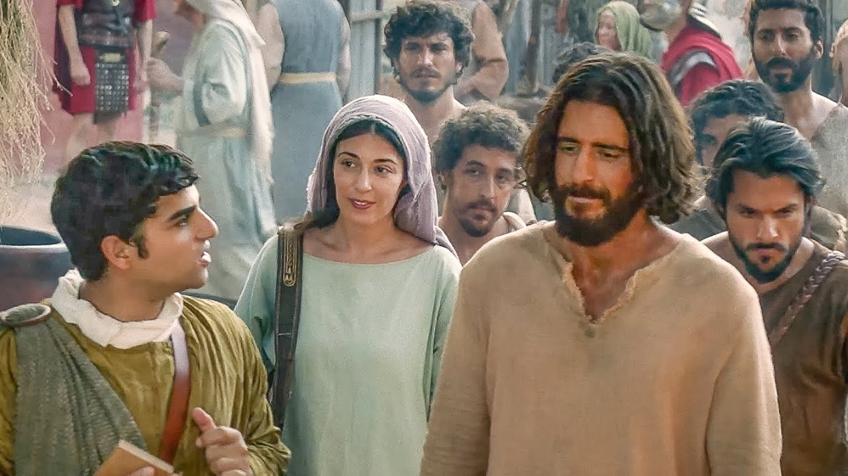
In “The Chosen,” Mary Magdalene seems pleased to have Matthew join them. Simon Peter on the right — not so much.
In any event, it seems before any of the disciples can answer the Pharisees’ question, Jesus steps in.
He responds, “Those who are well have no need of a physician, but those who are sick” (v. 12). He uses the language of medicine. He provides his diagnosis. Jesus acknowledges that those people, the bottom of the barrel so to speak, are indeed in need of him. They require healing.
He presents himself as one to heal, to restore, the unwell. He is the Great Physician.
Jesus seems to feel the Pharisees need a refresher course. Quoting Hosea 6, he recommends they “go and learn what this means, ‘I desire mercy, not sacrifice’” (v. 13). As for Hosea himself, the prophet finishes his thought with “the knowledge of God rather than burnt offerings” (6:6).
The unspoken question to the Pharisees is whether or not they are ill. Are they in need of healing? That would require a dramatic change in assumptions. Can they manage to do that? One aspect of such a change would be a recognition that this rabbi without official credentials has anything of value to say.
But what about his acts of power? No one can deny Jesus has performed deeds that are awe-inspiring. Matthew 9 is filled with stories of dramatic healing.
Could it be he’s a sorcerer? Is he in league with the powers of darkness?
Jesus finishes his thought by changing the perspective. “I have not come to call the righteous but sinners.” He is speaking of a sickness of the soul, an ailing of the spirit. Are the Pharisees ready and willing to do that type of introspection? Are we ready and willing to do that type of introspection?
Remember, according to Hosea, what is of ultimate value is “the knowledge of God rather than burnt offerings.” Translated into our context, what really matters is not simply showing up on Sunday morning and going through the motions of worship. If we are not changed, if the knowledge of God is not fostered, then what we do achieves little. Our worship needs to be dangerous.
I’ll let you ponder. To whom should it be dangerous? To what should it be dangerous?
Here’s something else to ponder. When answering the Pharisees, Jesus doesn’t tell them straight out what it means. He doesn’t give them a 1–2–3, an A-B-C. He doesn’t spell it out. He calls them to go beyond — “go and learn what this means.” Jesus invites them to go on a quest. They need to reach their own conclusions.
He doesn’t ask for any paperwork!

Jesus leads in a way giving permission, proposing the re-imagination of one-dimensional teaching. I’m speaking of teaching that confines and doesn’t liberate. He does this all the time. Look at the Sermon on the Mount, just chapters earlier. How many times do we encounter him with, “You have heard that it was said…” followed by, “But I say to you…”?
Perhaps the truth is found in the very search, not in a prescribed form. Who knows where the quest will lead?
Moving back to the story, the tax booth and dinner table are not accidental details. They are key components. Jesus enters Matthew’s ordinary world before Matthew ever enters a synagogue-centered religious world. Many churches struggle because they expect outsiders to cross all the cultural distance first. But Jesus himself crosses the distance.
One reason we have added words in the worship bulletin is to provide visitors a clue on what we’re saying and singing. It’s very easy to get lost. Trust me, I’ve had experiences like that. Including such directions is probably a minor note, but every little bit helps.
There is also a caution here, a word of warning. “Looking outward” cannot simply become another growth strategy. Jesus is not networking for institutional expansion. He is revealing the mercy of God. Outreach can easily become transactional. I have heard clergy and laity alike being quite open about it. “If these people aren’t going to come to church, why help them?” (Well, maybe not always that blunt!)
What in the world is their understanding of the gospel? They need to go back and meditate on Matthew 9!
The point is, a congregation may still remain inwardly focused while appearing externally active.
My wife Banu has often commented on church signs that proclaim, “All are welcome.” “You are welcome here.” Really? Do they actually mean that? (By the way, I’ve also had similar reactions.) I wonder if there’s anyone who might walk into the sanctuary and have the folks regretting they ever put that welcome sign out front!
You might recall my sermon on Palm Sunday regarding my weekend in Phoenix posing as a street person. I might have had a couple of folks wanting to go outside and rip down that welcome sign. But it need not be something so in-your-face. Can we think of any “tax collectors and sinners” in our community we’d rather not deal with?
Maybe “dealing with” is the wrong way to look at it. After all, Jesus isn’t simply “dealing with” his new-found friends. He isn’t merely tolerating them. Remember earlier when I tossed out the words “dinner party”? That is what’s going on. What’s breaking out is a shindig, a hoedown! The Pharisees would still be offended by his presence among them, but Jesus is actually having fun with these folks. That only compounds the outrage.
It’s difficult to enjoy yourself with people you can barely endure. That doesn’t exactly proclaim good will. Seriously, who wants to hang out with a bunch of sourpusses? Where’s the joy of the Lord?
One last thought on the process of healing. When it fully arrives, when the pain begins to fade away, what is the reaction? Is it, “Oh well, that was interesting.” Or is it a tangible sense of relief, a time of celebration, even an outburst of euphoria? My guess would be the latter.
And when that soul sickness is properly addressed, when there is the reality of restoration, how can we do less than give God the glory? Praise the Lord. It’s not a time for long faces. Instead, it is a time to make room at the table for all of God’s precious children.

photo by Zoshua Colah on Unsplash
So here we are, invited to go and learn what it means. Not handed a list but sent on a quest — just like the Pharisees. And maybe the answer we discover along the way is this: the knowledge of God looks like a dinner table with room for everyone who’s been shown the door.
Our worship becomes dangerous — dangerous to our assumptions, dangerous to our comfort with the familiar. With the same old, same old. The Great Physician hasn’t retired. He hasn’t traded the office for the golf course. And if we are honest, every last one of us comes to this table sick. That ought to make us pretty good at holding the door open.
메타데이터
- post_id
- ee120db49a5b
- slug
- tax-collectors-outcasts-and-us-ee120db49a5b
- url
- https://medium.com/@jamesmoore94/tax-collectors-outcasts-and-us-ee120db49a5b
- canonical_url
- https://medium.com/@jamesmoore94/tax-collectors-outcasts-and-us-ee120db49a5b
- author_url
- https://medium.com/@jamesmoore94
- status
- ok
- fetched_at
- 2026-06-25 07:00:49