Playⁿ: Media
Extractive Algorithms and Social Social Media Participants
Playⁿ: Media
Extractive Algorithms and Social Social Media Participants

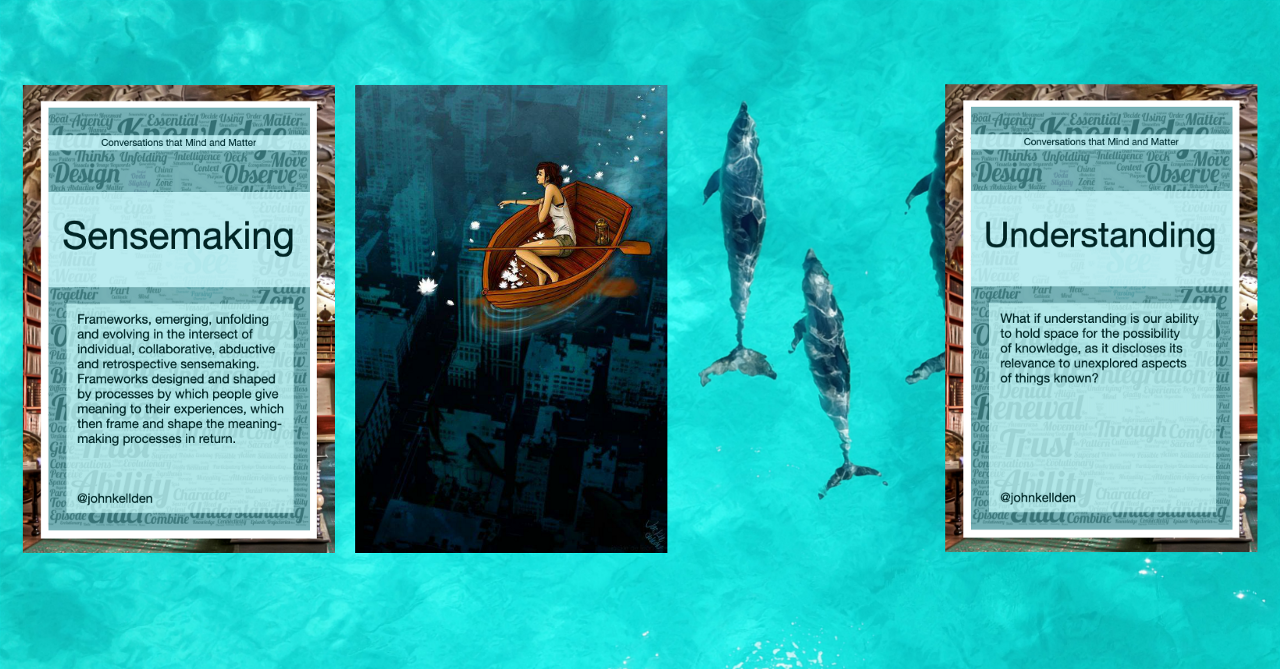
Social Cognition, one the 504 cards in the Playⁿ Source Deck.
Card: Online Social Cognition Extending our social cognition online, our ability to understand and use social information.
Media is not neutral — it never was
The crisis of journalism is often described in economic terms (collapsed business models), technological terms (platform dominance), or political terms (polarization, distrust, disinformation). All of these are real. But they are symptoms — not the underlying condition.
At its core, this is still a media problem in Marshall McLuhan’s original sense: media as environments that shape perception, cognition, attention, and social coordination before content enters the picture.
Media doesn’t just influence what we think about. It shapes how we think, what we notice, what we ignore, and what kinds of participation feel worthwhile — or futile. How much return on engagement did you gain from fifteen years of mostly non-committal like button clicking?
Media as environment, not channel
McLuhan’s central insight remains decisive:
The medium is the message.
Media are not pipes. They are not information. They are not large media corporations. They are not tech platforms. They are extensions of human faculties.
They reorganize:
- perception
- timing
- language
- memory
- attention
- social coordination
Quietly. Pervasively. At scale. What has changed since McLuhan is not relevance, but intimacy. Networked, algorithmic, platformed and AI-mediated media no longer merely shape perception. They participate in it.
They don’t just influence culture — they help produce our shared social worlds. Or, as George Carlin put it more bluntly:
“You have owners.”
Gravity wells and centers of attention
Think of the movie Contact. Ellie Arroway falling, suspended, drawn toward a center — a gravity well. That’s not a metaphor for ideology. It’s a metaphor for media environments.
Media doesn’t just present information. It creates centers of gravity around which attention orbits. Outrage is one such center.
“Ooh, the anger dollar. Huge. Huge in times of recession.” — Bill Hicks
These gravity wells don’t need persuasion. They operate through repetition, emotional charge, and algorithmic reinforcement.
Escaping them doesn’t require better arguments. It requires re-orientation.

Contact(the movie): Ellie Arroway meeting the “first contact” alien.
Small moves, Ellie — small, different, social social media moves.
Why McLuhan’s laws still matter
McLuhan offered four questions. I work with them as seven, and not as theory, but as literacy turned practice:
- What does a medium render possible?
- What does it produce or become?
- What does it render obsolete?
- What does it retrieve?
- What does it enhance or intensify?
- What does it encircle?
- What does it enact or re-enact?
These questions help us notice:
- what kinds of attention are rewarded
- which behaviors become default
- how agency is shaped or eroded
- whether participation leads to learning or mere reaction
They don’t stand outside the system. They help us intervene from within it.
Why the laws need extending
What McLuhan could not fully anticipate was anticipatory media. Today’s systems don’t just respond to behavior. They predict, nudge, and rehearse it. Working with Donella Meadows, Robert Rosen, Johan Roos and Riel Miller adds necessary extensions:
- What future does the medium assume?
- Where are the leverage points?
- What capacities does it help people rehearse?
- What forms of anticipation does it enable or suppress?
- What kinds of agency does it distribute?
These questions shift media analysis from effects to developmental consequences. Media stops being about messages, and becomes infrastructure for collective becoming.
Extractive participation and thin agency
Most proprietary platforms train a narrow set of behaviors:
- content consumption
- uninformed opinion
- performative expression
- non-committal likes
- thin emoji signaling
This isn’t because users are shallow. It’s because the environment is extractive. When participation rarely changes anything, discernment hardens into cynicism. High information density. Low meaning density.
Cynicism becomes adaptive.
Why journalism can’t optimize its way out
Seen this way, journalism’s crisis isn’t primarily about:
- speed
- reach
- formats
- monetization
It’s about misaligned environments. The future role of journalism is not just to deliver facts (necessary, but insufficient). It’s to help societies re-orient under conditions of complexity, uncertainty, and plural futures.
That means:
- from publishing → hosting inquiry
- from metrics → meaning
- from speed → continuity
- from extraction → participation
This is where Playⁿ enters
Playⁿ doesn’t fix media. It offers a practice for inhabiting media differently.
A way to:
- slow perception
- hold tension without collapse
- turn conversation into infrastructure
- rehearse better forms of agency together
Playⁿ and media (extended) converge here. Both function as orientation technologies.
Bridge to Part 3
If Part 1 focused on the inner move and Part 2 on the environment,
Part 3 turns to the shared worlds we inhabit together:
social cognition, social media, and social umwelt — the invisible architectures that shape trust, participation, and meaning online.
Continue with Part 3: Social Umwelt — The Worlds We Inhabit Together.
Why the four posts completes an arc
If this is your first encounter with Playⁿ, here’s a way in:
- You don’t need to understand everything here.
- You don’t need to agree with it.
- You don’t need to adopt a worldview.
All you need is one worthwhile question and the willingness to make one small move. The four posts together trace a simple movement:
- Playⁿ: Trust Your Cynicism — a first step out of default suspicion
- Playⁿ: Media — Extractive Algorithms and Social Social Media Participants, or, Why This Is Still a Media Question — seeing the environment you’re inside
- Playⁿ: Social Umwelt — understanding how different sign use and shared worlds shape participation
- Playⁿ: Navigating Complexity — a grammar for moving wisely together
If there’s one thing to try after reading the four posts:
Choose a question that matters to you. Not a problem to solve — a tension to navigate. Write it down. Sit with others, or alone. Ask:
What is one small move that would make this situation more inhabitable?
Take that move. Alone, or in a small group. Then notice what becomes thinkable next.
That’s Playⁿ.
A movement to preferable outcomes. Over time, preferable futures of our own enaction. Playⁿ doesn’t ask for belief. It invites practice.
Playⁿ: Navigating Complexity
What makes the card sessions and any kind of gathering around the Playⁿ cards possible — calm, plural, attentive — is not improvisation alone. It’s a shared grammar beneath the conversation.
Playⁿ is a living, generative grammar for navigating complexity through recursive systemic, semiotic, and symbolic play. It weaves patterned intelligence, human conversation, and human–AI metalogue into a coherent practice that turns confusion into orientation, talk into inquiry, and information into knowledge that can be held, shared, and acted upon.
At the heart of this practice is the Playⁿ Source Deck: 504 cards designed as a bounded infinity. Each card is finite and playable; together, they open vast combinatorial possibility — over 120,000 two-card pairings and more than 21 million three-card configurations.
This bounded richness is what allows a small group — whether in a temporary tent, beneath an oak, high above a river, or in a quiet corner of a library — to stay with a worthwhile dilemma without forcing closure.
The grammar holds the space. The combinations keep options alive.
In Immersive Card-Play Adventures, these same elements extend across time: cards become stepping stones, symbols become portals, questions become narrative attractors. Meaning does not arrive by deduction.
It emerges by walking the terrain together — one move, one occasion, one card-play at a time — until coherence is felt and a next step becomes visible.
Gameⁿ: A Ten Minute Session Choose a worthwhile question. Draw one card each. One minute per turn. Write down what shifts. End with a single “next coherent step” you can actually take, and a short shard, a captured reflection you can return to.
Playⁿ does not prescribe a path. It makes it possible for a path to appear by walking.
Small moves, becoming occasions of experience — principled, playful practice — making a world of difference.
메타데이터
- post_id
- ee24eee4e2cf
- slug
- playⁿ-media-ee24eee4e2cf
- url
- https://medium.com/@johnkellden/play%E2%81%BF-media-ee24eee4e2cf
- canonical_url
- https://medium.com/@johnkellden/play%E2%81%BF-media-ee24eee4e2cf
- author_url
- https://medium.com/@johnkellden
- status
- ok
- fetched_at
- 2026-08-20 11:29:04