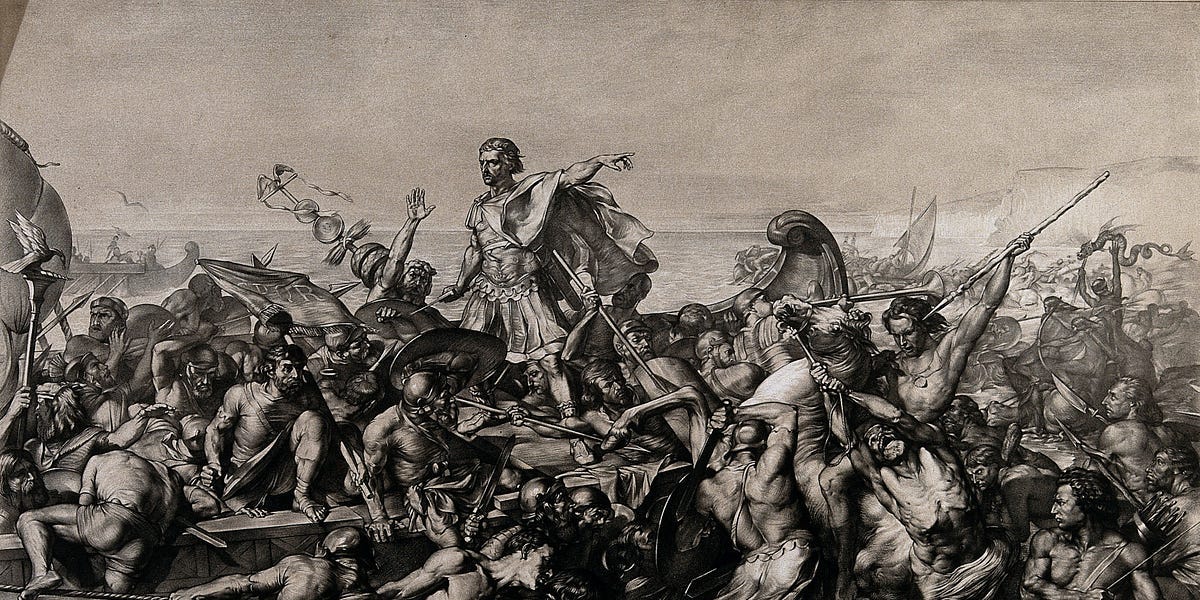
Did the Romans Like Swearing?
It is one of the great incongruities of the English language that, despite being one of the most versatile and malleable forms of…
Did the Romans Like Swearing?
It is one of the great incongruities of the English language that, despite being one of the most versatile and malleable forms of linguistic communication among the world’s great tongues, it is also, at times, downright baffling. Nobody can explain why, to any satisfactory degree, all letters ‘C’ in the words “Pacific Ocean” are pronounced differently, for example. They just are. And if anyone can talk me through how a non-English speaker is meant to rationalise words that end “-ough”, then please, knock yourself out.
At the same time, English allows for a freedom of expression that some other languages can only stare at with sullen jealousy. That’s not to say that these languages cannot spread their linguistic wings and peacocks around the room — just ask French, the showy little bastard. But English is, maybe, the one language in which linguistic expression is not so much guided by rules as it takes the rules and fucks them off into the nearest canal.
In particular, British English, which, after all, is just English, has an amazing ability to form swear words out of seemingly nothing at all. All English-speaking nations are very good at rude words, but the British have a remarkable ability to form rude phrases from everyday words that seem entirely innocent on their own.
Take any absolute adjective — “absolute”, “total”, “complete”, or something of that ilk, and add to it any noun — “plum”, “sausage”, ‘womble”, and then tack “you” on the start, and one has a perfectly constructed British insult. With careful practice, one can tweak the intonation so that the stress falls on exactly the right part of the resulting phrase, and what happens is magnificently British and almost unique to the glories of the English language.
My beautiful and long-suffering American wife has had to spend many an hour with me going over this very carefully with her, like Pygmalion, preparing her for the time we move to a country where the internet doesn’t crash each time it rains. It must contain exactly the right amount of contempt, not too much, not too little, and once one has it, one can then apply the formula universally until you realise that “You absolute suitcase….” is not only a great insult but just… works.
The Romans, of course, liked to curse and use rude language, just like everyone else. However, sometimes, our delicate sensitivities are guarded against the worst excess of ancient potty mouths by the pearl-clutching moral firewall that was the Victorians.
Ancient writers like Suetonius knew who their audiences were, and they wrote in a style that was meant to titillate and excite their audience. He knew that if he was talking about the bizarre sexual predilections of Roman emperors, his readers wanted it down and dirty. When the Victorians were translating it, however, they were aware that their own audiences were rather more sniffy about such brazen language, and so ‘being fucked up the ass’ becomes ‘took him in his embraces’ and ‘pissed all over it’ becomes ‘made water nearby.’ You get the idea.
This creates all sorts of issues, particularly when it comes to some of the more outrageous accounts of the sexual deviancy of the emperors. Suetonius’ accounts of the perversions of Tiberius are almost certainly wild exaggerations. Tiberius was a deeply unpopular figure for ancient historians, a situation not helped by his own decision to fuck off to Rhodes halfway through his reign and not come back, which left enough free space in the history books for people like Suetonius to fill with all sorts of salacious tittle-tattle.
But some of the accounts of what he got up to are not only carefully smoothed over by Victorian translators, but when one digs a little deeper into the linguistic structure, one realises that even in the 21st Century, one has something of a problem to deal with. Suetonius, for example, describes how Tiberius had a sexual penchant for acts involving children that are shocking even to modern sensibilities but not only that, he describes them in terms that mean if I am to be true to his intent — and as a translator, I have to be — then I can’t really hide them behind the sort of language the Victorians did, by saying that these individuals would be “joined together’, for example. Suetonius didn’t use the term ‘fucking’ because that word isn’t directly available to him. But I can use it, and so, with a slightly terrified air, those are the words necessary to describe these horrendous acts in the translation. Plus, of course, by doing so, I am doing what Suetonius tried to do with his readers — revolt and shock them.
There is one particularly famous example from Suetonius where Caesar, who had a somewhat baseless reputation for being the ‘bitch’ of King Nicomedes in his youth, tells the senate that he will, in the Victorian vernacular ‘mount their heads’, which is broadly how the Latin reads. The sentiment, however, is more along the lines of ‘Make them all suck his dick’ and while this might not be precisely what Suetonius has written, the whole point of this passage is that some wag in the senate shoots back the line “That would be some trick, considering you’re such a girl.” The modern swearing becomes almost necessary to explain the euphemisms being bandied about.
But how did the Romans use ‘bad language’? When exploring the linguistic legacy of ancient Rome, one encounters not only the lofty rhetoric of Cicero or the poetic finesse of Vergil but also the earthier, coarser underside of the Latin language. Profanity, obscenity, and taboo expressions are not modern inventions, and the Romans, as we shall see, had their own robust repertoire of swear words. Far from being incidental or peripheral, vulgar Latin reflects fundamental aspects of Roman society, including attitudes towards sex, class, gender, and morality.
In linguistic and anthropological terms, swearing refers to the use of language that violates societal norms about propriety, often invoking taboo topics such as sex, excretion, religion, or violence (Andersson & Trudgill, 1990). Swear words typically serve emotional, social, or expressive functions-venting frustration, asserting dominance, or mocking others. Obscenity specifically denotes language or imagery offensive to decency, particularly in reference to sexual or scatological matters. Profanity originally referred to irreverent speech about the sacred but has since broadened to include many taboo expressions.
Swearing can be categorised into several functions: dysphemistic swearing, which deliberately uses offensive terms; abusive swearing, which targets others with hostile intent; emphatic swearing, which stresses emotion; and cathartic swearing, which releases anger or pain. Importantly, whether a term is considered a “swear word” depends not on inherent meaning but on cultural context. Thus, to determine whether Latin had swear words, one must examine vocabulary and the socio-cultural framework in which that language was used.
Latin possessed numerous expressions that fulfilled the social and emotional functions of modern swearing. However, the Latin lexicon was embedded within a different cultural matrix, particularly regarding sex, religion, and bodily functions. Translating English terms like “fuck,” “shit,” or “bastard” directly into Latin risks anachronism unless grounded in usage by Roman speakers themselves.
Swearing and obscenity appear in diverse Roman literary genres, from the stage comedies of Plautus to the biting epigrams of Martial. These texts do not merely reflect vulgar speech but stylise it for entertainment, satire, or invective.
Martial (c. AD 38–104), whose Epigrammata teem with vulgarity, offers a panorama of Roman insult culture. In Epigram 1.35, he mocks a man’s odour: “ Lingis culum, Galle, quotiens quid dicis amicae: / nil lingis, Galle: mentula causa tua est” (Martial, Epigrams 1.35.1–2). The joke turns on sexual function and impotence-your penis, not your tongue, is doing the talking. Martial frequently uses mentula (penis) as both insult and synecdoche for masculinity, while also deploying culum (anus) and irrumare to denigrate the subject’s sexual passivity.
These examples show that swearing in Latin was not random vulgarity but deeply embedded in Roman concepts of honour, masculinity, and ridicule.
As seen above, futuere, irrumare, pedicare, and cinaedus are common. These terms functioned to mock or humiliate, particularly by implying submission or feminisation. Mentula (penis) and vagina (sheath, but also slang for female genitalia) appear as coarse anatomical references (Catullus, Carmen 97.2). Lupa (she-wolf) referred to a prostitute, also reflecting the animalistic tone of Roman sexual invective.
Literary evidence suggests that sexual and scatological humour pervaded domestic banter. Martial addresses a friend with lewd jokes; Petronius depicts obscene talk over dinner. However, elite Roman households likely regulated such language more than lower-class ones, with gender also playing a role-women’s use of obscenity was seen as transgressive.
The comic stage, particularly in Plautus and Terence, licensed obscene language under the veil of humour. Characters like slaves or pimps often voiced what polite society repressed. Sexual puns, anal jokes, and coarse threats abound, though usually framed as exaggerated caricatures.
As shown in Catullus, Martial, and Juvenal, poetry was a prime venue for swearing. Here, obscenity became a weapon-sharpened by metre and metaphor-to attack hypocrisy, vanity, and effeminacy. Poetic swearing was both performative and moralising.
Humorous obscenity thrived in certain settings-festivals, public baths, comedies-while being frowned upon in senatorial or religious contexts. The social reception of swearing thus depended on context, speaker, audience, and genre.
Gender shaped how swearing was judged. Male obscenity was often excused as assertive; female vulgarity was shamed. Swearing could also signal class: the elite mocked the coarse language of the lower orders, even as poets like Martial drew on it for authenticity.
The Romans undoubtedly used swear words-explicit, graphic, and often inventive. While culturally distinct from modern profanity, Latin obscenity fulfilled similar linguistic roles: venting emotion, mocking others, and asserting identity. Literary texts, graffiti, and inscriptions show that Roman swearing drew on sex, excretion, and power to challenge norms, insult rivals, or provoke laughter. To understand Roman obscenity is to understand how the ancients policed decency, negotiated shame, and expressed the inexpressible.
Expressing the inexpressible seems, sometimes, to be one of the major weapons in the translator’s arsenal. And one of the major hurdles.
메타데이터
- post_id
- ee298aabe3b4
- slug
- did-the-romans-like-swearing-ee298aabe3b4
- url
- https://medium.com/@jamescoverley_33594/did-the-romans-like-swearing-ee298aabe3b4
- canonical_url
- https://medium.com/@jamescoverley_33594/did-the-romans-like-swearing-ee298aabe3b4
- author_url
- https://medium.com/@jamescoverley_33594
- status
- ok
- fetched_at
- 2026-06-20 20:29:01