Why “Relatable” Books Aren’t Enough: What Really Engages Students in the Classroom
You picked the perfect book — so why aren’t students engaging?
Why “Relatable” Books Aren’t Enough: What Really Engages Students in the Classroom
You picked the perfect book — so why aren’t students engaging?
You spend time choosing it carefully: a Young Adult Literature novel that reflects real-world issues, features characters students might connect with, and tells a story that feels meaningful. On paper, it seems like exactly the kind of text that should spark conversation. But once the reading begins, the energy often falls flat. Students move through the pages, yet discussions stall and responses remain surface-level. The engagement you expected to occur never quite takes shape.
In one classroom, a teacher assigned a widely praised YA novel about identity and belonging. Students completed the reading, but their responses centered mostly on summarizing events. In another classroom using the same text, students worked in small groups, questioned each other’s perspectives, and debated character decisions well beyond class time.
The contrast is striking. The same book produces two completely different learning experiences. That difference reflects a central claim of this article: engagement is shaped less by the text itself and more by how students are invited to interact with it.
Photo by Vitaly Gariev on Unsplash
Photo by Vitaly Gariev on Unsplash
The Myth of “Automatic Engagement”
It is often assumed that relatability naturally leads to engagement. When students recognize themselves in a story, interest typically follows. Silva and Savitz, drawing on textual analysis and classroom response studies, explain that Young Adult Literature can increase student motivation by connecting with students’ identities and experiences (324). However, motivation alone does not lead to deeper engagement.
When engagement is examined through qualitative classroom observation, a more complex picture appears. Work by Suico, focused on classroom-based pedagogical studies, shows that students frequently demonstrate a basic understanding of themes but do not engage in deeper analysis unless instruction pushes them further (518–520). Suico’s studies suggest an important distinction. Students may be attentive and responsive, yet remain at an early stage of interpretation. Relatability draws students in, but it does not ensure that they will question, reflect, or analyze. The central point is that deeper engagement develops through structured opportunities to interact with ideas.
What Engagement Actually Looks Like
When engagement is present, it becomes visible through what students do with a text. They ask questions, respond to one another, and build ideas collectively rather than working in isolation. Ryan and Hurst’s qualitative case study of a YA literature book club offers a clear example of this process. By observing student discussions over time, they found that students’ interpretations became more complex through repeated interaction. Early responses tended to be descriptive, as students revisited ideas and responded to their peers, their thinking shifted toward deeper social and ethical analysis (418). This highlights a key point: engagement is not immediate. It develops through process and interaction.
Photo by dlxmedia.hu on Unsplash
A simple question about a character’s actions can lead to a broader conversation about identity or fairness, but only when students are given space and structure to explore those ideas. Without that support, responses often remain limited and disconnected.
The Difference Teaching Makes
The impact of instruction becomes especially clear when looking at how classroom environments are studied. Gunn’s research, based on classroom observation and instructional case studies, examines how different teaching approaches influence student participation. By analyzing real classroom interactions, Gunn found that students engaged more actively in environments that emphasized discussion, inquiry, and collaboration (214). In these settings, engagement was measured through student dialogue — how ideas were shared, challenged, and expanded over time. Students asked follow-up questions, connected ideas across the text, and built on each other’s thinking.
In contrast, classrooms centered on independent reading and comprehension tasks often produced shorter, more isolated responses. These patterns make one thing clear: the book itself remains the same, but the structure surrounding it determines the depth of engagement. That is why instructional design, not text selection alone, is the key issue.
Why Assigning a Book Is Only the Beginning
Selecting a meaningful text matters, but it does not ensure meaningful engagement. Hays, drawing on research in culturally sustaining pedagogy and teacher preparation studies, emphasizes that providing students with texts is only one part of effective instruction. Students must also be guided to interpret and reflect to engage deeply with what they read (38).
Similarly, Suico’s classroom-based analysis of YAL instruction shows that students can grasp important themes but often remain at a surface level, lacking structured opportunities for discussion and reflection (519). Based on the findings of Hays and Suico, engagement is not a natural outcome of reading alone. The framework is the primary focus and the issue through which students encounter the text. Instructional strategies such as open-ended questioning, guided discussion, and collaborative learning create the conditions for deeper engagement.
How Engagement Is Observed in Real Classrooms
Much of what is known about engagement comes from qualitative research methods that focus on classroom interaction. These studies often rely on observation, discourse analysis, and case study design to examine how students think in real time.
For example, Silva and Savitz combine textual analysis with classroom response analysis to explore how students interpret representations within YA literature (325). Their work examines how students discuss characters, themes, and identity, revealing how engagement unfolds through interpretation.
In similar studies, researchers analyze patterns in classroom conversations to track how ideas evolve. Rather than focusing solely on outcomes, they examine how students respond, question, and revise their thinking during discussions. These approaches show that engagement is not fixed. It develops through interaction and varies depending on how classroom experiences are structured.
Pedagogy as the Foundation of Engagement
Across this body of work, pedagogy consistently emerges as the primary factor shaping engagement. Gunn’s instructional research demonstrates that inquiry-based and discussion-driven classrooms create opportunities for deeper thinking and more sustained participation (215). Students in these environments are more likely to connect texts to broader social issues and develop more complex interpretations.
At the same time, Hays highlights that exposure to diverse and meaningful texts must be paired with structured opportunities for analysis and reflection (38). Without the support, engagement often remains limited, even when texts are relevant or compelling. Together, Gunn and Hays’ perspectives suggest a clear shift in how engagement should be understood: it is not merely a response to content but the result of intentional instructional design.
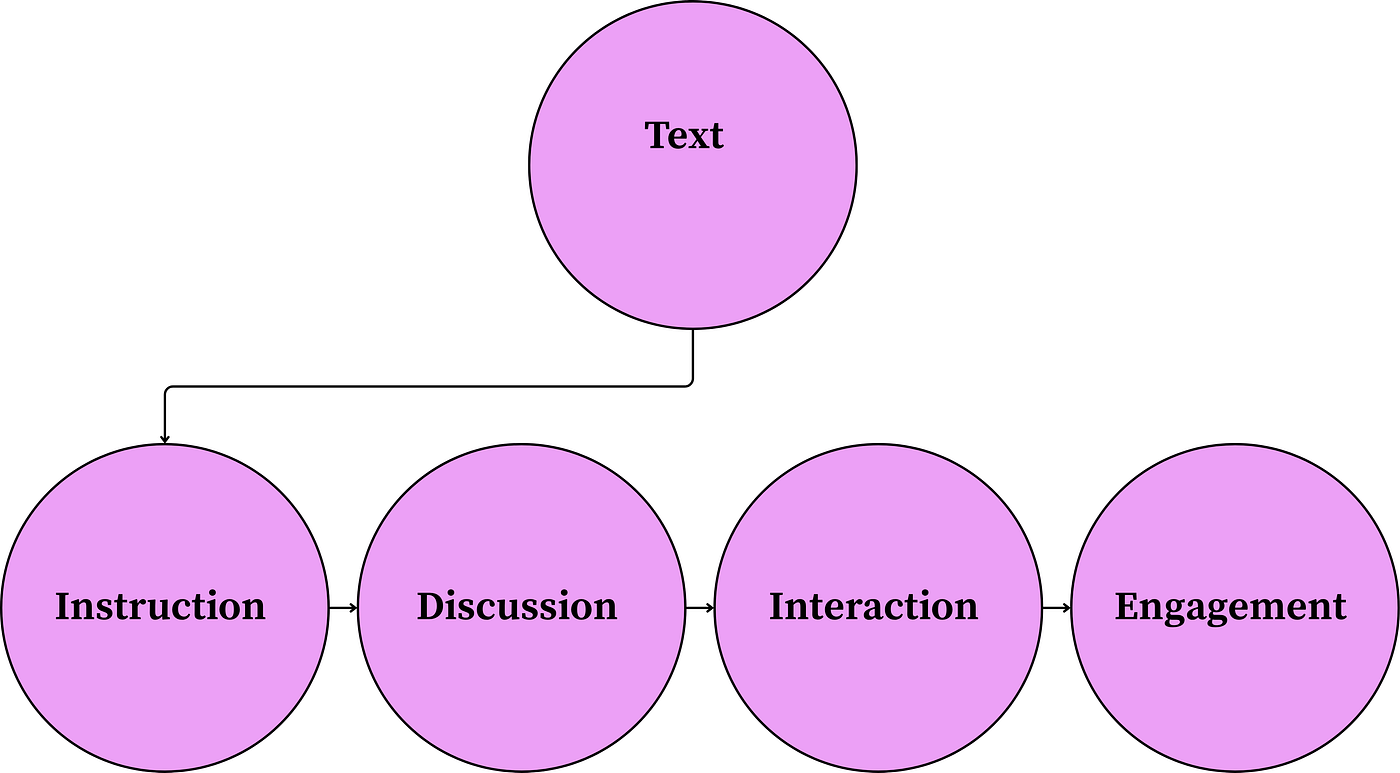
The Path from Text to Engagement Through Instructional Design | Alexandra Bouselli: Canva
From Reading to Participation
Engagement deepens when students move from reading independently to participating actively. Studies focused on classroom interaction, including observational and discussion-based research, track how students collectively build meaning. These research studies show that when students engage in dialogue, their responses become more detailed, interpretive, and interconnected (Gunn 214; Suico 520). This demonstrates that engagement operates at two levels. It is individual, as students interpret texts, and social, as they construct understanding together through discussion. Without opportunities for participation, engagement often remains limited; however, when such opportunities are available, understanding expands.
Representation Matters — but It Is Not Enough.
Young Adult Literature is often valued for its representation of diverse identities and experiences. YAL texts can help students see themselves reflected and encounter perspectives beyond their own.
However, classroom-based studies show that representation alone does not ensure deeper engagement. Students may recognize identity-related themes without analyzing their significance unless they are guided through discussion and reflection (Hays 38).
Similarly, studies of Young Adult Literature in social contexts show that students can understand complex issues but may not critically engage with them without structured support (Suico 520). This reinforces an important idea: representation creates opportunity, but pedagogy determines how that opportunity is explored.
A Shift in Perspective
Taken together, these insights suggest a clearer takeaway: engagement should be understood differently. Instead of asking which book will engage students, ask a more meaningful question: How are students being guided to engage with this text?
This transition emphasizes instructional design, classroom interaction, and structured opportunities for reflection. Engagement is not inherent in the text itself. It is shaped by the learning environment and by how students are guided to interact with it.
Looking Beyond the Classroom
These ideas also connect to broader conversations about how students engage with reading in general.
In a TEDx talk, English professor Erin Cole argues that many students enter college already feeling disconnected from reading. She explains that assigning only traditional or highly complex texts can sometimes reinforce that disconnection, rather than reduce it. Instead, she emphasizes the value of using accessible and relevant texts, such as Young Adult Literature, to rebuild students’ confidence as readers.
While accessibility alone does not guarantee deeper engagement, it can serve as an important starting point. When students feel more comfortable with a text, they are more likely to participate, which creates opportunities for the kinds of discussion and interaction that lead to meaningful engagement.
[embed]“Why I’m Not Afraid to Assign Y.A. Literature to College Students” | Erin Cole | TEDxCerritosCollege
What This Means For Teachers
Young Adult Literature offers powerful opportunities for engagement, identity exploration, and critical thinking; however, these outcomes are not automatic. The results depend on how students are supported in engaging with what they read. For educators, this yields a clear and important takeaway: Engagement is something we design, not something we assume. This idea also extends to broader conversations in education about accessibility and engagement.
As you reflect on your classroom, consider how you invite students into the reading experience. Are they encouraged to question, respond, and build ideas together? Are they moving beyond summary toward interpretation? Even small instructional changes can shift how students engage. One final question remains: Are students simply completing reading assignments, or are they actively working through ideas together? That distinction marks the beginning of meaningful engagement.
Works Cited
Gunn, AnnMarie Alberton. “Teachers Moving Forward on a Cultural Self-Awareness Spectrum: Diverse Children, Museums, and Young Adult Literature.” Multicultural Perspectives, vol. 18, no. 4, Oct. 2016, pp. 214–20, https://doi.org/10.1080/15210960.2016.1228335.
Hays, Alice. “Authentically Authored Native American Young Adult Literature (YAL) and Culturally Sustaining Pedagogy (CSP) in the Preparation of Preservice Teachers.” Journal of American Indian Education, vol. 56, no. 2, 2017, p. 34–38, https://doi.org/10.5749/jamerindieduc.56.2.0034.
Ryan, Eibhlín, and Heather Hurst. “‘Bullying Always Seemed Less Complicated before I Read’: Developing Adolescents’ Understanding of the Complex Social Architecture of Bullying through a YAL Book Club.” Research in the Teaching of English, vol. 55, no. 4, Routledge, May 2021, pp. 416–41, https://doi.org/10.58680/rte202131259.
Silva, Arsenio F., and Rachelle S. Savitz. “Defying Expectations: Representations of Youths in Young Adult Literature.” Journal of Adolescent & Adult Literacy, vol. 63, no. 3, May 2019, pp. 323–31, https://doi.org/10.1002/jaal.982.
Suico, Terri, et al. “Study and Scrutiny: Research on Young Adult Literature.” Study and Scrutiny: Research on Young Adult Literature, vol. 4, no. 1, Nov. 2020, pp. 518–20, https://doi.org/10.15763/issn.2376-5275.2020.4.1.i-ii. Accessed 28 May 2026.
메타데이터
- post_id
- ee2a27b65670
- slug
- why-relatable-books-arent-enough-what-really-engages-students-in-the-classroom-ee2a27b65670
- url
- https://medium.com/@abousell/why-relatable-books-arent-enough-what-really-engages-students-in-the-classroom-ee2a27b65670
- canonical_url
- https://medium.com/@abousell/why-relatable-books-arent-enough-what-really-engages-students-in-the-classroom-ee2a27b65670
- author_url
- https://medium.com/@abousell
- status
- ok
- fetched_at
- 2026-07-24 08:52:30




