AI Agents Don’t Process Data. They Interpret It.
Day 3 Shanghai Go-Global Talent Program
AI Agents Don’t Process Data. They Interpret It.
Day 3 Shanghai Go-Global Talent Program
GGTP Day 3, an AI founder shared their product.
They build smart rings and watches for sleep and health tracking, collecting continuous biometric signals like heart rate and sleep stages.
But what stayed with me wasn’t the hardware. It was a deeper structural problem:
they are not building data collection — they are building data interpretation.
The Gap in Current Wearables
Most wearables still assume the same pipeline:
Sensor → Score → Dashboard
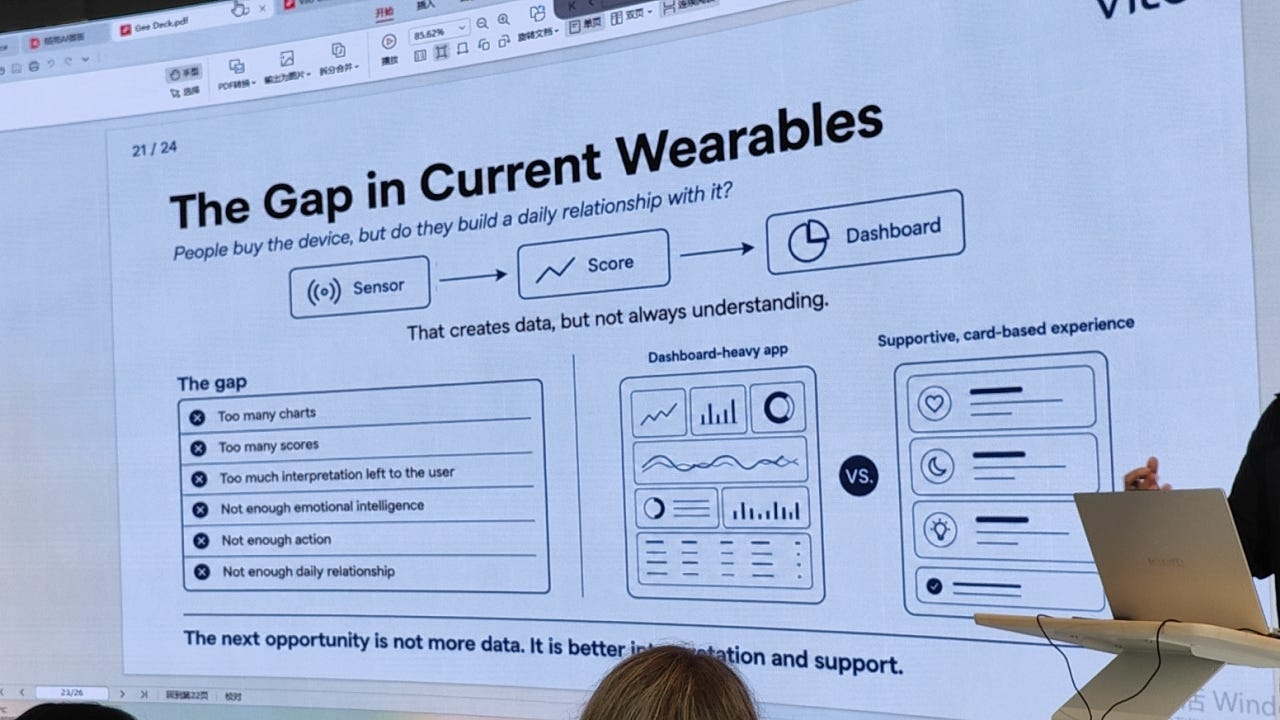
It looks complete. But in reality, it only produces data, not understanding. Users face too many charts and scores, too much interpretation pushed onto them, and too little emotional framing or actionable guidance. There is no real daily relationship with the product.
The result is simple: the product reports the body, but doesn’t help the user understand it.
I asked a simple question:
Do you clearly inform users what their data will be used for? And have you considered governance frameworks like the DSA?
The answer was direct:
They are still a small company. They are not at that stage yet.
That sentence stayed with me.
Because it reveals a pattern:
data governance always arrives after data collection.
A week earlier, I spoke with someone from Meta who worked in content governance for three years.
She told me something that changed my framing:
Under the EU DSA, fines can reach up to 6% of global revenue.
Governance is no longer backend compliance.
It is product surface. Design surface. Language surface.
I started noticing this everywhere.
For example, TikTok LIVE shows a greyed-out button when eligibility is not met.
No explanation. No progress indicator.
Just silence.
In the EU context, this becomes a “silent refusal” problem addressed by DSA Article 17.
That’s when I realized:
governance is not legal infrastructure.
It is a content design problem.
STEP 1 — Research
I used Mobbin to collect UI patterns across governance flows:

cookie consent, privacy policy, AI disclosure, account suspension, data sharing, biometric verification.
In two days, I gathered 26 examples across fintech, social, e-commerce, health, and AI tools.
Each sample was annotated with: category, region, regulation mapping, full copy, and effectiveness notes.
STEP 3 — Structuring
The 26 examples collapsed into five governance patterns:
Consent, Privacy, AI Disclosure, Moderation, Sensitive Data.
Each maps to structured legal requirements like GDPR Article 13 and DSA Article 17.
At this point, the insight was clear:
this is not research anymore — it is a system.
STEP 4 — From Skill to AI Agent (Harness Thinking)
I first tried packaging everything into a SKILL.md.
But it quickly became obvious:
a skill is just input → output.
No memory. No workflow. No system behavior.
So I shifted to a different concept: harness.
A harness is everything outside the model that makes it reliable:
- information boundaries
- tool systems
- execution orchestration
- memory state
- evaluation layer
- constraint repair
The shift is simple:
from “can the model answer?” to “can the system consistently produce the right process?”
AI Content Governance Agent
Step 1 — Identify content type (context, platform, audience) Step 2 — Retrieve relevant rules dynamically Step 3 — Decompose content into atomic risk units Step 4 — Apply local corrections only Step 5 — Run a second-pass reviewer agent Step 6 — Store cases for memory and improvement
Over time, it becomes a judgment system, not a checker.
Why this connects back to wearables
Wearables and AI skills fail for the same reason:
they generate data, but not interpretation systems.
The missing layer is not data.
It is structure for meaning.

메타데이터
- post_id
- ee2b52dfce01
- slug
- ai-agents-dont-process-data-they-interpret-it-ee2b52dfce01
- url
- https://medium.com/@sheffylab666/ai-agents-dont-process-data-they-interpret-it-ee2b52dfce01
- canonical_url
- https://medium.com/@sheffylab666/ai-agents-dont-process-data-they-interpret-it-ee2b52dfce01
- author_url
- https://medium.com/@sheffylab666
- status
- ok
- fetched_at
- 2026-06-09 15:37:30



