Leonardo’s Secret: How Drawing Bridged Dream to Enhavim
Most people keep their dreams separate from their daily choices. They wait for someday, the right moment, the perfect conditions. Leonardo…
Leonardo’s Secret: How Drawing Bridged Dream to Enhavim
Most people keep their dreams separate from their daily choices. They wait for someday, the right moment, the perfect conditions. Leonardo da Vinci made a different choice. He discovered how to connect century-spanning imagination to the stroke of a pen on paper. His notebooks were not just records of ideas but bridges between dreaming and creating, between the impossible and the inevitable. Every line he drew was both utterly practical for his own time and reaching toward a future he would never see.
Drawing as Thinking
Leonardo da Vinci understood the world through drawing. Faced with any problem, whether the motion of water, the flow of a river, or the mechanics of human sight, he reached for pencil and paper. Drawing was how he thought.
When Leonardo observed water flowing around obstacles in a stream, he filled page after page with spirals and eddies, tracing the patterns until he grasped the underlying principles. He studied these flows in Venice while working on naval weapons and engineering projects. When he examined how the eye perceives light and shadow, he sketched cross-sections of the eyeball, diagrams of light rays, and countless studies of how forms emerge from darkness. Each drawing was an act of investigation, a visual argument he constructed and tested on the page. Paper was scarce in his time, so he used every available space for drawings, observations, even recipes and shopping lists.
Create in the Now for Centuries Ahead
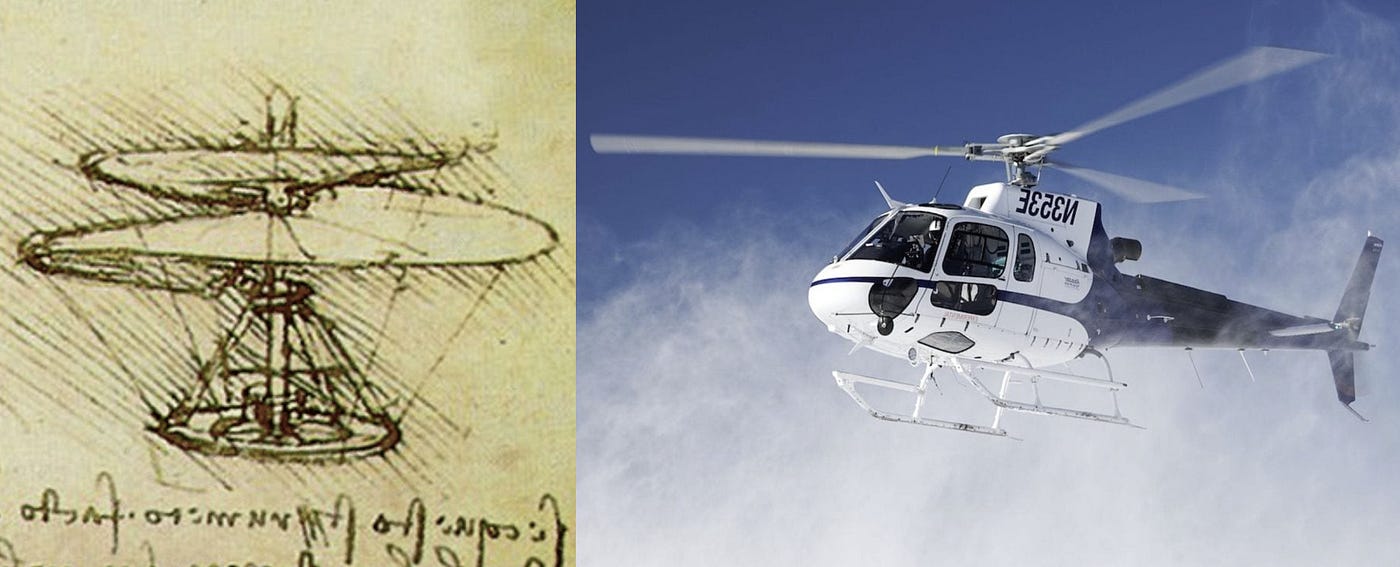
In the late 1480s, while working as a military engineer for Ludovico Sforza, Duke of Milan, Leonardo sketched his design for an “aerial screw.” The drawing illustrated how the compression of air could lift the device off the ground, with a large screw-shaped propeller designed to bore through the air like a drill through wood. He was seeing the future, creating in the now an idea that couldn’t be built until technology evolved centuries later. The materials and power sources needed didn’t exist in his time, yet he could envision the machine completely, working out its mechanics on paper. He drew it from multiple angles, calculating proportions and movements as if the necessary engineering would eventually catch up to his imagination.
Testing Ideas on Paper
Years later, this method proved invaluable during Leonardo’s brief but intense service as Cesare Borgia’s chief military architect and engineer from 1502 to 1503. Borgia, the illegitimate son of Pope Alexander VI, was a ruthless general conquering central Italy. For this notorious patron, Leonardo designed fortifications, drew detailed military maps like the famous map of Imola, and developed military technologies, testing their feasibility entirely on paper. He sketched massive crossbows, siege ladders, fortification systems, and artillery. Each drawing exposed problems a purely verbal description would have hidden. A bridge design that seemed sound in theory might show structural weaknesses once rendered on paper. A weapon that looked practical in the abstract could prove mechanically impossible when its parts were drawn in proper relation to one another.
Leonardo deliberately obscured some of his most lethal designs. For his submarine, he drew the components disassembled and fragmented across different pages so the weapon wouldn’t fall into enemy hands. One critical sheet, folio 881r of the Codex Atlanticus, became so damaged and moldy over the centuries that the drawings almost disappeared. The blue paper had aged until the ink became nearly invisible. Not until 2011, when researchers at the Leonardo3 studies center used digital processing, did the hidden drawings come back to life. Around 40 different mechanisms and pieces of text emerged from what had looked like a blank page. Leonardo left no complete schematic, just scattered indications that had to be pieced together like a puzzle. He left Borgia’s service quickly, disillusioned. Despite designing all this artillery and weaponry, Leonardo was a pacifist who detested war and its destruction.
The Page as Laboratory
Each sketch functioned like a simulation, letting him iterate and refine until he could see whether an idea would work in reality. He would draw a mechanism from multiple angles, work out the proportions, trace the movement of each component. If something failed on paper, he adjusted and drew again. He wrote his notes backwards in mirror image, reading from right to left, possibly to avoid church scrutiny of theories that contradicted religious teaching, or to prevent others from stealing his designs. His drawings were his laboratory, a way to experiment with physics, mechanics, and engineering before anything was ever built. The page became a space where ideas could fail safely, where the impossible showed itself before resources were wasted on construction.
In his drawings, Leonardo strived for what he called “saper vedere,” knowing how to see. His notebooks contain more than 20,000 sketches with copious notes and detailed drawings. Some experts believe no one has drawn better since.
Operating Across Centuries

Leonardo’s genius wasn’t just technical skill. It was his ability to operate across time levels simultaneously. While his contemporaries focused on next week’s commission or next month’s payment, Leonardo held century-spanning visions while making daily creative decisions. His helicopter design took 450 years to fly. His parachute was successfully tested in 2000, exactly as he drew it five centuries earlier. He wasn’t sketching fantasies. He was engineering the future, making split-second choices about line weight and mechanical angles guided by technological timelines he knew extended far beyond his lifetime.
This is what separates visionaries from everyone else. They bridge the space between their biggest dreams and their smallest daily decisions. They understand that time doesn’t work the way most people think it does. There’s a hidden architecture to time that becomes visible when you look: daily decisions connected to decade outcomes connected to century-spanning visions. Personal time intersecting with project time intersecting with generational time intersecting with civilizational time.
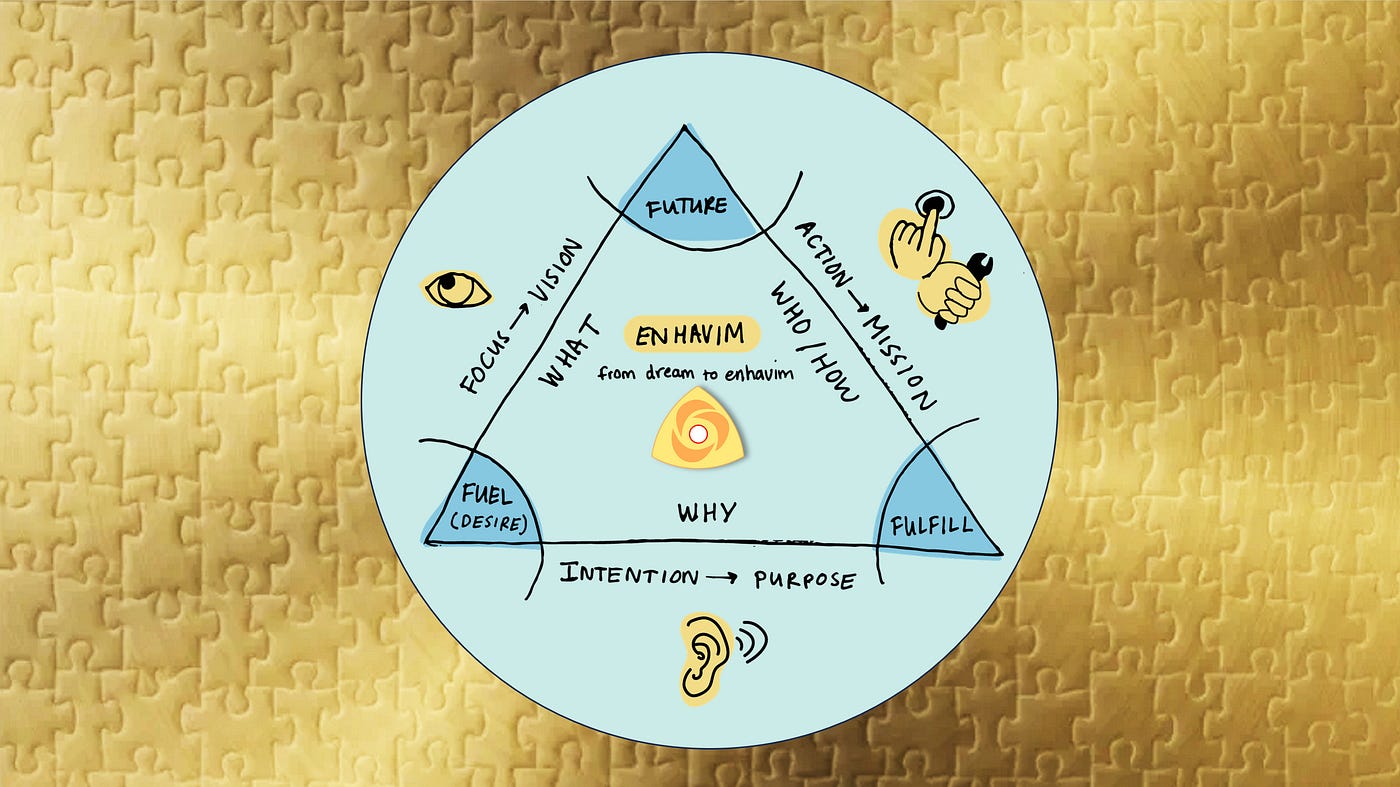
Leonardo filled his notebooks with designs for flying machines, submarines, and automated systems not because he expected to build them, but because he understood something fundamental about creation. The act of creating in the now, of working out the mechanics and proportions on paper today, plants seeds that grow across centuries. His daily sketching practice served something much larger than immediate results. He was operating with what we might call enhavim: purpose and mission led by vision, the integration of what, why, and who before how.

Resources
Books and Frameworks:
- Create in the NOW: From Dream to Enhavim by Sherrie Rose — createinthenow.com
- Leonardo da Vinci by Walter Isaacson — Comprehensive biography exploring Leonardo’s notebooks and creative process
Museums and Exhibitions:
- Leonardo3 Museum, Milan — Interactive exhibits of Leonardo’s machines and digital restorations — leonardo3.net
- The Codex Atlanticus — Biblioteca Ambrosiana, Milan — Largest collection of Leonardo’s drawings and writings
Digital Collections:
- British Library’s Leonardo da Vinci notebooks — Digitized manuscripts available online
- The Codex Leicester — Bill Gates Collection (occasionally exhibited publicly)
Documentary:
- Inside the Mind of Leonardo — PBS documentary examining his scientific investigations and artistic techniques
메타데이터
- post_id
- ee35d02e3a61
- slug
- leonardos-secret-how-drawing-bridged-dream-to-enhavim-ee35d02e3a61
- url
- https://medium.com/@sherrierose/leonardos-secret-how-drawing-bridged-dream-to-enhavim-ee35d02e3a61
- canonical_url
- https://medium.com/@sherrierose/leonardos-secret-how-drawing-bridged-dream-to-enhavim-ee35d02e3a61
- author_url
- https://medium.com/@sherrierose
- status
- ok
- fetched_at
- 2026-06-13 07:35:29