Ordinary Magic Tarot: 3 of Swords
An idea that is not dangerous is unworthy of being called an idea at all. — Oscar Wilde
Ordinary Magic Tarot: 3 of Swords
An idea that is not dangerous is unworthy of being called an idea at all. — Oscar Wilde
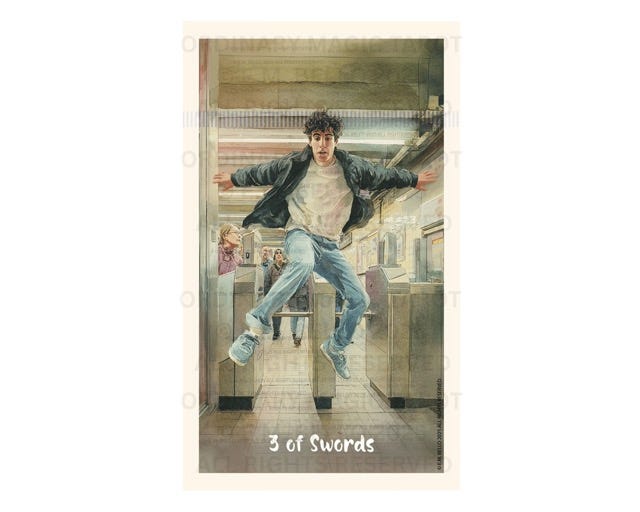
The station lights were too bright, the kind that made everything look exposed. Rai’s card flashed red again — insufficient balance. He glanced at the clock above the platform. Late. Always late. A line had begun to form, with restless commuters shifting in place. He looked around: a woman rummaging in her bag, a man tapping his card twice, the guard half-turned, distracted by a call.
His thoughts circled, neither gaining ground. For a moment, he hovered between two choices: go home, or go back to the payment machines. Just as he was about to turn away, a striking thought cut through, quick and sharp, like lightning through the air. It would take only a second. One step timed right, one breath held. A third current rose, silent, absolute, not deliberating, but deciding. The balance broke.
He moved forward, aligning himself behind the next man, matching his pace, his breath, the rhythm of the queue. The noise of the station seemed to narrow to a single sound, the soft click of the card reader. The man’s card beeped green, the gate slid open, and Rai slipped through the gap. In the same instant, the guard who had been on the phone turned sharply, his voice cutting through the noise. Rai didn’t look back. The decision had already been made; his body only followed.
He tore through the overground concourse, weaving between commuters, the sound of pursuit echoing behind him. The guard shouted again, closer this time. Rai’s breath came in bursts, his pulse drumming in his ears. He darted down the stairs toward the connecting tunnel, the air growing heavier, the light dimmer. The metro gates came into view — another barrier! The guard’s footsteps thundered on the tiles. Rai didn’t slow. He gathered speed, the world narrowing to the rhythm of his heartbeat and the flashing red of the turnstile lights.
He leapt. For a heartbeat, he was suspended in the air. The woman behind him gasped, but no one stopped him. He landed hard, stumbled, and kept running. Behind him, the guard shouted, but the sound was swallowed by the warning chime of the metro doors. They were closing. Rai lunged forward, slipping through the narrowing gap just as they sealed shut behind him.
He stood there, chest heaving, the train already in motion. His reflection in the window looked back, split by glare, fractured by motion. He told himself it was only a fare, only a shortcut. But the lie was thin. He’d done this before, different stations, same urgency, same escape. The pattern repeated: the small trespass that hid the larger one. Outside, the tunnels blurred into streaks of light. Inside, the thought lingered, how every decision begins as two opposing lines, until something unseen cuts through and forces movement. The third thought. The one that changes everything.
The 3 of Swords is often misread in modern tarot, frequently reduced to heartbreak and sorrow. Within the Tarot de Marseille tradition, the suit of Swords (Épées) represents the operations of the mind-analysis, judgement, and the structuring of thought. The third card in this sequence signals a necessary disruption or intervention that challenges the intellect, preventing it from stagnating or congealing, and from settling into indecision or double‑mindedness.
Writers such as Paul Marteau (1949) and Jodorowsky & Costa (2004) describe it as a card of mental recurrence and necessary awareness rather than emotional pain. In essence, it is interference that breaks up stasis, keeping the mental process in active circulation.
A. E. Waite, in contrast, assigns the 3 of Swords a distinctly emotional tone in The Pictorial Key to the Tarot (1910), describing it as removal, absence, delay, division, and rupture. His interpretation, later reinforced by the imagery of the pierced heart in the RWS deck, shifted the card’s focus from mental process to emotional suffering. This divergence between the Marseille and RWS traditions explains why the 3 of Swords remains one of the most persistently misinterpreted cards in modern tarot practice.
Excerpt from Ordinary Magic Tarot: Extraordinary Stories. All rights reserved.
Originally published at **Native Authority Tarot **on Substack.
메타데이터
- post_id
- ee37ad12cd62
- slug
- ordinary-magic-tarot-3-of-swords-ee37ad12cd62
- url
- https://medium.com/@nativeauthoritytarot/ordinary-magic-tarot-3-of-swords-ee37ad12cd62
- canonical_url
- https://medium.com/@nativeauthoritytarot/ordinary-magic-tarot-3-of-swords-ee37ad12cd62
- author_url
- https://medium.com/@nativeauthoritytarot
- status
- ok
- fetched_at
- 2026-07-10 06:45:42