Why Hyper-Violent Cinema Is Dominating India’s Box Office, And Why That May Not Last
From KGF to Dhurandhar, spectacle, catharsis and shrinking theatrical windows have reshaped what succeeds in Indian cinema.
Why Hyper-Violent Cinema Is Dominating India’s Box Office, And Why That May Not Last
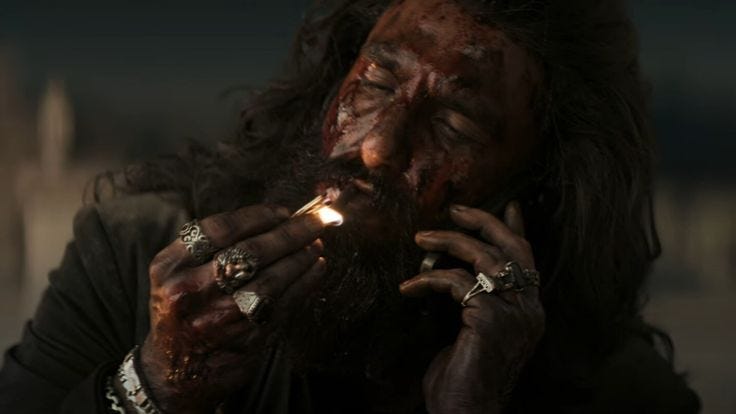
When Dhurandhar released in December 2025, it reignited a debate that has been building for years around Indian cinema’s increasing reliance on extreme violence, hyper-masculinity, and nationalist spectacle. The high-budget spy thriller, starring Ranveer Singh and directed by Aditya Dhar, drew both significant attention and criticism for blending fictional action with real-world political tensions. Several commentators described parts of the narrative as overtly nationalistic, while others defended it as mainstream commercial cinema operating within familiar genre conventions.
This pattern of controversy is not new. Animal (2023) became one of Bollywood’s biggest hits, grossing over ₹900 crore worldwide despite widespread criticism for glamorizing violence and reinforcing misogynistic and regressive gender dynamics. Supporters argued that the film portrayed a psychologically damaged protagonist rather than endorsing his actions, but the debate itself became part of its cultural footprint.
Earlier films followed similar trajectories. KGF: Chapter 2 (2022) earned more than ₹1,200 crore globally, becoming one of the highest-grossing Indian films ever. Its stylized brutality and operatic violence were central to its appeal. Pushpa: The Rise (2021) collected approximately ₹350 to ₹360 crore worldwide and built a massive following through its aggressive anti-hero narrative. Uri: The Surgical Strike (2019) grossed around ₹300 crore globally and became a landmark in contemporary patriotic cinema, celebrated by many viewers while criticized by others for jingoistic framing. Even earlier, Kabir Singh (2019) sparked national debate for what many perceived as the romanticization of toxic relationships and volatile masculinity. More recently, the 2024 film Kill pushed boundaries further, drawing attention from American producers behind John Wick who announced plans for a Hollywood remake.
It is undeniable, just by looking at the numbers, that these films are making more than just buzz. They are growing their audience and scaling above and beyond. But as these movies gain a larger audience, they are also drawing increasingly polarized opinions and extreme reviews. In the case of Animal, critics such as Anupama Chopra, Sucharita Tyagi, Shubhra Gupta, and Anna M. M. Vetticad questioned the film’s treatment of women and its framing of male rage. Writers including Nandini Ramnath and Poulomi Das pointed to what they described as the glamorization of cruelty. Kabir Singh faced criticism from reviewers who called it glamorising toxic masculinity and sexism, while director Sandeep Reddy Vanga dismissed the backlash as “pseudo,” and Rajeev Masand later remarked that the film reflected “who he is and how he thinks.” In the case of Uri: The Surgical Strike, publications such as The Wire and Scroll.in raised concerns about overt jingoism and argued that the film blurred the line between commercial entertainment and contemporary political messaging in the run-up to the 2019 general elections. Academic voices such as Shohini Ghosh and other media studies scholars have more broadly examined how hyper-nationalist narratives in popular cinema can reinforce majoritarian sentiment. Yet the films continue to dominate the box office. The question should not be about whether hyper-violent cinema works commercially. There is no denying the fact that it absolutely does. But the actual question should be why it works now, what structural forces enable it, and whether the industry can sustain this escalation without exhausting its own foundations.
Violence as a Signal of Scale
In the current Indian theatrical market, violence has become shorthand for importance. With compressed attention spans, shrinking theatrical windows, and simultaneous pan-India competition, films no longer have the luxury of slow thematic accumulation. They must announce their scale immediately. Theatrical windows have shrunk dramatically in India. While Hindi and Hollywood films generally maintain an eight-week window before OTT release, Tamil, Telugu, and Kannada films often face just four weeks, according to the Multiplex Association of India. When a film underperforms, even this brief window collapses. The box office showed a 15 percent growth in 2023 compared to 2022, but this was driven primarily by rising average ticket prices rather than increased footfall. Ticket prices climbed 26 percent above pre-pandemic levels by 2024, even as occupancy rates declined.
This shift helps explain why films like KGF: Chapter 2, Salaar, Vikram, and Jawan front-load intensity instead of allowing violence to build gradually. Violence is no longer simply an element within a film’s narrative; it has become a form of industrial signaling, marking that this is not disposable, not small-screen in scale, but something that demands theatrical attention. Director Sandeep Reddy Vanga, whose Animal (2023) grossed over ₹900 crore worldwide to become the highest-grossing A-rated Indian film of its time, described his approach in a pre-release interview: “Animal strikes a balance between emotions and violence. The equilibrium will be maintained throughout the film, providing an immersive experience.” The film’s violence, he argued, reflected “the hero’s instinctive behavior, which will be akin to animals.” Filmmaker Ram Gopal Varma, whose own films redefined on-screen violence in Indian cinema, praised Animal’s approach at a public event, stating that “the violence was more impactful than seeing armies fighting each other.” The effectiveness of violence, within this framework, lies not in its volume but in its emotional grounding; it must feel consequential rather than merely spectacle.
In Film Companion roundtables and promotional interviews, actors, writers, and filmmakers associated with such films have often framed violence in terms of performance, character, and genre rather than moral defense. In an October 2023 interaction reported by *The Times of India, Ranbir Kapoor described Animal* as “the darkest film I have done,” explaining that the character’s “psyche is very dark” and framing the role as an exploration of a complex, unfamiliar mindset rather than a conventional portrayal of villainy. In a December 2024 interview with Faye D’Souza, Shahid Kapoor acknowledged that “a lot of things that Kabir did was not acceptable” and that he “would not accept a guy like that,” but added that such men do exist and “girls… fall in love with guys like that,” defending the film’s right to depict uncomfortable realities without prescribing them.
Together, this combination of hyper-violence, vigilante stories, and morally ambiguous anti-heroes sends a strong signal of seriousness and scale when framed as existing at the most primal, “raw” and “gritty” levels of intensity within the current theatrical economy.
Why the Theatre Still Demands Blood
The Indian film industry continues to utilize narrative structures to resolve issues of morality and emotion. This is not by chance; Indian audiences have been accustomed to these narrative patterns for decades.
The distribution of emotional and moral labor in Hollywood across different platforms and formats is becoming increasingly common, rather than being contained within a single medium. The same can be said for violence; its transformation did not happen all at once. So, for a better understanding of India’s reluctance to follow this path, it is essential to examine how Hollywood has recontextualized violence over the decades, as cinema itself has evolved across generations rather than eliminating it altogether.
Hollywood Learned to Look Away
In 1967, Arthur Penn’s Bonnie and Clyde did something that had been unthinkable under the Hays Production Code. The film’s climactic death sequence showed Warren Beatty and Faye Dunaway’s bodies jerking like rag dolls as bullets riddled them in what Variety later described as a “dance-of-death” that “blasted away any last vestiges of the Hays Code, opening the floodgates to a fearless movie culture in which anything could be shown.”
What made the film revolutionary was not just that it showed blood, but how it showed it. The final ambush sequence lasted mere seconds in real time but was stretched through editing into what felt like an eternity. Director Arthur Penn had been influenced by French New Wave directors François Truffaut and Jean-Luc Godard. When film critic Roger Ebert saw it in 1967, he declared: “This is pretty clearly the best American film of the year.”
The controversy was immediate. Bosley Crowther of The New York Times campaigned against what he saw as increasing brutality, calling it “a cheap piece of bald-faced slapstick comedy.” But Pauline Kael’s 9,000-word New Yorker review defended the film’s artistic merit. The film earned $70 million worldwide, becoming Warner Bros.’ second-highest-grossing film behind My Fair Lady.
The Hays Code was officially abandoned in 1968, replaced by the MPAA ratings system. This created the infrastructure for what came next.
Two years later, Sam Peckinpah’s The Wild Bunch (1969) formalized cinematic violence into technique. Peckinpah used six cameras running at different speeds (24, 30, 60, 90, and 120 frames per second) to shoot the film’s major gunfights. Editor Lou Lombardo cut this footage into what critic Pauline Kael called “a traumatic poem of violence.” The film’s opening bank robbery begins with long takes establishing the town. Then, when violence erupts, the average shot length collapses to under two seconds.
Peckinpah and Lombardo use frame rate changes and rapid cutting to stretch and contract time within the same instant. The technique involved intercutting slow-motion shots of bodies falling with real-time chaos, showing gunshots from multiple angles, repeating impacts through different perspectives. This created what critics called “bloody ballet.”
The final massacre lasts nearly five minutes. Roger Ebert, who saw the original 144-minute cut, later wrote: “I stood up and called it a masterpiece.” But Peckinpah himself defended his approach: “The point of the film is to take this facade of movie violence and open it up, twist it so that it’s not fun anymore, just a wave of sickness in the gut.”
By the 1970s, Hollywood violence had split into two streams. The first stream internalized it psychologically. Martin Scorsese’s Taxi Driver (1976) made violence the product of urban alienation. Francis Ford Coppola’s The Godfather (1972) aestheticized organized crime but framed it as institutional corruption. The second stream made violence grotesque. Tobe Hooper’s The Texas Chain Saw Massacre (1974) industrialized horror.
Then Quentin Tarantino’s Pulp Fiction (1994) made violence ironic and aestheticized. Blood became part of the film’s color palette. Deaths happened mid-sentence. David Fincher’s Se7en (1995) made violence procedural, an intellectual puzzle rather than emotional release.
By the 2000s and 2010s, Hollywood had split violence into two incompatible streams. Either it became franchise spectacle where moral stakes disappear into CGI destruction (Avengers: Endgame), or it became auteur meditation where ambiguity is the point (No Country for Old Men).
Here is the crucial distinction that explains everything. Hollywood violence became aestheticized, turned into Tarantino’s choreographed performance and John Wick’s balletic movement. It detached itself from institutional closure, embracing ambiguity without resolution. Indian violence operates completely differently. It remains instrumental, serving narrative closure. It produces catharsis. It functions narratively to resolve moral tension that the film has spent hours building.
Hollywood has always been violent. The John Wick franchise itself epitomizes hyper-violence. The distinction lies in emotion rather than quantity of violence. In contrast, the violence portrayed in John Wick films is aesthetically pleasing while devoid of emotion, whereas Indian cinema carries emotional release and is often more artistically brutalized.
This distinction between the types of violence depicted in each region provides some insight into Hollywood’s ability to import the aftermath of violence to streaming services while India has not. violence in Hollywood exists to simply provide visual enjoyment, however in India it exists to provide closure to the storyline.
Streaming Can’t Replace the Collective Rush
HBO’s The Sopranos (1999–2007) spent 86 episodes exploring Tony Soprano’s psychology. The series does not resolve his violence. It ends in ambiguity and dread. AMC’s Breaking Bad (2008–2013) tracked Walter White’s moral decay over 62 episodes. The aftermath lingers across years. Characters live with consequences. The system remains broken. Long-form television allowed for what theatrical films could no longer sustain commercially: moral complexity unfolding over dozens of hours.
Long-form violence has become a significant part of the Indian streaming ecosystem. Netflix’s Sacred Games, featuring major stars and a dense mix of politics and brutality, marked a turning point for viewers unaccustomed to that level of explicit storytelling on Indian screens. It earned an International Emmy nomination and was included in The New York Times list of the 30 best international television shows of the decade. Amazon Prime Video’s Paatal Lok, (2020) earned comparisons to Sacred Games, with some critics calling it “perhaps the most confident step in the evolution of Indian streaming” since Made in Heaven. Similarly, Mirzapur expanded the appetite for serialized violence through its gangster-driven narrative set in the Hindi heartland. Its graphic brutality, profanity, and intergenerational power struggles turned it into one of India’s most talked-about streaming franchises, demonstrating that sustained, episodic violence could command mass attention outside the theatrical space. Despite the rise of these shows, streaming’s success has still not displaced theatrical cinema as the primary site of collective experience in India.
According to CNN Business, after the Modi government announced new regulations for streaming in 2021, Amazon canceled planned seasons of The Family Man and Paatal Lok. The platform announced plans to co-produce its first Indian film instead, a mythological tale. Netflix’s Indian subscriber base in 2020 was estimated at 4.2 million. By comparison, Animal alone sold tickets to an estimated 30–35 million people theatrically.
A film’s success is still measured by opening weekend collections, multiplex run length, and presence in collective conversation. Sacred Games was culturally significant among urban, English-speaking audiences. Animal dominated national discourse across class, language, and region. Box office still defines cultural dominance. Animal’s ₹900 crore theatrical gross generated more social conversation, media coverage, and collective ritual than any streaming series has achieved. Streaming success does not confer the same status as theatrical dominance.
The viewing habits, critical discourse, and audience expectations that allow The Sopranos or Breaking Bad to perform moral work in the West do not yet exist at comparable scale in India. Streaming is popular, but it has not replaced theatrical cinema’s cultural authority.
From Satya to Animal: The Violence Template Scaled Up
Animal does not invent its violent grammar. It intensifies one established by Ram Gopal Varma in films like Satya (1998) and Company (2002).
In Satya, Bhiku Mhatre’s killings are not morally debated within institutions. There is no reform arc. No courtroom reckoning. No investigative journalism exposing systemic corruption. Violence resolves tension immediately. Emotion translates directly into action. The film ends not with justice but with annihilation.
What made Satya revolutionary was not its violence per se but its complete absence of moral infrastructure. Systematically, the film shows that every entity meant to deliver justice is either corrupted or powerless. The police are compromised, operating within the same corruption they claim to police. Politicians are implicated in the networks of power they publicly denounce. The press offers no meaningful scrutiny. Justice exists as a concept, but there is no evidence of its functional capability. In that vacuum, violence becomes the only operative language.
Animal follows that template but scales it to pan-India proportions. The father-son estrangement at the film’s core does not culminate in confession, therapy, or reconciliation. It culminates in the corridor shootout and the final confrontation that leaves bodies scattered across marble floors. The psychological fracture is processed physically. The emotional rupture produces bodily confrontation which produces narrative closure.
Ram Gopal Varma himself publicly praised Animal, stating that its violence felt more impactful than large-scale battle sequences. That praise is significant. It situates the film within a specific lineage where intensity equals seriousness, where emotional authenticity is measured through visceral impact. But the logic stays the same after decades: emotional rupture produces bodily confrontation, which produces narrative closure.
The Angry Young Man Never Left
KGF traces back to the Amitabh Bachchan archetype of Deewaar (1975), but it transforms that template through scale and mythic framing.
In Deewaar, systemic betrayal produces the angry young man. Vijay’s father, a union leader, is forced to betray workers. The family is branded. Vijay grows up poor. He does not reform the system. He rises through smuggling, accumulating wealth outside institutional structures. His moral legitimacy comes entirely from suffering. The famous confrontation (“Mere paas maa hai”) ends not with institutional justice but personal sacrifice. Vijay dies in his mother’s arms after being shot by his policeman brother.
Rocky in KGF follows this precisely. Born in poverty, his mother dies dreaming of a better life. Exploitation in the Kolar Gold Fields is not addressed through unionization or reform. It is addressed through personal conquest. Rocky seizes the mines not by organizing workers but through strategic violence and charismatic dominance.
Structurally, these films follow a familiar emotional arc. A broken system produces personal suffering. That suffering becomes justification. Justification becomes dominance outside the law. And almost always, the only true ending available is death. However, structurally they share almost identical DNA. But the technical execution differs radically. Whereas Deewaar stays rooted in Mumbai’s docks and working-class tenements, KGF takes that same foundation and scales it into an almost mythical grandeur.
Director Prashanth Neel uses wide establishing shots showing Rocky backlit against industrial landscapes. The camera often places him in low-angle shots that make him tower over the frame. When violence erupts, the editing rhythm accelerates but maintains spatial coherence. You always know where Rocky is relative to his enemies.
The color grading desaturates everything except blood and gold. The Kolar Gold Fields are rendered in browns, grays, and blacks. Blood is the only vibrant red. Gold is the only warm color. This creates visual hierarchy: suffering (desaturated reality), violence (red), reward (gold).
The sound design layers industrial noise under everything, grinding metal, falling rocks, echoing chambers bleeding into dialogue and action. Violence hasn’t built organically here; it is intended to be perceived as mechanical. Punches land like metal hitting stone. The world itself feels engineered for brutality. And that reinforces the film’s central metaphor: Rocky is not just surviving industrial violence, he is shaped by it and eventually masters it.
What KGF adds to Deewaar’s template is not a new structure, but scale and mythologization. Deewaar was social realism with tragic weight. KGF presents myth as if it were history. The framing device, a journalist recounting Rocky’s story, turns him into legend before we even meet him. Every action feels pre-destined because the narrative keeps insisting that he is inevitable.
The anger plus systemic injustice formula remains the same. But where Deewaar asked the audience to sympathize with Vijay’s moral conflict, KGF asks them to submit to Rocky’s dominance.
Indian Vigilantism
Pushpa and Jawan follow a well-established South Indian mass cinema formula where the hero becomes parallel justice when institutions fail.
In Vijay Thalapathy’s Theri (2016) and Mersal (2017), corruption is exposed theatrically and punished decisively. In Theri, the protagonist, a police officer hiding under a new identity, hunts down those responsible for his wife’s death and eliminates them one by one. In Mersal, the doctor does not lobby for healthcare reform or file petitions. He kidnaps, punishes, and publicly shames corrupt medical officials while offering free treatment to the poor. The message is clear: the system is too slow, too compromised, or too indifferent. Justice must be delivered personally.
Earlier, Rajinikanth’s Baasha (1995) established this template decades earlier. Manickam appears to be a simple auto driver. But when his family is threatened, his past resurfaces. He was once a feared gangster who controlled the city’s underworld. The police cannot protect his loved ones. The courts are irrelevant. So he reactivates his former identity and dismantles the threat through force. His violence is framed not as crime, but as moral necessity.
Aparichit, directed by S. Shankar and released in 2005, takes this logic further. Shankar’s cinema has long been built around institutional failure and spectacular retribution, a lineage that later connects to Atlee, the director of Jawan, who has openly drawn from the same mass vigilante grammar. In Aparichit, the protagonist does not merely punish corruption; he constructs an alternate moral code rooted in vigilante retribution. When the legal system fails to act against negligence and civic apathy, he stages punishments himself, drawing from mythic and religious symbolism. The courtroom becomes irrelevant. The police become reactive. Justice exists only when he performs it.
This template repeats across Tamil and Telugu cinema. The decent man has a brutal capacity. The system fails. The man’s violence becomes necessary. The structure positions extra-legal action as tragic necessity rather than criminal choice.
In Jawan, the metro hijack, prison uprising, and televised confrontation are not investigations or legal proceedings. They are staged reckonings. Each sequence ends with punishment, not reform. The corrupt health minister does not face trial or parliamentary inquiry. He faces public humiliation and elimination orchestrated by the protagonist who has become parallel justice.
Pushpa extends this structure into the terrain of class and caste humiliation. He is not a policeman, a doctor, or a moral reformer. He is a daily-wage laborer in the red sanders smuggling trade, repeatedly belittled by officers and local elites who treat him as disposable. The system does not merely fail him. It mocks him. Pushpa does not seek legal recognition or structural reform. He studies the power hierarchy, manipulates it, and climbs it. When the police strip him of dignity, he responds not with appeal but with strategic escalation. His violence is not framed as rebellion against the state. It is framed as self-assertion within a system that has already denied him legitimacy. Like Baasha and Aparichit before it, Pushpa does not ask whether the hero is lawful. It asks whether he is justified. And once humiliation is established, justification becomes enough.
This is Indian vigilantism in narrative form. The structure remains constant. Institutions fail. The hero intervenes. Violence restores order, at least temporarily. And the audience leaves with the feeling that something has been settled, even if nothing systemic has changed.
Espionage, But Dirtier
Phantom (2015) established a covert retaliation structure where the state cannot respond officially, so an operative acts off the books to restore national honor. But Dhurandhar (2025) does something structurally different. It is not simply another espionage thriller. It is a cocktail of spy thriller and gangster drama, a hybrid template that explains its hyper-violence in ways the YRF Spy Universe cannot.
According to Wikipedia, Dhurandhar follows an undercover Indian intelligence agent who infiltrates Karachi’s criminal syndicates and political power structures in Pakistan in an effort to dismantle a terror network targeting India. The film’s storyline draws loose inspiration from multiple real-life geopolitical events and conflicts in South Asia, including the 1999 IC-814 hijacking, the 2001 Indian Parliament attack, and the 2008 Mumbai attacks.
But what sets Dhurandhar apart is how it merges espionage with gangster immersion. Film critic Baradwaj Rangan described it as “An audacious blend of gangster film and spy thriller” where the protagonist “infiltrates and climbs the ranks of a major mafia organization in Lyari, Pakistan, with the aim of gathering information of the nexus between it, the ISI, and terrorist organizations.”
This is not how YRF’s spy thrillers operate. The YRF Spy Universe features stylized action inspired by Mission: Impossible and Hollywood spectacle. Films like War and Pathaan emphasize clean choreography, glossy production design, and global locations. Pathaan was shot across Dubai’s skyscrapers, Spain’s coasts, and Himalayan peaks with a ₹250 crore budget. The action is spectacular but emotionally distant. Violence is balletic. It serves spectacle more than catharsis.
Dhurandhar operates differently. According to Middle East Eye, the film is “part espionage action thriller, part stylized music video, part documentary, and part video game.”
Although YRF’s Spyverse shares surface similarities with Dhurandhar in terms of action-thriller structure, it does not fully capture the film’s hybrid framework. The more direct lineage of Dhurandhar is Ram Gopal Varma’s Contract (2008). Contract is set against the backdrop of terrorism and infiltration by R.A.W. and the Intelligence Bureau. The story revolves around an ex-Special Protection Group Commando whose family is killed in a terrorist attack. Intelligence agencies recruit him to hunt the mastermind behind serial attacks in Mumbai. He infiltrates underworld gangs to reach the terrorist leader. Dhurandhar and Contract are based on the same formula: infiltration of the criminal underworld by utilizing intelligence as a means of achieving the targeted goal and the connections between terrorist organizations and organized crime. Unlike Contract, which appeared in a more limited way, Dhurandhar utilizes higher production values as well as a greater level of connectivity between the two forms of organized crime.
Baradwaj Rangan noted how Aditya Dhar humanizes the Lyari gangsters, giving them kinship and loyalty dynamics. The extended runtime allows immersion into the underworld hierarchy rather than treating it as mere backdrop.
According to Middle East Eye, the film includes disturbing depictions of events such as 26/11, grounding its violence in shock and emotional weight rather than stylized spectacle. This is where Dhurandhar diverges from the YRF spy universe. Films like Pathaan and War succeeded commercially through glossy choreography and global spectacle, with violence functioning as aesthetic display. Dhurandhar, by contrast, combines the infiltration structure seen in Contract with sustained gangster immersion, producing hyper-violence that serves narrative catharsis instead of visual flourish. The film’s ₹1,300+ crore worldwide gross underscores the viability of this hybrid model. Espionage structure plus gangster immersion becomes a mechanism for emotional resolution, not just action staging
Violence Must Conclude
Indian cinema did not become violent overnight. It inherited the angry young man from 1970s Bollywood, gangster interiority from Ram Gopal Varma’s 1990s films, southern vigilante spectacle from Rajinikanth and Vijay, and covert nationalist thriller models from post-2010s security state cinema.
What changed is pacing. Earlier films built toward violence gradually. Deewaar spends ninety minutes establishing Vijay’s moral position before major violence. Satya spends an hour immersing viewers in the underworld ecosystem before Bhiku’s killings escalate.
Hollywood pushed violence outward. You see it clearly in how films end. In No Country for Old Men, the killer walks away. There is no final duel, no moral accounting. The tension dissolves into a conversation at a kitchen table. In The Sopranos, Tony’s fate cuts to black. The audience sits with uncertainty. In Breaking Bad, the consequences stretch across five seasons before any kind of reckoning arrives. Violence is not required to settle everything immediately because the narrative world continues beyond the frame.
Indian theatrical cinema rarely allows that kind of exit. In Deewaar, Vijay does not fade into ambiguity. He is shot. He dies in his mother’s arms. In Satya, Bhiku Mhatre does not disappear into exile or therapy. He is gunned down. In KGF: Chapter 2, Rocky does not surrender to law or negotiation. He drives into the sea with the gold. In Jawan, corrupt ministers are not indicted through parliamentary inquiry. They are exposed and eliminated in staged confrontations. In Animal, the emotional rupture between father and son does not end in conversation. It ends in a corridor filled with bodies.
If the film introduces betrayal, humiliation, systemic rot, or national insult, the theatre demands something visible in return. A courtroom verdict is slow. A policy reform is abstract. A psychological breakthrough is internal. But a punch, a gunshot, a public humiliation, a body falling to the floor; those are legible to everyone in the hall instantly.
When Pushpa is stripped of dignity by a police officer, he does not file a complaint. He recalibrates power and retaliates. When Aparichit sees civic negligence kill innocent people, he does not campaign for administrative reform. He stages punishment. When Baasha’s family is threatened, he does not wait for protection. He reactivates violence. The conflict introduced must be answered before the audience leaves.
Structure only explains the why up to a point. It explains why hyper-violent cinema keeps returning as a solution. But it does not fully explain why it is operating at this sky-high level right now. In totality, the phenomenon can only be understood by bringing economics into the frame.
The Pan-India Gamble
After the immense success with Rajamouli’s two-parted saga Baahubali: The Beginning (2015) and Baahubali: The Conclusion (2017), the term Pan-India became popularized among filmmakers, producers, mass audiences, and within Indian pop culture as a whole. Since then, Pan-India distribution has fundamentally changed what succeeds at scale.
According to Collider, Pushpa 2: The Rule opened with $35 million globally on its first day in December 2024, eclipsing the previous record held by RRR ($26 million). It beat KGF: Chapter 2 ($19 million opening day) and Baahubali 2: The Conclusion ($25 million). In its home country of India, Pushpa 2 broke records across the board, delivering the biggest-ever debut in multiple languages. According to ETV Bharat, as of its 11th day in theaters, Pushpa 2 had crossed ₹900 crore in net collections in India alone, with the Telugu version contributing ₹16 crore, Hindi ₹55 crore, and smaller contributions from Tamil, Kannada, and Malayalam. Globally, the film surpassed the lifetime collections of RRR (₹1,230 crore) and KGF: Chapter 2 (₹1,215 crore) to become the third-biggest Indian grosser, trailing only Baahubali 2 (₹1,790 crore) and Dangal (₹2,070 crore).
India has several regional-language film industries that operate mostly independently of each other. Films like Pushpa 2 and RRR originate from the south of the country, while blockbusters like Pathaan and Jawan (both starring Shah Rukh Khan) are Hindi-language films originating from Maharashtra. What these hyper-violent films accomplished was transcending these linguistic silos through visual spectacle that required no cultural translation.
According to Business of Cinema, Baahubali: The Beginning and its sequel shattered box office records and became the highest-grossing Indian films of all time, proving that language is no barrier when it comes to compelling storytelling. The pattern held. KGF: Chapter 1 earned ₹44 crore net in Hindi territories (semi-hit), but KGF: Chapter 2 exploded to ₹435 crore net in Hindi alone (all-time blockbuster), according to Bollywood Life. Pushpa collected ₹108 crore net in Hindi (blockbuster), while RRR earned ₹274 crore net in Hindi. Meanwhile, films like Vikram (₹7 crore net in Hindi) and Ponniyin Selvan (₹20 crore net in Hindi) failed to leave marks outside their Tamil home markets despite strong local performance.
The data reveals a pattern. Films emphasizing hyper-violence and mythic scale crossed linguistic barriers. Films emphasizing dialogue, political nuance, or regional specificity did not. As Britannica noted, southern Indian films in Tamil, Telugu, Kannada, and Malayalam languages have somewhat eclipsed Hindi-language films at the box office in recent years, prompting the rise of the “pan-India film” released in several regional languages concurrently. According to BERNAMA, there is no regional divide in Indian cinema now. Such petty lines have blurred, and passionate moviegoers now identify their movies with the term “pan-India film.” Director S.S. Rajamouli, credited as the pioneer of pan-Indian film culture, demonstrated with RRR that Telugu cinema could dominate nationally and internationally. His film featured NTR Jr. (Telugu star) and Ram Charan (Telugu star) but was released simultaneously in Telugu, Tamil, Hindi, Malayalam, and Kannada, eventually winning an Academy Award for the song “Naatu Naatu.”
This market expansion did not happen through cultural diplomacy or linguistic neutrality. It happened through hyper-violence that communicated instantly across regional differences. A man protecting his family from armed attackers needs no translation. A protagonist avenging systemic betrayal requires no cultural decoder. Mythic scale and visceral spectacle bypass dialogue entirely.
The economic impact is undeniable. According to Whalesbook, Indian cinema is projected to close 2025 with box office collections between ₹13,000 and ₹13,500 crore, marking significant 10–14 percent growth from the previous year. This surge highlights how strong content, including regional and mid-budget films, is increasingly driving audience turnout. But the top 10 films of 2024 contributed 41 percent to the Indian box office, according to Ormax Media, solidifying the trend of higher contribution from top films in the post-pandemic years compared to 28–29 percent in the pre-pandemic years of 2018 and 2019. Films like Pushpa 2: The Rule, which transcend language barriers and resonate with audiences across multiple markets, have become increasingly critical.
Hyper-violence enabled this consolidation. It rebuilt event cinema by making theatrical releases cultural moments rather than entertainment options. It restored theatrical urgency in the post-streaming era by offering scale that home viewing cannot replicate. When Animal or KGF: Chapter 2 releases, it becomes an event that people discuss, debate, and experience collectively. Social media explodes with fan edits, reaction videos, and heated arguments. This collective energy drives footfall in ways that intimate character dramas cannot match.
According to The Hollywood Reporter India, while sectors like travel and hospitality rebounded post-pandemic due to quality of experiences, the return of theatrical audiences proved more challenging. “Theatrical experiences became a bigger challenge because audiences grew accustomed to watching content at home,” according to film exhibitor and distributor Akkshay Rathie. Many pre-pandemic films lacked the firepower to compel audiences to return. These were often dialogue-heavy or intimate films that did not significantly benefit from big-screen experience. As a result, the industry saw a wave of flops until movies like Pathaan, Animal, Gadar 2, and Jawan arrived, true theatrical experiences that could not be replicated at home. From a box office perspective, only a handful of films have really kept the exhibition sector afloat, according to Gautam Thakker, Chief Executive Officer at Everymedia Technologies.
In a 2024 study published in MediaSpace: DME Journal of Communication, researchers Mahima Bhardwaj and Ritwik Ghosh from K R Mangalam University analyzed audience reactions to Animal. Their findings revealed that “the young are more impressed and thrilled by such violent films, thus susceptible to its influence and ill effects with negative consequences.” The study showed that age group below 25 demonstrated affinity toward violent content, while “as the age group increased, the liking for the violence and such films decreased.”
But younger audiences are precisely the demographic that drives opening weekend collections and social media conversation. Their enthusiasm translates into viral marketing and repeat viewings. From a purely commercial standpoint, their preference for visceral intensity makes hyper-violence not just viable but optimal.
Certainty in an Age of Institutional Distrust
Hyper-violence provides emotional catharsis by offering certainty in uncertain times, externalizing diffuse frustration, and providing moral decisiveness that institutions no longer seem capable of delivering.
The post-pandemic period fundamentally altered not just exhibition economics but audience psychology. According to The Daily Star, for much of the post-pandemic period, theatrical exhibition had settled into a stark binary. Either films arrived with massive budgets and grand opening-weekend ambitions, or they bypassed cinemas entirely. The mid-budget theatrical film, once the backbone of Hindi cinema, appeared to be disappearing. Several films produced on budgets between ₹80 and ₹100 crore managed to draw audiences consistently despite limited marketing. In contrast, heavily mounted projects with familiar formulas failed to sustain momentum. The year 2025 exposed the limits of spectacle-driven cinema and reaffirmed audience appetite for emotional engagement.
But what kind of emotional engagement? The data shows audiences responded not to ambiguity or institutional critique, but to decisive moral resolution delivered through violence.
According to Ormax Media’s analysis of the great Indian box office divide, audience behavior has polarized. They are selective about which films merit a trip to the theater and which ones can be watched on streaming four to eight weeks later. This is the new normal. Success of films like Shaitaan and Munjya was encouraging because they were not over-reliant on star power or the action genre. But franchise films dominated. Four of the top 10 Indian films in 2024 were franchise films. For Hindi cinema, the number increased to five. Films that delivered clear catharsis, immediate resolution, and moral certainty without institutional mediation succeeded. Films that explored ambiguity or required patience failed.
Hyper-violence works in this context because it feels conclusive. In a country where institutional justice often feels slow, corrupt, or inaccessible, watching a protagonist deliver immediate, brutal consequences offers psychological satisfaction. The villain does not escape on technicalities. The hero does not wait for courts or police to process complaints through bureaucracy. Action substitutes for process. Catharsis replaces complexity.
The timing matters. According to Statista, prior to COVID-19, India’s box office revenue grossed over 114 billion Indian rupees. Post-pandemic, the return of moviegoers led to average ticket prices growing by nearly 37 percent in 2022. Video streaming platforms gained immense popularity during lockdowns when people were restricted to homes. The online video market in India comprises a mix of global and local players contending for attention of over 400 million users. Yet theatrical cinema maintained its cultural authority precisely because it offered something streaming could not: collective cathartic release.
According to The Hollywood Reporter, from a box office perspective, only a handful of films kept the exhibition sector afloat post-pandemic. “Unfortunately, many films made pre-pandemic but released later lacked the firepower to compel audiences to return to theatres. These were often dialogue-heavy or intimate films that did not significantly benefit from big-screen experience,” according to Akkshay Rathie. As a result, the industry saw flops until Pathaan, Animal, Gadar 2, and Jawan arrived, true theatrical experiences that could not be replicated at home.
What made these “true theatrical experiences”? Not technical craft alone. Emotional decisiveness. Each film delivered moral certainty through physical confrontation. Institutional failure converts into personal action. Systemic corruption is answered not through reform but through elimination. Emotional wounds are resolved not through dialogue or reconciliation but through violence that produces visible finality.
This is not celebration of violence. This is recognition of its function. In a structure where audiences trained by decades of theatrical resolution still expect catharsis before leaving the cinema, hyper-violence remains the most efficient delivery mechanism. It externalizes diffuse social frustration, economic inequality, political corruption, and institutional impotence into physical confrontation with clear winners and losers. It offers certainty when reality provides only ambiguity.
According to PVR Inox CEO Ajay Bijli, speaking to The Hollywood Reporter India, the financial year 2023–24 recorded 150 million people visiting their cinemas, with projections for 2024–25 around 140 million. While there has been a 10 to 15 percent dip in admissions post-pandemic, it is manageable, not existential. But audiences expect their expenditures on entertainment to be worthwhile. “Many films released in the last couple of years have failed to deliver the kind of entertainment that justifies ticket prices,” Rathie said. Films that delivered decisive catharsis justified premium pricing. Films that offered ambiguity or required patience did not.
This is the productive edge of emotional catharsis. Hyper-violence provides resolution where institutions provide only process. It delivers certainty where reality offers only complexity. It externalizes frustration that would otherwise have no outlet. The cost is moral inquiry, psychological aftermath, and institutional critique. The benefit is immediate emotional satisfaction at scale.
What the Spectacle Paid For
Hyper-violence enabled industrial confidence by demonstrating that Indian cinema could compete technically with global standards, justify budgets that would have been unthinkable a decade ago, and attract international attention that positioned India as more than regional player.
The budget escalation is documented and dramatic. According to Listi.in, Kalki 2898 AD (2024) was produced on an estimated budget of ₹600 crore, making it India’s most expensive film. 2.0 (2018) had budget estimates between ₹500–570 crore. RRR (2022) reported production budget around ₹550 crore. Baahubali 2 (2017) was produced on estimated ₹250 crore. These budgets reflect large-scale action sequences, period production design, extensive VFX, and international marketing pushes.
World of Reel reported that S.S. Rajamouli’s upcoming Varanasi has budget exceeding $150 million, making it the most expensive Indian film ever made. For context, RRR was produced on $72 million budget. Varanasi has more than double that, with extensive visual effects, lengthy shooting schedule across more than seven countries including India, Kenya, and Antarctica. This confidence in massive budgets is direct result of hyper-violent films proving such investments could be recovered.
The technical craft improved measurably. According to M-Clubs, Pathaan 2’s VFX budget of ₹150 crore set a new Indian standard. The film’s production values matched Mission Impossible-style spectacle. According to Tatvita Analysts, India’s VFX industry is projected to grow at 10 percent CAGR, higher than the global rate of 8.43 percent. Indian VFX companies like Makuta VFX (Chennai-based) reported revenue of ₹893.31 million in FY 2024, up from ₹578.94 million in FY 2023 and ₹223.33 million in FY 2022. The company acquired 80 percent stake in Tippett Studio, a renowned VFX company founded by Oscar-winning filmmaker Phil Tippett.
Red Chillies VFX, owned by Shah Rukh Khan, specializes in film visual effects and motion graphics. It worked on Ra.One, Pathaan, and Zero, reporting revenue of $13.6 million. The studio also worked on Hollywood projects including Sin City: A Dame to Kill For and Avengers: Age of Ultron. Moving Picture Limited set up its India office in 2007 and worked on The Jungle Book and The Lion King, winning an Academy Award for best visual effects in 2017. DNEG, a British-Indian company established in 1998, opened its Mumbai office in 2009 and produced award-winning projects.
According to IBEF, the global VFX market is projected to reach $30 billion by 2030 from $15 billion in 2023. India’s creative potential is gaining recognition. Emerging technologies like VR and Augmented Reality are transforming storytelling, while AI and ML are improving production efficiency. VFX enhances India’s rich cultural narratives, as seen in successful films like Baahubali and RRR.
VANAS Online Animation School noted that Brahmastra packed 4,500 VFX shots, more than even Avengers films. Its effects were praised as magical and cinematic, with fans noting it looked like “Avatar level visuals” by Bollywood standards. RRR contained around 2,800 VFX shots across multiple studios. The effects were so well integrated that viewers could not tell what was real and what was not. Critics and fans ranked it top-tier in Indian VFX cinema.
This technical advancement was directly funded by hyper-violent films’ commercial success. Baahubali 2 became India’s first ₹1,000 crore grosser, eventually collecting over ₹1,800 crore worldwide. The film set global box office records and proved regional cinema could dominate international markets. Its groundbreaking VFX, compelling storytelling, and larger-than-life presentation created confidence that massive budgets could be recovered, according to Listi.in.
The global visibility followed naturally. RRR became a phenomenon in the international market, eventually winning an Academy Award for the song “Naatu Naatu” in 2023. According to Britannica, the impact of globalization on film revenue can be seen in several films among the top 25 blockbusters. Dangal’s domestic earnings were lower than revenue it collected in China. RRR won international acclaim with Steven Spielberg going on record with his appreciation and James Cameron watching it twice.
According to CASI (Center for the Advanced Study of India), advances in VFX technology are producing spectacular imagery in Indian blockbusters. In Ponniyin Selvan, a 10th century kingdom comes back to life. In Pathaan, Shah Rukh Khan flies in and out of canyon valleys. These images are entirely computer-generated or artfully blend CGI with live-action photography. VFX supervisors, like cinematographers or production designers, are now involved in conversations about look and story of films at inception.
The 2024 film Kill secured distribution deals with Lionsgate for US and UK theatrical releases. Producers Karan Johar, Apoorva Mehta, Guneet Monga Kapoor, and Achin Jain stated they were “thrilled to be partnering with the studio that’s behind the success of globally acclaimed cinematic masterpiece such as John Wick.” American producers announced plans for Hollywood remake, demonstrating that hyper-violent Indian action had achieved technical parity worthy of adaptation.
This is the productive edge of industrial confidence. Hyper-violence justified budgets that improved technical infrastructure. It attracted global attention that positioned Indian cinema as competitive player. It created virtuous cycle: commercial success funded better craft, better craft attracted international recognition, international recognition justified even larger budgets.
The cost was narrative depth and moral complexity sacrificed for spectacle. The benefit was industrial transformation that elevated Indian cinema’s technical capabilities to levels that would have been impossible without hyper-violent films proving the commercial viability of massive investments.
The Backlash Was Inevitable
This is where female critics and long-form reviewers become crucial, not as reactionary opposition, but as diagnostic voices. Their criticism functions as evidence of what spectacle displaces: interiority, consequence, and the lived experience of those who absorb the fallout of violence rather than enact it.
Across respected publications, the critique is rarely “Violence should not exist.” It is consistently: violence is narratively endorsed without consequence, trauma is used as justification not inquiry, moral ambiguity collapses into mythic permission.
Film critic Sucharita Tyagi, in her review of Animal, wrote: “The film takes place in flashbacks, and I tried to figure out why. The first scene is a prosthetically aged Ranbir Kapoor in the year 2056, telling a group of men an inane story about a monkey in a jungle. Just like this scene, much of Animal’s screenplay presents sequence upon gory sequence, purely for the shock value they provide. Violence for violence’s sake, sexism for sexism’s sake, declarations of masculinity only because one can.” She called the film “desperately dull” and noted: “The treatment of women, mothers, wives, sisters, and girlfriends, is a bait the film wants us to rise to.”
Tyagi further observed: “Ranbir Kapoor is angry in the first scene and angry in the last. Animal isn’t written to present finesse in cinematic storytelling, character development, sub-plot, conflict, catharsis, or pathos. The film is a 3-and-a-half-hour-long bait for cultural commentators.”
When the official Animal Twitter account responded to her critical review by posting the film’s box office collection (₹817 crores) with the caption “#Animal remains invictus at the Box Office,” it revealed something crucial about how makers understand the conversation: commercial success is presented as a refutation of criticism, not engagement with it.
Anupama Chopra, founder of Film Companion, noted in her review that when she interviewed Sandeep Reddy Vanga following the release of Kabir Singh, their conversation concluded with him stating that “if people thought this was a violent film, he would show them what a violent film actually is.” Chopra observed that Animal “showcases various forms of violence, including emotional, psychological, sexual, and physical.” In a telling moment, she tweeted: “Can I just say I miss Kabir. #Animal” — a remark that itself became controversial when the film’s official account mockingly replied with a Netflix link to watch Kabir Singh again.
Shubhra Gupta of The Indian Express expressed disappointment that the performances of Ranbir Kapoor and Anil Kapoor had been “wasted in this pointless, vile tale.” She later named it the worst film of 2023.
Writing for Feminism in India, analysts noted specific scenes where violence against women was narratively framed without consequence: “Vanga cannot do without abusive, romantic relationships where the man abuses his power and the woman submits making his audience empathise with toxicity in the dynamics, normalising violence and subjugation in a relationship.”
The Swaddle argued that Animal functions as “feminist rage-bait,” a film deliberately structured to provoke criticism while treating “nuance like it’s for ‘beta cucks.’” The argument there is not that anti-heroes cannot exist, but that “a morally clear film knows the difference between centering an antagonist, and endorsing his antagonism.”
Film critic Suparna Sharma, writing in eShe, pointed out a broader pattern in Indian cinema: “rape and women’s trauma are used in Indian films as a cinematic tool to show men earning personal glory.” This instrumentalization, where female suffering becomes narrative fuel for male transformation, extends beyond Animal to a systemic issue.
These critiques align precisely with the essay’s warnings. When violence becomes the primary narrative driver, character arcs compress, moral tension collapses, and psychological aftermath disappears. This is narrative short-circuiting. Once shock becomes baseline, each film must outdo the last, brutality replaces originality, and audience numbness accelerates. This is the escalation trap. When repeated moral endorsement of extreme action becomes standard, masculinity flattens into dominance, ambiguity becomes risky, and introspection is displaced by force. The narrative myth begins to lose elasticity and hardens into spectacle. What once functioned as evolving dramatic mythology calcifies into repetition, where iconography replaces character development and escalation substitutes for progression.
Box Office Becomes the Argument
The way filmmakers respond reveals something important. They rarely defend the violence on moral grounds. They defend it on practical ones. They talk about scale, about audience demand, about theatrical experience, about what “works.” The argument is not that violence is ethically right. The argument is that it delivers.
Sandeep Reddy Vanga, in a podcast interview following Animal’s success, called critics including Anupama Chopra, Sucharita Tyagi, and Rajeev Masand “illiterates having zero knowledge” of film reviews. Speaking to Connect FM Canada, he stated: “Nobody speaks about the craft, the editing, sound design, because they are literally illiterate, uneducated when it comes to films.” He added: “It’s out of their capacity, I have seen other reviews also. The way they talk, they should go to China to teach English. Because they come up with new English words in every other video review. Other than that you won’t find anything else. Even in Kabir Singh, they were selective (in criticising) that Kabir (Shahid Kapoor) slapped, they didn’t mention that Preeti (Kiara Advani) was the first person to slap.”
Vanga later admitted in a podcast that Animal had “few illogical scenes,” defending cinematic liberty while acknowledging limits. “Many people ask me, cops nahi hai, cops nahin hai. Cops jaha hai, waha hai.” The casualness with which hundreds of deaths occur without institutional response does not bother him, it is cinema, but he recognizes the question signals audience discomfort with escalating implausibility.
The official Animal Twitter account’s responses to critics were revealing. When the account replied to critics by posting box office numbers rather than engaging with thematic concerns, it made explicit what the industry already knows: in a market driven by opening weekend collections, critical discourse matters less than commercial validation.
This pattern, makers avoiding ethical engagement while emphasizing technical craft and audience choice, validates the essay’s claim: violence is being justified through logistics, not aesthetics.
A Split Between Generations
The most pointed industry criticism has come not from young critics but from veteran writers and actors who built their careers in an earlier era of Indian cinema.
Javed Akhtar, lyricist and screenwriter of classics like Zanjeer, Deewar, and Sholay, spoke at the Ajanta Ellora International Film Festival in Aurangabad without naming Animal directly: “I believe it’s a testing time for the young filmmakers today as to what kind of characters they want to create that society will applaud. For instance, if there’s a film in which a man asks a woman to lick his shoe or if a man says it’s okay to slap a woman, and if the film is a super duper hit, then that’s very dangerous.”
He was apparently alluding to a scene from Animal where Ranbir Kapoor’s character asks Triptii Dimri’s character Zoya to lick his shoe to prove her love.
In a later interview with Barkha Dutt for Mojo Story, Akhtar clarified his position: “I did not opine on Animal, I opined on the audience. Honestly! If 10–12 people make a film with wrong values or a vulgar song, that’s not the issue. If 15 out of 140 crore people are perverts or have wrong values, it’s okay, doesn’t matter. The problem arises when society celebrates it, turning it into a superhit.”
He added: “The title itself is self-explanatory. If 15 people have made a film with the wrong values, that’s not the issue. But when it finds acceptance in the market and becomes a superhit, that’s the real problem.”
Akhtar argued that “vulgarity wasn’t invented in the last ten years; it has always been there. But now, it’s become normalized” in middle-class households.
The Animal team responded directly to Akhtar on Twitter: “Writer of your calibre cannot understand the betrayal of a lover (Between Zoya & Ranvijay) then all your art form is big FALSE & If a woman (betrayed and fooled by a man in the name of love) would have said ‘lick my shoe’ then you guys would have celebrated it by calling it feminism. Let love be free from the politics of gender. Let’s just call them lovers. LOVER cheated and lied. LOVER said lick my shoe. Period.”
Sandeep Reddy Vanga also called out what he perceived as Akhtar’s hypocrisy, pointing out that his son Farhan Akhtar is a co-producer of Mirzapur, known for its explicit content. Akhtar responded that Vanga could only find fault with a show produced by Farhan’s company Excel Entertainment, not one that he had directed or written himself.
Naseeruddin Shah, veteran actor and director, expressed similar concerns in an interview with Free Press Journal. While discussing films like The Kashmir Files, The Kerala Story, and Gadar 2, Shah stated: “Now the more jingoist you are the more popular you become, because this is what has been ruling this country. It’s not enough to love your country but beat drums about it and you have to create imaginary enemies. What these people don’t realise is that what they are doing is very harmful.”
Shah continued: “In fact, films like Kerala Story and Gadar 2, I haven’t seen them but I know what they are about, it’s disturbing that films like Kashmir Files are so massively popular whereas films made by Sudhir Mishra, Anubhav Sinha, and Hansal Mehta, who are trying to portray the truth of their times don’t get seen. But it’s important that these filmmakers don’t lose heart and continue telling stories.”
He concluded: “So regressive is a pretty mild word for what’s going on, it’s frightening where filmmakers are being coopted into making films which praise all the wrong things and run down other communities for no reason at all. It’s a dangerous trend.”
These veteran critiques matter not because they are morally superior but because they reveal a generational split: older filmmakers trained in parallel cinema’s tradition of social inquiry see current hyper-violence as regression, while younger makers see it as commercial pragmatism.
Hollywood Found an Exit. India Didn’t.
Hollywood didn’t become “less violent” out of ethics. It exited its hyper-violent phase by fragmenting audiences, penalizing theatrical glorification through ratings economics, and relocating psychological complexity to series.
From the 1980s onward, advances in special effects technology made violence “more spectacular and visceral,” with films like RoboCop (1987) and Die Hard (1988) showcasing elaborate action sequences. Directors like Martin Scorsese and Quentin Tarantino explored violence “not just as action but as a complex social and psychological phenomenon.”
But as theatrical windows shortened globally, down to an average of 30 days by 2023, and as low as 26 to 45 days by 2025, the economic model shifted. Streaming platforms allowed for 8 to 10 hour narratives that could sustain moral complexity. Theatrical releases had to justify premium pricing through spectacle, but spectacle alone proved insufficient without either intellectual property (Marvel, Star Wars) or auteur branding (Nolan, Villeneuve).
India lacks these release valves. With theatrical cinema still expected to unify audiences, resolve conflict, and justify ticket prices, hyper-violence remains central, not peripheral.
What Happens After
Hyper-violence will decline not through moral outcry or regulatory intervention, but through repetition, diminishing returns, and audience exhaustion. The data already shows this happening.
According to Business Standard, Indian box office collections touched ₹13,397 crore in 2025, up 13 percent from the previous year. But ticket sales (footfalls) slipped 6 percent, dropping to 832 million from 883 million the previous year. Average ticket prices rose 20 percent to compensate. This means fewer people are going to theaters, but they are paying more when they do. The worrying part, according to analyst Amit Khatri, is explained by what he calls a “habit issue”: when a film like Dhurandhar releases, “a lot of people go, but they don’t go for other films.”
The concentration is intensifying. According to Ormax Media, the top 10 films of 2024 contributed 41 percent to the Indian box office, compared to 28–29 percent in the pre-pandemic years of 2018 and 2019. Audiences are not abandoning theatrical cinema. They are becoming more selective. They will pay premium prices for event films but increasingly skip mid-budget spectacle.
High On Films’ assessment of 2025 was blunt: “2025 was not an exceptional year for mainstream Indian cinema. The machinery designed to churn out profit appears stuck in a peculiar limbo, where ambition has thinned out and risk feels almost allergic.” The review noted that “at a time when India appears to be racing ahead in adopting AI and machine-learning tools for cinematic production, the results have been creatively regressive rather than boundary-pushing.”
More revealing is Daily Pioneer’s analysis: “High-budget fatigue became a tangible reality as Baaghi 4, Thunderbolts, and Emergency collapsed under the weight of their own tropes. These failures highlighted a growing audience intolerance for spectacle devoid of substance.” The year 2025 functioned as “a rigorous cultural audit where box office volume finally stopped being the sole metric of artistic success.”
The Return of Genre Diversity
The second major shift documented by Business Standard is what they call “a lot of genre balance.” The top 30 films of 2025 included action drama (Dhurandhar, Kantara), romantic drama (Saiyara), mythological fantasy (Thamma), and social messaging (Sitaare Zameen Par). As the analyst noted, “The theory after the pandemic was that audiences would step out only for big-screen action films. This multi-genre scenario tells you that fundamentally the taste of the audience has not changed.”
This directly contradicts the assumption that hyper-violence permanently reshaped audience preferences. The data suggests audiences never abandoned other genres. They simply lacked options when only hyper-violent spectacles received major theatrical releases and marketing budgets.
Accio’s analysis of 2025 trends noted that “balancing star power, genre diversity, and regional storytelling will remain critical for success in India’s evolving film landscape.” The report emphasized “critical-audience synergy” where films with strong Letterboxd ratings (like Malayalam film Rekhachithram at 7.9/10) are projected to dominate both awards and box offices.
IMDb India’s landmark report 25 Years of Indian Cinema (2000–2025) analyzed data from over 250 million monthly users worldwide, examining the top five most popular Indian movies released each year. The report found that “Indian cinema has always been cyclical,” according to Yaminie Patodia, Head of IMDb India. The report examined 130 movies accounting for over 9.1 million user ratings, providing what IMDb calls “a unique, longitudinal view of global audience interest.”
Among the key findings: while Hindi cinema moved toward “urban-centric” storytelling, the popularity of South Indian movies like Animal and Pushpa highlighted “continuing demand for movies made for wide audiences.” But the report also noted that “the search for the new Shah Rukh Khan is likely to come up empty,” suggesting that star power alone cannot sustain the industry’s evolution.
The Shift Toward Interior Cinema
Daily Pioneer documented the most significant shift: “We moved into an era where quiet stories generated the loudest impact. While gargantuan productions like Sikander commanded high financial returns, they struggled to achieve the cultural permanence usually reserved for classics.”
The year witnessed “a significant shift toward a new form of domestic realism.” Sanya Malhotra’s performance in Mrs “provided a searing critique of the patriarchal kitchen. It acted as a mirror for millions who saw their invisible labour validated on screen.” High On Films praised how director Kadav “redirects its gaze towards the physical fatigue, mental abrasion, and quiet psychological toll experienced daily by its protagonist, Richa” in storytelling that is “sparse, economical, and rooted.”
This trend found ground in multiple films. According to High On Films, Ronth “feels less like a story and more like a night that never ends,” positioned at “the junction of reality and magic realism.” Swaaha was described as “a monochromatic social horror” that treated its subject matter with “stark sensitivity.” Kadak Singh was praised for keeping “the horrors ordinary: suicides, elopements, abuse, and bureaucratic dead-ends pile up not as incidents but as symptoms of an institution rotting in plain sight.”
These films did not achieve Dhurandhar-level box office. But they achieved something hyper-violent spectacles struggled with: cultural permanence. They generated sustained critical discourse, social media conversation beyond opening weekend, and recognition in year-end best-of lists.
According to Times Life, “female-led narratives” including Anushka Sharma’s Chakda Xpress, a biopic of cricketer Jhulan Goswami, “showed that audiences want stories of real-life heroes who reflect their struggles and triumphs. This marks a broader shift in viewer preferences, where underdog stories, especially those based on real people, are being embraced for their authenticity and emotional depth.”
The Next Wave Won’t Look the Same
The slate of most anticipated films for 2026, according to Just Web Series analysis based on IMDb rankings and digital traction, reveals the industry hedging its bets.
High-budget action continues: King (Shah Rukh Khan, directed by Siddharth Anand), Spirit (Prabhas, directed by Sandeep Reddy Vanga), Dhurandhar 2 (Ranveer Singh), Border 2 (Sunny Deol, war film sequel). These represent continuation of hyper-violent spectacle template.
But significantly, the list also includes Ramayana (mythological epic), Jana Nayagan (Vijay’s political action drama described as exploring “themes of leadership, power, and social change”), and multiple regional language films. The analysis notes: “The diversity of films lined up for 2026 reflects a cinematic landscape that is evolving rapidly. From mythology and patriotism to romance, politics, and psychological drama, Indian cinema is embracing scale without abandoning substance.”
Producer Deepan Boopathy’s predictions for 2026, published in July 2024, emphasized technological innovation (VR, AR), OTT platform dominance allowing “diverse voices and unique stories to flourish,” and “growing emphasis on diverse and inclusive storytelling.” He predicted “more films that celebrate underrepresented communities, challenge societal norms, and explore untold stories.”
Critically, Boopathy noted: “While OTT platforms are reshaping how we consume content, cinema halls will continue to be an integral part of the cinematic experience. However, the nature of these venues will evolve to meet changing expectations. By 2026, we can expect more luxury cinemas offering enhanced amenities, personalized services, and unique viewing experiences.”
This suggests theatrical cinema will survive by becoming more selective and premium, not by endlessly escalating violence.
An Alternative Outlook
The rise of Malayalam cinema provides the clearest counter-narrative to hyper-violence dominance. Films like Jallikattu (2019), The Great Indian Kitchen (2021), and Joji (2021) achieved critical and commercial success through psychological intensity rather than kinetic violence. They proved that regional Indian cinema can sustain ambiguity, moral complexity, and slow-burn tension while remaining commercially viable.
But the economics tell the real story. According to Film Companion, Malayalam hit Romancham (2023) was made on a budget of ₹3 crore and earned close to ₹60 crore. The kind of profit margin producers dream of. Malayalam cinema produces 100–120 films annually, with the vast majority made under ₹10 crore, compared to Tamil and Telugu industries where budgets typically exceed ₹20 crore. According to Filmmakers Fans, Malayalam budgets range ₹1–35 crore, while Hindi cinema ranges ₹15–100 crore.
This modest economics enabled artistic freedom. According to The India Forum, the New Wave’s focus on compressed narratives created greater attention to space, rooting films in specific locations. Films like Kumbalangi Nights, Jallikattu, and Ee. Ma. Yau depicted spaces filled with sexual tension, caste divides, and potential for violence rather than presenting locations as merely lyrical backdrops. The focus shifted from conventional masculine, invincible heroes to fragile, vulnerable characters. Female-oriented films like 22 Female Kottayam (2012), How Old Are You? (2014), and The Great Indian Kitchen (2021) became defining characteristics of this era.
The international recognition followed. Jallikattu was India’s official Oscar entry and premiered at Toronto International Film Festival, earning 96 percent approval on Rotten Tomatoes. In 2024, according to Punekar News, All We Imagine as Light became the first Indian film in 30 years to compete for Cannes Palme d’Or, winning the Grand Prix. Director Lijo Jose Pellissery received the Silver Peacock-Best Director trophy at the International Film Festival of India.
OTT platforms amplified this reach. According to Wikipedia, Drishyam 2, Nayattu, Kala, Joji, The Great Indian Kitchen, and Malik made the highest-rated 2021 movies list on IMDb. Malayalam cinema’s first superhero film Minnal Murali released on Netflix in December 2021, breaking YouTube trailer records with 6 million views and 500,000 likes in 24 hours. Platforms like Prime Video allowed films like Joji to debut directly to streaming, recovering costs before theatrical release.
Commercial success arrived without hyper-violence. In 2025, according to Wikipedia, L2: Empuraan became the first Malayalam film to cross ₹250 crore, eventually grossing ₹265.5 crore worldwide. Thudarum became the first to gross ₹100 crore from Kerala box office alone. Malayalam cinema totaled over ₹800 crore in the first half of 2025. According to Business Standard, Kantara: A Legend — Chapter 1 and three Malayalam films made the national top 30 chart in 2025.
But here is the limitation: Malayalam films contribute less than 5 percent of India’s total box office revenue despite producing 9 percent of films, according to The India Forum. This is both strength and constraint. It allows artistic freedom through modest economics but limits industrial reach. Even Malayalam’s biggest success, L2: Empuraan at ₹265 crore, operates at a fraction of pan-India blockbusters like Dhurandhar (₹1,349 crore) or Animal (₹900 crore).
The Malayalam model demonstrates that regional cinema can achieve pan-India recognition and international acclaim through craft and interiority, not just scale and brutality. Films succeeded not through hyper-violence but through what High On Films called “a level of nuance” in performances and “technical control” where “sound design and cinematography work in step with the performances to make every hesitation and fracture count.”
But it operates at different economics. Malayalam films do not require ₹500 crore budgets to succeed. They achieve profitability and cultural impact through smaller, controlled productions. The question is whether Hindi and Telugu industries can learn from Malayalam’s artistic discipline while maintaining their commercial scale, or whether scale itself prevents the kind of intimate craft Malayalam has perfected. Different economics produce different cinema. Both coexist, but only one can sustain hyper-violence at pan-India theatrical saturation.
The Market Moves On
According to Business Standard’s January 2026 analysis, hyper-violence is approaching saturation. Box office collections rose 13 percent in 2025 to ₹13,397 crore, but footfalls dropped 6 percent from 883 million to 832 million. Average ticket prices rose 20 percent to compensate. As Ormax Media documented, the top 10 films of 2024 contributed 41 percent to the Indian box office, compared to 28–29 percent in pre-pandemic years of 2018 and 2019. Audiences are becoming more selective, not less interested. Daily Pioneer documented high-budget fatigue as measurable reality, noting that Baaghi 4, Thunderbolts, and Emergency collapsed under the weight of their own tropes. Business Standard noted genre balance returned to the top 30, with action drama, romantic drama, mythological fantasy, and social messaging all represented, contradicting the theory that audiences only wanted action.
But what comes next? The honest answer is unclear.
One data point exists. According to DNA India, Ramayana: Part One is being made with an estimated budget of ₹4,000 crore, though other reports like The Hans India cite ₹835 crore. Either figure makes it among India’s most expensive films ever. The film is mythological epic rather than contemporary hyper-violence, starring Ranbir Kapoor as Lord Rama with release scheduled for Diwali 2026.
This suggests one possibility: big-budget investment shifting toward mythological spectacle divorced from contemporary realism. Violence as divine conflict rather than personal catharsis. But one film is not a trend. It could succeed and create template, or it could fail and prove nothing.
Mid-budget psychological cinema demonstrated commercial viability in 2025. Films like Mrs, Ronth, and Swaaha achieved what Daily Pioneer called “cultural permanence” despite modest box office compared to hyper-violent blockbusters. They generated sustained critical discourse and year-end recognition. This proves appetite exists when quality options are provided.
According to The India Forum’s analysis, Malayalam cinema proved regional films can achieve pan-India recognition through craft rather than brutality. Wikipedia documented that L2: Empuraan grossed ₹265 crore, Thudarum earned ₹100 crore from Kerala alone, and Malayalam cinema totaled ₹800 crore in first half 2025. These are significant numbers, though fractions of Dhurandhar’s ₹1,349 crore or Animal’s ₹900 crore.
OTT platforms continue expanding. According to producer Deepan Boopathy, streaming “offers an exciting opportunity to experiment with genres, narratives, and formats that may not have found space in traditional cinema.” But streaming has not replaced theatrical cinema’s cultural authority. Sacred Games and Paatal Lok were culturally significant among urban audiences but did not generate Animal-level national discourse.
Three outcomes remain possible. Hyper-violence could tone down into stylized mythology (the Ramayana model). It could collapse and give way to relationship-centric or psychological cinema (the Malayalam model scaled up). Or it could mutate into darker psychological cinema rather than mass brutality (something not yet clearly visible in current release patterns).
The question is whether Hindi and Telugu industries can evolve their economic models before hyper-violence exhausts itself completely. Malayalam proved different economics enable different cinema. But Malayalam contributes less than 5 percent of India’s total box office despite producing 9 percent of films. Scale matters. Whether craft can scale without sacrificing intimacy, or whether scale itself requires spectacle, remains the unresolved tension.
What is certain: spectacle has diminishing returns. Audiences tire of predictability. The next generation of filmmakers will seek contrast rather than continuation. That is how cinema always evolves, not through revolution but through exhaustion and renewal. The shift will not happen because of ethics. It will happen because of economics, because audiences vote with their wallets, because repetition breeds fatigue.
How long that takes, what form it takes, and whether it happens before or after several expensive failures, the data does not yet tell us.
Sources
- Wikipedia. “Sandeep Reddy Vanga.” https://en.wikipedia.org/wiki/Sandeep_Reddy_Vanga
- Wikipedia. “Animal (2023 Indian film).” https://en.wikipedia.org/wiki/Animal_(2023_Indian_film)
- 123telugu. “Interview: Sandeep Reddy Vanga — Animal strikes a balance between emotions and violence.” November 25, 2023. https://www.123telugu.com/interviews/interview-sandeep-reddy-vanga-animal-strikes-a-balance-between-emotions-and-violence.html
- Bollywood Hungama. “Ram Gopal Varma lauds Sandeep Reddy Vanga’s depiction of violence in Animal.” November 27, 2024. https://www.bollywoodhungama.com/news/features/ram-gopal-varma-lauds-sandeep-reddy-vangas-depiction-violence-animal-says-impactful-armies-war/
- Tyagi, Sucharita. “Animal Movie Review — Sucharita Tyagi.” Medium, December 1, 2023. https://sucharitatyagi.medium.com/animal-movie-review-sucharita-tyagi-fd3330d4fbd7
- SheThePeople. “Is Film Critic Sucharita Tyagi Being Targetted By Animal’s X Account?” December 19, 2023. https://www.shethepeople.tv/film-theatre/sucharita-tyagi-claps-back-at-animal-film-x-account-2031797
- DNA India. “‘This is extremely…’: Netizens slam Animal’s Twitter page for trolling critic’s review with box office collection.” https://www.dnaindia.com/bollywood/report-netizens-react-animal-twitter-page-trolls-critic-box-office-collection-ranbir-kapoor-sandeep-reddy-vanga-3072013
- DNA India. “Animal director Sandeep Reddy Vanga breaks silence on negative reviews, calls critics ‘illiterate.’” https://www.dnaindia.com/bollywood/report-animal-director-sandeep-reddy-vanga-breaks-silence-on-negative-reviews-says-he-been-targeted-ranbir-kapoor-3072122
- Feminism in India. “Film Review: ‘Animal’ Is A Stir Of Misogyny And Violence.” December 13, 2023. https://feminisminindia.com/2023/12/13/film-review-animal-is-a-stir-of-misogyny-and-violence/
- The Swaddle. “‘Animal’ Is Feminist Rage-Bait.” https://www.theswaddle.com/animal-is-a-product-of-critique-fatigue
- eShe. “How Bollywood uses violence against women to pander to male complexes.” April 12, 2024. https://eshe.in/2019/08/28/misogyny-in-bollywood/
- Media News 4U. “The contracted theatrical window is a challenge for the Indian film Industry: MPA Deloitte Report.” May 5, 2025. https://www.medianews4u.com/the-contracted-theatrical-window-is-a-challenge-for-the-indian-film-industry-mpa-deloitte-report/
- Whalesbook. “Indian Cinemas Roar Back in 2025: Box Office Triumph Fuels Massive 2026 Growth Hopes!” January 2, 2026. https://www.whalesbook.com/news/English/Media-and-Entertainment/Indian-Cinemas-Roar-Back-in-2025-Box-Office-Triumph-Fuels-Massive-2026-Growth-Hopes/6957c34a4342f77179fc0843
- ETV Bharat. “Javed Akhtar Labels Animal Makers As ‘Perverts’, But Says True Issue Lies Beyond The Film.” November 25, 2024. https://www.etvbharat.com/en/!entertainment/javed-akhtar-labels-animal-makers-as-perverts-but-says-true-issue-lies-beyond-the-film-enn24112505120
- Business Today. “‘Your art form is big FALSE’: ‘Animal’ makers hit out at Javed Akhtar for ‘lick shoe’ dig at film.” January 7, 2024. https://www.businesstoday.in/trending/entertainment/story/your-art-form-is-big-false-animal-makers-hit-out-at-javed-akhtar-for-lick-shoe-dig-at-film-412173-2024-01-07
- WION. “Explained | What’s the fuss around fans of Javed Akhtar and Animal film slamming each other?” https://www.wionews.com/entertainment/bollywood/news-explainer-what%E2%80%99s-the-fuss-around-fans-of-javed-akhtar-and-animal-film-slamming-each-other-677840
- Bollywood Hungama. “Javed Akhtar clarifies his comments on Animal, blames audience for promoting wrong values.” November 26, 2024. https://www.bollywoodhungama.com/news/bollywood/javed-akhtar-clarifies-comments-animal-blames-audience-promoting-wrong-values-12-15-people-made-animal-perverts/
- OpIndia. “Naseeruddin Shah upset over success of Kashmir Files and Kerala Story, calls it ‘dangerous trend’.” September 12, 2023. https://www.opindia.com/2023/09/naseeruddin-shah-rants-against-kashmir-files-kerala-story-gadar2-dubs-them-disturbing-dangerous/
- Koimoi. “Naseeruddin Shah Slams The Kerala Story & Gadar 2 For Allegedly Promoting Jingoism.” September 11, 2023. https://www.koimoi.com/bollywood-news/naseeruddin-shah-slams-the-kerala-story-gadar-2-for-allegedly-promoting-jingoism-its-disturbing-that-films-like-kashmir-files-are-so-massively-popular/
- DNA India. “Naseeruddin Shah says ‘it’s disturbing’ that films like The Kashmir Files, Kerala Story, Gadar 2 are so popular.” https://www.dnaindia.com/bollywood/report-naseeruddin-shah-says-it-s-disturbing-that-films-like-the-kashmir-files-kerala-story-gadar-2-are-so-popula-3059891
- IndieWire. “Theatrical Windows for Summer’s Films Were a Week Shorter Than 2023.” October 11, 2024. https://www.indiewire.com/news/box-office/theatrical-windows-summer-2024-films-week-shorter-previous-year-1235056046/
- No Film School. “What Are the Most Violent Movie Scenes of All Time?” October 25, 2024. https://nofilmschool.com/the-most-violent-movie-scenes-of-all-time
- Scroll. ‘Uri: The Surgical Strike’ movie review: The action is as slick as the propaganda.’ Jan 11, 2019. https://scroll.in/reel/908958/uri-the-surgical-strike-movie-review-the-action-is-as-slick-as-the-propaganda
- The Indian Express. ‘Kabir Singh was a product of who he is, how he thinks’: Rajeev Masand hits back at Sandeep Reddy Vanga for his unkind. July 15, 2023. https://indianexpress.com/article/entertainment/bollywood/kabir-singh-sanddep-reddy-vanga-product-of-who-he-is-rajeev-masand-hits-back-8839120/
- The Wire. “Uri is Predictably Patriotic With a Brand New Blood-Lust.” 11 Jan, 2019. https://thewire.in/film/movie-review-uri-predictably-patriotic
- Business Standard. “2025 best year for Indian cinema since pandemic despite lower footfalls.” January 14, 2026.
- https://www.business-standard.com/entertainment/2025-best-year-for-indian-cinema-since-pandemic-despite-lower-footfalls-126011401575_1.html
- High On Films. “The 25 Best Indian Movies of 2025.” January 2026. https://www.highonfilms.com/best-indian-movies-of-2025/
- Daily Pioneer. “Cinema 2025 flashback.” https://dailypioneer.com/news/cinema-2025-flashback
- Deadline. “Mass-Market Movies & Why The New Shah Rukh Khan Can’t Be Found — Read Findings From IMDb’s Report On Indian Cinema.” September 30, 2025. https://deadline.com/2025/09/imdb-indian-cinema-report-shah-rukh-khan-1236564788/
- IMDb. “25 Years of Indian Cinema: An IMDb Report 2025.” https://www.imdb.com/india/25-years-of-indian-cinema-report
- Just Web Series. “Top 10 Most Anticipated Indian Movies of 2026: From King to the Epic Ramayana.” December 2025. https://www.justwebseries.com/news-updates/top-10-most-anticipated-indian-movies-of-2026/
- Deepan Boopathy. “The Future of Indian Cinema: Trends and Predictions for 2026.” July 8, 2024. https://deepanboopathy.com/blog/the-future-of-indian-cinema-trends-and-predictions-for-2026-deepan-boopathy/
- Accio. “Latest Indian Movie Trends: Top 2025 Hits, Genres & Releases.” https://www.accio.com/business/latestindianmovietrends
- Times Life. “The most trending movies 2025 that shaped Indian cinema.” May 8, 2025. https://timeslife.com/life-hacks/the-most-trending-movies-2025-that-shaped-indian-cinema/articleshow/120985010.html
- Wikipedia. “Dhurandhar (film).” https://en.wikipedia.org/wiki/Dhurandhar
- Baradwaj Rangan. “Aditya Dhar’s ‘Dhurandhar’ is a smart, skilfully detailed espionage thriller.” December 6, 2025. https://baradwajrangan.wordpress.com/2025/12/05/aditya-dhars-dhurandhar-is-a-smart-skilfully-detailed-espionage-thriller/
- Middle East Eye. “Dhurandhar: A Bollywood thriller gives India a win that eluded it on the battlefield.” https://www.middleeasteye.net/discover/dhurandhar-indian-hindus-are-given-revenge-fantasy-against-pakistan
- Al Jazeera. “Why a Bollywood spy film sparked a political storm in India and Pakistan.” December 16, 2025. https://www.aljazeera.com/news/2025/12/16/why-a-bollywood-spy-film-sparked-a-political-storm-in-india-and-pakistan
- Wikipedia. “YRF Spy Universe.” https://en.wikipedia.org/wiki/YRF_Spy_Universe
- That Hashtag Show. “The YRF Spy Universe — Ranked.” November 2, 2023. https://www.thathashtagshow.com/lists/the-yrf-spy-universe-ranked/
- Britannica. “YRF Spy Universe.” June 20, 2025. https://www.britannica.com/art/YRF-Spy-Universe
- Wikipedia. “Contract (2008 film).” https://en.wikipedia.org/wiki/Contract_(2008_film)
- Grokipedia. “Contract (2008 film).” https://grokipedia.com/page/Contract_(2008_film)
- IMDb. “Dhurandhar (2025).” https://www.imdb.com/title/tt33014583/
메타데이터
- post_id
- ee37d6483e69
- slug
- why-hyper-violent-cinema-is-dominating-indias-box-office-and-why-that-may-not-last-ee37d6483e69
- url
- https://medium.com/@swarnn/why-hyper-violent-cinema-is-dominating-indias-box-office-and-why-that-may-not-last-ee37d6483e69
- canonical_url
- https://medium.com/@swarnn/why-hyper-violent-cinema-is-dominating-indias-box-office-and-why-that-may-not-last-ee37d6483e69
- author_url
- https://medium.com/@swarnn
- status
- ok
- fetched_at
- 2026-07-23 21:35:45




