STM32F1 NVIC Interrupt Management
Let’s go step by step and summarize how NVIC interrupt management works in STM32F1 (Cortex-M3 core):
STM32F1 NVIC Interrupt Management
Let’s go step by step and summarize how NVIC interrupt management works in STM32F1 (Cortex-M3 core):
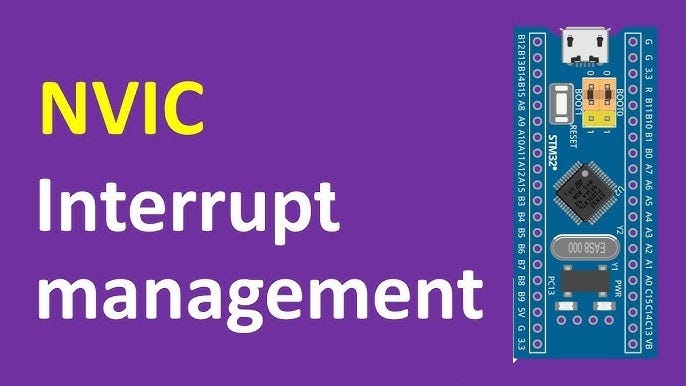
1. NVIC Basics
- The Nested Vectored Interrupt Controller (NVIC) is part of the ARM Cortex-M3 core.
- It manages external interrupts (IRQ) and exceptions (like SysTick, HardFault).
- STM32F1 devices support up to 60+ interrupt vectors, depending on the model.
2. Interrupt Vector Table
- Stored in Flash at address
0x0800 0000(or relocated to SRAM if configured). - Each entry holds the start address of the interrupt handler function.
- Handlers are declared as C functions, e.g.:
void EXTI0_IRQHandler(void) {
    // Your code for EXTI Line0 interrupt
}
3. Enabling NVIC Interrupts
Interrupts are controlled in two steps:
- Peripheral-level enable (configure the specific peripheral, e.g., EXTI, USART, TIM).
- NVIC-level enable using CMSIS functions:
NVIC_EnableIRQ(EXTI0_IRQn);   // Enable EXTI line 0 interrupt
NVIC_DisableIRQ(EXTI0_IRQn); // Disable- Each
*_IRQnis defined instm32f10x.h.
4. Priority Management
- STM32F1 NVIC supports 4 bits of priority → 16 priority levels (0 = highest, 15 = lowest).
- Use:
NVIC_SetPriority(EXTI0_IRQn, 5); // Set EXTI0 interrupt priority to 5- Priorities define preemption: lower number = higher priority.
- If two interrupts have the same priority, the one with the lower IRQ number wins.
5. Nested Interrupts
- If a high-priority interrupt occurs during a lower-priority ISR, NVIC preempts the running ISR.
- Cortex-M3 automatically saves context (registers) to the stack, so you don’t need special prologue/epilogue assembly code.
6. Pending & Active States
- Each interrupt has three states: Pending, Active, Inactive.
- Software can manually trigger interrupts:
NVIC_SetPendingIRQ(EXTI0_IRQn);   // Force interrupt
NVIC_ClearPendingIRQ(EXTI0_IRQn); // Clear pending flag- Useful for testing or triggering ISRs without hardware events.
7. Interrupt Masking
- Globally disable interrupts:
__disable_irq();   // Disable all IRQs
__enable_irq(); // Re-enable- For finer control, use PRIMASK (all interrupts except NMI and HardFault) or FAULTMASK (disables all except NMI).
8. Best Practices
- Keep ISRs short and fast — offload heavy work to the main loop or an RTOS task.
- Always clear the interrupt flag inside ISR, or it will retrigger endlessly.
if (EXTI_GetITStatus(EXTI_Line0) != RESET) {
    // Handle interrupt
    EXTI_ClearITPendingBit(EXTI_Line0);  // Clear flag
}- Avoid calling
printf()or blocking functions inside ISRs.
Summary: On STM32F1, the NVIC provides priority-based, nested interrupt management. You enable interrupts both in the peripheral and NVIC, assign priorities, and keep ISRs efficient. Cortex-M3 hardware simplifies nesting by automatically handling stack saving/restoring.
메타데이터
- post_id
- ee3a9ceed3aa
- slug
- stm32f1-nvic-interrupt-management-ee3a9ceed3aa
- url
- https://medium.com/@pqshedy33/stm32f1-nvic-interrupt-management-ee3a9ceed3aa
- canonical_url
- https://medium.com/@pqshedy33/stm32f1-nvic-interrupt-management-ee3a9ceed3aa
- author_url
- https://medium.com/@pqshedy33
- status
- ok
- fetched_at
- 2026-06-20 20:29:01