Stalingrad Over, but Pockets of Resistance Continued Fighting
Stalingrad is a watershed in WW II. The Germans suffered a defeat and Von Paulos, the German Commander agreed to an unconditional…
Stalingrad Over, but Pockets of Resistance Continued Fighting
Photo by Seb Mooze on Unsplash
Stalingrad is a watershed in WW II. The Germans suffered a defeat and Von Paulos, the German Commander agreed to an unconditional surrender. Paulos was taken to the Russian headquarters at Stalingrad where he and his chief of staff were interrogated. During the interrogation, Russians requested Paulos to ask the German soldiers who were still holding out to surrender. He did not agree to issue any appeal and merely stated that he could not pass such orders as he was a prisoner of the Russians and not a free man. On questioning he stated that he had observed that Russian soldiers had fought to the last man and bullet and not surrendered at many places, and it was up to the soldiers themselves, if they wanted to surrender.
A total of 93000 soldiers surrendered, but nearly 11,000 soldiers hiding in pockets in Stalingrad refused to surrender. They carried on fighting. The reason for this was the fear that if they fell into Russian hands it would be certain death. They were aware that they had treated the Russian POWs abominably and at least 2 million had been starved to death. They thus fought on.
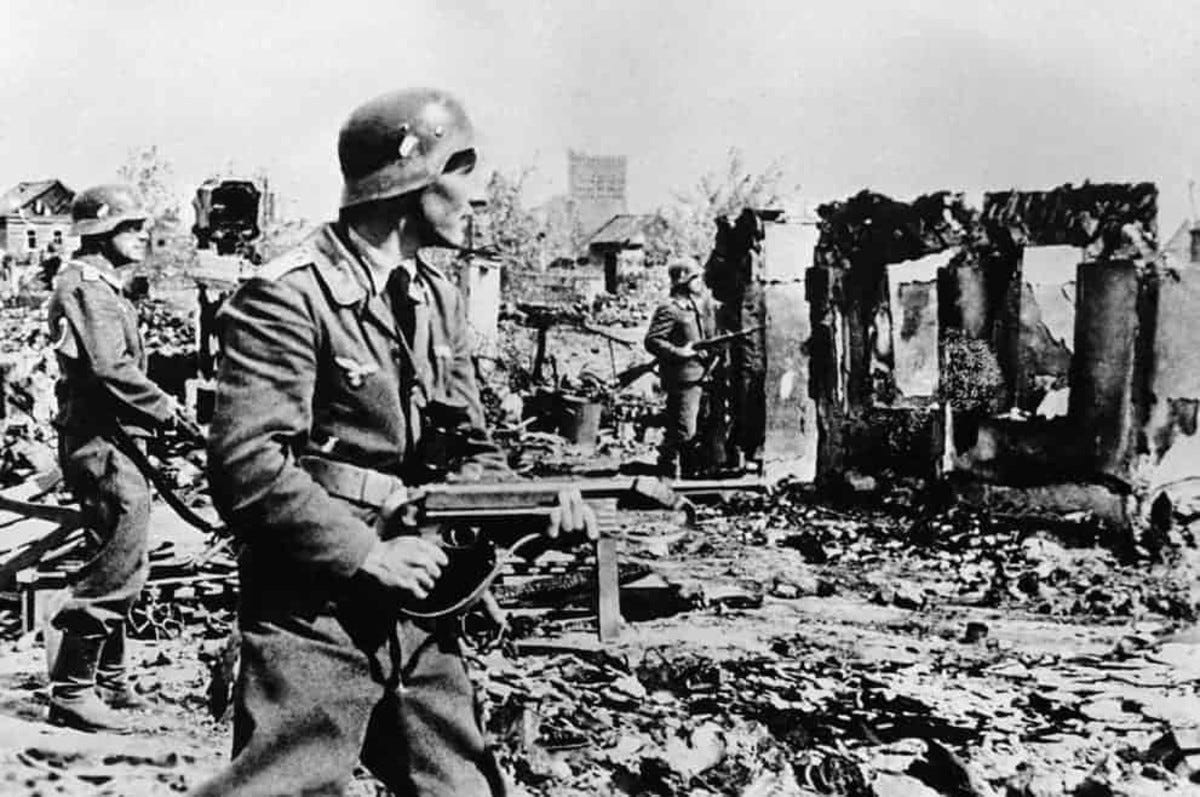
General Karl Strecker who commanded the northern pocket issued an order to his officers in the final days that any soldier seen breaking away from their unit and moving toward Soviet positions was to be shot dead. On the first of February, he came to know of the surrender of Paulos. Strecker gathered his staff and told them that the military situation was hopeless and that all troops under his command had the freedom to act as their conscience saw fit. The next morning Strecker surrendered his 11th Corps to Soviet troops. Thousands of troops of the 11th Corps however decided to continue fighting as they feared Soviet captivity. If figures have a meaning almost 11,000 soldiers continued fighting the Russian army in the ruins of Stalingrad.
The German soldiers formed small groups and hid in the basements and sewers and sometimes came out to snipe at the Russians. They scavenged on food and overall operated in small clusters at various places in the city. The soldiers who had nobody to report to continued their precarious existence and at several places when confronted put up a fight. This existence was preferable to the soldiers then surrendering to the Russians and being marched to their labor camps and certain death.
The soldiers remained an important threat to the Russian army and the NKVD troops were ordered to search each building and flush out the German soldiers. Orders were given to either kill them or capture them. Despite this order, these remnants of the German Sixth Army continued to hold out well into late March 43.
The 10th NKVD division had been in the area for the last six months to capture and execute Russian deserters. The NKVD troops were assisted by the 252 rifle division and they searched the city pockets and basements for the hidden German soldiers. Some of the German soldiers were captured from sewers in savers and flushed out. During the entire month of February, almost 2418 German soldiers were killed.
Some of the German soldiers tried to escape through the Russian lines to German-held territory. They entered the villages and changed clothing and at other places, they were robbed and murdered. The NKVD did a thorough job and as per the reports, 8600 soldiers were captured. This included some soldiers who had escaped from the nearby prison camps.
The soldiers dreaded capture by the Red Army and continued fighting. Their fears were not unfounded and though the Russians respectably treated the generals it was not so with the other ranks and officers. At the end of the war and after 10 years in captivity only 6000 Germans set foot in Germany again. There cannot be much sympathy for these soldiers because they were instrumental in perpetrating terrible atrocities on the Russian POWs

Annihilation
The battle of Stalingrad is a sad story for the German armyThe general opinion of the Russians about Von Paulos is that he was an honorable `Field Marshal. He was kept in a dacha in Moscow and had even sought a meeting with Stalin. After the July plot to assassinate Hitler, he began to make broadcasts on radio Moscow. In 1953 he came back to Germany and met Walter Ulbricht the first secretary of the German Communist Party. 22 generals were taken into captivity and a majority of them sided with the Russians, especially after the July bomb plot. For a student of history and the world war, the bigger battles are known to all but it is these smaller incidents that make this entire period so interesting.
Last Word
I think Hitler had a warped sense of what is right and wrong. Despite all that has been written I am still not clear as to what was his grouse racially against the Slavs. I can understand his logic as far as the Jews are concerned and he blamed them for the loss of Germany in World War I. I do not know how he came to admire the Japanese because he had never been in touch with any Japanese before and had never visited Japan. There is an age-old theory that the Aryans migrated to Germany and northern India from Central Asia. He latched onto it to justify propping up Subhas Chandra Bose and the India Legion. The swastika is a very important emblem of the Hindus and also has a lot of spiritual significance. I wonder how he latched on to this swastika as an emblem for the Nazis. I think it was adopted by Rosenberg who is supposed to be the high priest of the nazi philosophy.
Throughout his life, Hitler had a very cluttered existence. This was so right from the days when he was a painter in Vienna. What carried the day for him was his magnetic personality and his theatrical actions that seemed to mesmerize the listeners. He had a great opportunity to become perhaps the greatest man in History but his racial theories and warped mind led him instead to doom.
메타데이터
- post_id
- ee52bf52af8c
- slug
- stalingrad-over-but-pockets-of-resistance-continued-fighting-ee52bf52af8c
- url
- https://medium.com/@emge01/stalingrad-over-but-pockets-of-resistance-continued-fighting-ee52bf52af8c
- canonical_url
- https://medium.com/@emge01/stalingrad-over-but-pockets-of-resistance-continued-fighting-ee52bf52af8c
- author_url
- https://medium.com/@emge01
- status
- ok
- fetched_at
- 2026-07-23 08:49:49




