"Advancing Healthcare with Artificial Intelligence: Applications, Challenges, and Future…
Introduction: Artificial Intelligence (AI) is poised to revolutionize healthcare by improving patient outcomes, enhancing operational…
"Advancing Healthcare with Artificial Intelligence: Applications, Challenges, and Future Directions"
Introduction: Artificial Intelligence (AI) is poised to revolutionize healthcare by improving patient outcomes, enhancing operational efficiencies, and enabling more personalized treatments. With AI’s ability to process and analyze vast amounts of data, it is already making significant strides across various domains in healthcare, from diagnostics to drug discovery. This research explores the key applications of AI in healthcare, the challenges it faces, and the potential future directions of this technology.

Applications of AI in Healthcare:
-
Diagnostics and Medical Imaging: AI has proven to be a powerful tool in medical imaging, where deep learning algorithms can analyze medical images such as X-rays, CT scans, and MRIs with remarkable accuracy. These systems assist radiologists in detecting abnormalities like tumors, fractures, and other conditions earlier and more accurately than traditional methods. Example: AI models for detecting breast cancer have demonstrated higher accuracy rates compared to human radiologists, improving early diagnosis and treatment outcomes.
-
Predictive Analytics: AI-driven predictive models use data from patient histories, genetics, and lifestyle factors to forecast disease progression or complications, allowing for earlier interventions. These tools can predict everything from the likelihood of a heart attack to the risk of sepsis or hospital readmission. Example: AI-based systems in intensive care units can predict patient deterioration, allowing healthcare teams to intervene before critical events occur.
-
Personalized Medicine: AI allows for more tailored treatment plans by analyzing genetic data, patient records, and clinical trials. This personalized approach helps to select the most effective treatment, minimizing side effects and improving patient outcomes. Example: IBM Watson Health’s AI algorithms analyze cancer patient data to recommend personalized treatment options based on the individual’s genetic profile.
-
Robotic Surgery: AI in robotic surgery enhances the precision and effectiveness of surgical procedures. AI algorithms provide real-time data and decision support to assist surgeons in performing delicate operations with improved outcomes and shorter recovery times. Example: The da Vinci Surgical System leverages AI to assist surgeons in minimally invasive surgeries, enhancing accuracy and reducing recovery time.

Challenges in AI Healthcare:
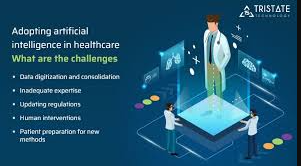
1.Data Privacy and Security: AI requires large datasets to function effectively, and much of this data is sensitive health information. Ensuring patient privacy and protecting data from cyber threats is critical, especially as healthcare increasingly moves toward digital systems.
-
Bias and Equity: AI algorithms can inadvertently inherit biases present in the training data, leading to disparities in healthcare outcomes, especially for underrepresented groups. Ensuring fairness and equity in AI-driven healthcare is an ongoing challenge.
-
Regulatory and Ethical Issues: The adoption of AI in healthcare requires rigorous regulatory frameworks to ensure safety and efficacy. Additionally, the ethical implications of AI decision-making in life-and-death situations need to be carefully considered.
-
Integration with Healthcare Systems: Integrating AI with existing healthcare infrastructures, including Electronic Health Records (EHRs) and hospital management systems, remains a challenge. Interoperability and user adoption are barriers to widespread use.
Future Directions:
-
AI in Drug Discovery: AI has the potential to accelerate drug discovery by predicting molecular interactions and identifying promising candidates for new medications. This could shorten the timeline for developing life-saving drugs and reduce costs.
-
Telemedicine and Remote Monitoring: The future of AI in healthcare is closely tied to advancements in telemedicine and remote patient monitoring. AI algorithms can analyze data from wearable devices and home health monitoring systems, providing real-time insights into patient health and enabling remote care.
-
AI in Mental Health: AI could play a significant role in mental health diagnostics and treatment by analyzing speech patterns, facial expressions, and behavioral data to identify signs of mental health conditions such as depression, anxiety, or autism.
4.AI-Enhanced Population Health Management: AI can analyze vast amounts of data from diverse sources to help predict public health trends, track disease outbreaks, and manage healthcare resources more effectively, improving population health outcomes.
Conclusion: AI has the potential to transform healthcare by enhancing diagnostic accuracy, personalizing treatments, and improving efficiency. However, challenges related to data privacy, bias, and regulation must be addressed to unlock its full potential. As AI technologies continue to evolve, their integration into healthcare will likely lead to more precise, patient-centered care, paving the way for a new era in medical practice. The future of AI in healthcare holds immense promise, from drug discovery to mental health management, potentially reshaping the entire healthcare landscape.
Conclusion: AI has the potential to transform healthcare by enhancing diagnostic accuracy, personalizing treatments, and improving efficiency. However, challenges related to data privacy, bias, and regulation must be addressed to unlock its full potential. As AI technologies continue to evolve, their integration into healthcare will likely lead to more precise, patient-centered care, paving the way for a new era in medical practice. The future of AI in healthcare holds immense promise, from drug discovery to mental health management, potentially reshaping the entire healthcare landscape.
메타데이터
- post_id
- ee5cc633bc3e
- slug
- advancing-healthcare-with-artificial-intelligence-applications-challenges-and-future-ee5cc633bc3e
- url
- https://medium.com/@zakera.yasmeen.ms/advancing-healthcare-with-artificial-intelligence-applications-challenges-and-future-ee5cc633bc3e
- canonical_url
- https://medium.com/@zakera.yasmeen.ms/advancing-healthcare-with-artificial-intelligence-applications-challenges-and-future-ee5cc633bc3e
- author_url
- https://medium.com/@zakera.yasmeen.ms
- status
- ok
- fetched_at
- 2026-08-08 11:36:04





