The Invisible Layer of Finance: What Powers Every Digital Transaction
The plumbing behind every tap, swipe, and click — and why it may be the most valuable infrastructure in the modern economy
The Invisible Layer of Finance: What Powers Every Digital Transaction
The plumbing behind every tap, swipe, and click — and why it may be the most valuable infrastructure in the modern economy
It’s 7:43 AM. You tap your phone at a coffee shop terminal. Half a second later: Approved.
The transaction felt instantaneous. It wasn’t.
In the time between the tap and the approval, your payment crossed a chain of systems most businesses never think about: tokenization services, gateways, processors, card networks, fraud engines, issuing banks, settlement rails.
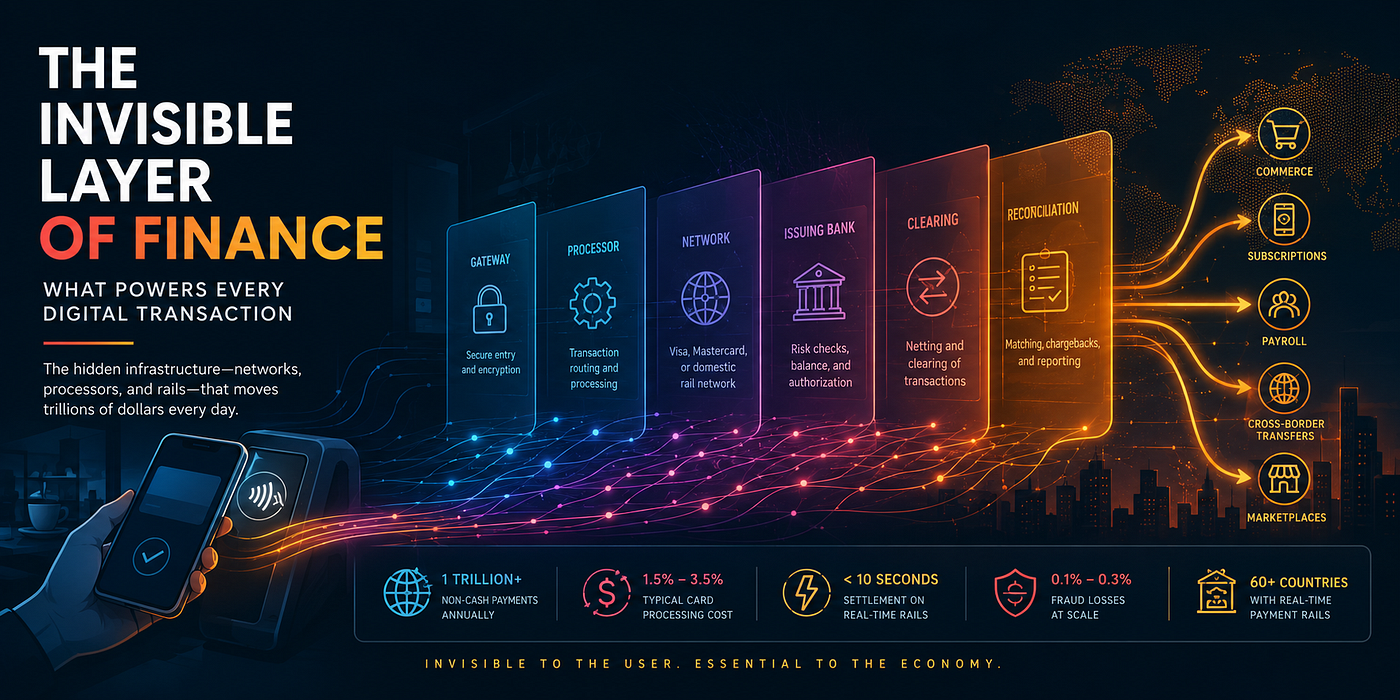
Your bank checked risk. A network routed messages. A processor translated protocols. A fraud model scored the transaction in milliseconds. Somewhere in the stack, fees were calculated, liabilities assigned, and settlement instructions queued.
The coffee arrived immediately. The money won’t.
In most cases, the actual movement of funds happens hours later — sometimes days later — through a separate clearing and settlement process hidden entirely from the customer.
That invisible machinery now powers nearly every part of the global economy: e-commerce, payroll, subscriptions, marketplaces, remittances, gig work, embedded finance. Trillions of dollars move through it every year.
Most people never see it.
Most merchants barely understand it.
And increasingly, that hidden layer is where the real competitive advantage in finance lives.
Context & Problem (Refined)
For most of human history, payment was physical and immediate. Coins changed hands. Cash moved across a counter. A cheque could be inspected and verified in real time.
Digital payments broke that model entirely.
When you tap a card or pay online, no money physically moves in that moment. What moves first is information: authorization requests, encrypted credentials, fraud signals, ledger updates, routing instructions.
That required an entirely new trust layer built around one deceptively simple question:
Can this transaction be trusted?
The problem is that this infrastructure was never designed as a single coordinated system. It evolved in layers.
Card networks emerged in the 1960s. ACH systems followed in the 1970s. Internet gateways appeared in the 1990s. Real-time payment rails arrived decades later. Each generation was added on top of the last.
The result is a financial stack that often looks seamless from the outside while remaining deeply fragmented underneath.
A single checkout flow can involve 10–20 separate systems, many operating on different standards, timelines, and software generations. Some still rely on architecture designed before the internet existed.
That complexity creates real economic drag.
Merchants routinely pay 1.5–3.5% per card transaction without understanding where the fees go. E-commerce authorization failures silently destroy revenue. Reconciliation across multiple processors remains painfully manual. And when payments break, funds can disappear into operational limbo for days.
Modern commerce runs on infrastructure most businesses cannot fully explain.
System Breakdown (Refined Transition + Tone)
To understand why this layer matters, it helps to follow a payment from beginning to end — not conceptually, but mechanically.
Because the reality is less like “sending money” and more like coordinating a distributed network of approvals, risk checks, and delayed settlement instructions.

Step 1 — Initiation
The customer taps, clicks, or scans. Payment credentials — usually tokenized rather than raw card data — are passed to the merchant’s checkout system.
Step 2 — Encryption and routing
The merchant forwards the transaction to a gateway such as Stripe, Adyen, or Braintree. The gateway encrypts the data and routes it to a processor or acquiring bank.
Step 3 — Authorization request
The processor sends the request through the appropriate rail: Visa or Mastercard for cards, ACH for US bank transfers, UPI in India, SEPA in Europe, PIX in Brazil.
The request reaches the issuing bank — the institution responsible for approving or declining the transaction.
Step 4 — Risk and balance checks
The issuer evaluates the transaction in milliseconds.
Is the account valid? Are funds available? Does the behavior look suspicious? Is the device trusted? Does the location make sense?
Modern fraud systems increasingly rely on machine learning models trained on behavioral and device-level data.
If the transaction passes, the issuer authorizes the payment and places a temporary hold on funds.
Step 5 — Response
The approval travels back through the chain to the merchant.
To the customer, this entire process feels instantaneous.
In reality, multiple independent institutions just coordinated a trust decision in real time.
Step 6 — Clearing and settlement
The transaction itself still hasn’t settled.
Hours later — sometimes days later — clearing begins. Financial obligations are calculated between institutions, and funds move between accounts.
Traditional card rails typically settle within one to three business days.
Real-time systems like UPI and PIX can settle in seconds.
Step 7 — Reconciliation
Finally comes the least glamorous — and often most painful — part of the stack: reconciliation.
Authorizations must match settlements. Chargebacks must be tracked. Failed transactions must be identified. Missing webhooks and mismatched IDs have to be resolved.
This is where many finance teams discover how complicated modern payments actually are.
The brilliance of the invisible layer is that most consumers never notice any of it.
The danger is that when it fails, almost nobody knows where to look.
Deep Dive (Sharper Framing)
The Three Eras of Payment Infrastructure
Modern payments are not built on one system. They’re built on three generations of infrastructure running simultaneously.
And each generation reflects a different philosophy about how money should move.

Generation 1: Card networks
Visa and Mastercard built the original global payment graph.
Their real innovation wasn’t moving money — it was coordinating trust between strangers at scale.
Card networks operate primarily as messaging and guarantee systems. They route authorization requests and guarantee settlement between banks and merchants. That model enabled global commerce, but it also embedded interchange economics deeply into the system.
For decades, that tradeoff made sense.
Now it’s under pressure.
Generation 2: ACH and batch rails
ACH networks were designed for efficiency, not speed.
They power payroll, direct debit, and bank transfers at extremely low cost. But they operate in batches, often with delayed failure visibility and limited real-time feedback.
For subscription businesses and platforms, that delay creates operational friction that consumers rarely see but finance teams deal with constantly.
Generation 3: Real-time rails
The third generation changes the architecture entirely.
Systems like India’s UPI and Brazil’s PIX move money instantly, operate continuously, and dramatically reduce transaction costs.
They are not simply faster versions of cards.
They are fundamentally different payment models.
That distinction matters because it reshapes who captures value in the stack.
Stronger Insight Upgrades (Examples)
Instead of:
“The invisible layer is the real moat.”
Use: In payments, user experience is easy to copy. Infrastructure isn’t.
Most durable fintech businesses didn’t win because they designed better checkout buttons. They won because they built deeper routing logic, stronger fraud systems, better reconciliation tooling, and tighter relationships with the underlying rails.
Instead of:“Payments are not solved.”
Use: Payments only look solved from the surface.
Underneath, global commerce still relies on fragmented networks, inconsistent standards, delayed settlement systems, and decades of accumulated engineering debt.
Instead of: “Authorization failure is silent revenue destruction.”
Use: Few metrics in commerce are more underestimated than authorization rates.
A failed payment is rarely retried. Most customers simply disappear.
Moving authorization performance from 88% to 93% can create more enterprise value than launching an entirely new product line.

Conclusion
The modern economy runs on a system most people never see.
Between a tap and an approval sits an invisible network of fraud models, routing engines, processors, settlement rails, and bank infrastructure coordinating trust in real time. It is one of the most complex operational systems ever built — and one of the least understood.
That complexity matters more than most businesses realize.
The companies that treat payments as a strategic infrastructure layer — not just a checkout feature — operate differently. They understand their authorization rates, settlement exposure, fraud economics, and routing dependencies because those variables directly shape margins, growth, and resilience.
And as real-time rails, open banking, and AI-driven orchestration reshape the stack, the competitive advantage is moving even deeper into the infrastructure itself.
Consumers will never think about the invisible layer.
But the companies that understand it will increasingly control how money moves.
That is where the real leverage is.
메타데이터
- post_id
- ee63b631858b
- slug
- the-invisible-layer-of-finance-what-powers-every-digital-transaction-ee63b631858b
- url
- https://medium.com/analysts-corner/the-invisible-layer-of-finance-what-powers-every-digital-transaction-ee63b631858b
- canonical_url
- https://medium.com/analysts-corner/the-invisible-layer-of-finance-what-powers-every-digital-transaction-ee63b631858b
- author_url
- https://medium.com/@prajapatiritika886
- status
- ok
- fetched_at
- 2026-06-11 21:11:36