Understanding the Sigmoid Activation Function: The Math and Its Role in Neural Networks
The sigmoid activation function is one of the foundational building blocks of neural networks. Despite being overshadowed by newer…
Understanding the Sigmoid Activation Function: The Math and Its Role in Neural Networks
The sigmoid activation function is one of the foundational building blocks of neural networks. Despite being overshadowed by newer activation functions like ReLU (Rectified Linear Unit) in modern deep learning architectures, the sigmoid remains a critical concept for understanding how neural networks operate. In this article, we’ll explore what the sigmoid function is, its mathematical underpinnings, its applications, and why it’s still relevant today.
What is the Sigmoid Activation Function?
The sigmoid function is a mathematical function that maps any real-valued number to a value between 0 and 1. Its “S-shaped” curve gives it the name “sigmoid,” derived from the Greek letter sigma (Σ). Formally, the sigmoid function is defined as:

Here:
- x is the input to the function.
- e is Euler’s number (e≈2.718), the base of the natural logarithm.
Key Characteristics of the Sigmoid Function:
Output Range : The output of the sigmoid function always lies between 0 and 1.
- As x→∞, σ(x)→1.
- As x→−∞, σ(x)→0.
- Smoothness : The sigmoid function is differentiable everywhere, which makes it suitable for gradient-based optimization techniques.
- Non-linearity : The sigmoid introduces non-linearity into neural networks, enabling them to model complex relationship.
Visualizing the Sigmoid Function
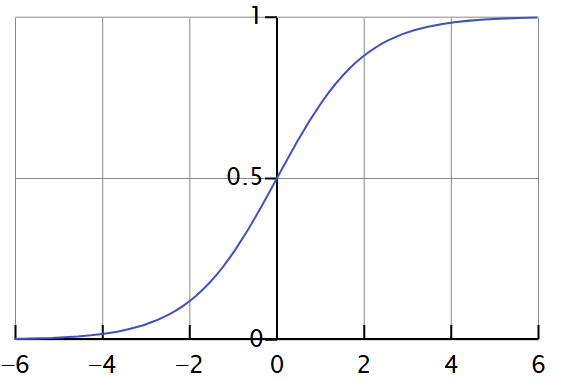
To better understand the sigmoid function, let’s visualize it. Below is a plot of σ(x) for values of x ranging from -6 to +6:

From the graph, we can observe:
- For large positive inputs, the output approaches 1.
- For large negative inputs, the output approaches 0.
- Near x=0, the function transitions smoothly between these extremes.
This smooth transition makes the sigmoid function particularly useful in scenarios where probabilities are involved, such as binary classification problems.
The Mathematics Behind the Sigmoid Function
Let’s delve deeper into the math behind the sigmoid function.
Derivative of the Sigmoid Function
One of the reasons the sigmoid function is widely used in neural networks is because it has a simple derivative. The derivative of σ(x) with respect to x is given by:

This formula is elegant and computationally efficient because it reuses the value of σ(x), which is already computed during the forward pass of the network. This property simplifies backpropagation, the algorithm used to train neural networks.
Why is the Derivative Important?
The derivative of the activation function determines how gradients flow through the network during training. A well-behaved derivative ensures stable updates to the weights, which helps the network converge to an optimal solution.
Limitations of the Sigmoid Function
While the sigmoid function has many advantages, it also has some limitations that have led to its reduced usage in modern deep learning architectures:
Vanishing Gradient Problem :
- For very large or very small values of x, the gradient of the sigmoid function becomes extremely small (close to 0).
- This slows down learning during backpropagation, especially in deep networks, as the gradients diminish exponentially as they propagate backward through layers.
Non-zero Centered Output :
- The sigmoid function outputs values between 0 and 1, which are not centered around zero. This can lead to inefficient weight updates during training.
Computationally Expensive :
- The exponential computation in the sigmoid function is more expensive compared to simpler functions like ReLU.
Despite these limitations, the sigmoid function is still widely used in specific contexts, such as output layers for binary classification problems.
Applications of the Sigmoid Function
1. Binary Classification
In binary classification tasks, the sigmoid function is often used in the output layer of a neural network to produce a probability score. For example, if the network predicts whether an email is spam or not, the sigmoid function converts the raw output into a probability between 0 and 1.
2. Logistic Regression
The sigmoid function is the core of logistic regression, a fundamental machine learning algorithm for binary classification. It models the probability of a binary outcome using the logistic function.
3. Probabilistic Interpretation
The sigmoid function naturally lends itself to probabilistic interpretations, making it ideal for scenarios where the output needs to represent a likelihood.
Conclusion
The sigmoid activation function is a cornerstone of neural networks, offering a smooth, differentiable, and probabilistic mapping of inputs. While its limitations have led to the rise of alternative activation functions, the sigmoid remains a vital concept in machine learning and deep learning. By understanding its mathematical properties and applications, you gain valuable insights into the inner workings of neural networks.
If you’re eager to dive deeper into data science and artificial intelligence, consider exploring personalized training options tailored to your learning goals. Visit my profile and services page here or connect with me on Instagram @ig.koshurai.com for one-on-one DS & AI training.
Happy learning! 🚀
메타데이터
- post_id
- ee658fb4b053
- slug
- understanding-the-sigmoid-activation-function-the-math-and-its-role-in-neural-networks-ee658fb4b053
- url
- https://medium.com/@koshurai/understanding-the-sigmoid-activation-function-the-math-and-its-role-in-neural-networks-ee658fb4b053
- canonical_url
- https://medium.com/@koshurai/understanding-the-sigmoid-activation-function-the-math-and-its-role-in-neural-networks-ee658fb4b053
- author_url
- https://medium.com/@koshurai
- status
- ok
- fetched_at
- 2026-07-16 23:19:56