The Year I Tried to Beat the Market and Found the Edge Hiding in My Own Backyard
What building my own quant research desk taught me about alpha, honesty, and the one lever I could actually control.
The Year I Tried to Beat the Market and Found the Edge Hiding in My Own Backyard
What building my own quant research desk taught me about alpha, honesty, and the one lever I could actually control.
Photo by Olena Bohovyk on Unsplash
Let me ask you something before we begin.
What if the single biggest improvement you could make to your portfolio had nothing to do with finding a better stock? No secret screen. No clever signal. Nothing the crowd hadn’t already seen.
I’ll be honest. That’s not where I expected this journey to end, but it’s exactly where it took me, and I think the story is worth your time.
A year ago, I set out to build something I’d wanted for a long while: my own investment research desk, run with the same discipline a serious institution would demand. Not a fund. A system. A pipeline that could take any idea I had, put it through the wringer, and tell me the truth about whether it actually worked, before a single dollar of my own money was ever on the line.
I went looking for an edge. What I found instead was a mirror. Let me show you what it reflected.
Building a Desk That Tells You the Truth
Here’s the first thing I learned, and it surprised me: the most important thing I built wasn’t a strategy at all. It was the machinery to stop myself from lying to myself.
Think about that for a second. Every one of us walks into the market carrying a quiet little voice that wants the backtest to look good. That voice is dangerous. So before I tested a single idea, I built guardrails against it.
Every idea gets written down first: the hypothesis, the rule, the line in the sand for what counts as a win. I lock it in, so I can’t move the goalposts after I see the score. Every test runs on data that still includes the companies that went bankrupt and disappeared, because quietly deleting the losers is the oldest way to manufacture a beautiful lie. And every result gets a second set of eyes whose only job is to find the crack in the foundation.
Is it tedious? Absolutely. But here’s the payoff: it doesn’t make my good ideas better. It makes my bad ideas honest. And a process you can actually trust is one that tells you “no” cleanly, and often.
I’ve come to trust my “no” far more than my “yes.”
The Graveyard Is the Real Treasure
So what happened when I ran the strategies we all talk about with such conviction? The deep-value screens. The classic trend systems. The bet on the biggest winners. The narrative and sentiment plays. The earnings-season games.
Most of them died.
And they died in ways that taught me something every time:
- Some were beta wearing a costume. They looked like skill, but a plain, cheap index gave me the same ride for a few basis points. I was paying for genius and getting the market.
- Some were survivorship tax. They only shone because the test had quietly buried the bodies.
- And some were one lucky decade in a trench coat, a single golden era carrying an entire track record that fell apart everywhere else.
Now, here’s the part I want you to hear. None of that means these approaches are scams. It means that by the time an idea reaches you and me, all polished and written up and easy to read, the market has usually already eaten whatever was special about it. That’s not me being cynical. That’s just what a crowded, competitive market does to public information.
So I stopped mourning the graveyard and started treasuring it. Because that graveyard is a map. It shows you exactly where the edge isn’t, so you can finally stop paying to dig there.
The Lesson From a Half-Fueled Rocket
Now, let me get to the finding that actually changed how I invest.
I borrowed a way of thinking from how SpaceX looks at a rocket. The raw metal? Cheap. Practically a rounding error. The real cost, and the real opportunity, lives in the process, in everything you do to that metal.
Your capital works the same way.
The market is a brutal, crowded arena where any edge you find gets competed away by people faster and better-funded than you or me. But your own portfolio? Your own operations? That’s not an arena. There’s no opponent there. It’s just you.
And when I finally looked there, honestly, without flinching, I found the equivalent of a rocket sitting half-fueled on the launchpad. A real chunk of my capital was just sitting there. Idle. Earning next to nothing. Quietly dragging down the rate at which the whole thing could compound.
No one was competing with me to fix that. There was no genius on the other side of the trade. It was pure, uncontested waste, right in my own backyard.
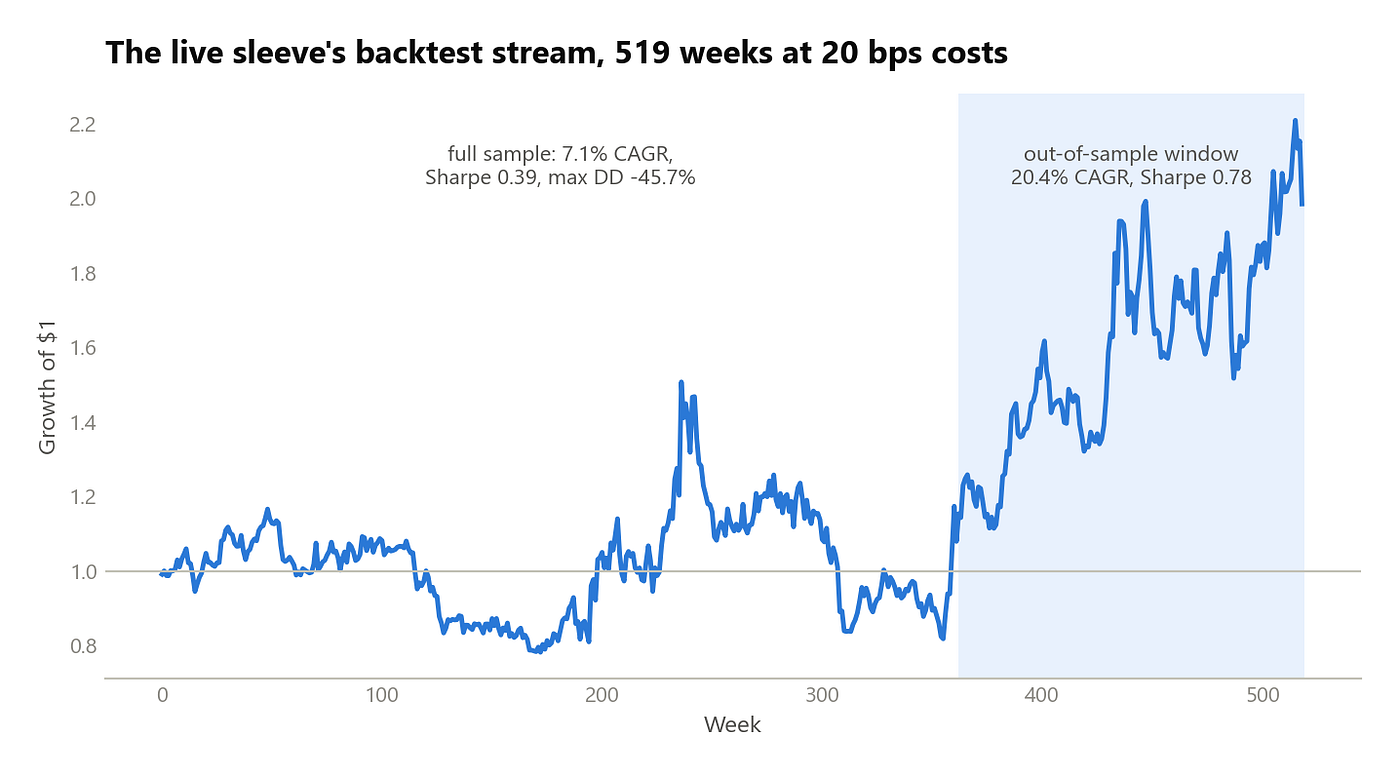
Putting that idle capital back to work, carefully, with exposure scaled to volatility, gated by trend, and never on borrowed money, turned out to be the highest-confidence improvement I could make. Not a signal. Not a secret. Just refusing to leave my own capital sitting on the bench.
Here’s the lesson, and I’d write it on the wall if I could: when the market won’t hand you an edge, go find the inefficiency you actually control.
Redefining the Word “Risk”
This whole project forced me to do something uncomfortable. It made me define my terms. And the definition I landed on isn’t the one in the textbook.
I don’t measure risk as volatility. I don’t even measure it as a drawdown. To me, risk is the permanent loss of capital: bankruptcy, dilution, fraud, a business in terminal decline, or being forced to sell something sound at the absolute bottom.
The temporary dip of a healthy company that will recover? That’s not risk. That’s the weather. (And that’s only true, mind you, if you never take on the kind of leverage that can force your hand. Which is exactly why I don’t.)
Reframe risk like that, and everything downstream changes. The goal stops being “make the line on the chart smoother.” It becomes this: compound as fast as you reasonably can, while making permanent loss nearly impossible. The tools that control drawdown earn their seat at the table not because a bumpy ride is bad, but because they keep a rough patch from ever becoming the one thing that truly matters: a forced, permanent mistake.
Where This Leaves Us
A full year of rigorous testing led me somewhere almost embarrassingly simple.
Be honest about what is and isn’t an edge. Build the machinery to keep yourself honest. Own broad market exposure cheaply. Guard against ruin like your life depends on it. And hunt down the waste in your own process like it’s the alpha, because, it turns out, it is.
It’s not a hot tip. I can’t sell you that, and I wouldn’t trust anyone who tried. It’s a discipline. But it’s one I can defend, one that survives contact with real data, and one that compounds, in capital and in judgment, over time.
That, it turns out, was the alpha all along.
Thanks, as always, for reading. If this resonated, I’d love to hear how you think about risk and your own process in the comments. That’s where the best conversations happen. None of this is financial advice; it’s simply one practitioner sharing what the data taught him.
메타데이터
- post_id
- ee673bc39f72
- slug
- the-year-i-tried-to-beat-the-market-and-found-the-edge-hiding-in-my-own-backyard-ee673bc39f72
- url
- https://medium.com/gradient-growth/the-year-i-tried-to-beat-the-market-and-found-the-edge-hiding-in-my-own-backyard-ee673bc39f72
- canonical_url
- https://medium.com/gradient-growth/the-year-i-tried-to-beat-the-market-and-found-the-edge-hiding-in-my-own-backyard-ee673bc39f72
- author_url
- https://medium.com/@LesterLeong
- status
- ok
- fetched_at
- 2026-06-20 20:29:01