Power, Perception, and Nigeria’s Next President.
Since Nigeria’s return to democracy in 1999, every president, without exception, has pursued a second term. This instinct is not uniquely…
Power, Perception, and Nigeria’s Next President.
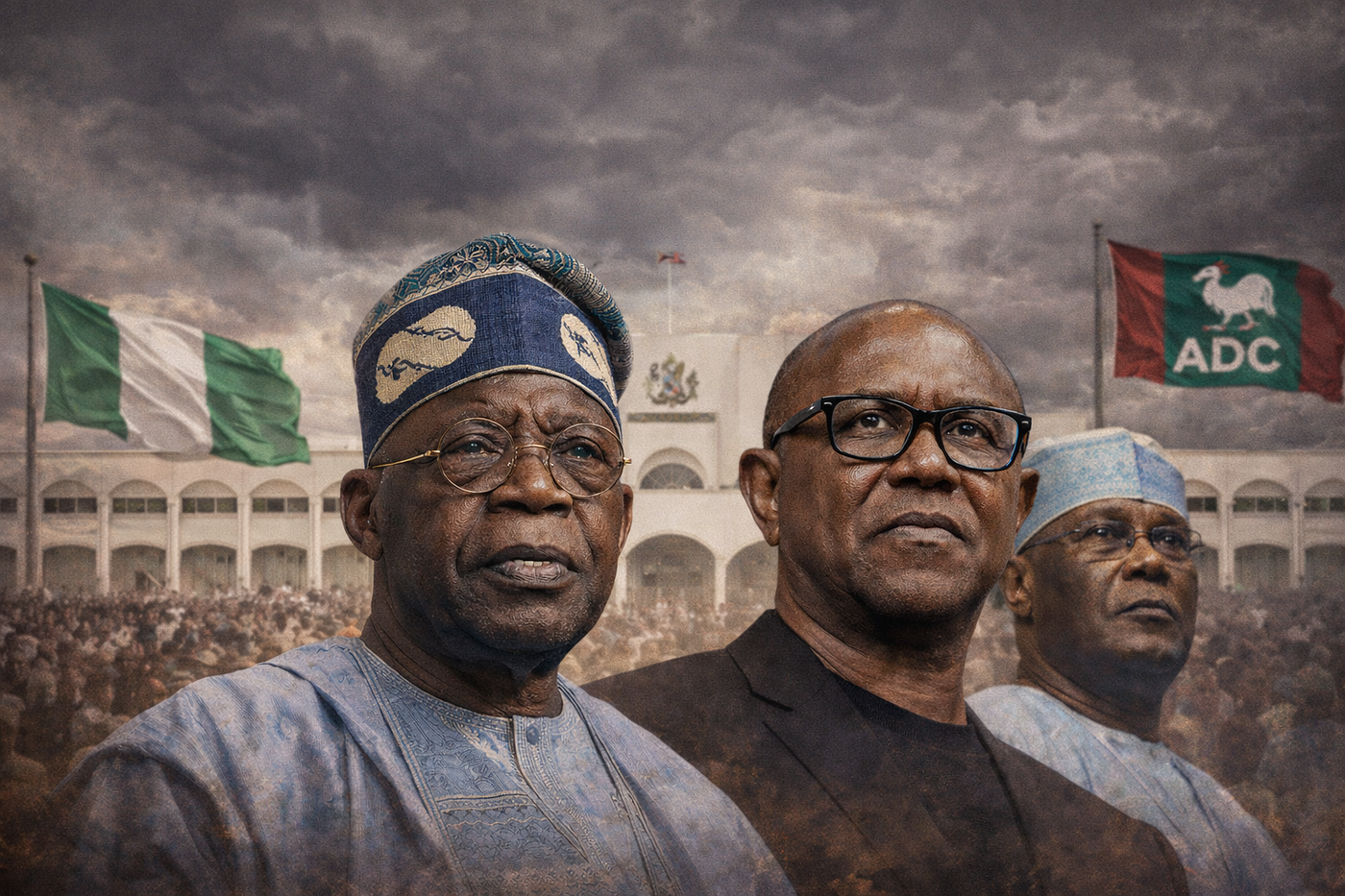
Tinubu, Obi & Atiku
Since Nigeria’s return to democracy in 1999, every president, without exception, has pursued a second term. This instinct is not uniquely Nigerian; it is evident even in the world’s most advanced democracies and economies. However, in our case, it often seems that the moment a first victory is secured, the focus shifts almost immediately to entrenching power, first by clinching a second term, and, where ambition allows, angling for a third.
The motivation behind this desire to cling to political power for as long as possible is largely universal, but in Nigeria, it is compounded by the near-absoluteness of presidential power. For example, while it is generally accepted within the global political space that the powers of the U.S. President are stronger than those of Nigeria’s President, within their respective domestic contexts, Nigeria’s presidency is far more absolute. This is driven primarily by weak institutions and a lack of respect for the rule of law. There are simply too many things a Nigerian president can do and get away with that would be unthinkable in more developed democracies. We establish this context to make one point clear: the office is extraordinarily lucrative, and the incentive to hold on to it is immense.
It is, therefore, unsurprising that President Tinubu would naturally do everything within his power to secure re-election, just as opposition parties will equally position themselves to mount a serious challenge. And at the heart of this contest for Nigeria’s most coveted political seat, based on our electioneering history, are two primary determinants: the size and depth of political structure and the extent of public goodwill. A classic example is former President Muhammadu Buhari, who contested on the platform of the All Nigeria Peoples Party (ANPP) in 2003 and 2007 and later the Congress for Progressive Change (CPC) in 2011, losing all three times. What remained consistent across his earlier attempts was a lean political structure and limited public goodwill. By 2015, however, that equation changed: a broad alliance of previously fragmented opposition parties provided the needed structure, while widespread frustration with President Jonathan’s handling of the economy generated the public goodwill that was absent in Buhari’s prior runs. Many may remember the rallying cry that captured the moment, “Sai Baba, Sai Buhari.” That same alignment, though noticeably weaker after his first term, remained sufficient to deliver Buhari’s re-election in 2019.
Between the two factors of public goodwill & political structure, however, history and our opinion suggest that public perception ultimately edges political structure. The clearest illustration of this is the 2023 presidential election. Many observers believe the election would have produced a different outcome in the absence of alleged large-scale rigging. Case in point, President Bola Tinubu arguably was, and remains, the foremost political godfather in Nigeria. Structurally, his base was solid. But public opinion was largely against him, driven by multiple factors: the failings of the Buhari administration, party continuity, the personalised ambition captured in “emi lokan,” and most importantly, the emergence of a candidate who galvanized popular support, Peter Obi.
Obi entered the race with little to no traditional political structure. Yet, in an election with one of the lowest voter turnouts in Nigeria’s history, approximately 27–28% of eligible voters, he secured 6,101,533 votes against Tinubu’s 8,794,726. The biggest shock was Obi’s victory in Lagos, Tinubu’s political stronghold, where he won by such commanding numbers, edging out APC and dwarfing PDP as though it (PDP) had only just been formed. For a state Tinubu had dominated since 1999, this was a rude awakening. Many observers posit that Obi’s margins were wider than officially reported and that, despite efforts to manage the numbers, his lead could not be erased.
The reaction within the APC, particularly in Lagos, was swift and revealing. The party’s national youth leadership went into overdrive, while the sitting governor seeking re-election essentially restarted his campaign, appearing on every available platform. Victory was no longer assured. What had been taken for granted was now under threat. Structure had been tested on the altar of a defiant, citizen-driven movement.
For context, the 2023 election produced several historic firsts. No candidate crossed 40% of the total votes cast. Tinubu’s 36.61% represented the lowest winning percentage since 1999. The margin of victory of approximately 1.81 million votes made it the tightest presidential race in Nigeria’s democratic history, a sharp contrast to previous elections decided by wider margins. Even more telling was the Labour Party’s surge. In 2019, its presidential candidate received just 5,074 votes (0.019%). Four years later, the party pulled over six million votes. This was the clearest signal yet that party structure alone is no longer determinative.
Unsurprisingly, preparations for 2027 have been underway almost since the 2023 election concluded. Between then and now, at least eight governors, mostly from the PDP, have defected to the APC, alongside ten senators, thirty members of the House of Representatives, over one hundred state legislators, and dozens of local government officials. The objective is clear: further entrench political structure, with the expectation that it will trickle down into popular support. But if the last election taught us anything, it is that this assumption is flawed.
Today, the court of public opinion is largely against President Tinubu, and frankly, there appears to be little he can do to reverse this before 2027. Hyperinflation has eroded purchasing power. Transportation costs have soared following fuel price increases. Healthcare, power supply, and security continue to underperform. The naira has depreciated by over 129% in 2024 alone. Yet, citizens are told to “endure” while the government spends over $60 million on a presidential yacht, a new fleet of vehicles, the Vice-President’s residence, and extensive presidential travels.
On the fiscal front, the picture is even more troubling. Tinubu’s administration is borrowing externally at a rate of ₦4.45 trillion per year, matching Buhari’s average annual borrowing despite Buhari borrowing over eight years and Tinubu doing so in just over two. In 2.3 years, Tinubu has accumulated ₦35.64 trillion in domestic debt, nearly matching Jonathan’s entire five-year total and approaching Buhari’s eight-year accumulation. Between 2023 and 2028, Nigeria is projected to spend over ₦91 trillion on debt servicing alone, with the debt service-to-revenue ratio reaching 131% by mid-2025. In plain terms, the country is spending more than it earns just to service debt, and more troubling, without a commensurate positive impact on the citizenry. Even for the average citizen, and certainly for the informed observer, this inspires little confidence in the country’s leadership.
As we approach 2027, we align with the view expressed by former Governor Ayo Fayose: Peter Obi remains the primary force within the newly formed ADC and the most viable challenger to President Tinubu. Obi retains significant clout through the Obidient movement, and Tinubu understands this.
It appears that what Obi needs now is a functional party structure to support the public goodwill he has amassed. While some argue he can win without a political structure, that view underestimates the nature of the opposition he now faces. The obstacles of 2023 were formidable, but the machinery ahead is even more sophisticated. If illegal voting and electoral manipulation are to be factored in, as history suggests, then this structure becomes indispensable.
It leads to the critical question: will Atiku Abubakar finally throw his weight behind Obi, or will personal ambition once again override strategic necessity? Obi’s supporters have made it clear that a vice-presidential slot will not mobilise turnout. The ADC therefore faces a defining choice: back Obi and significantly increase the chances of success, or field a perennial candidate, spend heavily, and wait another four years. An ADC failure would be Tinubu’s greatest advantage. Game on.
This article was jointly written Paul Amusa
메타데이터
- post_id
- ee70bd2f01ff
- slug
- since-nigerias-return-to-democracy-in-1999-every-president-without-exception-has-pursued-a-ee70bd2f01ff
- url
- https://medium.com/the-civic-atlas/since-nigerias-return-to-democracy-in-1999-every-president-without-exception-has-pursued-a-ee70bd2f01ff
- canonical_url
- https://medium.com/the-civic-atlas/since-nigerias-return-to-democracy-in-1999-every-president-without-exception-has-pursued-a-ee70bd2f01ff
- author_url
- https://medium.com/@sbolaniran
- status
- ok
- fetched_at
- 2026-07-13 06:23:13