Why CBAM Is Turning Carbon Transparency Into a Global Business Standard
Every major business transformation begins with a simple idea.
Why CBAM Is Turning Carbon Transparency Into a Global Business Standard
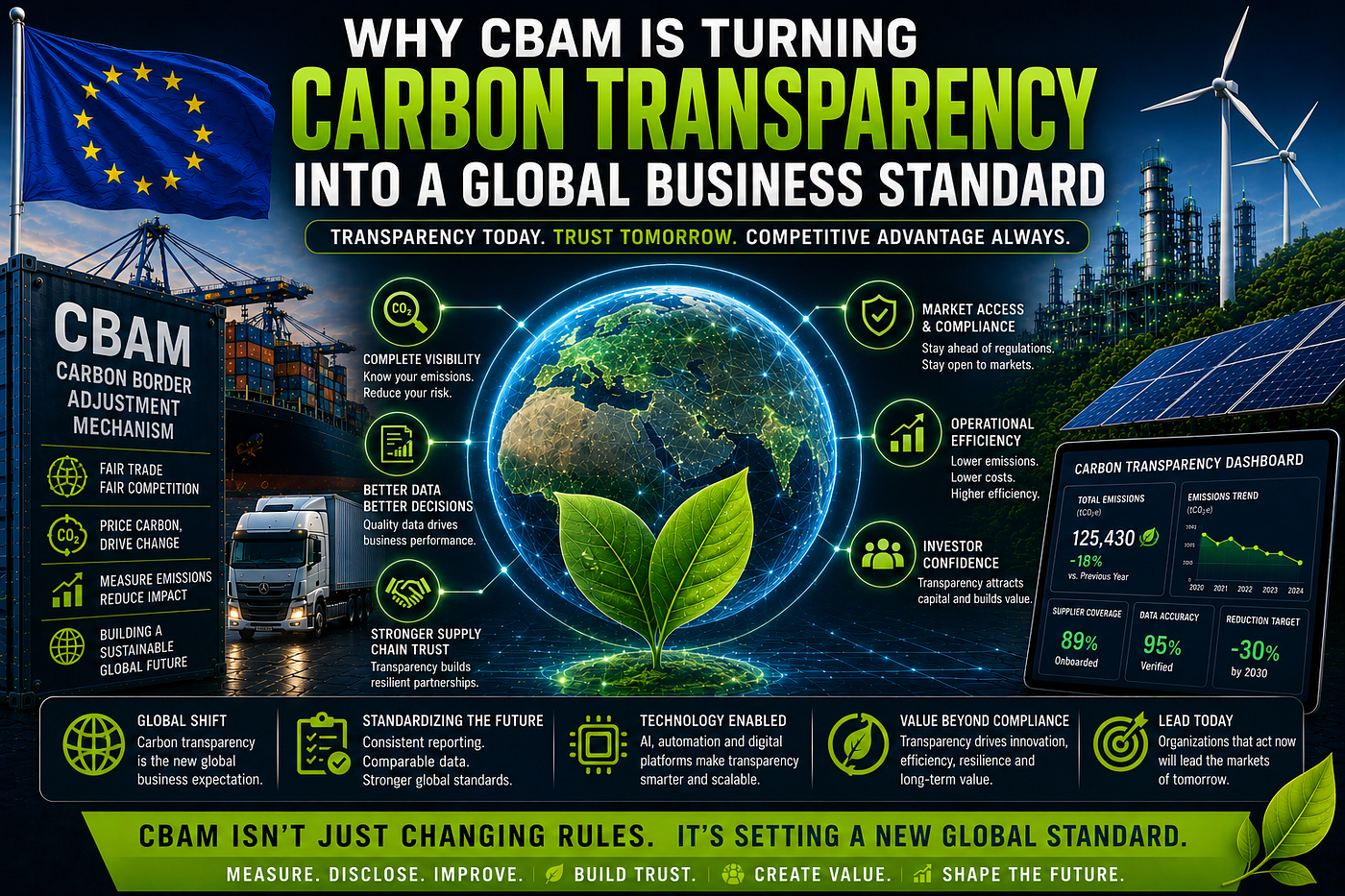
Every major business transformation begins with a simple idea.
Financial reporting created transparency around company performance.
Quality standards created transparency around product reliability.
Cybersecurity frameworks created transparency around digital resilience.
Today, another form of transparency is rapidly emerging.
Carbon transparency.
And the European Union’s Carbon Border Adjustment Mechanism (CBAM) is helping accelerate its adoption across the global economy.
Most companies initially encounter CBAM as a regulatory requirement.
They focus on emissions reporting.
Supplier engagement.
Data collection.
Verification procedures.
Compliance deadlines.
These activities are necessary.
But they may represent only the beginning of a much larger transformation.
Because once transparency becomes valuable, markets tend to demand more of it.
History repeatedly demonstrates this pattern.
Investors wanted greater financial visibility.
Accounting standards evolved.
Customers wanted higher quality assurance.
Certification frameworks expanded.
Organizations wanted stronger cybersecurity confidence.
Security reporting became more sophisticated.
The same progression may now be occurring with carbon information.
What begins as a reporting requirement often evolves into a market expectation.
And market expectations can be powerful drivers of change.
CBAM is encouraging companies to understand emissions in ways that were rarely necessary in the past.
Manufacturers increasingly need information from suppliers.
Importers need emissions data from producers.
Businesses need visibility across multiple layers of complex supply chains.
The result is a growing demand for reliable carbon intelligence.
This demand is creating something significant.
A global infrastructure for carbon transparency.
Companies are investing in emissions-management systems.
Software providers are developing advanced reporting platforms.
Verification organizations are expanding assurance services.
Artificial intelligence solutions are helping businesses analyze carbon data more effectively.
Consultants are building specialized expertise.
Entire ecosystems are emerging around transparency.
This is important because infrastructure often determines the speed of adoption.
The easier it becomes to collect and manage emissions information, the faster transparency spreads across industries.
Over time, practices that once seemed complex become standard business operations.
The internet followed this path.
Cloud computing followed this path.
Digital payments followed this path.
Carbon reporting may follow a similar trajectory.
The organizations that embrace transparency early often gain advantages.
The most immediate advantage is visibility.
When companies begin measuring emissions, they frequently discover operational insights that extend beyond environmental reporting.
Energy consumption patterns become clearer.
Production inefficiencies become easier to identify.
Supplier performance becomes more measurable.
Operational risks become more visible.
The information collected for compliance purposes often supports broader business improvements.
This is one reason why transparency tends to create value.
Information reduces uncertainty.
Reduced uncertainty improves decision-making.
Better decisions improve performance.
The cycle reinforces itself.
Customers are increasingly rewarding transparency as well.
Large organizations want confidence in the products and services they purchase.
They want suppliers capable of providing credible information.
They want partners prepared for evolving market expectations.
Companies that can deliver reliable carbon data strengthen trust.
Trust strengthens business relationships.
And strong relationships create long-term opportunities.
Investors see similar benefits.
Organizations capable of demonstrating transparency often appear more resilient and better prepared for future challenges.
They are viewed as companies that understand their operations deeply and manage risks proactively.
That perception can influence investment decisions.
The financial implications are becoming increasingly important.
As transparency expands, carbon information may begin influencing competitive positioning in the same way that financial information influences investment decisions today.
Companies with stronger visibility could gain advantages.
Companies with better reporting systems could build credibility.
Companies with deeper operational intelligence could improve performance.
The value of transparency extends far beyond compliance.
Technology will continue accelerating this trend.
Artificial intelligence is making emissions analysis faster and more accurate.
Automation is reducing reporting burdens.
Advanced analytics are uncovering new opportunities for optimization.
Digital platforms are improving collaboration across supply chains.
The result is a business environment where transparency becomes easier, more scalable, and more useful.
What makes CBAM especially significant is its global reach.
Even organizations located far from Europe are paying attention.
Supply chains cross borders.
Manufacturing networks span continents.
Customers operate internationally.
As emissions information moves through these networks, transparency spreads beyond any single market.
The effects become global.
This creates an interesting possibility.
In the future, carbon transparency may become as routine as financial reporting.
Businesses may expect emissions data in the same way they expect pricing information, quality certifications, and delivery schedules.
The transition will not happen overnight.
But the foundations are already being built.
Companies are investing.
Technologies are maturing.
Standards are evolving.
Market expectations are rising.
Each development strengthens the momentum.
The organizations that recognize this shift early may gain significant advantages.
Not because they comply more efficiently.
But because they develop capabilities aligned with the future direction of global commerce.
Transparency has a way of becoming permanent once markets discover its value.
Financial transparency never disappeared.
Quality transparency never disappeared.
Digital transparency never disappeared.
Carbon transparency may be next.
If that happens, CBAM will be remembered for more than its role in climate policy.
It will be remembered as one of the mechanisms that helped establish carbon transparency as a global business standard.
And companies that adapt early may find themselves exceptionally well-positioned for the next era of international trade.
Here’s the continuation with a fresh premium CBAM article for your Medium paywall series:
Why CBAM Is Turning Carbon Transparency Into a Global Business Standard
Every major business transformation begins with a simple idea.
Financial reporting created transparency around company performance.
Quality standards created transparency around product reliability.
Cybersecurity frameworks created transparency around digital resilience.
Today, another form of transparency is rapidly emerging.
Carbon transparency.
And the European Union’s Carbon Border Adjustment Mechanism (CBAM) is helping accelerate its adoption across the global economy.
Most companies initially encounter CBAM as a regulatory requirement.
They focus on emissions reporting.
Supplier engagement.
Data collection.
Verification procedures.
Compliance deadlines.
These activities are necessary.
But they may represent only the beginning of a much larger transformation.
Because once transparency becomes valuable, markets tend to demand more of it.
History repeatedly demonstrates this pattern.
Investors wanted greater financial visibility.
Accounting standards evolved.
Customers wanted higher quality assurance.
Certification frameworks expanded.
Organizations wanted stronger cybersecurity confidence.
Security reporting became more sophisticated.
The same progression may now be occurring with carbon information.
What begins as a reporting requirement often evolves into a market expectation.
And market expectations can be powerful drivers of change.
CBAM is encouraging companies to understand emissions in ways that were rarely necessary in the past.
Manufacturers increasingly need information from suppliers.
Importers need emissions data from producers.
Businesses need visibility across multiple layers of complex supply chains.
The result is a growing demand for reliable carbon intelligence.
This demand is creating something significant.
A global infrastructure for carbon transparency.
Companies are investing in emissions-management systems.
Software providers are developing advanced reporting platforms.
Verification organizations are expanding assurance services.
Artificial intelligence solutions are helping businesses analyze carbon data more effectively.
Consultants are building specialized expertise.
Entire ecosystems are emerging around transparency.
This is important because infrastructure often determines the speed of adoption.
The easier it becomes to collect and manage emissions information, the faster transparency spreads across industries.
Over time, practices that once seemed complex become standard business operations.
The internet followed this path.
Cloud computing followed this path.
Digital payments followed this path.
Carbon reporting may follow a similar trajectory.
The organizations that embrace transparency early often gain advantages.
The most immediate advantage is visibility.
When companies begin measuring emissions, they frequently discover operational insights that extend beyond environmental reporting.
Energy consumption patterns become clearer.
Production inefficiencies become easier to identify.
Supplier performance becomes more measurable.
Operational risks become more visible.
The information collected for compliance purposes often supports broader business improvements.
This is one reason why transparency tends to create value.
Information reduces uncertainty.
Reduced uncertainty improves decision-making.
Better decisions improve performance.
The cycle reinforces itself.
Customers are increasingly rewarding transparency as well.
Large organizations want confidence in the products and services they purchase.
They want suppliers capable of providing credible information.
They want partners prepared for evolving market expectations.
Companies that can deliver reliable carbon data strengthen trust.
Trust strengthens business relationships.
And strong relationships create long-term opportunities.
Investors see similar benefits.
Organizations capable of demonstrating transparency often appear more resilient and better prepared for future challenges.
They are viewed as companies that understand their operations deeply and manage risks proactively.
That perception can influence investment decisions.
The financial implications are becoming increasingly important.
As transparency expands, carbon information may begin influencing competitive positioning in the same way that financial information influences investment decisions today.
Companies with stronger visibility could gain advantages.
Companies with better reporting systems could build credibility.
Companies with deeper operational intelligence could improve performance.
The value of transparency extends far beyond compliance.
Technology will continue accelerating this trend.
Artificial intelligence is making emissions analysis faster and more accurate.
Automation is reducing reporting burdens.
Advanced analytics are uncovering new opportunities for optimization.
Digital platforms are improving collaboration across supply chains.
The result is a business environment where transparency becomes easier, more scalable, and more useful.
What makes CBAM especially significant is its global reach.
Even organizations located far from Europe are paying attention.
Supply chains cross borders.
Manufacturing networks span continents.
Customers operate internationally.
As emissions information moves through these networks, transparency spreads beyond any single market.
The effects become global.
This creates an interesting possibility.
In the future, carbon transparency may become as routine as financial reporting.
Businesses may expect emissions data in the same way they expect pricing information, quality certifications, and delivery schedules.
The transition will not happen overnight.
But the foundations are already being built.
Companies are investing.
Technologies are maturing.
Standards are evolving.
Market expectations are rising.
Each development strengthens the momentum.
The organizations that recognize this shift early may gain significant advantages.
Not because they comply more efficiently.
But because they develop capabilities aligned with the future direction of global commerce.
Transparency has a way of becoming permanent once markets discover its value.
Financial transparency never disappeared.
Quality transparency never disappeared.
Digital transparency never disappeared.
Carbon transparency may be next.
If that happens, CBAM will be remembered for more than its role in climate policy.
It will be remembered as one of the mechanisms that helped establish carbon transparency as a global business standard.
And companies that adapt early may find themselves exceptionally well-positioned for the next era of international trade.
CTA
Subscribe to Genecapsule for expert insights on CBAM, ESG, sustainability, AI, climate innovation, and the future of global business.
메타데이터
- post_id
- ee72c95483f4
- slug
- why-cbam-is-turning-carbon-transparency-into-a-global-business-standard-ee72c95483f4
- url
- https://medium.com/@anandv_62921/why-cbam-is-turning-carbon-transparency-into-a-global-business-standard-ee72c95483f4
- canonical_url
- https://medium.com/@anandv_62921/why-cbam-is-turning-carbon-transparency-into-a-global-business-standard-ee72c95483f4
- author_url
- https://medium.com/@anandv_62921
- status
- ok
- fetched_at
- 2026-06-18 07:02:39