Ocean Infrastructure: Could the Ocean Become Humanity’s Next Climate Infrastructure?
A speculative engineering proposal exploring whether localized ocean thermal regulation could one day influence evaporation, moisture…
Ocean Infrastructure: Could the Ocean Become Humanity’s Next Climate Infrastructure?
A speculative engineering proposal exploring whether localized ocean thermal regulation could one day influence evaporation, moisture transport, and regional climate.
I. Introduction: Can the Ocean Become New Infrastructure?
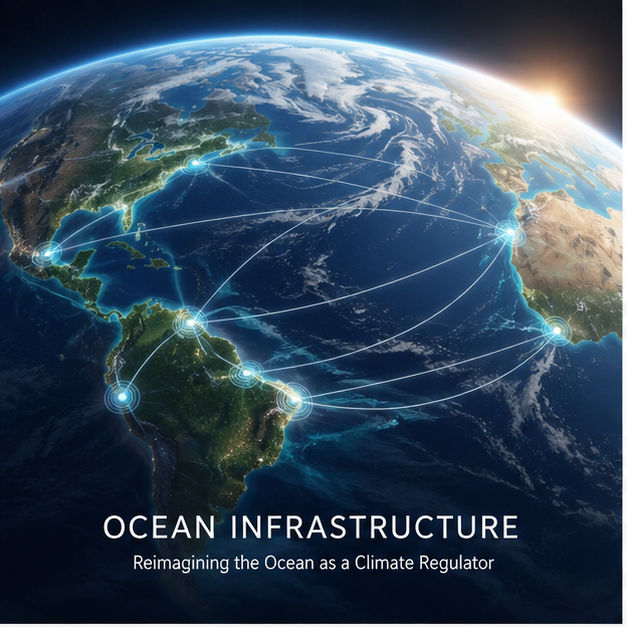
Over the past two centuries, humanity has built vast systems — railways, power grids, reservoirs, and the internet. Their common feature is the reorganization and redistribution of resources, rather than the creation of resources from nothing. The ocean has long been viewed as a shipping lane, a source of fisheries, and an energy carrier. But can we envision another possibility — treating the ocean itself as an “infrastructure” system helping regulate heat, water vapor, and regional climate?
The concept of “Ocean Infrastructure” proposed in this article aims to elevate the ocean from a mere “natural backdrop” to a new platform for future resource management and climate regulation. This vision is built on the irreplaceable physical functions of the ocean within the Earth system.
The ocean is the planet’s largest heat reservoir. Thanks to seawater’s high heat capacity and relatively low reflectivity, about half of the solar energy reaching the Earth’s surface is absorbed by the ocean. According to the Intergovernmental Panel on Climate Change (IPCC) Sixth Assessment Report, as much as 91% of the additional global heat caused by greenhouse gases since the Industrial Revolution has been absorbed by the ocean, while only about 1% has gone into the atmosphere. The heat content of just the top 2 to 3 meters of the ocean is equivalent to that of the entire atmosphere. Considering that the average depth of the ocean is about 3,500 meters, its total heat capacity is more than a thousand times that of the atmosphere.
At the same time, the ocean contributes approximately 84% of total global surface evaporation, making it the primary source of atmospheric water vapor. This exchange of heat and water vapor between the ocean and atmosphere — known as air-sea interaction — is the core engine driving atmospheric circulation and shaping global climate patterns.
Viewing the ocean as infrastructure means that humanity might, on the basis of understanding and respecting these natural laws, attempt to moderately guide or utilize its regulatory functions. Ocean current systems, for example, are the Earth’s natural “heat conveyor belts.” The Gulf Stream carries vast amounts of warm water from the equator to high latitudes, releasing heat equivalent to roughly one-fifth of the total solar radiation received by the North Atlantic, significantly moderating the winter climate of northwestern Europe.
Among the many cutting-edge explorations, Marine Cloud Brightening (MCB) is one of the most representative and controversial concepts. This technique proposes spraying atomized seawater into low-lying marine stratocumulus clouds to increase the concentration of tiny cloud droplets, thereby enhancing cloud albedo and reflecting more sunlight back into space, achieving localized or global cooling. Its inspiration comes in part from the observed fact that ship tracks can brighten clouds. However, this approach still faces significant uncertainties regarding regional climate side effects, long-term ecological impacts, and international governance, and is currently far from being applied.
But regardless of its ultimate success or failure, the very proposal of MCB marks a shift in human perception — beginning to view the ocean as an operable, designable climate-regulating infrastructure, rather than merely a passive physical space that supports human activities.
This article does not propose an engineering project ready for implementation. Rather, it presents a thought experiment intended to stimulate discussion and identify experimentally testable questions.
II. Thought Experiment: Starting from One Hundred Meters of Coastline
Having discussed the grand energy cycles between the ocean, atmosphere, and global climate, we might temporarily set aside the macroscopic picture and turn instead to a question that is as small and as easily verifiable as possible.
Most people living along the coast of Southern California have had a similar experience: driving along the shoreline, the weather can change noticeably within just a few hundred meters — or even one or two hundred meters. One side is bathed in sunshine, while the other is shrouded in low clouds, mist, or even drizzle. The locally familiar May Gray and June Gloom are quintessential examples of this coastal microclimate. They are primarily influenced by the Marine Layer — a phenomenon that occurs when cool, moist marine air is capped by a warmer layer of air above (a temperature inversion), acting like an invisible lid that traps the cool, humid air near the surface.
This everyday observable microclimate phenomenon leads us to the thought experiment of this article.
The largest desalination plant in nature is neither a reverse osmosis facility nor a distillation tower — it is the ocean itself. The sun heats the sea surface, seawater evaporates to form water vapor, the atmosphere transports it, and eventually, rainfall returns fresh water to the land. The entire process requires no high-pressure pumps, no membrane materials, and consumes virtually no anthropogenic energy.
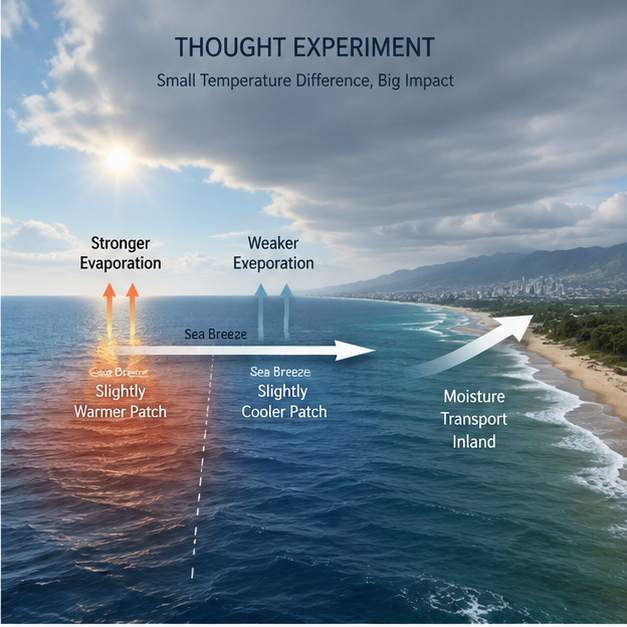
So, here is a question worth considering: If the goal is not to change the weather over an entire region, but merely to slightly increase the chances of moisture transport reaching adjacent land, could we exert extremely limited guidance over this natural freshwater production process?
Imagine selecting an experimental sea area close to the coast, with relatively calm sea conditions. We are not proposing temperature differences of tens of degrees Celsius, nor are we attempting to generate strong winds. Instead, we would use albedo modification, localized shading, shallow-layer thermal regulation, or other low-disturbance methods to create a sustained, weak sea-surface temperature gradient over scales of tens of meters, hundreds of meters, or even a few kilometers. For instance, one patch of sea surface would be slightly warmer, another slightly cooler. Then, leveraging the naturally existing sea-breeze or monsoon background, we would observe whether such minute perturbations can alter evaporation, moisture transport, or near-surface airflow.
The real question is not weather control but a more fundamental engineering question: What is the minimum effective engineering scale on the ocean?
If it requires covering hundreds of square kilometers, such a vision would have little practical significance. But if a few tens of meters, a few hundred meters, or an experimental area of a few square kilometers could produce stable, measurable physical responses, then it would at least merit further investigation. The development of engineering science often does not begin with large-scale systems, but rather with the search for a minimum unit that can be repeatedly verified. This was true for transistors, for solar cells, for wind tunnel experiments — and perhaps future ocean infrastructure should likewise start with a “minimum ocean unit.”
Therefore, this article does not attempt to answer whether rainfall can ultimately be increased. Instead, it proposes a more modest research pathway: Does a minimum experimental scale exist at which local sea-surface temperature perturbations can leave a repeatedly observable signal in the real ocean environment? If the answer is yes, then it would be worthwhile to continue investigating whether such signals can be progressively amplified through evaporation, convection, and moisture transport, ultimately serving regional water resource management.
III. Ocean Thermal Grid: From Single Point to System
Suppose the thought experiment from the previous section is ultimately validated: a limited-area sea zone can, through localized thermal regulation, produce stable and measurable effects on evaporation, moisture transport, or near-surface airflow. The next natural question then becomes: if such an experimental unit can be replicated, can multiple units form a collaborative network?
Throughout the history of human engineering, it is often not individual facilities but networks that have truly transformed the way society operates. Power transmission stations form the power grid; reservoirs form watershed regulation systems; communication base stations form the internet; urban green spaces and shelterbelts form ecological networks. The significance of a network lies not merely in its scale, but more importantly in its capacity for coordination, redundancy, and resilience. Even if one node ceases to function, the entire system can still continue operating and dynamically adjust resource allocation in response to changing environmental conditions.
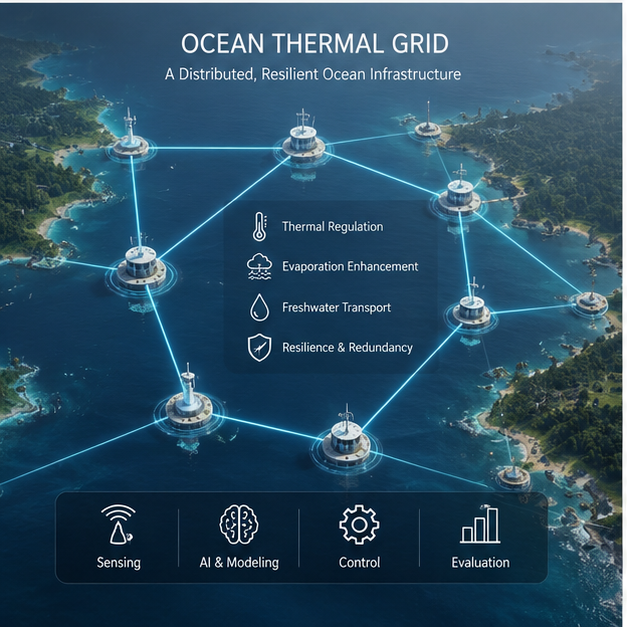
This article therefore explores a longer-term concept — the Ocean Thermal Grid. The “grid” here does not mean continuous coverage over the entire ocean, but rather consists of multiple independent, distributed nearshore nodes. Each node is responsible only for localized, limited thermal regulation, while the entire system — through spatial arrangement, operational strategies, and real-time feedback — collectively influences regional-scale evaporation, moisture transport, or local environmental conditions.
This idea shares many similarities with modern distributed systems. Each node can operate independently, deciding whether to participate in regulation based on local weather, sea conditions, and ecological factors, rather than relying on a single large-scale engineering project. Nor is it necessary for different sea areas to have identical designs; strategies can vary according to seasons, currents, wind fields, and regional needs. Such a system naturally possesses better fault tolerance and is easier to build and validate incrementally, rather than requiring a massive one-time infrastructure investment.
Of course, this concept currently remains an engineering vision rather than an established technical pathway. The ocean and atmosphere constitute a highly complex coupled system. Whether multiple nodes would reinforce each other, cancel each other out, or even generate new feedback mechanisms will depend on long-term simulations using high-resolution coupled ocean-atmosphere models. With advances in digital twins, regional meteorological simulation, and artificial intelligence optimization, it may become possible in the future to first establish a “digital Ocean Thermal Grid” in computers — continually optimizing node locations, operational strategies, and control parameters — before deciding whether real-ocean experiments are worthwhile.
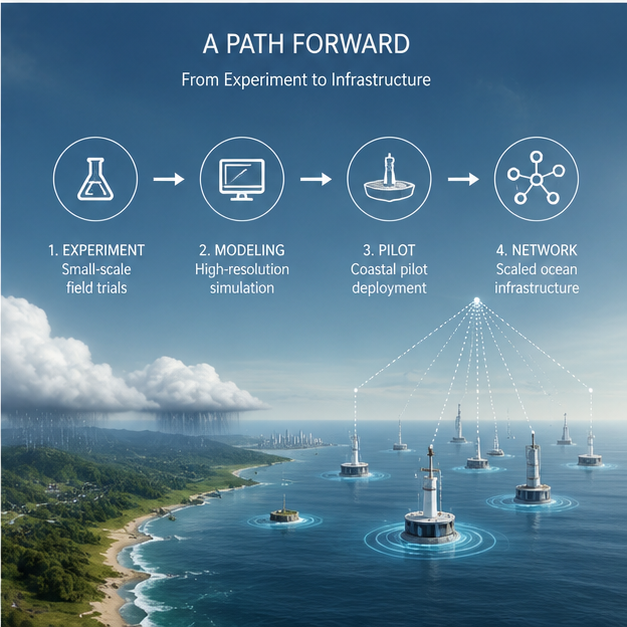
This article therefore favors a gradual development path: first validate a single node, then study multiple nodes, and finally explore networked coordination. If the previous section discussed the “minimum ocean unit,” then this section examines whether these minimum units can form a new type of infrastructure that is resilient, self-adaptive, and capable of sustainable evolution.
IV. An Infrastructure Revolution Beyond Land Constraints
Looking back at the history of human infrastructure development, most major projects have been built on land. From roads, railways, reservoirs, and power grids to internet data centers, they have collectively shaped modern civilization. Yet the ocean, which covers approximately 70 percent of the Earth’s surface, has long been regarded more as a space for resource extraction and transportation than as infrastructure itself.
In recent years, however, this perception has been quietly shifting. Concepts such as floating offshore wind power, marine ranching, offshore solar platforms, autonomous ocean robots, and the “Blue Economy” are emerging one after another, indicating that humanity has begun to consider the ocean as a major stage for future engineering activities. Today, these projects primarily serve energy, food, and resource development. In the future, could they also take on another task — participating in the regulation of heat, water vapor, and environmental processes?
If the “minimum ocean unit” proposed earlier can be established, and the “Ocean Thermal Grid” can take shape, then we might further envision a new form of infrastructure. It would transport neither goods nor electricity. Instead, through a large number of distributed nodes, it would work in concert with the ocean and atmosphere, participating in the reorganization of natural energy and water cycles. It would not replace nature, but rather, within the winds, evaporation, and rainfall processes that already exist in nature, seek out physical mechanisms that can be gently guided and amplified.
Of course, this remains a vision of the future. Today, we cannot answer whether such infrastructure could truly influence regional rainfall, let alone assert that it could alter the behavior of monsoons or typhoons. But with advances in coupled ocean-atmosphere models, digital twins, artificial intelligence control, and ocean engineering, a question that once belonged entirely to the realm of science fiction may one day enter the laboratory and numerical simulation: Can humanity, through distributed ocean infrastructure, moderately influence the formation environment, evolutionary pathways, or statistical characteristics of large-scale weather systems such as monsoons and typhoons, rather than merely responding to them passively?
Over the past century, humanity has continuously expanded the scale of infrastructure. In the next century, perhaps what matters more is expanding the boundaries of infrastructure — moving from land to ocean, from managing resources to organizing natural processes, from passively adapting to climate change to exploring more proactive, more refined, and more responsible approaches to environmental conditioning. Whether ocean infrastructure can become part of that story, no one can say. But just as many major projects began with seemingly distant visions, perhaps what is truly worth starting is not building a massive system, but seriously posing a question worth investigating.
V. From Thought Experiment to Laboratory: An Open Invitation
The “Ocean Infrastructure” proposed in this article remains, for now, only a concept. Whether it holds scientific value should not be determined by imagination, but answered by experiment.
We suggest making the first step as simple as possible. A transparent experimental chamber, several shallow water surfaces with controllable temperature, basic temperature and humidity sensors, anemometers, and visualizable smoke — these are sufficient to construct a basic HVAC or fluid dynamics experimental platform. The goal is not to simulate the entire ocean, nor to generate rainfall, but to answer a more fundamental question: Can minute surface temperature differences produce repeatable, measurable moisture transport, natural convection, and near-surface airflow in a controlled environment?
If this most basic physical process can be validated, then it would be worthwhile to proceed to larger-scale numerical simulations, nearshore experiments, and engineering scale-up. If, on the other hand, experimental results show that such effects are extremely weak or quickly eliminated by disturbances, then this vision can be revised in a timely manner. Either way, the findings will help us better understand the energy exchange between the ocean and the atmosphere.
We therefore prefer to regard this article as an open experimental initiative rather than an engineering plan. We sincerely invite research teams from fields such as HVAC engineering, civil engineering, environmental engineering, ocean engineering, fluid mechanics, and meteorological science to jointly design, refine, and validate this minimum experiment. For universities and research institutions that have coastal field stations, wind tunnels, environmental simulation chambers, or hydraulic engineering laboratories, the cost of such validation would not be high, yet it might answer a question that has rarely been systematically discussed before.
At the same time, research institutions that have long focused on desalination, water resources, and drought mitigation — particularly those in the Middle East, North Africa, and other coastal water-scarce regions — may be able to evaluate from different perspectives whether this concept merits further exploration. Even if it ultimately cannot become a new freshwater technology, it could still provide new experimental data for air-sea interaction studies, regional climate modeling, or coastal engineering.
Perhaps the answer in the future will be negative; perhaps it can only produce extremely limited effects. But if even a portion of the answer is affirmative, then the “Ocean Infrastructure” we propose today would be more than just a scientific speculation — it could become a long-term research endeavor worthy of sustained exploration over the coming decades: a new type of infrastructure that seeks to manage heat and water cycles within natural systems, rather than merely managing energy, transportation, and information.
References (validated July 7, 2026):
https://www.ipcc.ch/report/ar6/wg1/figures/chapter-7/faq-7-1-figure-1
https://www.investigo.biblioteca.uvigo.es/xmlui/handle/11093/1112?locale-attribute=en
https://digital.nls.uk/early-gaelic-book-collections/archive/77379047?mode=transcription
https://www.noaa.gov/jetstream/ocean/marine-layer
https://ui.adsabs.harvard.edu/abs/2025EGUGA..27.4905Z/abstract
메타데이터
- post_id
- ee9529bde48e
- slug
- ocean-infrastructure-could-the-ocean-become-humanitys-next-climate-infrastructure-ee9529bde48e
- url
- https://medium.com/@zhikai.wang/ocean-infrastructure-could-the-ocean-become-humanitys-next-climate-infrastructure-ee9529bde48e
- canonical_url
- https://medium.com/@zhikai.wang/ocean-infrastructure-could-the-ocean-become-humanitys-next-climate-infrastructure-ee9529bde48e
- author_url
- https://medium.com/@zhikai.wang
- status
- ok
- fetched_at
- 2026-07-13 06:23:13