What I Got Wrong About ROS2 (And the Mental Model That Finally Clicked)
A beginner-friendly explanation of what ROS2 actually is — no code, no jargon, just the ideas.
What I Got Wrong About ROS2 (And the Mental Model That Finally Clicked)
A beginner-friendly explanation of what ROS2 actually is — no code, no jargon, just the ideas.

Back in 2024, I decided to learn ROS2.
I spent the first five days just trying to install it. I tried macOS first, then realized I needed Linux, then fought version mismatches, then finally got a simulator running — without understanding a single thing I had done.
I could launch a robot. I could make it move. But I had no idea what was actually happening under the hood.
The problem wasn’t ROS2. The problem was where I started. I started with tools, commands, and tutorials. What I needed was a mental model.
This post is the explanation I wish I had read on day one.
Misconception 1: “ROS2 is an operating system”
When I first heard “Robot Operating System,” I pictured something that boots up the robot and runs everything.
That is not what ROS2 is.
ROS2 is middleware. It sits on top of a real operating system — usually Linux — and helps programs talk to each other. It does not replace Linux. It does not manage memory, schedule tasks, or drive the screen.
Think of it this way: Linux is the body. Your robot programs are the muscles and senses. ROS2 is the nervous system that carries signals between them.
You still need the body. You still need the muscles. But without the nervous system, nothing coordinates.
The takeaway: ROS2 does not run the robot. It organizes how the robot’s programs communicate.
Misconception 2: “ROS2 is the robot’s brain”
If ROS2 is not the operating system, maybe it is the intelligence — the thing that decides where to go and what to do.
Nope.
ROS2 does not decide anything. It carries decisions. If you write a program that plans a path, ROS2 helps that program send the plan to the motors. If you write a program that reads a camera, ROS2 helps that program share the image with the planner.
The brain is the code you write. ROS2 is the network of nerves that lets that brain reach the rest of the robot.
The takeaway: ROS2 is not intelligent. It lets intelligent programs talk to the rest of the system.
Misconception 3: “ROS2 is very hard to understand”
This one held me back the longest.
ROS2 looks hard because the surface is cluttered. There are packages, workspaces, launch files, build tools, simulators, and a hundred commands. If you start there, it feels overwhelming.
But the core idea is simple.
ROS2 is a way for independent programs to send typed messages to each other over named streams. That is almost the entire story.
The rest is tooling. The tooling matters, but it only makes sense once you understand the core idea.
It is like learning to drive. If you start by memorizing every button in the cockpit, it feels impossible. If you start with the idea that turning the wheel moves the tires, the cockpit becomes manageable.
The takeaway: Start with the mental model. The tools become understandable afterwards.
Misconception 4: “ROS2 handles real-time”
Robots need precise timing. Motors must respond quickly. Sensors must stream continuously. So I assumed ROS2 guaranteed all of that.
It does not — at least not by default.
ROS2 is fast and reliable enough for many real robots. But if you need hard real-time guarantees, you need extra pieces: a real-time kernel, the right middleware settings, and careful node design.
ROS2 gives you the infrastructure. Real-time is a property of the whole system, not a switch you flip.
The takeaway: ROS2 is not a real-time operating system. It can be part of a real-time system, but that requires deliberate design.
The Unifying Model: Nodes, Topics, and the Compute Graph
Once the misconceptions fell away, the real model became clear.
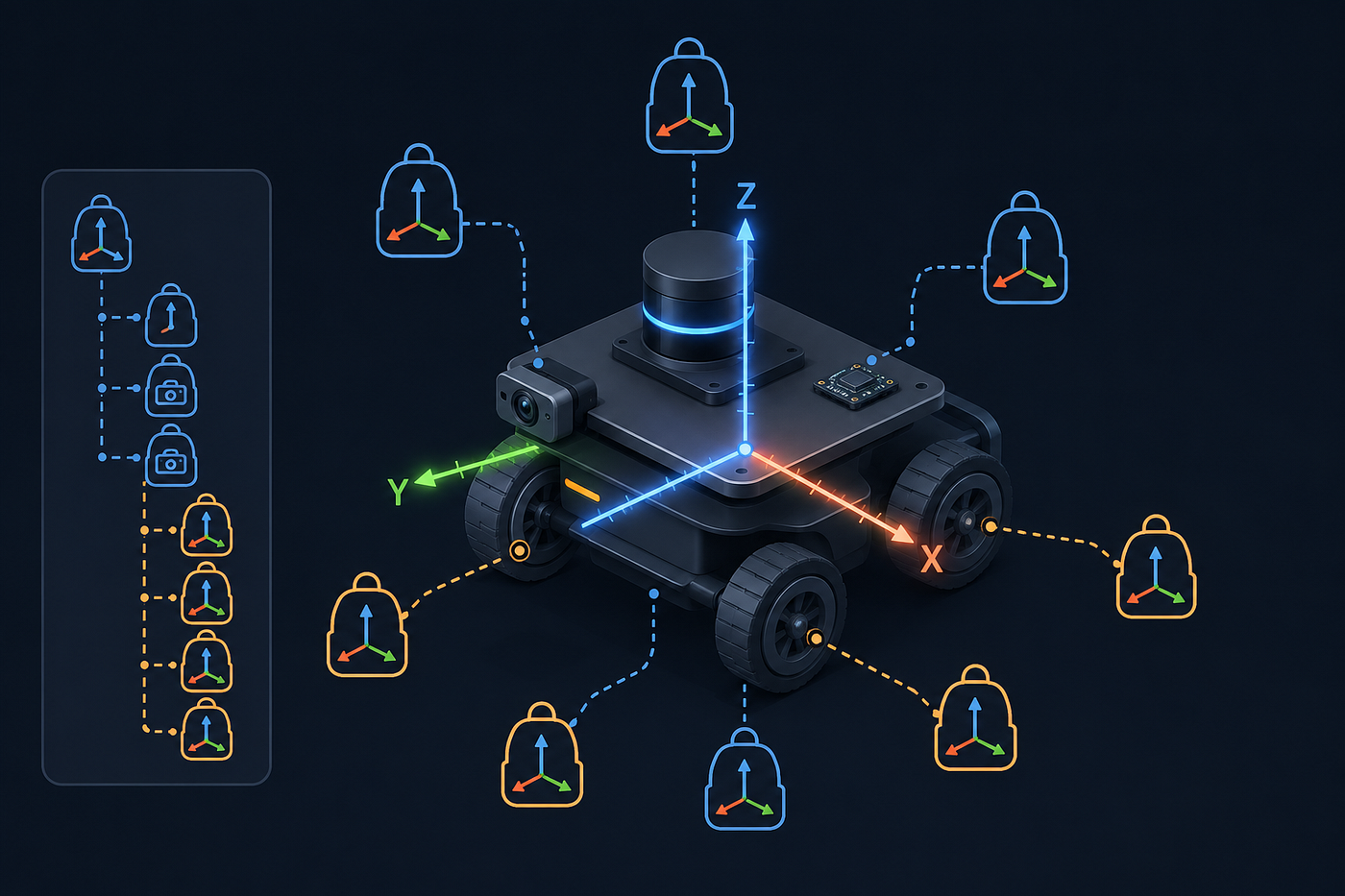
A ROS2 system is a compute graph. It has three basic pieces:
- Node: an independent program that does one job. A LiDAR driver. A path planner. A motor controller.
- Topic: a named data stream.
/scanfor laser data./cmd_velfor movement commands. - Message: the typed data structure that travels on a topic.
A node publishes messages to a topic. Other nodes subscribe to that topic and receive the messages.
The powerful part is decoupling. The LiDAR node does not know who subscribes to /scan. It just publishes. The planner subscribes without knowing who publishes. You can replace either one without breaking the other.
This is why ROS2 scales. You can start with a simple robot, then add a camera, swap the planner, or move a node to another machine — all without rewriting the whole system.
The takeaway: ROS2 is a communication framework for independent robot programs. The compute graph is the live map of how those programs connect.
The Hidden Layer: DDS
Underneath ROS2 is something called DDS, which stands for Data Distribution Service.
You do not need to understand DDS deeply to use ROS2. But knowing it exists explains a lot.
DDS handles three things for you:
- Discovery: nodes find each other automatically, with no central server.
- Transport: messages move between nodes, whether they are in the same process or on different machines.
- Quality of service: you can set rules about reliability, history, and durability.
That is why ROS2 works across a network almost for free. That is why you do not need to manually connect every node. DDS does the plumbing.
The takeaway: ROS2 wraps DDS. DDS handles the hard networking so you can focus on robot logic.
So, What Is ROS2 Really?
ROS2 is middleware that lets independent programs talk to each other through named, typed data streams.
That is it. Everything else — packages, launch files, simulators, build tools — exists to support that idea.
If you are building a robot with one sensor and one motor, you might not need ROS2. You can write a single program. But once you have multiple sensors, multiple algorithms, and multiple actuators, you need a way to organize the chaos.
That is when ROS2 becomes valuable.
Final Thought
I spent my first week with ROS2 fighting installations and copy-pasting commands. I was learning the cockpit before I understood the car.
If I could go back, I would start with this question: What problem does ROS2 solve?
The answer: robots are many independent programs that need to talk. ROS2 is the framework that lets them talk cleanly, reliably, and at scale.
Start there, and the rest becomes much easier.
메타데이터
- post_id
- eea090e69d62
- slug
- what-i-got-wrong-about-ros2-and-the-mental-model-that-finally-clicked-eea090e69d62
- url
- https://medium.com/@shoaib6174/what-i-got-wrong-about-ros2-and-the-mental-model-that-finally-clicked-eea090e69d62
- canonical_url
- https://medium.com/@shoaib6174/what-i-got-wrong-about-ros2-and-the-mental-model-that-finally-clicked-eea090e69d62
- author_url
- https://medium.com/@shoaib6174
- status
- ok
- fetched_at
- 2026-06-21 07:44:09