Hong Kong Market Outlook: How Hang Seng, China Tech, Property Stocks, and Global Risk Affect…
Hong Kong is one of Asia’s most important financial markets. It connects global capital with mainland China, international investors…
Hong Kong Market Outlook: How Hang Seng, China Tech, Property Stocks, and Global Risk Affect Investors
Hong Kong is one of Asia’s most important financial markets. It connects global capital with mainland China, international investors, regional banks, technology companies, property developers, insurers, consumer brands, and exchange-traded funds. For investors, the Hong Kong market outlook is not only about whether the Hang Seng Index rises or falls. It is about understanding how the Hang Seng Index, China technology stocks, property shares, Hong Kong dollar interest-rate conditions, and global risk sentiment work together.
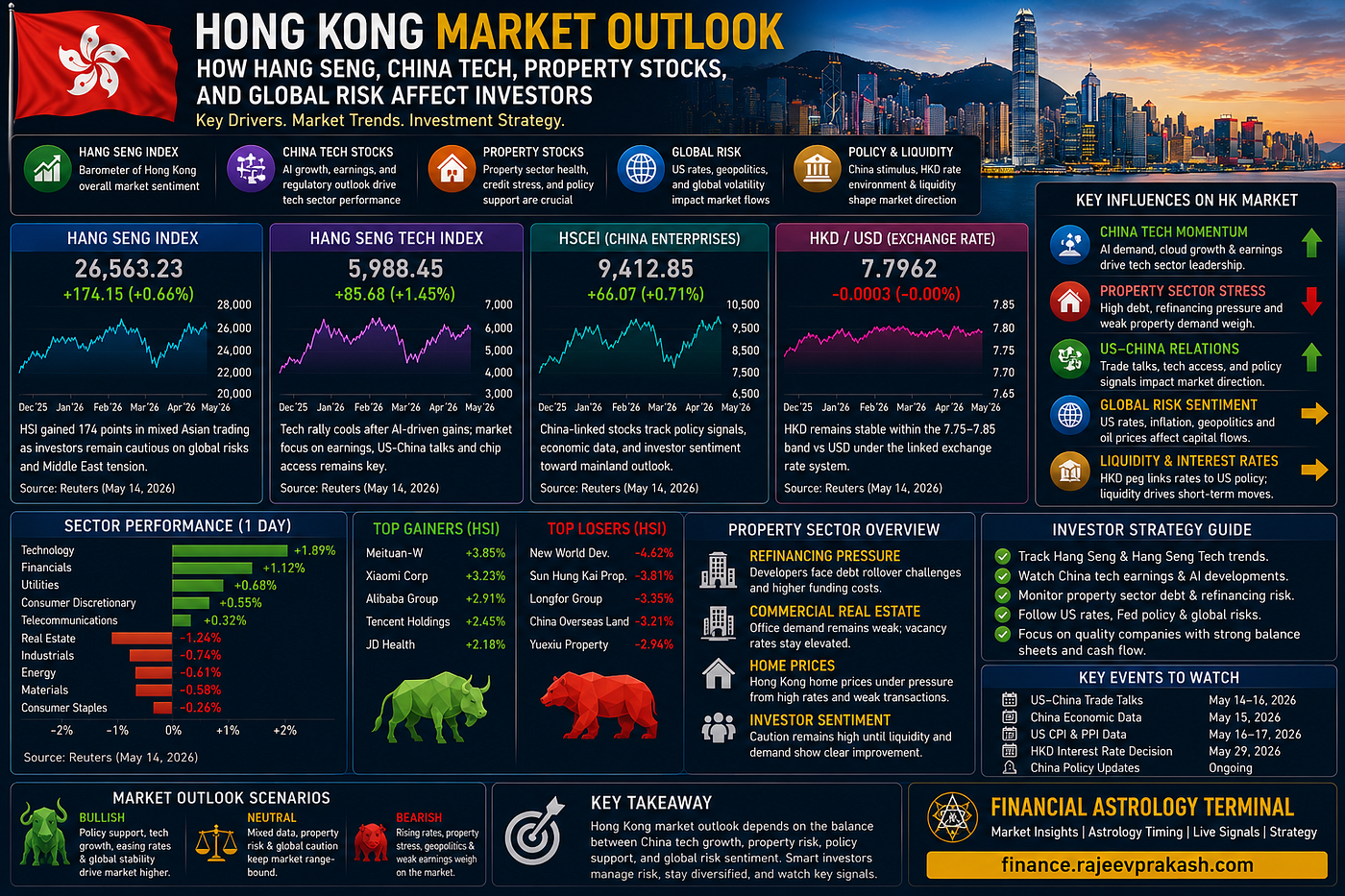
Hong Kong Market Outlook
Hong Kong has a unique market structure. It is a global financial centre, but its stock market is strongly linked to mainland China. Many major companies listed in Hong Kong earn revenue from China. At the same time, Hong Kong’s currency system is linked to the U.S. dollar, which means U.S. Federal Reserve policy can influence Hong Kong interest rates and liquidity. This makes Hong Kong a market where China policy, U.S. rates, technology sentiment, property stress, and global capital flows all matter.
As of May 14, 2026, Hong Kong shares remain sensitive to technology trends, China policy expectations, Middle East risk, U.S.-China talks, and property-sector concerns. The Hang Seng Index gained 174 points to around 26,563 during mixed Asian trading, even as the recent AI and technology rally showed signs of cooling and investors remained cautious due to geopolitical tension.
For investors, this creates an important question: should Hong Kong be treated as a recovery market, a China-tech opportunity, a property-risk market, or a global-risk barometer? The best answer is that it is all of these at once. That is why timing, sector selection, and risk management matter.
Why Hong Kong Matters for Asian Investors
Hong Kong plays a special role in Asian markets. It gives global investors access to Chinese companies, regional financial institutions, property developers, technology firms, insurance groups, consumer companies, and global trading flows. Many international funds use Hong Kong as a gateway to China exposure. When sentiment toward China improves, Hong Kong-listed shares often attract inflows. When global investors become worried about China, property risk, or U.S.-China tensions, Hong Kong can come under pressure quickly.
The Hong Kong market also matters because it is a liquidity hub. Large Chinese technology companies and mainland-linked companies trade in Hong Kong. This allows global investors to express views on China’s economy, AI development, consumer recovery, property stress, policy stimulus, and export performance.
Hong Kong also remains a major listing venue. Reuters reported that Hong Kong maintained its position as the world’s top IPO venue by funds raised in the first quarter of 2026, with 40 listings raising HK$110.4 billion, equal to about $14.1 billion. This is important because IPO activity reflects capital-market confidence, investor demand, and Hong Kong’s role as a financing centre.
However, Hong Kong is not a simple growth market. It is highly sensitive to policy, global rates, China demand, and real estate conditions. Investors should treat it as a market that can move strongly when confidence improves but can also become volatile when risks return.
Hang Seng Index: The Main Hong Kong Market Signal
The Hang Seng Index is Hong Kong’s most important equity benchmark. It includes large companies across financials, technology, property, consumer, energy, telecom, utilities, and mainland-linked sectors. When the Hang Seng rises, it usually suggests improving investor sentiment toward Hong Kong and China-linked equities. When it falls, it may reflect risk aversion, technology weakness, property stress, global-rate pressure, or capital outflows.
The Hang Seng Index is especially important because it combines old-economy and new-economy exposure. Traditional banks, insurers, developers, and utilities sit alongside large Chinese internet and technology companies. This creates a market that can shift quickly between value, growth, defensive, and policy-sensitive leadership.
Investors should not read the Hang Seng as one single story. A rise in the index may be driven by China technology stocks, while property shares remain weak. It may be supported by banks while internet names fall. It may rise on policy hopes but fail to continue if earnings do not improve.
Reuters provides real-time market information for the Hang Seng Index and its related Hong Kong benchmarks, showing how closely global investors track the index for trading and investment decisions.
For timing, investors should watch Hang Seng support and resistance levels, turnover, mainland inflows, China tech momentum, property-stock performance, and global risk appetite.
Hang Seng Tech Index: Why China Tech Drives Market Mood
The Hang Seng Tech Index is one of the most important parts of the Hong Kong market. It tracks major technology and internet-related companies listed in Hong Kong. These companies are often linked to e-commerce, cloud computing, artificial intelligence, online platforms, gaming, fintech, electric vehicles, and digital services.
When Hang Seng Tech performs well, Hong Kong market sentiment often improves. Technology stocks attract both global investors and regional traders because they offer growth exposure. When China tech stocks rally, the broader Hang Seng can benefit. When they sell off, the Hong Kong market can weaken quickly.
Reuters data showed the Hang Seng Tech Index had gained 3.65% over one month as of May 8, 2026, but remained down 2.41% over one year, highlighting the mixed nature of the technology recovery.
China technology shares are influenced by several factors. These include AI demand, semiconductor access, regulatory policy, platform-economy rules, consumer spending, earnings growth, U.S.-China technology tensions, and global Nasdaq sentiment. If global AI sentiment remains strong and China policy stays supportive, tech shares can attract capital. If regulatory risk or geopolitical restrictions return, investors may reduce exposure.
For Hong Kong investors, China tech is both an opportunity and a risk. It can drive strong rallies, but it can also create sharp drawdowns. Timing is essential.
U.S.-China Relations and Hong Kong Tech Stocks
Hong Kong technology stocks are heavily influenced by U.S.-China relations. Trade talks, tariffs, export controls, chip restrictions, AI hardware access, sanctions, and diplomatic meetings can all affect investor sentiment.
Technology companies need access to chips, cloud infrastructure, software ecosystems, global demand, and capital markets. Any change in U.S.-China policy can affect valuations quickly. This is why investors closely watch diplomatic meetings and trade negotiations.
A recent market focus has been the Trump-Xi summit and whether both sides can maintain trade stability. Reuters reported that markets were watching talks for signs of continuity in a trade truce, while investors also focused on technology developments and AI-related access.
For Hong Kong-listed technology shares, a stable U.S.-China relationship can reduce risk premiums. A worsening relationship can increase uncertainty and pressure valuations.
Investors should therefore track global tech sentiment and geopolitical developments before entering Hang Seng Tech positions.
Property Stocks: The Biggest Local and Mainland Risk
Hong Kong’s property sector is one of the most important risk areas for the market. Property developers, landlords, commercial real estate owners, and real estate-linked financial companies can influence investor confidence. The sector is affected by interest rates, office demand, housing prices, refinancing conditions, debt levels, and mainland property stress.
Hong Kong property stocks have been under pressure because of high interest rates, weak office demand, debt concerns, and slower property activity. The city’s property market is also affected by mainland China’s property downturn, because investor confidence toward Chinese real estate can spill over into Hong Kong-listed developers.
A key example is New World Development. Reuters reported that Blackstone withdrew from a proposed $4 billion deal with New World Development after the heavily indebted developer refused to give up control. New World has been trying to refinance debt and improve liquidity in a difficult Hong Kong property market affected by tight credit and a sluggish office sector.
This matters because property stress can affect banks, developers, landlords, insurers, and overall investor confidence. If property risks ease, Hong Kong equities may receive support. If refinancing stress worsens, the market may remain cautious.
Interest Rates and the Hong Kong Dollar Peg
Hong Kong has a linked exchange-rate system. The Hong Kong dollar trades within a narrow band of 7.75 to 7.85 per U.S. dollar, and interest rates in Hong Kong tend to move closely with U.S. interest rates. Reuters has noted that this structure keeps the Hong Kong dollar relatively stable but also links Hong Kong financial conditions to U.S. Federal Reserve policy.
This is very important for investors. When U.S. rates rise or remain high, Hong Kong liquidity can tighten. Higher rates can hurt property developers, mortgage borrowers, REITs, and leveraged companies. They can also reduce investor appetite for equities because cash and fixed-income returns become more attractive.
When U.S. rates fall, Hong Kong liquidity conditions may improve. Property stocks, banks, and rate-sensitive sectors may react positively. However, if rate cuts happen because global growth is weakening, the market reaction can still be mixed.
The Hong Kong Monetary Authority follows the Federal Reserve closely under the currency-board system. Reuters reported that Hong Kong’s de facto central bank lowered its base rate by 25 basis points to 4.25% in October 2025, tracking a Fed cut.
For 2026 investors, the key is to watch U.S. inflation, Fed policy, Treasury yields, HKD liquidity, HIBOR, and property-sector refinancing risk.
Global Risk and Hong Kong Market Sentiment
Hong Kong is highly sensitive to global risk. When global investors are confident, Hong Kong can attract capital because it offers exposure to China, technology, financials, property recovery, and Asia growth. When global risk rises, investors can quickly reduce exposure.
Global risk can come from U.S. rate expectations, Middle East tensions, oil price spikes, U.S.-China trade friction, weak China data, currency volatility, or global tech corrections. Because Hong Kong is an open financial market, it reacts quickly to international news.
In May 2026, Asian markets traded mixed as the AI rally cooled and Middle East conflict kept sentiment cautious. Despite this, the Hang Seng gained 174 points to around 26,563. This shows how Hong Kong can rally even in a cautious environment, but investors should still watch whether momentum is broad or concentrated.
Global risk also affects sector rotation. During risk-on periods, China tech and consumer stocks may lead. During risk-off periods, utilities, telecoms, and dividend stocks may perform better. Property stocks may remain vulnerable if credit conditions tighten.
China Policy and Mainland Stimulus
Hong Kong market performance is deeply connected to China policy. When Beijing signals support for growth, consumption, property, credit, or technology, Hong Kong-listed shares can rally. When policy support disappoints, the market may weaken.
Mainland policy affects Hong Kong through several channels. It influences China technology companies, property developers, banks, insurers, consumer companies, and state-linked enterprises. It also affects foreign investor confidence toward China-linked assets.
China’s economic outlook in 2026 has shown signs of resilience, with analysts seeing the country as on track to meet its growth target. Citi analysts have expressed preference for technology and export-oriented stocks, while also maintaining overweight views on technology, basic materials, healthcare, and internet sectors.
For Hong Kong investors, China stimulus expectations matter because many Hang Seng companies are directly or indirectly tied to mainland demand. A stronger China recovery can help Hong Kong equities. A weak or delayed policy response can limit upside.
China Property Risk and Hong Kong Shares
Mainland property risk is one of the biggest factors affecting Hong Kong shares. Many property developers and financial institutions listed in Hong Kong are affected by China’s real estate slowdown. Even companies not directly involved in property can be affected through consumer confidence, bank exposure, land sales, construction demand, and local government finances.
A stronger property rescue package could improve sentiment. However, investors need evidence that housing sales, prices, refinancing, and developer liquidity are stabilising. Policy announcements can create short-term rallies, but the market needs real improvement.
Hong Kong’s own property market also faces pressure from high rates and office-market weakness. The collapse of Blackstone’s proposed investment in New World Development highlights how difficult the environment remains for heavily indebted developers.
For investors, property shares can offer recovery potential, but they carry high risk. Balance sheets, refinancing dates, asset sales, liquidity, and debt maturity profiles matter.
Banks and Financial Stocks in Hong Kong
Banks and financial companies are important parts of the Hong Kong market. They are affected by interest rates, loan growth, property exposure, mainland China flows, capital-market activity, and credit risk.
Higher interest rates can support bank margins, but they can also increase credit stress, especially in property-linked lending. Weak office demand and developer debt problems can raise risk. At the same time, Hong Kong’s role as an IPO and capital-market hub can support financial-sector activity when listings and trading volumes improve.
Hong Kong’s strong IPO activity in early 2026 is a positive signal for capital markets. The city’s first-quarter fundraising performance showed that investors still use Hong Kong as a major listing centre.
For bank and financial-stock investors, the outlook depends on interest-rate trends, property loan exposure, mainland capital flows, IPO activity, and market liquidity.
Consumer and Internet Stocks
Consumer and internet stocks in Hong Kong depend heavily on mainland China demand. E-commerce, food delivery, travel, gaming, online advertising, luxury spending, and retail platforms all respond to household confidence and consumption trends.
If China’s consumer recovery improves, Hong Kong-listed internet and consumer shares may benefit. If households remain cautious due to property losses or job uncertainty, these stocks may struggle.
Technology stocks can rally on AI optimism, but consumer-facing internet companies still need spending growth. Investors should separate platform technology from consumer demand. A cloud or AI-related company may benefit from enterprise spending, while an e-commerce firm depends more on household confidence.
For timing, watch China retail sales, travel data, online consumption, platform earnings, margin trends, and regulatory commentary.
Hang Seng vs Hang Seng Tech: Reading Market Breadth
Investors should compare the Hang Seng Index with the Hang Seng Tech Index. If both rise together, the market rally is stronger. If Hang Seng rises but tech lags, the move may be driven by banks, insurers, energy, or defensive shares. If tech rises but property and financials remain weak, the rally may be narrow.
A broad Hong Kong recovery needs participation from technology, financials, consumer stocks, and selected property shares. If only one sector leads, investors should be careful.
Market breadth matters because Hong Kong can be volatile. A rally driven by a few large technology names can reverse quickly if sentiment changes. A rally supported by multiple sectors is more durable.
Technical Analysis for Hong Kong Market Timing
Technical analysis helps investors convert market views into actionable levels. For the Hang Seng Index and Hang Seng Tech Index, investors should watch support, resistance, moving averages, momentum, trading volume, and market breadth.
If Hang Seng breaks above resistance with strong turnover and tech confirmation, market momentum may improve. If it fails near resistance while property shares remain weak, traders should be cautious. If Hang Seng Tech holds support while global tech sentiment improves, selected China tech stocks may offer opportunities.
Technical analysis is especially useful in Hong Kong because the market reacts quickly to policy headlines, U.S. rate changes, China data, and global risk events. Investors need price levels to avoid emotional decisions.
Financial Astrology Timing for Hong Kong Markets
Financial astrology can add a timing layer to the Hong Kong market outlook. It studies planetary cycles, lunar phases, retrogrades, eclipses, and timing windows that may influence market psychology, risk sentiment, volatility, and trend changes.
For Hong Kong, this timing layer can be applied to the Hang Seng Index, Hang Seng Tech Index, HKD liquidity, China tech stocks, property shares, banking stocks, and global risk windows. A supportive timing window near Hang Seng support may suggest recovery potential if price confirms. A difficult timing window during property stress, rising U.S. yields, or technology weakness may require caution.
Financial astrology should not replace technical analysis or macro research. It works best when combined with market data, price action, sector rotation, and risk management.
Bullish Scenario for Hong Kong Stocks
A bullish Hong Kong market scenario would require several positive signals. China policy should remain supportive. Technology shares should continue to attract capital. U.S.-China tensions should stay contained. Property refinancing risk should ease. U.S. rates should stabilise or fall. Global risk appetite should improve.
In this environment, Hang Seng may continue recovering, Hang Seng Tech may lead, financial stocks may improve, and selected property shares may rebound. IPO activity and capital-market confidence could add further support.
A bullish setup becomes stronger when both Hang Seng and Hang Seng Tech rise with broad participation.
Neutral Scenario for Hong Kong Stocks
In a neutral scenario, Hong Kong stocks may remain range-bound. Technology shares may recover selectively, but property risk may limit confidence. China policy may support sentiment without producing a strong economic rebound. U.S. rates may remain restrictive, keeping pressure on property and liquidity.
This type of market favours selective investing. Investors may prefer quality China tech, strong insurers, dividend-paying financials, and companies with solid balance sheets. Traders should use support and resistance levels rather than chasing every rally.
Bearish Scenario for Hong Kong Stocks
A bearish scenario could develop if global risk rises, U.S. yields move higher, China tech sentiment weakens, property refinancing stress worsens, and China stimulus disappoints. In this case, Hang Seng could face renewed pressure, and property shares may remain weak.
High-debt developers, weak consumer names, and speculative technology stocks may underperform. Investors should reduce leverage, manage position size, and focus on capital protection.
Practical Strategy for Hong Kong Investors
Hong Kong investors should build a dashboard that includes the Hang Seng Index, Hang Seng Tech Index, China Enterprises Index, HKD/USD, U.S. Treasury yields, HIBOR, China policy announcements, property-stock performance, China tech earnings, IPO activity, and global risk sentiment.
Before investing, ask whether the rally is tech-led, policy-led, property-led, or liquidity-led. Check whether property shares are stabilising or still under pressure. Watch whether U.S. rate expectations are helping or hurting Hong Kong liquidity. Review whether China tech momentum is supported by earnings or only by short-term sentiment.
Long-term investors may focus on quality China technology companies, strong financials, dividend shares, and companies with stable cash flow. Traders should respect stop-losses and avoid chasing sharp policy-driven rallies without confirmation.
Why a Hong Kong Market Dashboard Helps
A Hong Kong-focused dashboard helps investors track Hang Seng movement, China tech stocks, property shares, HKD liquidity, U.S. rate trends, China policy, global risk, and financial astrology timing in one place.
Without a dashboard, investors may follow only headlines and miss the broader structure. With a dashboard, they can see whether the market is supported by technology, property, financials, policy, liquidity, and global risk appetite.
This helps investors make better timing decisions.
Conclusion
The Hong Kong market outlook depends on how the Hang Seng Index, China technology stocks, property shares, interest-rate conditions, and global risk interact. The Hang Seng Index reflects broad Hong Kong and China-linked equity sentiment. Hang Seng Tech shows investor appetite for growth, AI, internet platforms, and China innovation. Property stocks reveal the health of the credit and real estate cycle. Global risk and U.S. rates influence liquidity, capital flows, and market confidence.
Hong Kong remains a powerful market for investors because it connects China and global capital. However, it also carries unique risks. China tech can rally sharply, but it remains sensitive to regulation and geopolitics. Property shares can rebound on policy support, but debt risk remains serious. The HKD peg provides currency stability, but it also links Hong Kong rates to U.S. policy.
The best strategy is to combine index analysis, sector rotation, property-risk review, China policy monitoring, U.S. rate awareness, technical levels, and disciplined risk management. Financial astrology can add another timing layer when used with price confirmation and market data.
To explore Hong Kong market timing, Hang Seng trends, China tech stocks, property-risk signals, global market risk, live signals, financial astrology insights, and multi-asset dashboards, visit the https://finance.rajeevprakash.com/
메타데이터
- post_id
- eea151484aa7
- slug
- hong-kong-market-outlook-how-hang-seng-china-tech-property-stocks-and-global-risk-affect-eea151484aa7
- url
- https://medium.com/@techiteindia/hong-kong-market-outlook-how-hang-seng-china-tech-property-stocks-and-global-risk-affect-eea151484aa7
- canonical_url
- https://medium.com/@techiteindia/hong-kong-market-outlook-how-hang-seng-china-tech-property-stocks-and-global-risk-affect-eea151484aa7
- author_url
- https://medium.com/@techiteindia
- status
- ok
- fetched_at
- 2026-06-28 04:42:08




