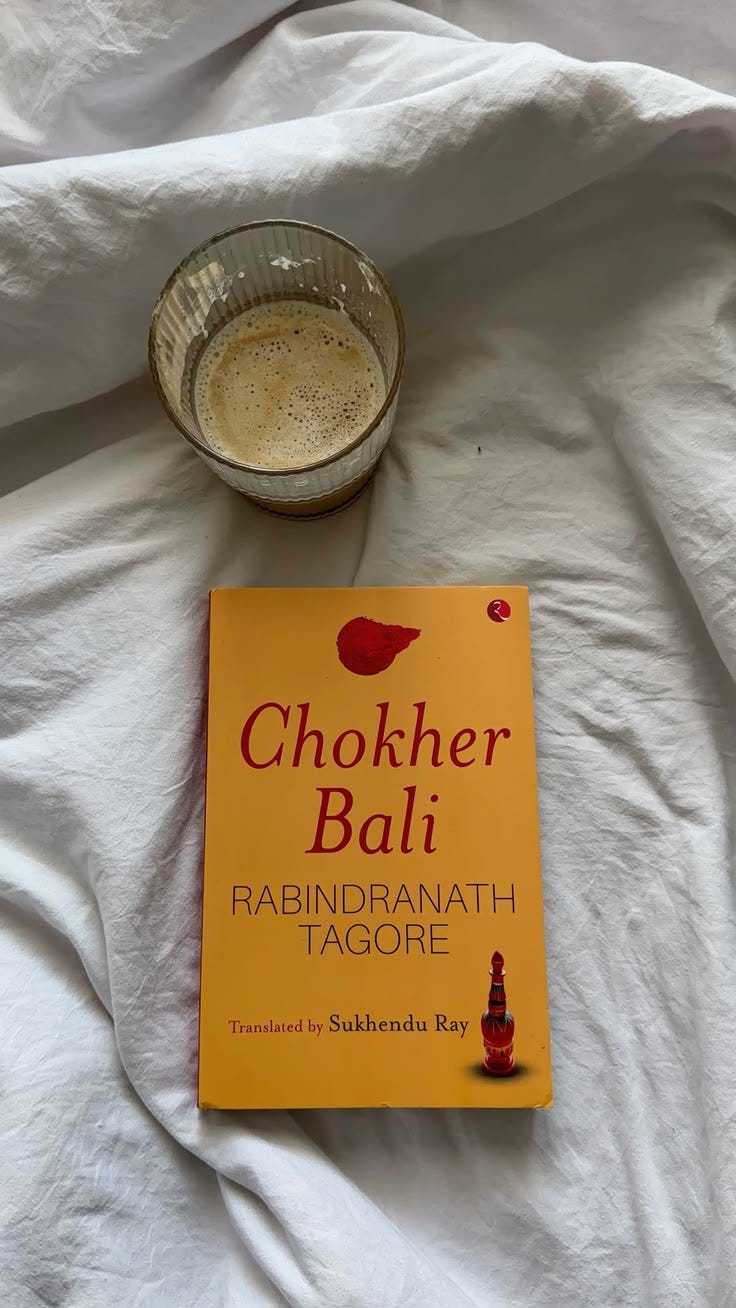
Chokher Bali : When love, loneliness and jealousy collide.
A personal reflection on Rabindranath Thakur timeless novel .
Chokher Bali : When love, loneliness and jealousy collide.
A personal reflection on Rabindranath Thakur timeless novel .
I did not begin reading “Chokher Bali” with any particular intention. Before picking up the novel, I had watched its film adaptation. When the film ended, however, I was left with a strange feeling—as if the story had more to offer than what could be captured on screen. I felt that the novel deserved a place in my life, even if only for a few days. That feeling alone was enough to make me open the book. Halfway through the novel, I was convinced that Bihari and Ashalata were my favourite characters. But when I turned the final page, I realised that amidst the four central characters, Annapurna stood quietly above them all. Her presence is never loud, yet her wisdom and selflessness leave one of the deepest impressions. Today, I admire Bihari and Annapurna equally.
Bihari : A Heart Guided by Wisdom
Bihari earned my admiration because of his remarkable self-restraint, kindness, wisdom, and unwavering loyalty. Throughout the novel, Mahendra repeatedly misunderstands and humiliates him, yet Bihari never allows resentment to shape his actions. Even when he has every reason to walk away, he chooses to remain loyal to his friend. Whenever Mahendra finds himself in trouble, Bihari is the first to stand beside him, asking for nothing in return. What moved me even more was his humility. Whenever accusations were directed at him, he rarely argued to defend himself. Instead, he quietly stepped aside, perhaps believing that proving himself right was less important than protecting others from further pain. In a world where pride often outweighs compassion, Bihari’s character feels timeless. A friend like him is not simply found; he is a blessing.
Annapurna: The Gentle Voice of Wisdom
If Bihari represents integrity, Annapurna represents unconditional love and sacrifice. She willingly leaves behind the home and people she loves because she fears that her presence might create even the slightest disturbance in Ashalata’s married life. Never once does she place her own comfort before the happiness of those she loves. To me, Annapurna is one of the quiet heroes of the novel. Near the end of the story, Annapurna offers Ashalata a piece of advice that has remained with me ever since. She says, in essence, that the satisfaction we gain from blaming others is far smaller than the pain of carrying resentment in our own hearts. It is easy to give advice but much harder to show a way forward. Then she gently offers one: whatever has happened, let it go and move on.
Perhaps this is why Annapurna’s character continues to resonate with me long after I finished the novel. Her greatest strength lies not in dramatic actions, but in her quiet wisdom, compassion, and ability to forgive.
Ashalata: The Beauty and Burden of Innocence
Of all the characters in Chokher Bali, Ashalata is the one who earned my deepest sympathy. She is innocent, gentle, timid, and remarkably trusting. She is neither highly educated nor particularly skilled in managing a household, yet she possesses something far more valuable—a heart that loves with complete sincerity. At the beginning of the novel, her mother-in-law, Rajlakshmi, struggles to accept her, believing that this young bride has taken her beloved son away. Ironically, the same woman who once saw Ashalata as a threat eventually comes to regard her as the very embodiment of Lakshmi, the goddess of prosperity and grace. I believe Ashalata places her complete trust in Binodini because, apart from Mahendra, she has no one she can truly call her own. She has never experienced deep companionship or close friendship. When Binodini enters her life with warmth and affection, Ashalata embraces her without hesitation. Her trust is absolute. Yet it is precisely this innocence that leaves her vulnerable. At first, I thought Binodini simply took advantage of Ashalata’s trust. But as I reflected more deeply, I found myself asking a different question: Did Binodini deliberately betray Ashalata, or was she herself a prisoner of her own loneliness and unfulfilled desires? The novel never offers a simple answer, and perhaps that is what makes it so enduring. Ashalata taught me that trust and innocence are beautiful qualities, but they must be accompanied by wisdom. Blind faith, however pure, can sometimes become the very reason we suffer the deepest wounds. More often than not, it is those closest to us who possess the power to hurt us the most. Although Ashalata appears emotionally fragile at the beginning of the story, the final chapters reveal an unexpected strength. When Mahendra gradually becomes distant, she does not accuse him or suspect his loyalty. Instead, she turns inward and searches for faults within herself. She cannot even imagine that another woman might have entered her husband’s heart. This unwavering faith is both admirable and heartbreaking. Another detail that stayed with me was Ashalata’s lack of confidence in herself. Throughout the novel, she repeatedly considers herself foolish while placing Binodini on a pedestal of intelligence and refinement. A person who constantly belittles herself can rarely believe that she truly deserves love, respect, or recognition. In many ways, Ashalata’s greatest struggle is not with the people around her, but with the way she sees herself. Her love for Mahendra is profound, selfless, and unconditional. It is the kind of love that asks for nothing except the happiness of the one it loves. I sincerely hope everyone experiences such pure affection at least once in their lifetime. One moment that particularly moved me occurs when Mahendra is completely consumed by his feelings for Binodini. Even then, Ashalata tries to protect him from humiliation rather than exposing or condemning him. Earlier in the novel, when she returns from Kashi and notices that Mahendra no longer speaks to her with the same warmth as before, she never questions his loyalty. Instead, she wonders whether she herself has unknowingly done something wrong. For Ashalata, the possibility that Mahendra could love another woman is almost unimaginable. Perhaps that is why her pain feels so real. She loses not only the affection of the man she loves but also the certainty upon which she has built her entire world.
Binodini: A Villain, a Victim, or Simply Human?
To me, Binodini is the most complex character in Chokher Bali. She is intelligent, educated, exceptionally beautiful, and remarkably capable. She can effortlessly win people’s affection and adapt to almost any situation. Yet beneath her confidence lies a woman who seems uncertain about what she truly wants. Binodini never longed for wealth or status. Perhaps what she desired most was what Ashalata had received so effortlessly—love, respect, and a place where she truly belonged. As a young widow, she was forced to live within the harsh limitations imposed by society. While Ashalata, despite being less accomplished in Binodini’s eyes, was surrounded by affection and admiration, Binodini remained an outsider. Watching Ashalata receive the love she had always been denied must have deepened her loneliness and resentment. Even Bihari, a man of wisdom and integrity, found himself drawn toward Ashalata rather than her. To Binodini, this must have felt like salt being rubbed into an open wound. The questions that seem to haunt her are painfully simple: Why is no one allowed to love me? Why must I spend my entire life dressed in white? Why should widowhood determine the rest of my existence? Through Binodini, I believe Rabindranath Tagore explores how loneliness, social exclusion, and deprivation can slowly reshape one’s personality .
Yet one question continues to trouble me. Can we place all the responsibility on society and her circumstances? Or must we also acknowledge that Binodini made choices for which she bears responsibility? I do not believe there is an easy answer. Perhaps that moral ambiguity is precisely what makes her one of Tagore’s most unforgettable creations.
Mahendra: A Man in Love with Himself
If I had to choose the weakest character in the novel, it would undoubtedly be Mahendra. He is impulsive, emotionally immature, and astonishingly lacking in self-control. At one moment, he is so devoted to Ashalata that he neglects his own mother. Soon afterwards, he abandons Ashalata emotionally and becomes consumed by his fascination with Binodini. Rather than guiding his emotions, he allows them to guide him. What disappoints me most is that Mahendra, who has enjoyed privilege, education, and comfort throughout his life, should have been the most sensible person in the story. Instead, he repeatedly makes poor decisions without considering their consequences. At one point, Mahendra convinces himself that his heart is spacious enough to love both Ashalata and Binodini. To me, however, this is not generosity; it is self-deception. True love cannot be divided according to convenience. He even believes that Ashalata should remain content simply because she still possesses a part of his affection. I cannot help but wonder: if another man had entered Ashalata’s heart, would Mahendra have shown the same broad-mindedness he expected from her? I sincerely doubt it. Still, I would not say that Mahendra is entirely without conscience. There are moments when he recognises his own disgrace and struggles with the consequences of his actions. Another reason for his growing attachment to Binodini lies in the contrast between the two women. Ashalata is inexperienced in household management, whereas Binodini is graceful, capable, and efficient. Gradually, Binodini begins taking over responsibilities that traditionally belonged to Ashalata—organising the household, encouraging Mahendra to attend college, and managing everyday affairs with confidence. It is easy to understand why Mahendra admired her competence, even though admiration eventually turned into emotional betrayal. Mahendra also teaches us another important lesson: excessive pride can blind us to our own weaknesses. At the beginning of the novel, he thinks very highly of himself and believes he is somehow different from everyone else. Yet pride often makes people careless, and it is in those careless moments that the seeds of tragedy are sown.
The Line I Could Not Forget
One sentence from the novel has stayed with me more than any other. Binodini says to Mahendra:
"You do not love me. You do not love Ashalata either. You love only yourself."
To me, this single line captures Mahendra’s character perfectly. More importantly, it raises a profound question about human nature. How often do we truly love another person, and how often do we simply love the way they make us feel? Perhaps we are more attached to our own emotions than to the people who awaken them.
What Chokher Bali Left Behind
For me, Chokher Bali is far more than a story of love and betrayal. It is a profound exploration of loneliness, desire, jealousy, self-restraint, sacrifice, and the fragile nature of human relationships. The novel taught me that love is one of life’s greatest gifts, but it should never come at the cost of losing ourselves. We should never become so emotionally dependent on another person that our entire world collapses when they leave. Love is beautiful, but so are self-respect, emotional resilience, and the strength to stand on our own. That is why Chokher Bali continues to resonate with readers more than a century after it was written. It does not simply tell us a story—it asks us difficult questions about ourselves. And perhaps that is the true mark of timeless literature.
메타데이터
- post_id
- eea1635ab24e
- slug
- chokher-bali-when-love-loneliness-and-jealousy-collide-eea1635ab24e
- url
- https://medium.com/@tajriyantaiba/chokher-bali-when-love-loneliness-and-jealousy-collide-eea1635ab24e
- canonical_url
- https://medium.com/@tajriyantaiba/chokher-bali-when-love-loneliness-and-jealousy-collide-eea1635ab24e
- author_url
- https://medium.com/@tajriyantaiba
- status
- ok
- fetched_at
- 2026-08-01 20:51:11




