Melatonin Long-Term Use: Benefits, Risks, Safety & When to Avoid
Melatonin is one of the most widely used sleep supplements in the world. The real question is whether it is the right tool for your…
Melatonin Long-Term Use: Benefits, Risks, Safety & When to Avoid
Melatonin is one of the most widely used sleep supplements in the world. The real question is whether it is the right tool for your specific sleep problem — and what happens when you use it every night.
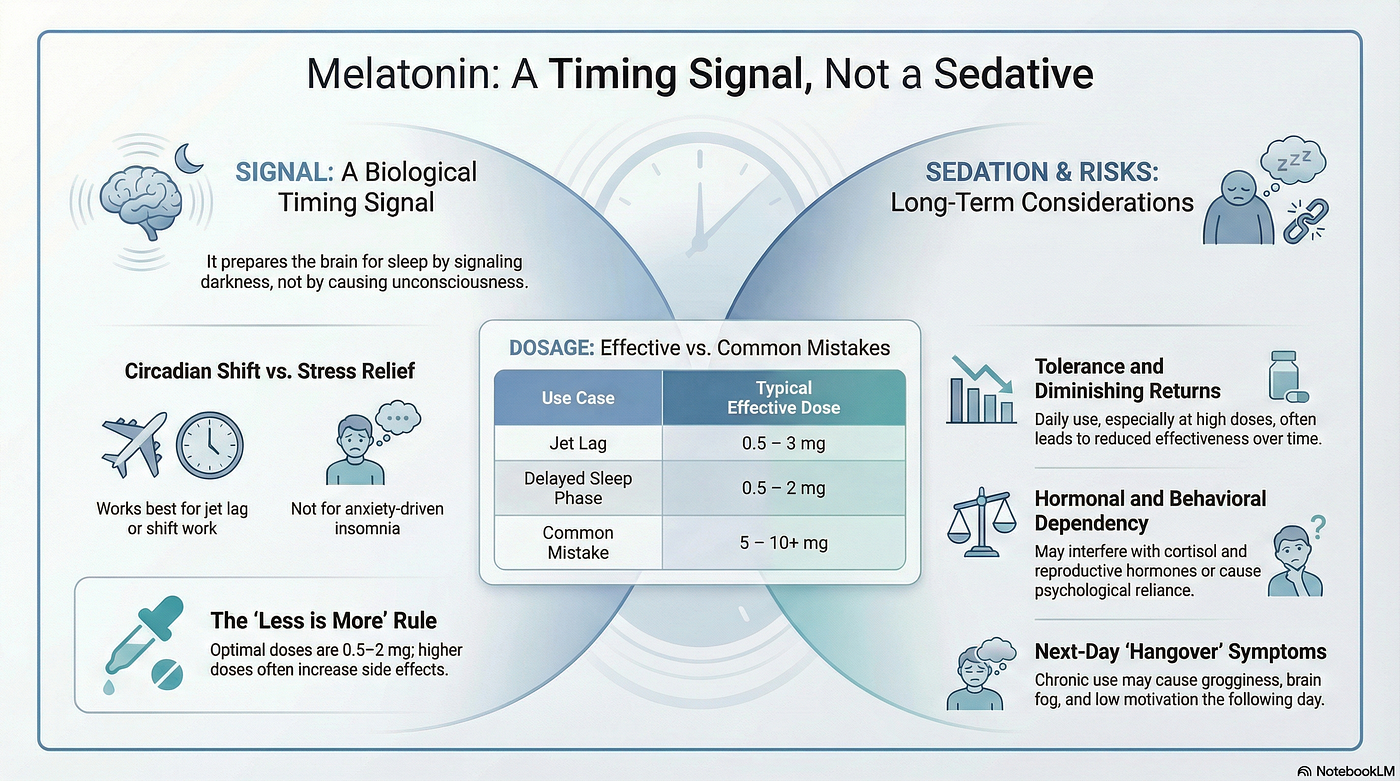
Melatonin is not a sedative. It is a biological timing signal — a hormone produced by the pineal gland in response to darkness, whose primary role is to tell the brain that night has arrived and that the body should prepare for sleep. Used correctly, it can be very effective. Used for the wrong reason, or at the wrong dose, it can become less effective over time or create new problems.
The most important distinction in melatonin use is this: it works best when the problem is timing. It is often the wrong tool when the problem is stress, anxiety, rumination, or nervous system overactivation.
What melatonin actually does
Melatonin helps shift internal timing and may slightly reduce alertness. It does not directly force unconsciousness. This is why it works well for jet lag and delayed sleep phase — situations where the body clock is genuinely misaligned — and often works less well for people whose primary issue is that they cannot switch their mind off at night.
Short-term benefits
For the right use case, melatonin’s short-term profile is genuinely useful: it may reduce sleep latency when timing is the main issue, can help shift sleep timing earlier, is helpful for travel across time zones, is generally well tolerated, and is not addictive in the traditional chemical sense.
Melatonin works best when the problem is timing. It is often less effective when the problem is stress, anxiety, rumination, or physical tension.
What happens with long-term daily use
Research on long-term daily melatonin use in healthy adults is limited — most studies examine short-term use over days, weeks, or a few months. Several practical patterns emerge from clinical use and available evidence.
Tolerance and diminishing effect — Some users notice melatonin feels less effective over time, particularly when using higher doses of 3 to 10 mg every night. This is the most commonly reported pattern in regular users.
Reliance on external timing signals — Melatonin can help set the circadian clock, but it should not replace the natural cues that regulate it: morning light exposure, consistent wake time, and dim evenings. Using melatonin as a substitute for these habits undermines the goal.
Possible hormonal interactions — Melatonin interacts with multiple biological systems, including cortisol rhythm, reproductive hormone signaling, and thyroid-related pathways. Effects are usually mild, but long-term daily supplementation in young healthy adults is not as well studied as short-term use. This is worth knowing, not ignoring.
Next-day symptoms — Grogginess, headache, brain fog, low motivation, and vivid dreams are more likely with higher doses or late timing. These are not universal but are frequently reported and dose-dependent.
The dosage problem most people get wrong
More melatonin is not better. In many cases lower doses work better and cause fewer next-day side effects. Common effective doses are often closer to 0.5 to 2 mg — for jet lag, delayed sleep phase, and general sleep timing support. The 5 to 10 mg doses commonly sold in many markets are, for most people, significantly more than needed.
Timing matters as much as dose. Taking melatonin too late or at too high a dose significantly increases morning grogginess without improving sleep quality.
Is melatonin addictive?
Melatonin is not chemically addictive in the way that sedative drugs are. However, behavioral reliance can develop — particularly when people use melatonin nightly for stress-based insomnia rather than circadian timing support, and begin to feel they cannot sleep without it. This is a psychological dependence on a nightly ritual, not physical addiction. The distinction matters, but both are worth avoiding.
Who should be cautious with long-term use
Pregnant or breastfeeding women. People with autoimmune conditions. Those with epilepsy or seizure history. People using antidepressants, blood pressure medication, or anticoagulants. Teenagers and children unless medically supervised. And people with persistent insomnia that has not been properly assessed by a clinician — melatonin can mask an underlying issue that deserves proper attention.
When calming-based support is a better fit
If your insomnia is driven mainly by stress, anxiety, overthinking, or physical tension, a calm-first approach is often more appropriate than a timing signal. Magnesium to support relaxation and nervous system balance. L-Theanine to reduce mental tension. Glycine to support sleep quality and body temperature regulation. Calming herbal extracts to support a smoother wind-down. These address the actual cause rather than applying a hormonal signal to a non-hormonal problem.
Frequently asked questions
Is melatonin safe long term? Short-term use is generally well tolerated. Long-term daily use has less safety data, especially in healthy adults using it nightly for stress-based insomnia rather than circadian rhythm support. Strategic use for timing-specific situations is better supported than habitual nightly use.
Can melatonin stop working? Some users report it becomes less effective over time, especially at higher nightly doses. Poor timing, excessive dosage, and unresolved stress can all make it feel less effective independently.
Does melatonin affect hormones? It interacts with cortisol rhythm, reproductive hormone signaling, and other endocrine pathways. Effects are usually mild, but long-term daily use is not fully understood in all populations.
Is 10 mg of melatonin too much? For most people, yes. Common effective doses are closer to 0.5 to 2 mg. Higher doses increase next-day grogginess without proportionally improving sleep quality.
What is better than melatonin for stress insomnia? A calming-based approach — magnesium, L-Theanine, glycine, and selected herbal extracts — is often more appropriate when the main issue is nervous system arousal rather than circadian timing.
메타데이터
- post_id
- eeb166386d26
- slug
- melatonin-long-term-use-benefits-risks-safety-when-to-avoid-eeb166386d26
- url
- https://medium.com/@contact_26220/melatonin-long-term-use-benefits-risks-safety-when-to-avoid-eeb166386d26
- canonical_url
- https://medium.com/@contact_26220/melatonin-long-term-use-benefits-risks-safety-when-to-avoid-eeb166386d26
- author_url
- https://medium.com/@contact_26220
- status
- ok
- fetched_at
- 2026-06-23 17:05:31