How to Create a VPN in Android Without Coding (2026 Guide)
The VPN market is no longer dominated only by large cybersecurity companies. In 2026, startups, SaaS businesses, indie founders, and even…
How to Create a VPN in Android Without Coding (2026 Guide)
The VPN market is no longer dominated only by large cybersecurity companies. In 2026, startups, SaaS businesses, indie founders, and even non-technical entrepreneurs are entering the VPN industry faster than ever before.
Demand for online privacy, remote work security, encrypted communication, and protection against digital surveillance continues growing globally. At the same time, modern VPN frameworks, white-label systems, APIs, and managed infrastructure providers have dramatically lowered the barrier to entry for launching a VPN product.
This has created a major opportunity for businesses looking to enter the cybersecurity market through VPN app development.
But there is one reality many founders discover too late:
Launching a VPN app is relatively easy. Building a VPN product that scales profitably, retains users, and maintains infrastructure quality is much harder.
Why Android Is the Smartest Starting Point for VPN Startups
Android remains one of the strongest entry points for VPN startups because of:
- Massive global mobile adoption
- Public Wi-Fi dependency
- Remote work growth
- Mobile-first internet behavior
- Greater VPN flexibility compared to iOS
Unlike Apple’s ecosystem, Android gives developers more flexibility for VPN protocol integration and background networking behavior.
For startups entering VPN app development, Android often provides the fastest path to MVP validation before expanding into iOS, Windows, and macOS environments.
Many successful VPN startups begin with Android-first infrastructure strategies for this reason.
Can You Really Create a VPN Without Coding?
Yes — but this is where many founders misunderstand the market.
“Without coding” does not mean “without backend systems.”
Most businesses entering the VPN market today avoid building:
- VPN protocols from scratch
- Native networking frameworks manually
- Backend systems internally
- Global server architecture themselves
Instead, they use:
- White-label VPN platforms
- VPN SDKs and APIs
- Managed infrastructure providers
- Prebuilt authentication systems
- Customizable admin dashboards
This significantly reduces launch time and upfront engineering costs.
With modern white-label systems and managed backend services, some startups can launch a basic Android VPN MVP within weeks instead of spending months building infrastructure internally.
However, backend quality still determines whether the product scales successfully long term.
A VPN app that performs well with 1,000 users can become unstable at 20,000 users if backend optimization and server scaling are poorly planned.
That is where many VPN startups quietly fail.
Can Android VPN Apps Become Profitable?
Yes — but profitability depends heavily on infrastructure efficiency and retention.
Most VPN businesses monetize through:
- Monthly subscriptions
- Premium privacy features
- Enterprise remote-access systems
- Secure business communication tools
The VPN market can generate strong recurring revenue, but many startups underestimate how quickly operational costs grow under higher traffic volume.
Bandwidth scaling, server distribution, and traffic optimization directly affect profitability.
Some VPN startups gain users successfully but struggle financially because infrastructure expenses increase faster than subscription revenue.
This is why scalable backend planning matters early in VPN app development.
Step 1: Define the VPN Business Model First
One of the biggest mistakes founders make is choosing infrastructure before defining market positioning.
Before launching, businesses should decide whether they are building:
- Consumer VPN products
- Enterprise VPN systems
- Privacy-focused VPN apps
- Streaming VPN services
- Secure remote work platforms
This affects:
- Monetization strategy
- Protocol selection
- Compliance requirements
- Server architecture
- Scalability planning
Many technically functional VPN apps fail because they enter crowded markets without clear differentiation.
Step 2: Choose the Right VPN Protocol
Protocols are the foundation of every VPN application.
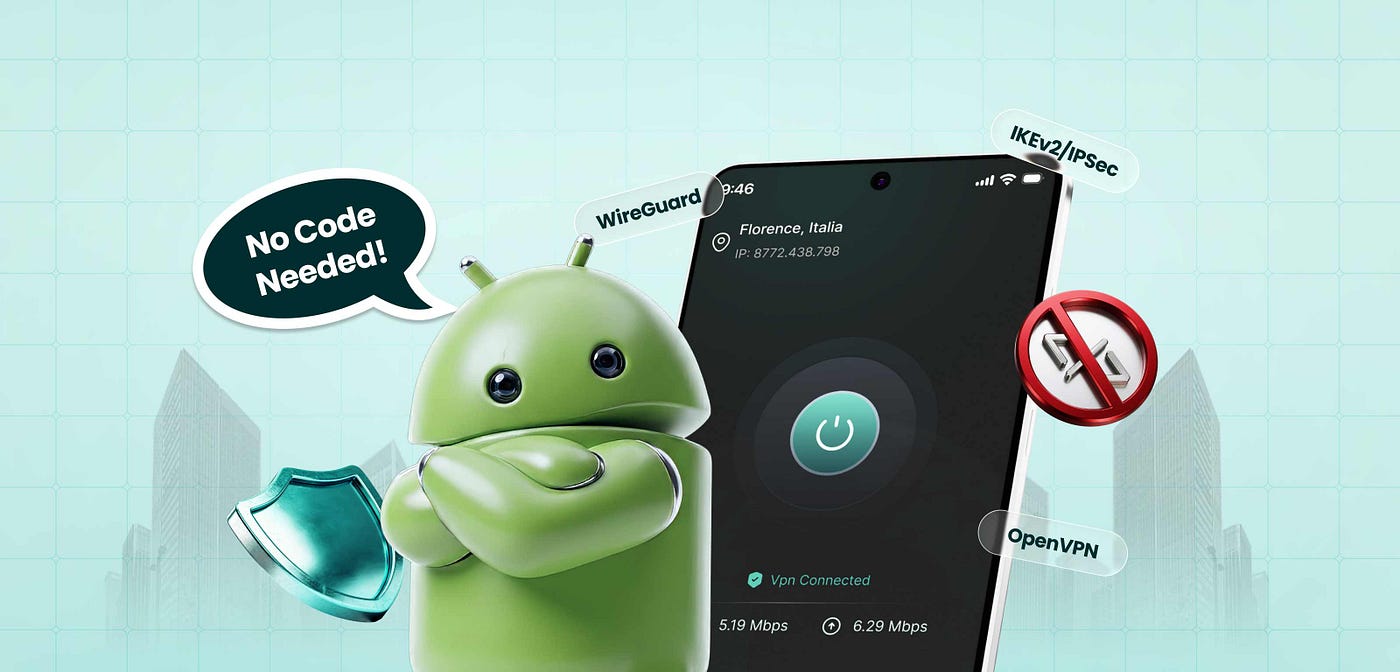
Most Android VPN platforms commonly use:
- WireGuard
- OpenVPN
- IKEv2/IPSec
WireGuard has become especially popular because of its:
- Faster connection speed
- Lower battery consumption
- Lightweight architecture
- Better mobile performance
However, protocol selection is not only about speed.
For example, WireGuard improves performance significantly, but it also requires carefully engineered privacy systems for secure session handling and no-log architecture.
That backend complexity is something many no-code VPN founders underestimate early.
Step 3: Use White-Label VPN Systems Carefully
White-label VPN systems provide one of the fastest ways to enter the VPN market.
Most platforms include:
- Android VPN app templates
- Integrated server systems
- Subscription management
- Authentication systems
- Admin dashboards
- Protocol integration
This allows startups to focus more heavily on:
- Branding
- User acquisition
- Market positioning
- Growth strategy
However, there is a hidden tradeoff many founders miss.
Some low-quality white-label VPN providers create infrastructure lock-in, making migration expensive once user growth accelerates.
Others rely on overcrowded shared servers that reduce connection quality under higher traffic loads.
Infrastructure quality matters far more than most startups initially realize.
Step 4: Optimize Infrastructure Earlier Than You Think
One hidden reality in VPN app development is how quickly infrastructure costs can escalate.
Even relatively small Android VPN applications require:
- Stable server routing
- Traffic balancing
- DNS management
- Performance monitoring
- Backend optimization
Poor backend planning often leads to:
- Slow connection speeds
- Frequent disconnects
- Battery drain
- Server overload
- High user churn
Many founders focus heavily on launching quickly but underestimate how difficult maintaining server quality becomes as user volume grows.
User Experience Is Now a Competitive Advantage
The VPN market has become highly competitive.
Users expect Android VPN apps to provide:
- One-click connectivity
- Fast server switching
- Minimal battery usage
- Stable mobile performance
- Reliable uptime
- Clean onboarding experience
VPN apps also request highly sensitive device permissions, which means users often judge trustworthiness within seconds of opening the app.
Even technically secure VPN products struggle if performance feels slow or unreliable.
In 2026, user retention depends just as much on usability and stability as it does on encryption.
Security and Compliance Still Matter
Many startups focus heavily on launch speed while overlooking security governance.
This creates serious long-term risk.
Modern VPN products must address:
- No-log architecture
- DNS leak prevention
- GDPR compliance
- Infrastructure monitoring
- Access management
- Security auditing
Trust is one of the most valuable assets in the VPN industry. Once lost, it becomes extremely difficult to recover.
Why Businesses Partner With Professional VPN Development Teams
While white-label systems reduce coding requirements, scalable VPN app development still requires expertise across:
- Cybersecurity engineering
- Backend systems
- Protocol optimization
- Cloud architecture
- Performance engineering
- Operational scaling
Kolpolok Limited helps startups and businesses launch secure VPN products with scalable backend systems, protocol optimization, and long-term performance engineering designed for real-world growth.
Final Thoughts
Creating a VPN in Android without building everything from scratch is more achievable than ever in 2026. White-label platforms, SDKs, and managed backend services have made VPN app development significantly more accessible for startups entering the cybersecurity market.
But the VPN businesses succeeding long term are not simply launching faster — they are building stronger backend systems, optimizing scalability earlier, and creating better user experience from the beginning.
In the modern cybersecurity market, backend quality is no longer just a technical advantage. It is a business advantage.
메타데이터
- post_id
- eeb8f718c434
- slug
- how-to-create-a-vpn-in-android-without-coding-2026-guide-eeb8f718c434
- url
- https://medium.com/@kolpolok/how-to-create-a-vpn-in-android-without-coding-2026-guide-eeb8f718c434
- canonical_url
- https://medium.com/@kolpolok/how-to-create-a-vpn-in-android-without-coding-2026-guide-eeb8f718c434
- author_url
- https://medium.com/@kolpolok
- status
- ok
- fetched_at
- 2026-07-09 20:10:33