Diverse Minds Create Richer Solutions
Great minds don’t think alike… but they can learn to think together!
Diverse Minds Create Richer Solutions
Great minds don’t think alike… but they can learn to think together!
In today’s article, discover the power of Cognitive Styles and how understanding diverse ways of thinking can transform your team’s collaboration. By appreciating each person’s unique approach, you can unlock new levels of creativity and problem-solving. Start thinking differently and watch your team achieve more together.
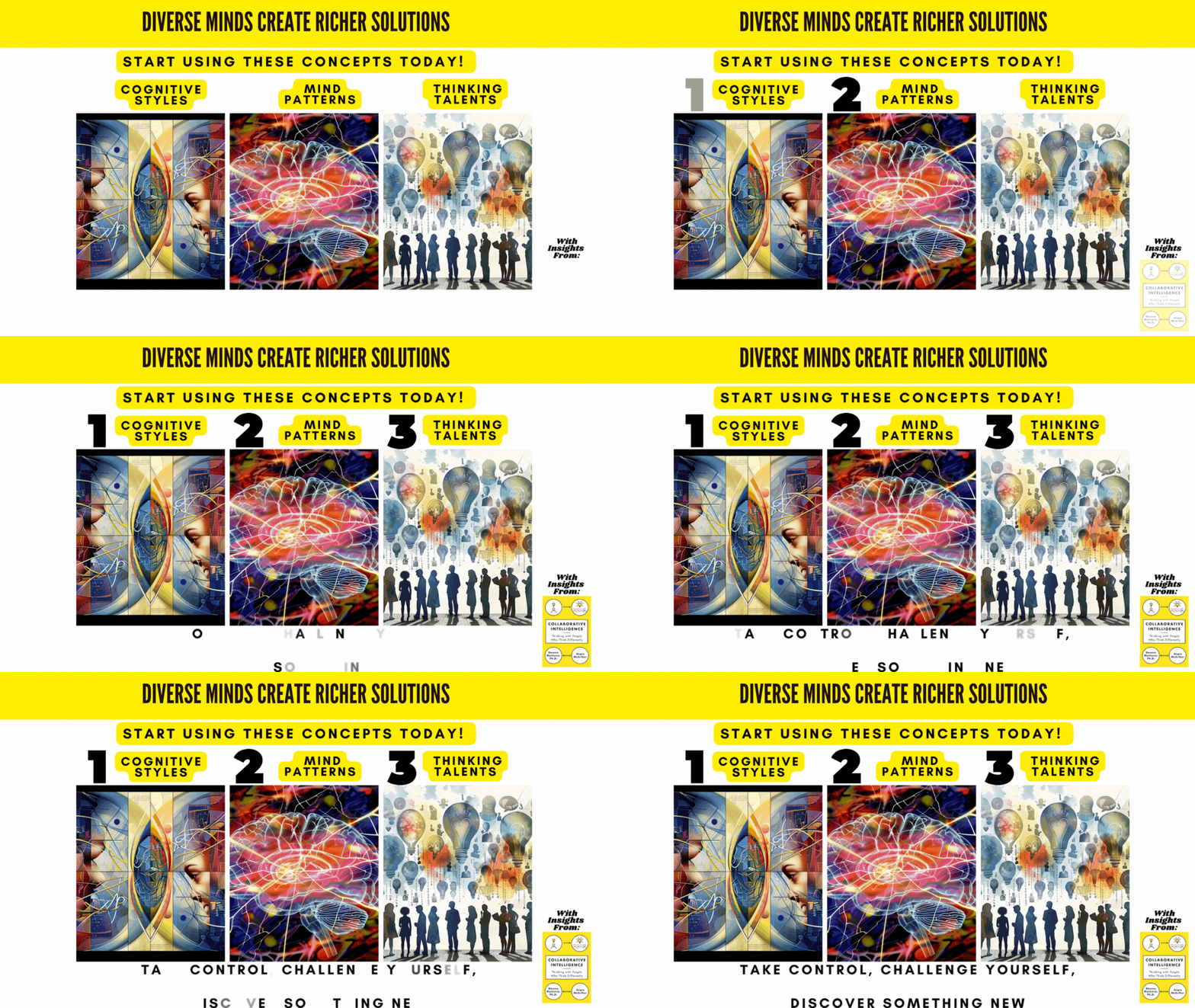
IN TODAY’S ARTICLE:
1. 📖“Collaborative Intelligence” Overview
2. 💪Put Three Concepts into Practice Today
- Cognitive Styles: Diverse minds create richer solutions
- Mind Patterns: Perspective shifts unlock new possibilities
- Thinking Talents: Nurtured strengths lead to collective excellence
3. 👀 See the Concepts in Action!
- Read the Short Story ’Blueprints of the Mind: Building Beyond Boundaries’
- Gain Wisdom the Fable ‘The Wisdom of the Wild: Unity in Diversity’
4.🌳How to Grow Your Professional Network in 30 Seconds
5. 🧠Interested in Expanding Your Mind More? Check out these.
i Some links on this page are affiliate links
1. 📖 “Collaborative Intelligence” OVERVIEW
“The most significant gift our species brings to the world is our capacity to think. The most significant danger our species brings to the world is our inability to think with those who think differently.”
Dawna Markova and Angie McArthur’s ‘Collaborative Intelligence’ illuminates the power of cognitive diversity and effective communication in fostering successful collaboration, urging professionals to unlock their potential by understanding and leveraging their unique collaborative skills. Are you ready to discover how your unique collaborative intelligence can elevate your ability to work with others and lead to unparalleled success?”
AMAZON: Audiobook (8 hours, 47 minutes) and book available:
*BLINKIST (here): **19 minute in-depth audio book summary***
2. 💪PUT THREE (3) KEY CONCEPTS* FROM THE BOOK INTO PRACTICE TODAY
Let’s dive into each concept, learn practical ways to put them into practice, and expand our understanding by seeing how Business Leaders, Educators, Human Resources Professionals, Innovation Managers, and Team Leaders can use these concepts.
1️⃣ Cognitive Styles
2️⃣ Mind Patterns
3️⃣ Thinking Talents
*You’ll find several more concepts in the book
1️⃣COGNITIVE STYLES
“Great minds don’t think alike… but they can learn to think together!”
Cognitive Styles are a cornerstone concept in “Collaborative Intelligence,” highlighting the diverse ways individuals process information and approach problems.
You learn that everyone has a preferred way of thinking, categorized into four quadrants: analytical, procedural, relational, and innovative. Understanding these styles shows you how to better navigate interactions and collaborations by appreciating the different perspectives each style brings to the table. It’s about recognizing and valuing the unique cognitive approaches of your colleagues and yourself, enhancing teamwork and problem-solving.
Implementing Cognitive Styles is like conducting a symphony orchestra.
Each section of the orchestra (strings, woodwinds, brass, percussion) brings a unique sound to the performance, much like how each cognitive style contributes a distinct perspective to a team. The conductor (team leader) must understand how to harmonize these different sounds (styles), directing them to play together in a way that creates a beautiful, cohesive piece of music.
Imagine you’re conducting an orchestra where each section represents a different cognitive style. How would you ensure that all sections contribute harmoniously to the performance?
Page-to-practice ideas to show you how to use this concept:
- Analytical thinkers: You can leverage your ability to process data and facts by spearheading projects that require critical analysis and precision. Focus on analyzing data for projects. Break complex problems into smaller parts to solve more effectively.
- Procedural thinkers: You excel in understanding processes and logistics. Use your understanding of processes to optimize team workflows, improving efficiency and productivity.
- Relational thinkers: Your strength lies in empathy and understanding emotions. Use empathy to resolve team conflicts by actively listening and finding common ground, strengthening team cohesion.
Page-to-practice ideas tailored to:
- Business Leaders: By understanding and identifying the cognitive styles of your team members, you can better assign tasks that match their natural way of thinking. For analytical thinkers, assign them to roles that require data analysis and critical thinking. This ensures everyone is working in their zone of genius, leading to higher productivity and satisfaction.
- Educators: Recognize the diverse cognitive styles in your classroom to tailor teaching methods accordingly. For students who show a procedural thinking style, incorporate step-by-step instructions in your lessons. This personalized approach can enhance learning outcomes and student engagement.
- Human Resources Professionals: Use knowledge of cognitive styles to design training programs that cater to all employees. For relational thinkers, include group activities that foster teamwork and empathy. This makes training more effective and inclusive.
- Innovation Managers: Foster a culture of innovation by leveraging the diverse cognitive styles of your team. Encourage innovative thinkers to lead brainstorming sessions, while analytical thinkers can evaluate the feasibility of ideas. This collaborative environment can lead to breakthrough innovations.
- Team Leaders: Build stronger, more cohesive teams by appreciating and utilizing the different cognitive styles of team members. For example, assign project management tasks to those with a procedural thinking style, ensuring projects are executed efficiently and effectively.
2️⃣MIND PATTERNS
“We habitually misread people and therefore miscommunicate with one another… [we need to learn] to fluidly shift the ways we communicate to accommodate others.”
Mind Patterns delve into how your brain engages with the world around you, focusing on the combination of attention types and perceptual channels.
This concept teaches you about the six distinct patterns that arise from the interplay of focused, sorting, and open attention with kinesthetic, visual, and auditory perceptions. By understanding your own and others’ mind patterns, you’re equipped to tailor your communication and collaboration strategies, ensuring more effective and empathetic interactions in both personal and professional settings.
Putting Mind Patterns into practice can be likened to looking through a kaleidoscope.
Just as turning the kaleidoscope creates an ever-changing pattern of colors and shapes, shifting between focused, sorting, and open attention offers new perspectives and solutions. Focused attention is like zooming in on one specific pattern, while sorting attention shifts the pieces to form a new image. Open attention allows all the colors and shapes to blend together, revealing unexpected and innovative patterns.
How often do you ‘turn the kaleidoscope’ to view your challenges and opportunities from different perspectives, and how could doing so more intentionally benefit you?
Page-to-practice ideas to show you how to use this concept:
- Focused attention: You can improve your concentration on single tasks by minimizing distractions in your workspace. For example, set specific times for checking emails and messages, allowing you to dedicate uninterrupted periods to your most critical work.
- Sorting attention: Enhance your ability to categorize and digest information by using tools like mind maps or lists. This helps in organizing your thoughts and ideas, making it easier to see the bigger picture and make informed decisions.
- Open attention: Foster creativity and innovation by allowing yourself time to daydream and ponder various possibilities. Schedule regular “thinking” breaks where you step away from direct tasks to let your mind wander, which can lead to breakthrough ideas and solutions.
Page-to-practice ideas tailored to:
- Business Leaders: Enhance decision-making by encouraging a mix of focused, sorting, and open attention among your leadership team. This ensures a balanced approach to problem-solving, combining detailed analysis, big-picture thinking, and creative insights.
- Educators: Adapt teaching strategies to cater to the various mind patterns of your students. For example, use open attention activities like brainstorming to stimulate creativity and engagement in learning.
- Human Resources Professionals: Implement recruitment and development strategies that acknowledge different mind patterns. This can lead to more dynamic teams capable of tackling complex problems from multiple angles.
- Innovation Managers: Promote an environment where different mind patterns are valued, encouraging employees to use their natural attention styles to contribute uniquely to innovation projects.
- Team Leaders: Recognize and utilize the distinct mind patterns within your team for problem-solving and project planning. This can enhance team performance and innovation by ensuring a variety of perspectives are considered.
3️⃣ THINKING TALENTS
“Market share determines who is right and who is wrong. Mind share asks what is possible.”
Thinking Talents highlight the innate capacities individuals have that energize and direct their thought processes.
From the book, you discover that each person possesses around five of these 35 distinct talents, shaping their unique form of intelligence and problem-solving abilities. This concept encourages you to identify and leverage your thinking talents, as well as those of your team members, fostering an environment where each person’s strengths are recognized, valued, and utilized for collective success.
Using your thinking talents is like gardening.
Just as a gardener knows that different plants require specific conditions to thrive — sunlight for some, shade for others, and varying amounts of water and nutrients — all individuals possess unique thinking talents that need the right environment and care to flourish. In a team setting, acknowledging and nurturing these diverse talents allows for a vibrant and productive garden, where every plant contributes its best to the overall landscape.
How can we adjust our team’s environment to better nurture the diverse thinking talents, ensuring each member, like a plant, grows to their full potential?
Page-to-practice ideas to show you how to use this concept:
- Creating intimacy: If this is one of your talents, use it to build deeper relationships within your team. Organize regular one-on-one meetings where team members can share not just work-related updates but also personal stories. This strengthens trust and collaboration.
- Making order: Use your knack for organization by helping your team prioritize their tasks and set clear, achievable goals. Your ability to see the order in chaos can guide your team through complex projects with ease.
- Taking charge: If you’re naturally inclined to lead, take the initiative in situations where direction is needed. Volunteer to lead new projects or guide your team through change. Your confidence and ability to motivate others can drive your team towards success.
Page-to-practice ideas tailored to:
- Business Leaders: Identify the thinking talents within your organization to better align roles and responsibilities. For example, those with a talent for creating intimacy could excel in client relations roles, enhancing customer satisfaction and loyalty.
- Educators: Understand the thinking talents of your students to foster a learning environment that maximizes their potential. Encourage students with a talent for making order to assist in organizing group projects or classroom activities.
- Human Resources Professionals: During recruitment and team formation, consider the balance of thinking talents to build well-rounded teams that are capable of both creative thinking and practical execution.
- Innovation Managers: Leverage the unique thinking talents of your team to drive innovation. Encourage those with a talent for taking charge to lead projects, ensuring that ideas are not only generated but also implemented effectively.
- Team Leaders: Utilize the thinking talents of your team members to assign tasks that play to their strengths. This not only increases job satisfaction but also team productivity and cohesion.
AMAZON: Audiobook (8 hours, 47 minutes) and book available:
*BLINKIST (here): **19 minute in-depth audio book summary***
3. 👀SEE THE CONCEPTS IN ACTION🏰📜
🏰Read the Short Story
Blueprints of the Mind: Building Beyond Boundaries
In the heart of a bustling city, nestled among the echoing sounds of progress and the relentless march of time, lived a young architect named Elara.
She was known for her innovative designs and a peculiar way of working that mystified her colleagues. Elara’s projects were not just buildings; they were embodiments of collaboration, innovation, and understanding.
Elara’s journey began with a challenging project: to design a community center that would serve as a beacon of unity and creativity. She knew that to succeed, she would need to apply her understanding of Cognitive Styles, Mind Patterns, and Thinking Talents.
Cognitive Styles: Elara observed her team, recognizing the diversity in their thinking. James was analytical, favoring data and logic, while Mia thrived on relational thinking, emphasizing emotions and teamwork. Elara devised a plan to blend these styles, ensuring each member’s approach was valued, leading to a harmonious and innovative design process.
Mind Patterns: Throughout the project, Elara encouraged her team to shift between focused, sorting, and open attention. In brainstorming sessions, she urged them to embrace open attention, allowing creativity to flow freely. During planning phases, focused attention took precedence, ensuring precision and detail. This fluidity between mind patterns enriched the project with both creativity and meticulousness.
Thinking Talents: Recognizing the unique talents of her team, Elara assigned roles that capitalized on these strengths. Leo’s talent for envisioning future possibilities made him the perfect lead for the sustainability aspect of the project, while Ava’s knack for creating intimacy ensured the community’s needs and dreams were deeply understood and integrated into the design.
As the community center took shape, it became clear that it was more than a building; it was a testament to the power of understanding and leveraging diverse cognitive styles, mind patterns, and thinking talents. The center was not only functional but also a source of inspiration, a place where every corner and curve told a story of collaboration and innovation.
The Moral of the Story: The story of Elara and her team illustrates that embracing the diversity of cognitive styles, mind patterns, and thinking talents within a team leads to unparalleled creativity, harmony, and success. It teaches us that understanding and leveraging these differences are key to achieving our collective goals.
AMAZON: Audiobook (8 hours, 47 minutes) and book available:
*BLINKIST (here): **19 minute in-depth audio book summary***
📜 Read the Fable
The Wisdom of the Wild: Unity in Diversity
In a land filled with diverse landscapes — rugged mountains, deep forests, vast plains, and serene lakes — lived four unique animals: Leo the Lion, who ruled the savannah with his analytical prowess; Cora the Owl, perched high in the forest, revered for her procedural acumen; Faye the Fish, who navigated the waters with relational finesse; and Gideon the Gazelle, who roamed the plains with an innovative spirit.
Each animal led their domain successfully, but a challenge arose when the seasons became unpredictable, affecting each area differently. They needed to find a way to adapt together, or they risked the well-being of their homes and the land they shared.
Leo focused on the data and patterns of the seasons, trying to predict the changes. Cora developed step-by-step plans for each area to respond to the immediate effects of the changes. Faye emphasized the importance of supporting each other, fostering a network of aid across the land. Gideon envisioned a future where they could harness the power of the changing seasons to their benefit.
Initially, they worked in isolation, each convinced their approach was best. However, as the seasons grew more erratic, it became clear that no single strategy was sufficient.
In a moment of inspiration, Faye called everyone to the Great Lake, a place where all territories intersected. Here, she proposed a union of their efforts, combining their unique cognitive styles and mind patterns.
Leo used his analytical thinking to understand the broader patterns of change, Cora organized their collective efforts with precision, Faye ensured that communication and support flowed freely among them, and Gideon inspired innovative solutions to use the changes to their advantage.
Together, they not only overcame the challenge but also thrived, creating a balanced ecosystem that was resilient to change. The diverse landscapes flourished like never before, interconnected and strong.
Moral of the Fable: The fable teaches that diversity in cognitive styles, mind patterns, and thinking talents is not just beneficial but essential for overcoming challenges. By embracing and integrating our differences, we can achieve far greater things than we can alone.
AMAZON: Audiobook (8 hours, 47 minutes) and book available:
*BLINKIST (here): **19 minute in-depth audio book summary***
4. 🌳GROW YOUR PROFESSIONAL NETWORK IN 30 SECONDS
Feel free to send me a connection request on LinkedIn — it’s always great to meet new professionals!
https://www.linkedin.com/in/kcbarr/
5. 🧠INTERESTED IN EXPANDING YOUR MIND MORE? CHECK OUT THESE SERIES:
메타데이터
- post_id
- eebb2f4ab3bf
- slug
- diverse-minds-create-richer-solutions-eebb2f4ab3bf
- url
- https://medium.com/@kcbarr/diverse-minds-create-richer-solutions-eebb2f4ab3bf
- canonical_url
- https://medium.com/@kcbarr/diverse-minds-create-richer-solutions-eebb2f4ab3bf
- author_url
- https://medium.com/@kcbarr
- status
- ok
- fetched_at
- 2026-07-19 20:33:55