Special Extended Kaluza-Klein Theory: Topological Electrodynamics
Part I: Geometry of Energy Bands, Topology of Atomic Orbitals, and the Interdimensional Nature of Electric Current
Special Extended Kaluza-Klein Theory: Topological Electrodynamics
Part I: Geometry of Energy Bands, Topology of Atomic Orbitals, and the Interdimensional Nature of Electric Current
Abstract
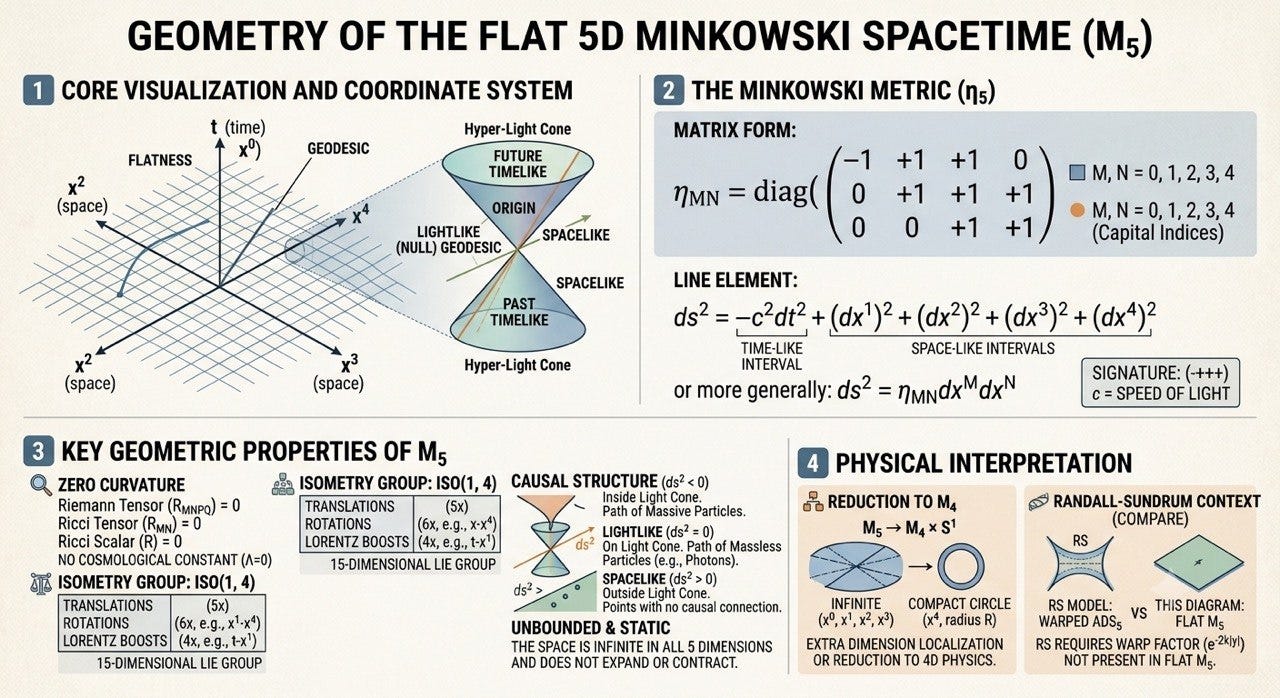
This paper lays the theoretical foundations of the Special Extended Kaluza-Klein (SEKK) theory — an independent extension of the General Extended Theory, focused on a purely geometric and topological description of electromagnetic phenomena. Traditional electrodynamics and condensed matter physics operate with the concepts of point charges, statistical probabilities, and abstract energy barriers. Within the framework of SEKK, a fundamental revision of these concepts is proposed: physical mass is postulated as a marker of the local topology of the state space, energy bands (including the bandgap and Dirac cones) are interpreted as geometric properties of the metric, and the electron orbital is defined as a macroscopic topological knot (domain wall) separating the curled-up 4D vacuum of external space and the unfolded 5D cavity inside the atom. It is shown that the classical radius of the electron orbit is a strict function of the vacuum expectation value (VEV) of the Higgs field and geometric constants. Based on this, a new model of alternating electric current is derived as a dynamic process of continuous phase transition and energy transfer between the 4D brane and the 5D bulk.
Introduction: From Abstract Entities to Pure Geometry
Modern theoretical physics faces a conceptual crisis when attempting to unify quantum mechanics, field theory, and spacetime geometry. In standard electrodynamics, the concept of “energy” is often used as an abstract substance, concealing the true mechanics of field interactions.
Within the framework of the Special Extended Kaluza-Klein (SEKK) theory, a fundamental postulate is introduced: energy and mass are not independent entities or “fillers” of an empty vacuum, but are markers of the topological state of a multidimensional continuum. What is termed an “energy action” in classical physics (such as photon absorption or thermal excitation) is formalized in SEKK as the transfer of a quantum of metric deformation — a topology of the second type acting upon the stationary geometric state of the system (topology of the first type).
The purpose of Part I of this work is to synthesize the concepts of the band structure of solids with the geometry of the Higgs field and the multidimensional metric, rigorously proving the topological nature of atomic structures and electric current.
Section I. Topological Nature of Semiconductors and Conduction Band Deformation
Section II. The Electron Orbital as a Topological Knot at the 5D/4D Boundary
Section III. Electrodynamics as an Interdimensional Phase Transit (Alternating Current)
Section IV. Time as a Phase Lag in Multidimensional Continuum Impedance
Full article (Google Docs) EN:
https://docs.google.com/document/d/15XdPMLxSOCrl_uaZB0TewX1zMyZFQmRJj5sPuS4os-g/edit?usp=sharing
Full article (Google Docs) RU:
https://docs.google.com/document/d/18kMBxGHZFi01RifKt_7xqwhcESBiOPwGztvQT2aEL3w/edit?usp=sharing
메타데이터
- post_id
- eecb869e068f
- slug
- special-extended-kaluza-klein-theory-topological-electrodynamics-eecb869e068f
- url
- https://medium.com/@chpelum/special-extended-kaluza-klein-theory-topological-electrodynamics-eecb869e068f
- canonical_url
- https://medium.com/@chpelum/special-extended-kaluza-klein-theory-topological-electrodynamics-eecb869e068f
- author_url
- https://medium.com/@chpelum
- status
- ok
- fetched_at
- 2026-07-18 11:12:31