8 Books You Should Definitely Read at Least Once in Your Life
The same ten books show up on every one of these lists, and not one of them is on this one.
8 Books You Should Definitely Read at Least Once in Your Life
The same ten books show up on every one of these lists, and not one of them is on this one.
I run a book club called the Useful Readers Club, and I get through somewhere north of 70 books a year, which means I am the person friends message when they want a recommendation, and I have started to quietly dread the question.
Because what most people actually want is for me to tell them to read The Alchemist or 1984 or Sapiens, the same ten books every single one of these lists has been recycling since before I could read, and I refuse to do it. You already know those books exist and may have probably bought a couple and let them sit on a shelf looking important. You do not need me for that.
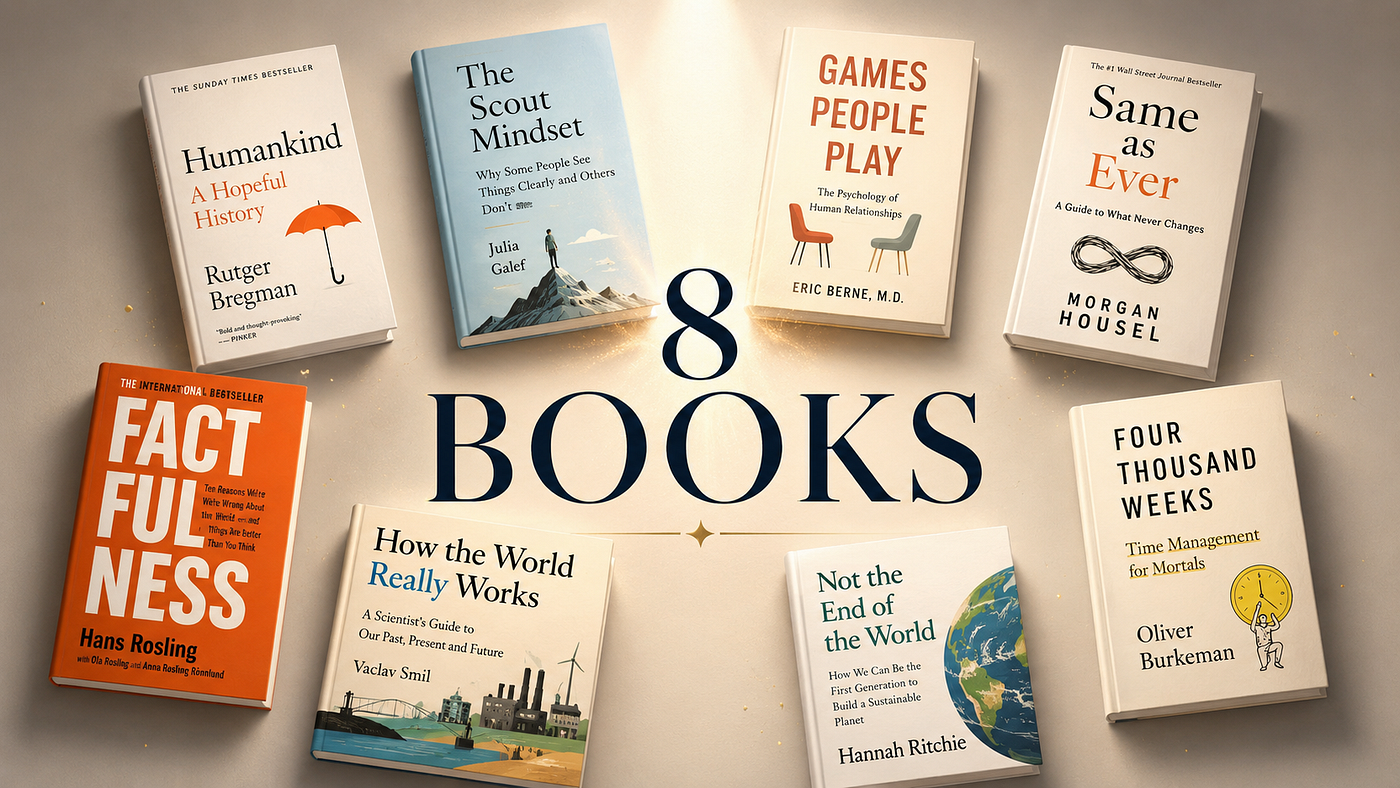
So this is the list I give people when they push me. 8 nonfiction books that did something to the way I think, none of which you will find on the usual before-you-die roundups, mostly because they are too new, too nerdy, or too strange to make the cut. One of them, I read the month I quit my job, which I will get to.
This post is the short version. The long version is something I actually built, because the recommendation question never stops, and eleven books was never going to cover it. It is a Notion database of 159 books I have read and filtered down over the years, sorted into nine categories, each one tagged with my rating, the difficulty, the tone, and a “read this if” line so you can match a book to whatever you are actually going through right now. No generic top-100 list scraped off the internet. Every book earned its slot by changing something real. It is $9, and you can grab it from the link below.
#1 Humankind by Rutger Bregman
There is a popular novel called The Lord of the Flies, which is actually the debut novel of British author William Golding. It's about a group of schoolboys who wash up on an island and turn feral inside a week.
The author of Humankind, Bregman, opens the book by pointing out that this actually happened, in 1965, to six boys from Tonga who got stranded on a rock in the Pacific for fifteen months, and they built a vegetable garden, set up a rota for keeping a fire going, made a guitar out of driftwood, and agreed that whenever two of them got into a fight they each had to go off to opposite ends of the island and cool down before anyone was allowed to talk again. The entire time they spent on that island, nobody got eaten or killed; in fact, they were healthier when the rescue boat finally turned up than when they left.
The rest of the book is the author basically taking a blowtorch to every famous study you have ever heard quoted to prove that people are secretly monsters. The prison experiment, the woman who supposedly got stabbed while thirty-eight neighbors watched and did nothing, all of it turns out to be staged, exaggerated, or flat-out wrong.
I read this book the same year I walked away from a stable salary to write on the internet for a living, which only works if you are willing to bet that a few thousand strangers will behave decently enough to keep showing up and paying for your stuff. So far, the strangers have held up their end better than most companies I have worked for, and this book is the closest thing I have to an explanation for why.
#2 The Scout Mindset by Julia Galef
The central idea in this book is that you can hold a belief like a soldier defending a fort, where being wrong feels like losing, or like a scout climbing a hill to see what is really out there, where being wrong just means you drew the map better and move on.
I would love to tell you I am a scout, but unfortunately, I am a soldier most of the time, especially in the comments under my own posts when someone tells me I am wrong about something I wrote, and I feel my blood pressure do something it should not be doing over something so small.
This book is basically a gym for catching that reflex and choosing the other thing instead. It is short, it is not preachy, and it has aged far better than the rest of the thinking-about-thinking shelf.
#3 Games People Play by Eric Berne
This book is from 1964, and it reads like it, so give it a chapter before you bail. The author argues that a large part of what looks like normal conversation is people running the same hidden little routines on each other, over and over, without anyone admitting it.
The friend who asks for advice and then shoots down every single thing you suggest, because they never wanted advice; they just wanted an audience. The relative who keeps a running scoreboard of everything you have ever done wrong so they can cash it in during the next argument. He gives these games names, and once you have the names, you cannot stop seeing them everywhere.
I spotted one of my own about thirty pages in. There is a sponsor who went silent on me for a year and then came back with a very warm email about how my rates were too high because they had tracked no real impact from the last campaign, which is a move designed to make me feel guilty and drop my price before I have even noticed I am negotiating against myself. Berne has a name for that kind of thing, too. I did not drop the price. Small win, but I will take it.
#4 Same as Ever by Morgan Housel
Everybody and their cousin has read his money book by now, so I am pointing you at this one instead. It is about the small handful of things that never change, no matter how much the world around them does. You know things like the way people lose their heads when they are scared, the way a good story beats a true statistic every single time, and the way comfort quietly sets up the next disaster while everyone is feeling safe.
The book has short chapters, each with one idea built around a story you actually remember afterward. I work in tech, where the entire culture is built on sprinting after whatever is new, so a whole book about what stays exactly the same landed on me harder than it probably should have.
#5 Factfulness by Hans Rosling
The author of this book, Rosling, spent years giving rooms full of clever people a little multiple-choice quiz about the actual state of the world. Most of them were basic stuff like what share of girls finish school, whether extreme poverty is rising or falling, and how many kids get vaccinated.
The people who took the quiz were mostly professors and journalists, and the Davos private-jet crowd, and they did worse than if they had just guessed at random. A chimpanzee throwing darts at the answer sheet would have beaten them.
The author’s point is not that these people are stupid; it is that almost all of us are walking around with a picture of the world that froze sometime around 1995, so we are convinced everything is falling apart when most of the things that matter have actually been getting better for decades.
I spend an embarrassing share of my day inside news feeds because it is genuinely part of the job, and that is exactly the diet that rots your sense of reality, so this was less a fun read and more a factory reset for my brain.
#6 How the World Really Works by Vaclav Smil
Smil is the writer Bill Gates reads when he wants to feel less optimistic, which should tell you the vibe here. The author is a very calm man who explains the four unglamorous things modern life is actually built on: ammonia, steel, concrete, and plastic.
The ammonia chapter on its own is worth the whole book. Roughly half the people alive on the planet right now are fed by synthetic fertilizer, which means that without a single chemical reaction worked out in a German lab in 1909, billions of us would simply never have existed. You and me, quite possibly included.
It drags in places, and I am not going to pretend otherwise. But I write about technology for a living, which means I spend my weeks buried under launches and keynotes and people swearing that this particular technology is about to change everything forever, and there is no better cure for that than a book that walks you slowly through how long and hard it is to change anything physical in the real world. Read it, and you will stop falling for the hype for the most part.
#7 Not the End of the World by Hannah Ritchie
Ritchie is a data scientist at Our World in Data, and if you are constantly surrounded by climate dread, this is one of those rare books that take the whole thing seriously without making despair the only honest response. The author goes through one piece at a time, including air, food, energy, plastic, waste, and presents real numbers for everything.
I keep a terrace garden, which sounds very peaceful right up until you are standing on a Chennai rooftop in April, wondering whether any of it means anything while the whole city slowly bakes. This book did not exactly make me feel great, but it did point me to the unsexy stuff that changes the math, instead of the performative things that just make you feel like you did something, and that’s far more useful than another round of guilt.
#8 Four Thousand Weeks by Oliver Burkeman
Fine, this is the one well-known book on the list, so dock me a point if you have to, but it earns its place. While it looks like just another productivity book, once you actually read it, you realize it is not trying to help you control your time but to convince you that you never will, and that the trying is the very thing eating away at the life you want to live.
The whole argument of this book is that a human life is only about 4000 weeks, and you have already burned through a chunk of yours. I used to often tell myself that if I could just find the right system, I could fit it all in: the work, the reading, the family, the business, and the better version of myself I was always just about to become.
Watching a film with my wife used to feel like theft from some future me who would have spent those two hours more wisely. I read this book the month before I handed in my notice. I am not going to claim it made the decision for me, but it did take away the excuse I was hiding behind.
If you are only going to pick up one, start with Humankind or Factfulness, as they go down easily, and they will mess with your head in the right way. And if you have a book that belongs on a list like this one and somehow never shows up on any of them, send it my way. Finding those is half the reason I started the book club.
One more thing, since you made it to the end. The uncomfortable part of reading 70 books a year is that most of them leak straight back out. You finish, you highlight 20 passages, and a month later the whole thing has dissolved into someone else’s good points while your actual life keeps running exactly as it did before. I got tired of that, so I built a fix for myself and then turned it into something you can use. It is a 30-day journal, and you take one book, pull one specific change out of it, sign your name to it, and run it as a real experiment for a month, one question a day. By day 30 the idea is not an idea anymore, it is something you do. Check it out below:
메타데이터
- post_id
- eed8d14f3bee
- slug
- 8-books-you-should-definitely-read-at-least-once-in-your-life-eed8d14f3bee
- url
- https://medium.com/the-useful-life/8-books-you-should-definitely-read-at-least-once-in-your-life-eed8d14f3bee
- canonical_url
- https://medium.com/the-useful-life/8-books-you-should-definitely-read-at-least-once-in-your-life-eed8d14f3bee
- author_url
- https://medium.com/@raja96
- status
- ok
- fetched_at
- 2026-06-20 20:29:01