Beyond the APY Trap: Why Capital Efficiency Is the Real Product in DeFi
For years, DeFi competed on one number:
Beyond the APY Trap: Why Capital Efficiency Is the Real Product in DeFi

For years, DeFi competed on one number:
APY.
Protocols raced to display the highest yield. Users chased triple-digit returns. Liquidity flowed wherever the percentage was biggest.
Yield became the product.
But here’s the twist:
The highest APY is rarely the most efficient use of capital.
In mature financial systems, yield is not the product. Capital efficiency is.
And DeFi is finally entering that phase.
The APY Illusion
The early era of DeFi was defined by incentives. Emissions were high. Rewards were aggressive. Capital was mercenary.
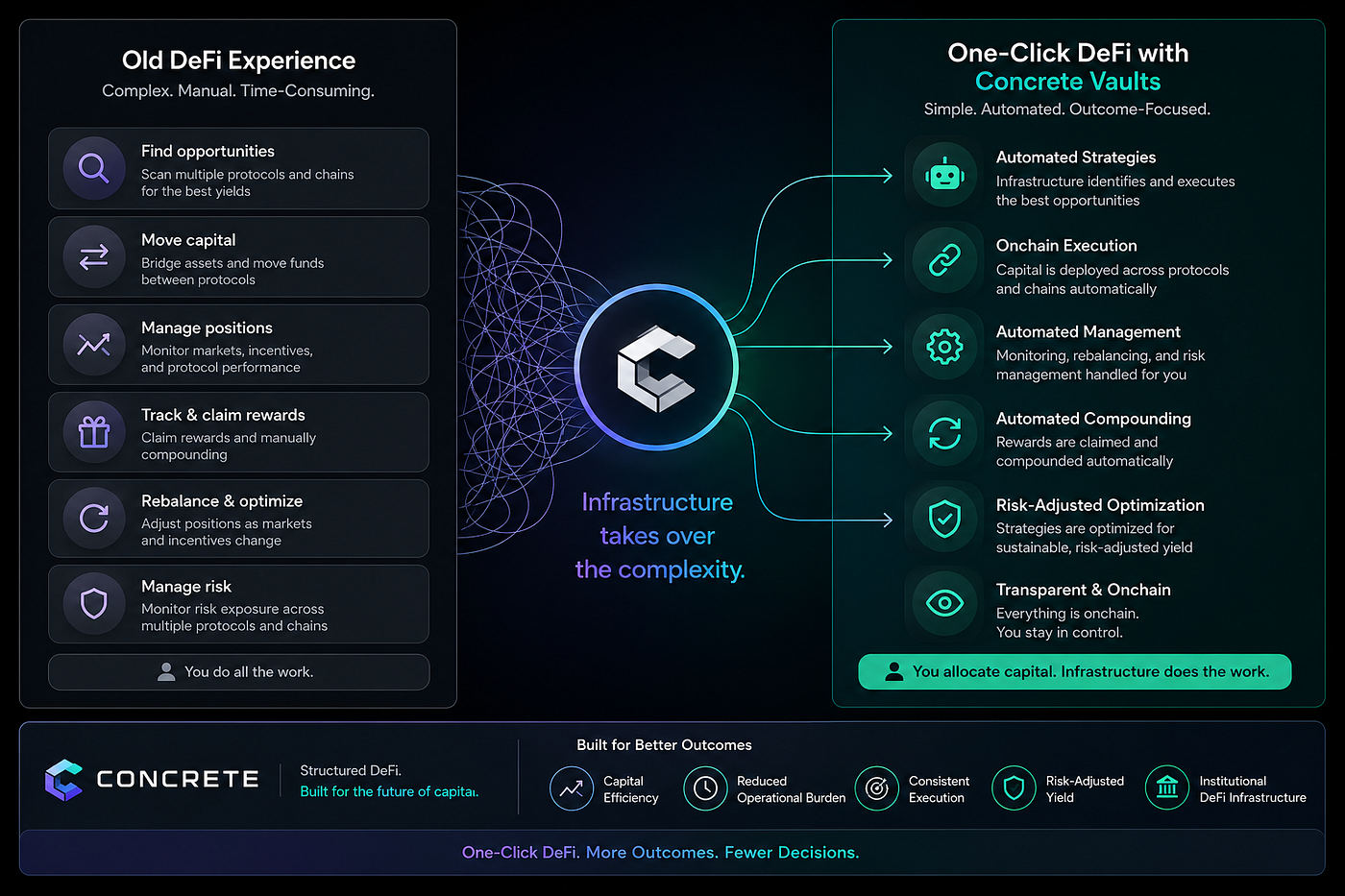
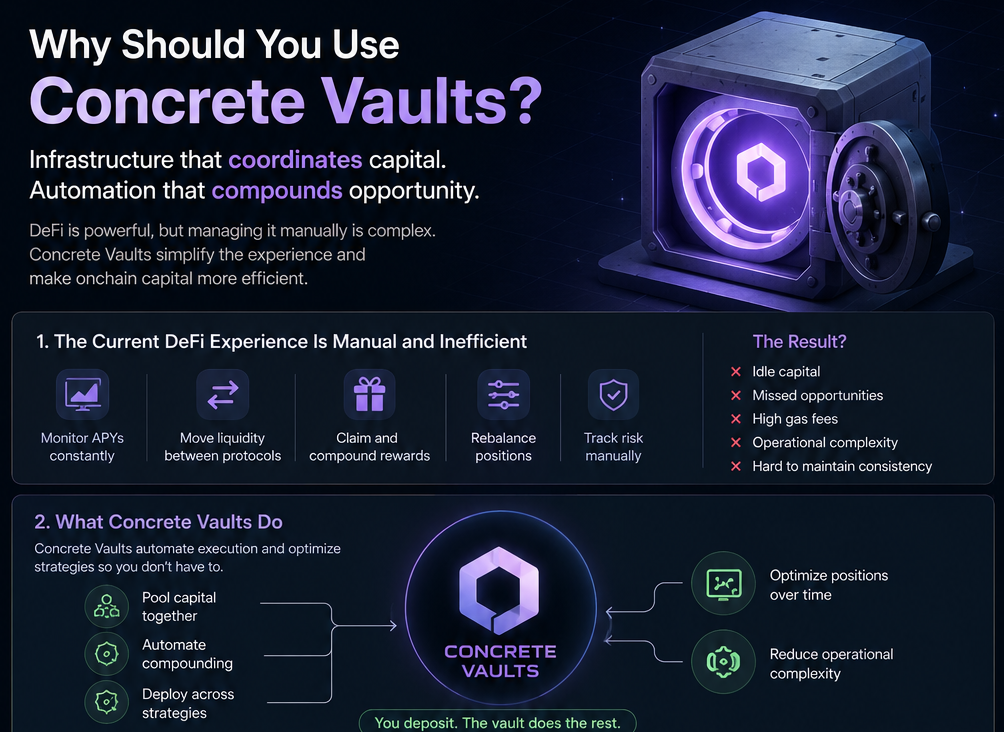
Users jumped from pool to pool paying gas, bridging chains, absorbing slippage, all in pursuit of the next headline APY.
But what actually happened?
- Rewards diluted
- Incentives collapsed
- Gas ate compounding
- Idle capital accumulated
- Risk spiked relative to return
Chasing yield often destroyed capital efficiency.
The industry optimized for visible yield, not effective deployment.
And those are very different things.
What Capital Efficiency Actually Means
Capital efficiency sounds technical, but the intuition is simple.
It means your capital is:
- Working continuously — no idle downtime
- Minimizing opportunity cost — always allocated to its best use
- Optimized for risk-adjusted yield, not raw APY
- Compounding automatically, without operational friction
- Reducing unnecessary transactions
- Avoiding volatility drag
- Allocated with intention, not emotion
Think of capital like inventory in a business.
If it’s sitting on the shelf, it’s inefficient. If it’s deployed intelligently, it compounds.
That’s capital efficiency.

Concrete Vaults
Why Most of DeFi Is Actually Inefficient
Ironically, much of DeFi today is structurally inefficient.
Idle Liquidity
Billions sit underutilized in pools that aren’t fully borrowed or optimally deployed.
Emission-Driven Yield
High APYs often come from token subsidies, not productive capital use. When emissions stop, yield disappears.
Gas Friction
Manual compounding and repositioning eats returns, especially for smaller allocators.
Liquidity Mercenaries
Short-term capital floods into incentives and exits just as quickly, destabilizing pools.
Manual Management
Users are forced to act like portfolio managers, constantly monitoring, reallocating, reacting.
The result?
A system that optimizes for yield optics instead of efficient onchain capital allocation.
The Shift: DeFi Vaults as Capital Allocators
The next phase of DeFi isn’t about higher yields.
It’s about smarter capital deployment.
This is where Concrete vaults represent a structural shift.
Instead of being passive yield wrappers, Concrete vaults are designed as active capital allocators infrastructure for managed DeFi.
They:
- Aggregate liquidity to improve allocation efficiency
- Automate rebalancing across strategies
- Minimize idle capital
- Enable automated compounding
- Optimize allocation over time
- Target risk-adjusted yield instead of raw APY
This reframes DeFi vaults entirely.
They are no longer farming tools.
They are capital engines.
Concrete Vaults as an Efficiency Engine
What makes Concrete different is architectural.
Concrete vaults are built around active capital management:
Allocator
The portfolio brain. Dynamically manages exposure across strategies to optimize deployment.
Strategy Manager
Defines the controlled strategy universe, ensuring capital flows only into vetted, structured opportunities.
Hook Manager
The risk enforcement layer. Implements guardrails and constraints that maintain defined risk boundaries.
Risk-Adjusted Allocation
Concrete optimizes for capital efficiency, not yield marketing. That means prioritizing sustainable, risk-aware deployment.
Continuous Compounding
Rewards are reinvested automatically, reducing friction and operational drag.
ctASSETs as Capital Primitives
ctASSETs abstract strategy complexity into clean, standardized capital units making allocation scalable, composable, and institutional-ready.
Concrete doesn’t just “offer yield.”
It engineers efficient capital flows.
That is a very different product.
Why Institutions Care
Retail users often chase yield.
Institutions optimize deployment.
Institutional DeFi isn’t driven by hype cycles, it’s driven by:
- Predictability
- Capital preservation
- Defined risk boundaries
- Scalable allocation
- Cleaner accounting
- Lower operational drag
- Measurable risk-adjusted yield
Institutions don’t want to jump farms.
They want structured, managed DeFi exposure.
Capital efficiency is how institutional capital evaluates systems.
And DeFi will not mature without it.
The Bigger Shift
Every financial system evolves the same way:
Phase 1: Speculation Phase 2: Incentives Phase 3: Infrastructure
DeFi is entering Phase 3.
The future won’t be defined by emissions wars.
It will be defined by:
- Capital efficiency over APY
- Risk-adjusted yield over headline returns
- Onchain capital allocation over yield chasing
- Managed DeFi over manual farming
- Infrastructure over hype
Vaults become the default interface.
Allocation becomes the core primitive.
Efficiency becomes the product.
Explore Concrete at app.concrete.xyz
메타데이터
- post_id
- eed9517ff1c0
- slug
- beyond-the-apy-trap-why-capital-efficiency-is-the-real-product-in-defi-eed9517ff1c0
- url
- https://medium.com/@I_SODL/beyond-the-apy-trap-why-capital-efficiency-is-the-real-product-in-defi-eed9517ff1c0
- canonical_url
- https://medium.com/@I_SODL/beyond-the-apy-trap-why-capital-efficiency-is-the-real-product-in-defi-eed9517ff1c0
- author_url
- https://medium.com/@I_SODL
- status
- ok
- fetched_at
- 2026-07-08 00:36:00