Part 4 — Why Transformations Fail: Resistance, Fear, and What to Do About Them
This is the fourth article in a five-part series inspired by Marty Cagan’s 2024 book Transformed, exploring the Product Operating Model…
Part 4 — Why Transformations Fail: Resistance, Fear, and What to Do About Them
This is the fourth article in a five-part series inspired by Marty Cagan’s 2024 book Transformed, exploring the Product Operating Model from a personal point of view. A look at the less linear side of change — why it stalls, where resistance comes from, and how to turn it into learning.
Not every transformation feels inspiring up close. In theory, it sounds exciting. In practice, it challenges beliefs, habits, and comfort zones. The Product Operating Model is no exception. It questions old power structures, redefines leadership, and invites teams to take on a kind of ownership that demands vulnerability. And it is precisely at that point that resistance appears.
Understanding resistance
Resistance is not an external obstacle; it is a natural human reaction. Every significant change generates fear — fear of losing control, relevance, or safety. In organizations, that fear takes different forms:
- In leadership, as difficulty letting go of control.
- In teams, as fear of making mistakes or being exposed.
- In culture, as attachment to old processes that once seemed to work.
Recognizing these reactions is not a sign of weakness but of awareness. The first step in transforming resistance is to see it as data, not as an enemy.
As Marty Cagan explains in Transformed, most resistance is rooted in fear — not of change itself, but of losing control, relevance, or stability.
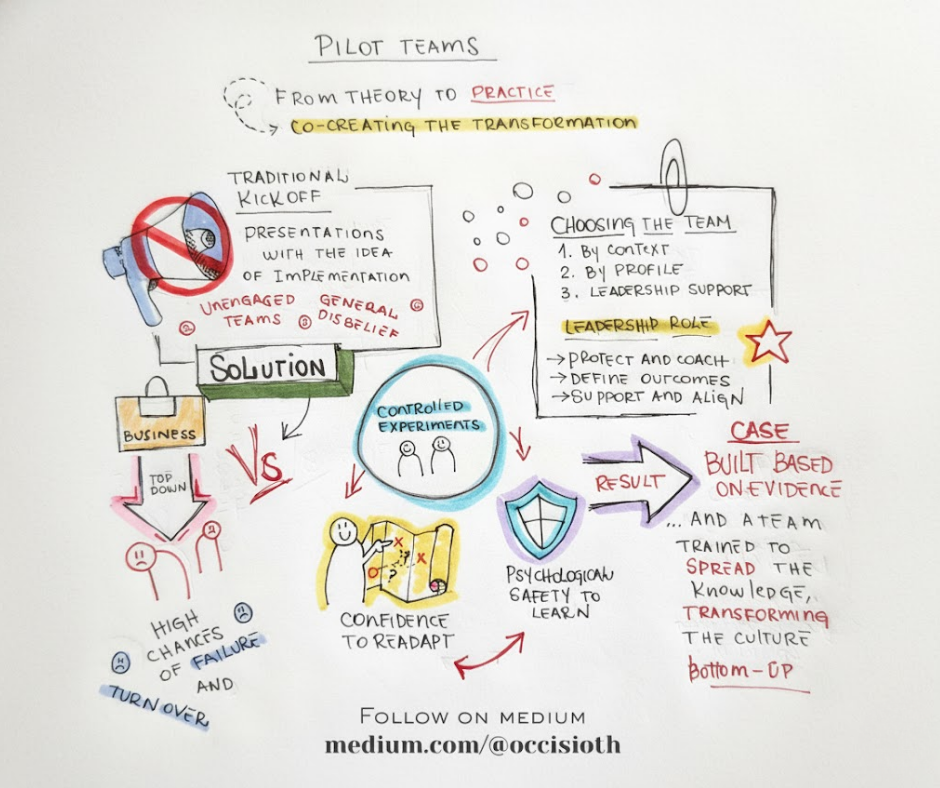
Resistance usually stems from the fear of loss — loss of control, status, or predictability. This fear intensifies when transformation is imposed from the top down, without context.
That is why communication needs to be transparent from the beginning. People must understand why the change is happening and what it is meant to fix. It is not enough to say that the culture will change; leaders need to explain what was holding the company back and how the new model creates space for learning and growth.
Teams engage when they feel part of the construction, not when they feel like its target.
The role of leadership in moments of resistance
Leaders are the first thermometer of transformation. If they react defensively, the team mirrors that behavior. If they react with curiosity, the team learns.
The leader’s role in this moment is to replace pressure with listening and judgment with context. A few practices can help:
- Encourage open conversations about fears and uncertainty.
- Share learnings from other pilots or teams that have moved ahead.
- Reinforce that transformation is not a performance test but a process of evolution.
Leadership must stay focused on progress, not perfection. Cultural transformation is an iterative process.
Resistance as feedback
Resistance is a form of feedback. Instead of fighting it, the Product Operating Model encourages companies to listen. Each objection is a clue about what still needs to be adjusted:
- “That will never work here.” → Lack of context or internal examples.
- “We do not have time for discovery.” → Incentives still tied to delivery, not learning.
- “My manager will never approve this.” → Lack of real autonomy or clarity on outcomes.
These statements are not barriers; they are cultural data points. Each one reveals a piece of the system that still operates with a project mindset.
The goal is to create an environment where these voices can be heard and translated into action. Resistance is not solved by persuasion but by evidence and consistency. When people see real results, fear starts to lose its power.
Tracking team health is tracking transformation
Transformation does not move forward through plans alone. It moves forward when people feel safe to experiment. Tracking team morale and well-being is a key part of that process.
A few simple questions can help take the pulse of the change:
- Do people understand the purpose of the transformation?
- Do they feel safe to test and fail?
- Do they feel supported by leadership?
These answers are as valuable as business metrics. Culture is measured by observing behaviors, not just results.
Learning as the antidote to resistance
Resistance fades as learning grows. The more a company experiments, gathers evidence, and shares success, the less space there is for skepticism. Every successful pilot, every validated insight, and every measurable outcome becomes fuel for transformation.
In the end, the organizations that overcome resistance are not the ones that avoid conflict, but the ones that learn to use discomfort as a driver for evolution.
✨ Sneak peek of the final chapter Part 5: Leading the Transformation — How to Sustain the Product Operating Model Over Time
Every transformation needs continuity. In the next article, we will talk about how to keep the Product Operating Model alive after the pilot phase, how to develop new leaders, and how to turn autonomy into a sustainable system. The goal is no longer to start the change but to sustain the learning.
⛳️ Product Operating Model articles:
메타데이터
- post_id
- eeda0b48aec0
- slug
- part-4-from-discovery-to-product-how-to-stop-shipping-software-and-start-delivering-value-eeda0b48aec0
- url
- https://medium.com/@occisioth/part-4-from-discovery-to-product-how-to-stop-shipping-software-and-start-delivering-value-eeda0b48aec0
- canonical_url
- https://medium.com/@occisioth/part-4-from-discovery-to-product-how-to-stop-shipping-software-and-start-delivering-value-eeda0b48aec0
- author_url
- https://medium.com/@occisioth
- status
- ok
- fetched_at
- 2026-06-28 10:39:35