The Truth About Alcohol and Your Heart
For a generation, a daily glass of red wine was sold as heart medicine. The better evidence has quietly taken that story apart. Here is…
The Truth About Alcohol and Your Heart
For a generation, a daily glass of red wine was sold as heart medicine. The better evidence has quietly taken that story apart. Here is what an interventional cardiologist actually tells patients now.
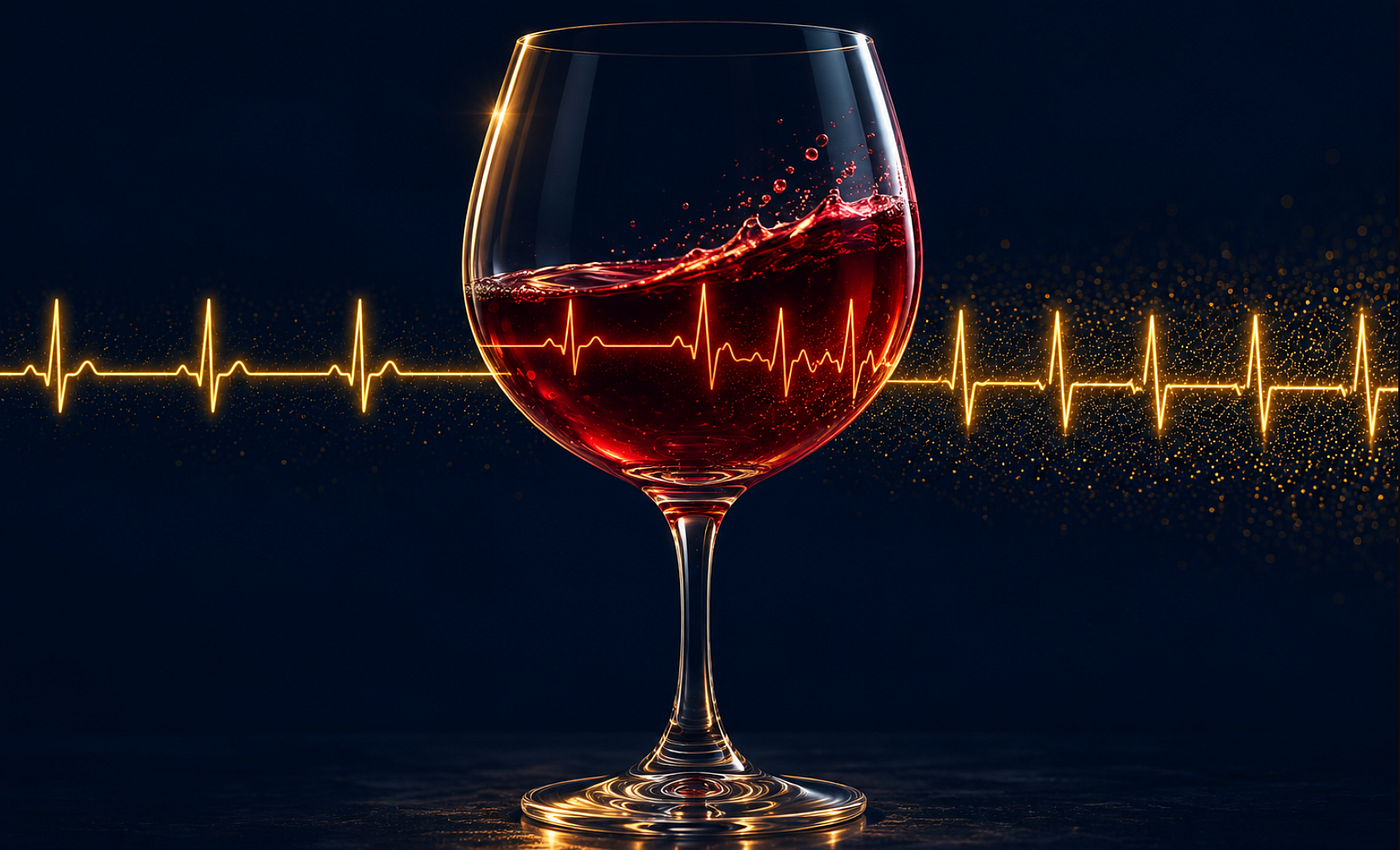
One drink is not a diagnosis. The habit, night after night, is something your heart keeps score of.
The patient who thought the wine was helping
Nadia was 54, careful about most things, and genuinely surprised to be in my clinic. She walked every morning, kept her weight steady, and had her cholesterol where she wanted it. She also had a glass or two of red wine most evenings, and she described it to me the way people describe a supplement. She believed it was protecting her heart. For most of my career, that is precisely what doctors like me told people like her.
She had come in because her heart occasionally raced and skipped, a fluttering that came and went and had started to wake her at night. As we worked through the possible triggers, one stood out with uncomfortable clarity. It was the wine. Not a bottle a night, nothing anyone would label heavy drinking. Just steady, daily, and more than her heart was comfortable carrying.
Feeling in control of your drinking is not the same as your heart being unaffected by it.
The science: how a comforting story fell apart
The red-wine idea did not come from nowhere. For decades, large population studies found that moderate drinkers had fewer heart attacks than people who did not drink at all. On the surface, that looked like solid evidence that a little alcohol protected the heart, and it became one of the most reassuring health messages of the late twentieth century.
The flaw was hidden in the comparison group. The people who did not drink were not a clean, healthy baseline. They included former drinkers who had stopped because they were already unwell, and lifelong non-drinkers who often had other health or social disadvantages. Set against that group, moderate drinkers looked protected. But moderate drinkers also tended to be wealthier, more physically active and less likely to smoke. The wine was collecting credit that really belonged to the rest of their lives.
Researchers call this confounding, and it quietly inflated alcohol’s reputation for years.
The moderate drinkers were not healthier because of the wine. They were healthier in ways that had nothing to do with it.
When scientists found a way around that bias, the protective signal dissolved. One approach, called Mendelian randomisation, uses natural genetic differences in how people process alcohol to compare groups that are otherwise similar, sidestepping the lifestyle confounding. A 2022 study in JAMA Network Open applied this to more than 370,000 people. It found that light drinking carried only a small increase in cardiovascular risk, and that the risk then rose steeply, not gently, as intake climbed. There was no comfortable level at which alcohol was doing the heart a favour.
That is why the official message has shifted. In 2023, the World Health Organization stated plainly that, when it comes to health, no level of alcohol consumption can be called completely safe. And in 2025, the American Heart Association reviewed the entire field in a scientific statement and landed somewhere far more cautious than the old story. Its conclusion was not that alcohol clearly harms the heart at every level, but something quieter and more damaging to the myth: it is no longer clear that any drinking belongs in a heart-healthy life, and the confident claim that alcohol protects the heart no longer holds up against the better methods. The fine detail is still debated. The direction is not.
The mechanism: what alcohol does once the folklore is stripped away
Set the wine mythology aside and the biology is refreshingly plain. Alcohol acts on the cardiovascular system in several ordinary, unglamorous ways, and none of them is protective.
It raises blood pressure. In the clinic, reducing alcohol is one of the more reliable non-drug ways I have to bring a stubborn pressure back down. It raises triglycerides, one of the blood fats that contributes to cardiovascular risk. It delivers a considerable number of empty calories that tend to settle as visceral fat, the metabolically active fat around the organs that drives insulin resistance and inflammation. And it disturbs the heart’s electrical rhythm.
Alcohol is not a mystery to the heart. It lifts the pressure, lifts the triglycerides, adds visceral fat, and unsettles the rhythm.
That last effect is the one I see most directly. Alcohol is one of the clearest and best-documented triggers for atrial fibrillation, the irregular rhythm that markedly raises the risk of stroke. Crucially, this is not only a heavy-drinker problem. In a randomised controlled trial published in the New England Journal of Medicine in 2020, regular drinkers who already had atrial fibrillation were asked either to keep drinking or to cut alcohol right back. The group who cut back had significantly fewer episodes of the arrhythmia over the following months. The rhythm settled when the drinking did.
Nadia, sitting in my clinic with her intermittent flutter, was a small version of that trial playing out in real life.
The myth: “but a glass of red is good for me”
This is still one of the most common things patients say to me, often almost as a reflex. It is worth being precise about why it no longer holds.
The belief rests entirely on those early observational studies, and on the specific, now-discredited assumption that the fewer heart attacks in moderate drinkers were caused by the alcohol rather than by everything else those drinkers had going for them. Once the better methods removed that assumption, the benefit vanished. What remains is a substance that raises blood pressure, disturbs rhythm, and is classed as a Group 1 carcinogen for several cancers, entirely separate from its effects on the heart.
None of this means a single glass at a wedding will harm you, and I am not asking anyone to treat a drink as poison. What I am asking is that we stop filing alcohol under the heading of heart-healthy. It is not medicine. At its best it is a small and avoidable risk, and that risk climbs faster than most people expect as the glasses accumulate.
The useful question is not whether alcohol is good for you. It is how much, how often, and whether it is quietly creeping up.
What actually helps
The good news for anyone who drinks is that the most effective change is also one of the simplest, and it is not the one most people reach for. When people decide to cut down, they usually try to shave a little off each glass. The heart responds far better to whole nights off than to marginally smaller amounts every night.
• Count honestly for a week. Write down every drink, home pours included. Home measures are typically about a third larger than a pub measure, and almost everyone underestimates their intake.
• Build in alcohol-free days. Two or three completely dry nights a week give your blood pressure and your heart rhythm real time to recover, in a way that a slightly smaller nightly drink does not.
• Drop the nightcap. Alcohol before bed feels sedating but fragments the second half of the night, which is exactly when the cardiovascular system is meant to be resting and repairing.
• Take a fluttering pulse seriously. If your heart races or skips, particularly after drinking, mention it to your doctor rather than waiting to see if it settles. Atrial fibrillation is treatable, and the trigger is often modifiable.
THREE THINGS YOU CAN DO THIS WEEK:
1. Keep an honest drink diary for seven days, counting home pours at their true size, and see where the real number lands.
2. Choose two nights this week to make completely alcohol-free, and hold them for a fortnight rather than trimming a little off every night.
3. If your heart has ever raced or skipped after drinking, write down when it happens and take it to your next appointment to ask about it.
Alcohol is not a heart tonic and never really was. The gain is in the pattern and the nights off, not in any single glass.
References
- Biddinger KJ, Emdin CA, Haas ME, et al. Association of habitual alcohol intake with risk of cardiovascular disease. JAMA Netw Open. 2022;5(3):e223849. https://doi.org/10.1001/jamanetworkopen.2022.3849
- Anderson BO, Berdzuli N, Ilbawi A, et al. Health and cancer risks associated with low levels of alcohol consumption. Lancet Public Health. 2023;8(1):e6–e7. https://doi.org/10.1016/S2468-2667(22)00317-6
- Piano MR, Marcus GM, Aycock DM, et al. Alcohol use and cardiovascular disease: a scientific statement from the American Heart Association. Circulation. 2025. Published online 9 June 2025. https://doi.org/10.1161/CIR.0000000000001341
- Voskoboinik A, Kalman JM, De Silva A, et al. Alcohol abstinence in drinkers with atrial fibrillation. N Engl J Med.2020;382(1):20–28. https://doi.org/10.1056/NEJMoa1817591
메타데이터
- post_id
- eede49a18513
- slug
- the-truth-about-alcohol-and-your-heart-eede49a18513
- url
- https://medium.com/heart-reset-journal/the-truth-about-alcohol-and-your-heart-eede49a18513
- canonical_url
- https://medium.com/heart-reset-journal/the-truth-about-alcohol-and-your-heart-eede49a18513
- author_url
- https://medium.com/@h.bulluck
- status
- ok
- fetched_at
- 2026-07-16 19:21:33