The Jeans That Came Back Wrong
Why moving a winning denim style to a cheaper factory is never just a sourcing decision — and what a scaling brand has to freeze before it…
The Jeans That Came Back Wrong
Why moving a winning denim style to a cheaper factory is never just a sourcing decision — and what a scaling brand has to freeze before it makes the move.

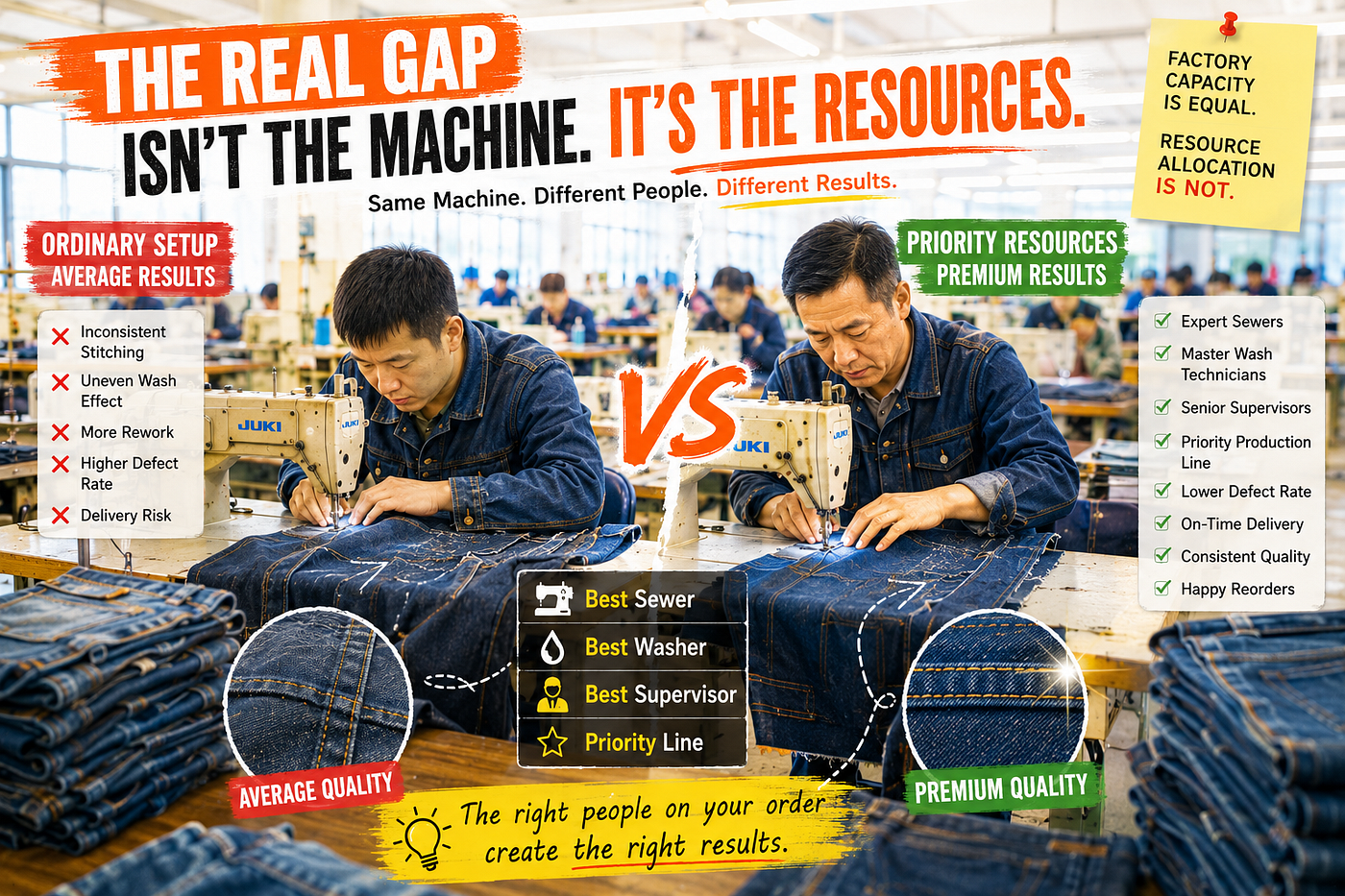
It is the same five-pocket jean that has carried a brand for two seasons. Same fit, same fabric on the spec sheet, same customer who keeps reordering it. The brand has grown, the volume is real, and a new factory has quoted a number meaningfully lower than the current one. The founder does the rational thing. They ask for the itemized cost — show me where the money goes — and, satisfied the breakdown looks reasonable, they move the style.
The bulk arrives. Construction measures out perfectly. And the jean is, somehow, not the jean. The blue has tipped a little red. The hand is stiffer. Nothing you could point to on a measurement chart, and everything a customer notices the instant they pick it up next to last season’s.
This is the most ordinary disaster in denim, and almost everything written about it is written by the people selling the move. So here is the version from the side that has to live with the reorder.
The audience for this is narrow on purpose: scaling brands, the ones running tens of thousands of units a season on a proven style, deciding whether to add or switch to a second production source. If you are launching your first small run, this is not your problem yet. If you are running a winning style at volume, this is the problem that quietly decides whether it stays winning.
The tension nobody names
A source switch arrives dressed as a sourcing problem — find the factory, send the tech pack, negotiate the price. For a winning style it is nothing of the kind. It is a continuity problem, and the price quote, the one document everyone trusts, is the one document that tells you nothing about whether continuity survives.
Because a denim specification is not a recipe. We treat it like one — hand the same recipe to a competent kitchen, get the same dish — and denim breaks that assumption before the garment is even sewn, at the dyeing stage.
Why the same spec makes a different jean
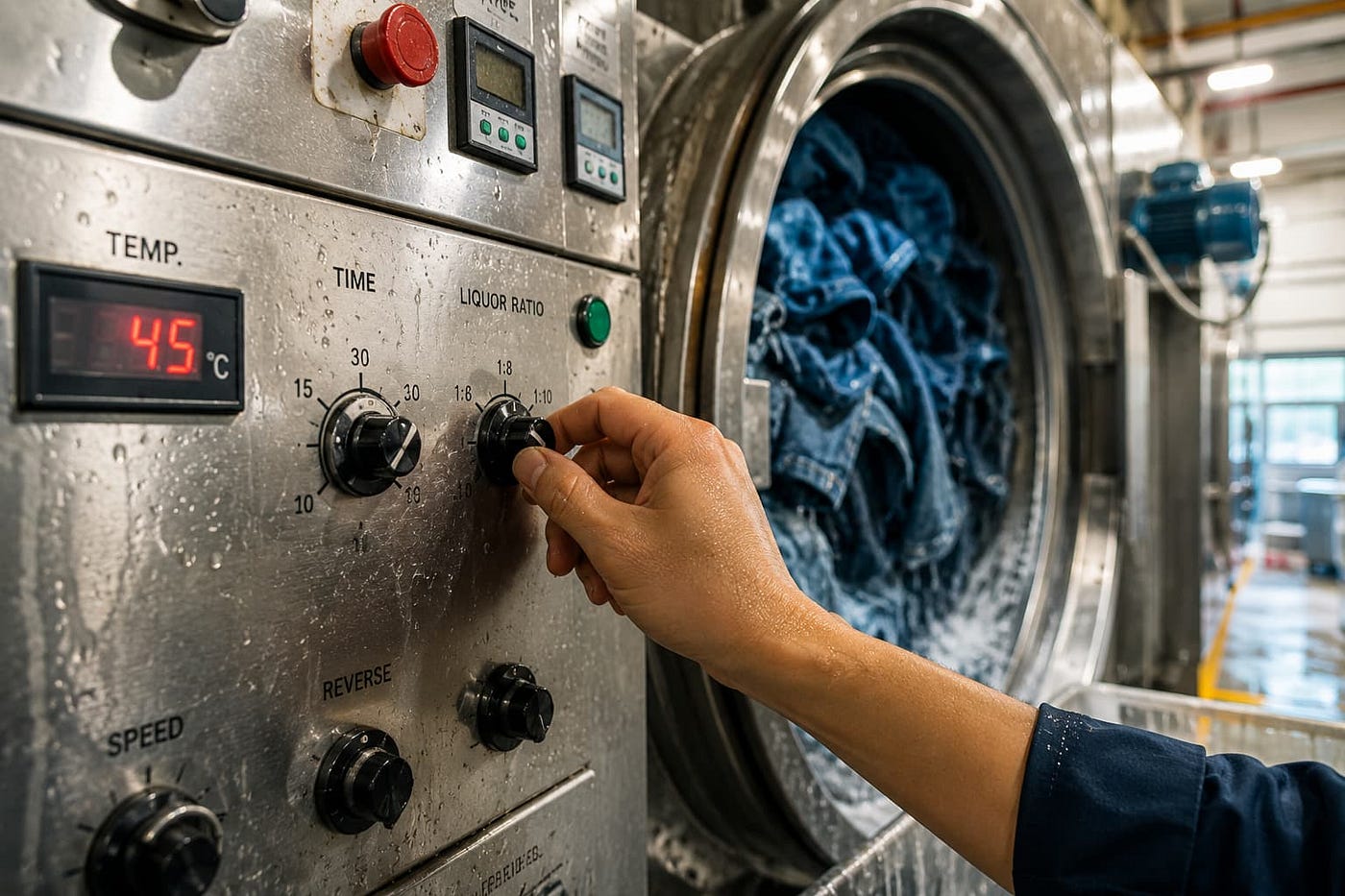
Indigo on denim is ring-dyed. The dye wraps the outer layer of each warp yarn and leaves a white core — which is the whole reason denim fades the way it does when the surface abrades in the wash. How deep that ring sits is governed by dyebath pH, redox potential, the number of dips, yarn tension, roller pressure. That chain of variables differs from mill to mill, and inside a single mill, from one dye lot to the next.
Researchers have taken two commercial denims with the same initial color depth, washed them under identical conditions, and watched them come out different shades — with ring-dye penetration named as the cause. Same starting color. Same wash. Different finished garment.
So the thing that decides whether your jean survives the move lives upstream of the spec sheet and downstream of it — in the dye behavior and the wash recipe — but rarely on the sheet itself. Identical construction spec is necessary. It is nowhere near sufficient.
What “freeze” actually has to mean
Freezing a style is not signing a tech pack. Borrowed from engineering, a freeze is a sequenced commitment — you lock the parameters that constrain other parameters first, because the order of dependency is real. In denim that order runs downhill: fiber and dye decisions constrain what the wash can do, never the reverse. You cannot meaningfully freeze a wash recipe before you have frozen the fabric and dye behavior it will act on.
The full freeze is seven layers — fiber, yarn, dye, weave, finishing, wash recipe, construction — and the completeness is the part you do not get to negotiate. But where you start is driven by where the pain is. A move made to chase a lower price gets the wash-cost-bearing fields pinned first, because that is exactly where a cheaper source will look to economize. A move made because quality is already wobbling gets dye lot and shade pinned first.
And then there are two kinds of fields, which is the distinction most sourcing advice never draws. Some fields a lab settles: weight, yarn count, weave density, strength, shrinkage, colorfastness — each has a test method, and there is no argument. Other fields only a physical object settles: post-wash handfeel, washed appearance, and perceived color. Color is the trap, because it looks like a number. ΔE will hand you a number. But there is no universal pass/fail ΔE threshold for denim — the tolerance is negotiated against an approved shade band, and a single reading flattens exactly the mottled, abraded complexity that makes the garment look like itself.

The risk that never shows up on the quote
Here is the part the cost spreadsheet hides.
When a move is driven by price — and most are — the founder compares two quotes and takes the lower. What the quote will not tell you is how the lower number is reached. In a thin-margin business, a factory that knows a brand has real volume will often take the order at a slim or negative margin just to begin the relationship. That price is real. It is also borrowed against the future. Once volume is steady, the pressure to recover that margin does not vanish — it goes looking for somewhere to live, and it tends to live in the steps a customer cannot see: a shortened enzyme cycle, less stone, an under-run desize, a thinner wash.
Those are the exact variables that move finished color and handfeel. They do not trip an AQL inspection — there is no missing seam, no wrong label. They produce a garment that is uniformly, subtly off. Invisible in carton one. Obvious by reorder four, once the drift has compounded across lots.
So the dangerous switch is not the one to a worse factory. It is the one to a cheaper quote whose costing you never made transparent at the level that matters — not what is your price per unit, but which wash variables are you committing to hold, and how will we check them against the garment my customer already approved.
The decision rule
Not every style earns the full freeze. Match the depth to the stakes, and the stakes are reorder probability × volume × wash complexity. A style that reorders for two years at five-figure volumes with a heavy wash is a different risk object than a one-season rigid-denim piece that will never come back. The blunt rule: the more it repeats, the more volume rides on it, the more the wash does to the fabric — the deeper you freeze. And a change of mill (where dye and wash live) carries more finish risk than a change of sewing source (where the risk is dimensional).
The release gate is the same regardless: a pilot run on the new source’s actual line, actual fabric, actual wash, judged against the original approved garment — not against the new factory’s own first sample. The freeze defines the target. The pilot proves the new source can hit it. Skipping the pilot to save two weeks is the single most common way a frozen spec still lands as a drifted bulk.
Does this fit you?
It fits if you are scaling, your style reorders, the wash is doing real work, and you are weighing a cheaper or second source. The freeze is what lets you take the lower price and keep the jean.
It does not fit if the style is a one-off, the volume is low, the denim is rigid with minimal wash, or it will never reorder. Then a full freeze plus pilot is cost without a return, and a partial check on the few fields that drift is enough.
The freeze never buys a guarantee. The drift can still happen — a different wash on a different line is, after all, a different process. What the freeze buys is the one thing a source switch most needs and most often lacks: a fixed point to measure against, early, while the decision is still cheap to reverse.
This is a condensed narrative of a longer decision guide. The full version — with the seven-layer freeze sequence, the verifiable-vs-reference field tables, the depth-of-freeze matrix, and the sourced evidence — lives here: Switching denim production runs: what should be frozen before moving a style?
메타데이터
- post_id
- eee86c00dc6f
- slug
- the-jeans-that-came-back-wrong-eee86c00dc6f
- url
- https://medium.com/@jonny_87023/the-jeans-that-came-back-wrong-eee86c00dc6f
- canonical_url
- https://medium.com/@jonny_87023/the-jeans-that-came-back-wrong-eee86c00dc6f
- author_url
- https://medium.com/@jonny_87023
- status
- ok
- fetched_at
- 2026-06-23 03:48:11