More than Might: How inclusive and accountable strategies can transform C-IED responses
By Julien Joly and Paul Amoroso
More than Might: How inclusive and accountable strategies can transform C-IED responses
By Julien Joly and Paul Amoroso
Improvised explosive devices (IEDs) have become a defining feature of contemporary asymmetric violence, with far-reaching consequences for peace, security, and sustainable development. IEDs not only take lives, but also spread fear, undermine governments, block aid, and destroy communities. The UN has described IEDs as a major global threat — because of both the immediate casualties they cause and the long-lasting damage they inflict on societies.
For years, the response to IEDs was predominantly a military one, focusing on efforts to ‘defeat the device’, ‘attack the networks’, and ‘prepare the force’. While these steps are important, they are not sufficient. Without tackling the deeper causes of the issue — such as weak governance, marginalization, and lack of trust in state institutions — the devastating ramifications of IEDs will persist.
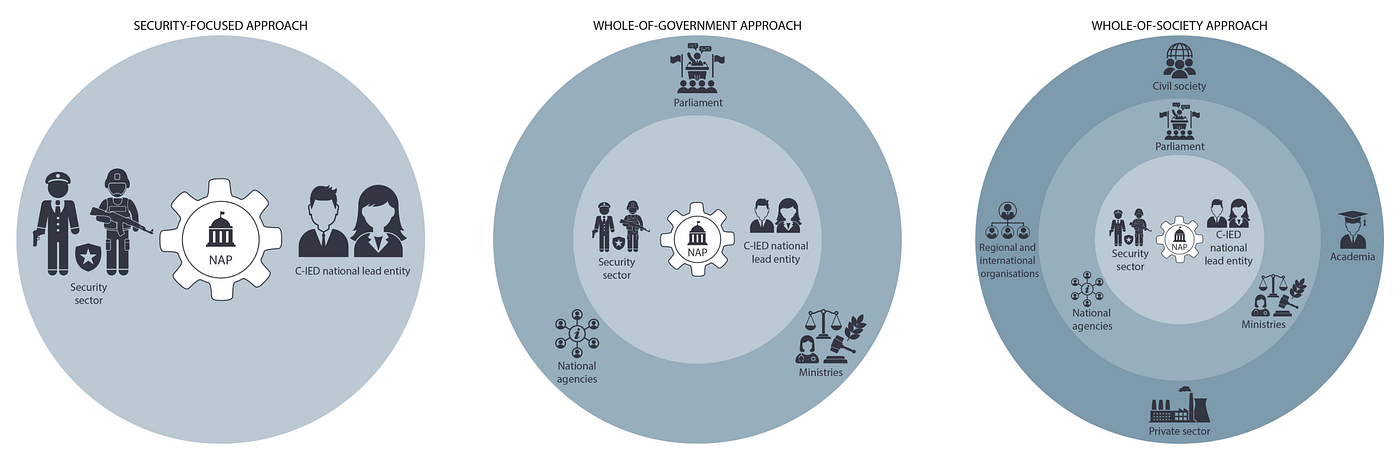
A whole-of-society approach broadens the scope beyond the military dimension, recognizing that security also depends on justice, governance, opportunity, and trust. It brings together governments, affected communities, civil society, humanitarian and development actors, academia, and the private sector — all of whom hold crucial knowledge and influence. This approach does not replace military or law enforcement roles, but instead situates them within a wider framework of accountability and cooperation, balancing security imperatives with the protection of rights and livelihoods. Ultimately, lasting solutions to the use of IEDs require inclusion, shared responsibility, and the meaningful participation of those most affected in order to shape responses that are both effective and sustainable.
Beyond security-led approaches
Modern counter-IED (C-IED) doctrine took shape in Iraq and Afghanistan, where non-state armed groups turned to IEDs as an effective way to offset the technological and operational advantage held by state forces.
The rapid spread of IEDs in the 2000s prompted large-scale military responses. In Iraq, the Joint Improvised Explosive Device Defeat Organization was established to coordinate C-IED efforts across coalition forces. Their work combined technology development, intelligence gathering, and field support. A similar approach emerged with the Joint Task Force Paladin in Afghanistan, where technical solutions and training became central to C-IED strategies. These efforts reflected an increasingly institutionalized focus on innovation and coordination. While they yielded some tactical gains, however, they did little to stop the ongoing IED attacks, which continued to devastate civilians. Between August 2021 and May 2023, more than 3,700 civilians in Afghanistan were killed or injured by IEDs. Iraq has also continued to endure recurring attacks and their destabilizing impact long after the surge in international C-IED investment.
These measures fell short because they failed to balance immediate security responses with the political, economic, and social investments needed for long-term stability. Equipping state security forces with threat-informed capabilities, while simultaneously fostering governance, trust, and social cohesion, is key to developing sustainable solution; a wide spectrum of stakeholders must also work in concert to address both IEDs and the drivers of instability. Security-centric responses alone cannot solve the IED threat.
From ‘whole-of-government’ to ‘whole-of-society’
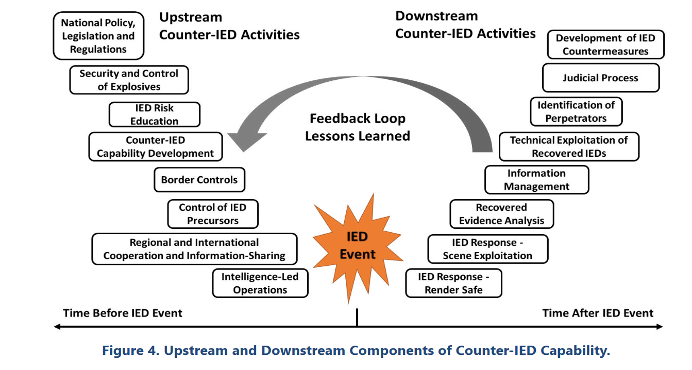
In 2017, the UN General Assembly asked the United Nations Institute for Disarmament Research (UNIDIR) to create a tool to assist governments in understanding the broader context. The Counter-IED Capability Maturity Model and Self-Assessment Tool (C-IED CMM) Self-Assessment Tool is designed to help countries assess not just their military responses, but also their laws, institutions, and coordination across sectors (see Figure 1).
The tool also introduced the concept of stakeholder mapping, which examines all the ‘communities of practice’ involved in C-IED — military, police, government departments, judiciary, humanitarian and development actors, private companies, and communities. Mapping helps identify gaps, overlaps, and opportunities for collaboration.
Figure 1 Upstream and downstream components of C-IED capability
Source: UNDIR, Counter-IED Capability Maturity Model and Self-Assessment Tool (2020)
In summary, the Self-Assessment Tool treats C-IED as both a governance and a security issue. Crucially, by broadening the scope of actors involved, the SAT also lays the groundwork for moving from a ‘whole-of-government’ approach towards a more ambitious ‘whole-of-society’ model.
Operationalizing a whole-of-society approach to C-IED
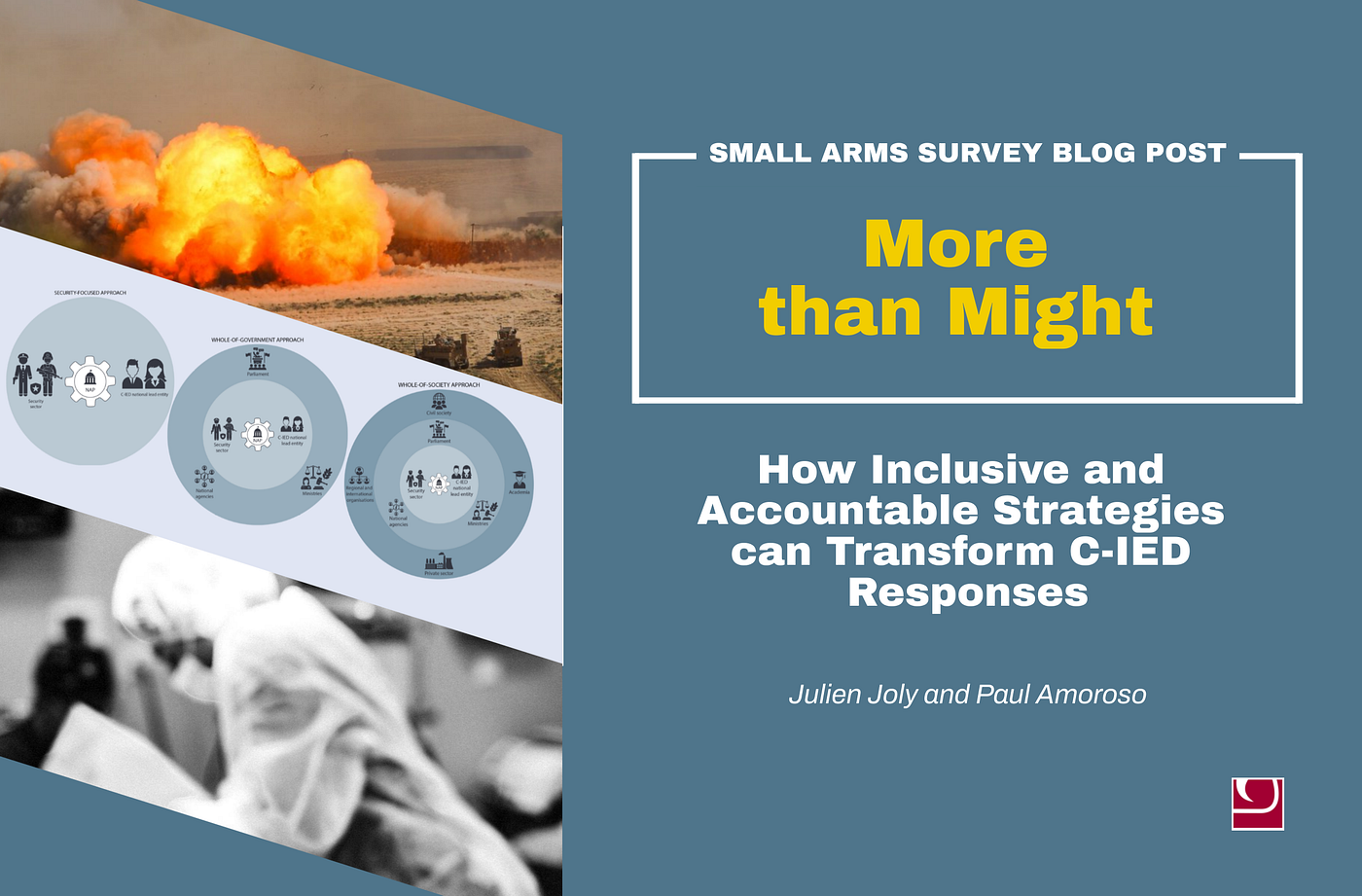
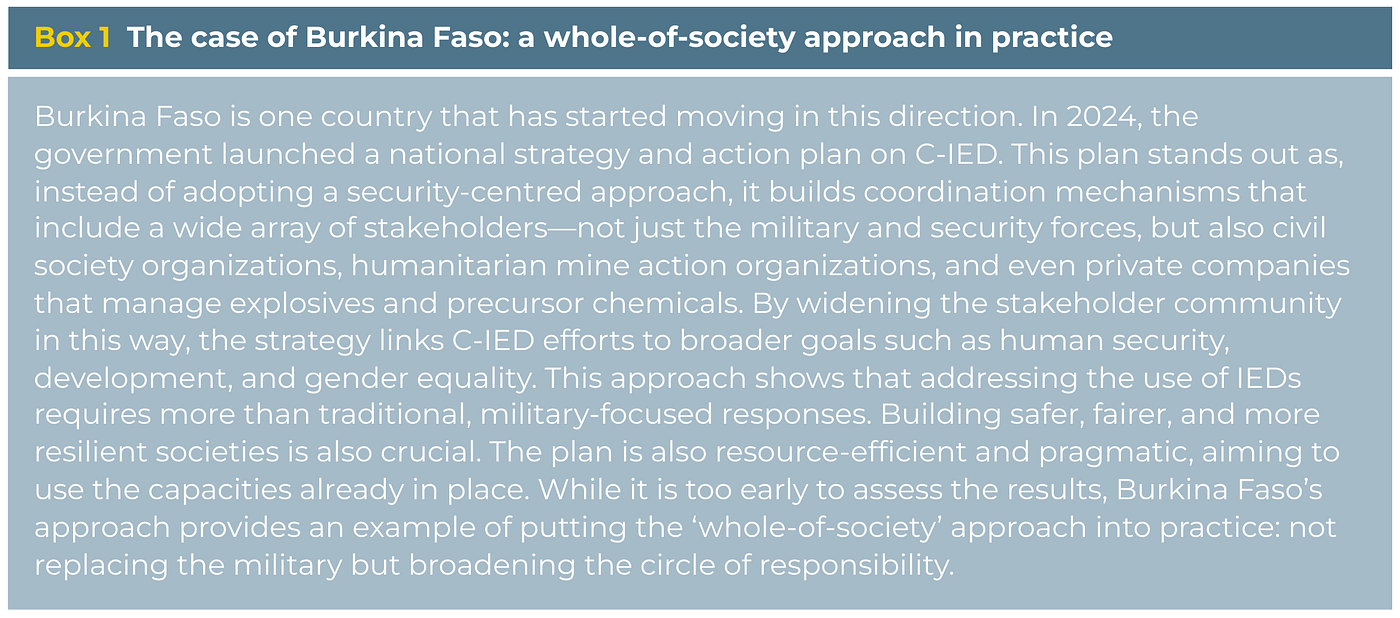
Turning concept into practice is challenging (see Box 1). It requires not only incorporating non-traditional C-IED stakeholders — such as civil society, academia, industry, and regional and international bodies — into C-IED efforts, but also ensuring that their participation is meaningful (see Figure 2). At the heart of this lies trust. Affected communities, who should be central to these efforts, are often marginalized and may have little confidence in government institutions. Rather than relying on one-way communication and awareness-raising campaigns, those managing C-IED initiatives must engage in genuine dialogue that includes listening to communities, understanding their concerns, and co-developing solutions that reflect local priorities. Making C-IED efforts gender-responsive is also vital, as women experience violence differently and offer insights that can inform strategies and make them more inclusive, equitable, and effective.
Figure 2 Enhancing inclusiveness: a ‘whole-of-society’ approach
Source: Adapted from Small Arms Survey, How-to-Guide: Developing Strategies and National Action Plans on Small Arms Control (2025)
To design and develop an effective, threat-informed whole-of-society C-IED response, the first step is to conduct a baseline assessment to assess both the threat and the current capabilities to counter it (UNIDIR’s CMM Self-Assessment Tool provides guidance for the latter). The baseline assessment must be conflict-sensitive — taking into account the threats, their drivers and enablers, and existing capacities at national, subnational, and local levels. Once the baseline assessment has been completed, the next steps are to develop action plans, coordinate resources, and establish reporting systems to support accountability and ensure that efforts remain effective and threat-informed.
Mandates need to be coordinated to allow security forces to focus on immediate IED threats while civilian and community actors work to address root causes; all parties should complement each other’s efforts. All C-IED initiatives should integrate the principles of good governance to avoid doing harm. For example, militarizing a border post might stop the flow of IED components and personnel at that particular location, but risks undermining efforts within civilian communities if it also cuts off food or trade.
Safeguards and humanitarian space
Adopting a whole-of-society approach to C-IED holds significant promise but also presents considerable challenges — particularly concerning the tension between security priorities and civilian and humanitarian principles. When the response focuses too heavily on immediate threats, broader goals such as long-term resilience, equitable governance, economic stability, and social cohesion are often sidelined. This imbalance can be counterproductive. For instance, redirecting aid to align with security objectives may undermine humanitarian values, entrench exclusionary governance, and fuel grievances that create conditions for IED use.
It is therefore crucial to ensure that roles are clearly defined. Security forces, justice institutions, and humanitarian actors each have distinct mandates, and respecting those boundaries is key to maintaining trust. Military and law enforcement agencies play a vital role in addressing immediate threats, but their actions must remain accountable to civilian oversight and aligned with the everyday security needs of communities.
A more balanced approach requires security forces to operate within governance frameworks that promote accountability; transparency; and the protection of livelihoods, mobility, and access to essential services. Meanwhile, civilian institutions and community actors must be empowered to address the underlying causes of violence and build long-term resilience. When mandates are respected, accountability ensured, and human security prioritized, the efforts of military, civilian, and community actors can reinforce each other.
Conclusion
IEDs remain a persistent threat in many unstable contexts. As versatile and destructive asymmetric weapons, they cannot be effectively addressed through security-centric measures alone. Experience shows that such approaches fail to deliver lasting results. A whole-of-society response links immediate threat mitigation with long-term resilience, building trust through inclusion and accountability, and treating communities not only as victims but as essential partners in shaping stability.
This approach requires a paradigm shift in current C-IED efforts, focusing on inclusive, coordinated initiatives that engage a wide spectrum of stakeholders across society. Protecting populations and laying the foundations for stability demands responses that extend beyond security actors to encompass governance, development, and community engagement.
The forthcoming United Nations General Assembly (UNGA) resolution on IEDs¹ offers a timely opportunity to advance this vision. Putting whole-of-society engagement at the centre of the resolution will encourage UN member states to adopt inclusive strategies, strengthen accountability and civilian oversight, and invest in evidence-based tools that unite security, governance, humanitarian, and development actors. Framing C-IED as a shared responsibility linked to human security and sustainable development will help ensure that international commitments translate into practical, durable support for the states and communities most affected.
[1]^ While forthcoming UNGA resolutions are not formally announced in advance, Australia and France have jointly introduced biennial resolutions on C-IED since 2015. The next iteration of this resolution is expected to be tabled in 2026, continuing this established pattern of engagement.
This blog post was produced with the generous support of the German Federal Foreign Office.
Blog posts are intended as a way for various Small Arms Survey collaborators and researchers to discuss small arms- and armed violence-related issues, and do not necessarily reflect the views of either the Small Arms Survey or its donors.
메타데이터
- post_id
- eee8f3e1f09a
- slug
- more-than-might-how-inclusive-and-accountable-strategies-can-transform-c-ied-responses-eee8f3e1f09a
- url
- https://medium.com/@smallarmssurvey/more-than-might-how-inclusive-and-accountable-strategies-can-transform-c-ied-responses-eee8f3e1f09a
- canonical_url
- https://medium.com/@smallarmssurvey/more-than-might-how-inclusive-and-accountable-strategies-can-transform-c-ied-responses-eee8f3e1f09a
- author_url
- https://medium.com/@smallarmssurvey
- status
- ok
- fetched_at
- 2026-08-08 17:33:10