Blackbeard: The Real Sea Terror Behind the Movie Myth
Before cinema turned Blackbeard into a dark pirate villain, Edward Teach had already built one of the most feared names in the history of…
Blackbeard: The Real Sea Terror Behind the Movie Myth
Before cinema turned Blackbeard into a dark pirate villain, Edward Teach had already built one of the most feared names in the history of the sea.

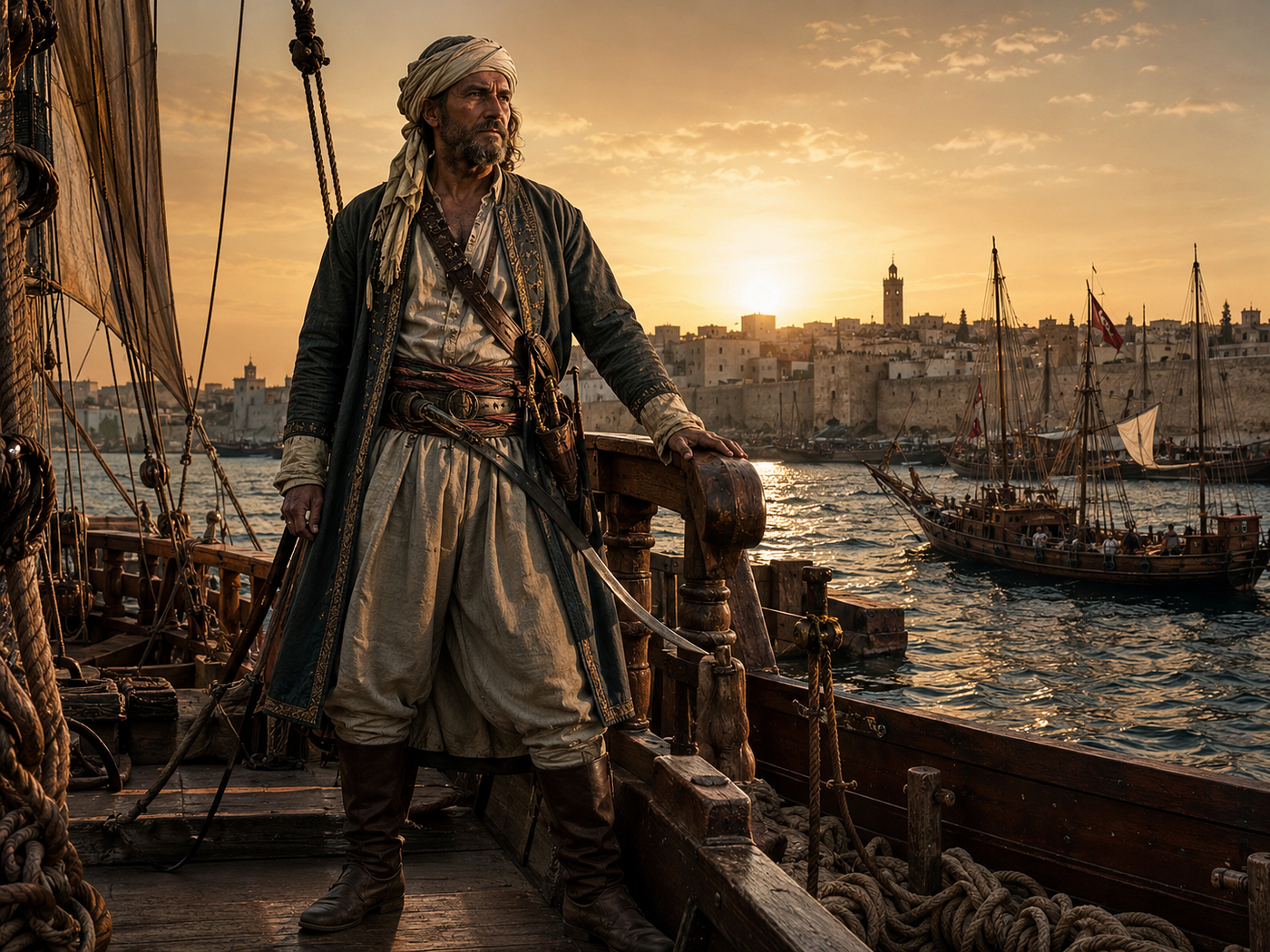
Blackbeard, the feared Atlantic pirate captain, shown in a historically inspired reconstruction aboard a ship reminiscent of the Queen Anne’s Revenge. AI-generated illustration.
1. Blackbeard Was Not Invented by Movies
Some pirates were created by fiction. Blackbeard was not one of them.
The movie version of Blackbeard belongs to fantasy: dark ships, curses, strange powers, and a villain made larger than life for the screen. But behind that fictional image was a real man: Edward Teach, also written as Edward Thatch or Thack. [S6]
He lived in the early eighteenth century and became one of the most famous pirates of the Atlantic world. His career was not very long, but it was powerful enough to turn his name into a legend. [S1]
That is what makes Blackbeard different from many fictional pirate captains. He did not need a novelist or filmmaker to make him frightening. He had already done that himself.
The real Blackbeard understood something that later movies also understood very well: fear is a performance. If people believed he was almost impossible to resist, then many of them would surrender before the real violence began.
That was his genius.
He made his name into a weapon.
2. Edward Teach and the World That Created Him
Blackbeard belonged to the period often called the Golden Age of Piracy. This was the age when pirates operated across the Caribbean, the West Indies, the Atlantic, and the eastern coast of Britain’s North American colonies.
This world was not romantic. It was built from war, trade, slavery, harsh labour at sea, privateering, colonial rivalry, and broken maritime lives. Many pirates had experience as sailors before they became outlaws. They knew ships, weapons, routes, ports, weather, and the discipline of life at sea.
Edward Teach came out of that world.
His early life is still uncertain. Even his surname appears in different forms. That uncertainty helped the legend grow. When a man’s beginning is unclear, people fill the silence with stories.
But by the time he became known as Blackbeard, one thing was certain: he was no ordinary robber at sea. He was a man who knew how to make people afraid before he even reached them.
A pirate could fight every ship he met. But that was risky. Men could die. Ships could be damaged. Cargo could be lost. Blackbeard understood that reputation could do part of the work for him.
If a merchant crew heard his name and believed resistance was hopeless, then Blackbeard had already won half the battle.
3. Queen Anne’s Revenge
Blackbeard’s most famous ship was Queen Anne’s Revenge.
Before it became his flagship, the vessel was called La Concorde. It had been a French slave ship. Blackbeard captured it in 1717 and transformed it into one of the most feared pirate ships of the age. [S2]
This detail is important because it reminds us that pirate history was tied to the darker world of the Atlantic. Queen Anne’s Revenge was not born as a romantic pirate ship. It came from the world of slavery, empire, trade, and violence.
Once Blackbeard took it, the ship became the centre of his power.
A small pirate boat could raid. A major armed ship could intimidate. Queen Anne’s Revenge gave Blackbeard the kind of presence that made him more than a simple thief at sea. It gave him firepower, status, and the ability to threaten larger targets.
For a brief moment, Blackbeard was not just a pirate captain.
He had become a serious Atlantic threat.
4. The Theatre of Fear
Blackbeard’s image became almost as famous as his crimes.
His long dark beard, weapons, and terrifying appearance were part of the story. Accounts of Blackbeard often describe him as deliberately frightening. Royal Museums Greenwich notes that his appearance was designed to terrify victims into surrender. [S3]
This is where Blackbeard becomes strangely modern.
He understood reputation before modern branding had a name.
The beard, the weapons, the smoke, the violent reputation — all of it helped create a character that people feared. Some accounts say he placed slow-burning fuses in his beard or around his head during attacks, making his face appear surrounded by smoke. Whether every detail was exact or exaggerated, the purpose was clear.
Blackbeard wanted to look terrifying before the fighting even began.
That does not mean he was only acting. He was a violent pirate. But he also understood psychology. A frightened crew could be easier to control than a brave one. A ship that surrendered quickly was safer and more profitable than one that fought to the end.
This is why Blackbeard feels so cinematic. Long before film, he had already turned himself into a living image.
Movies later gave him fantasy.
History had already given him terror.
5. The Charleston Blockade
One of Blackbeard’s boldest actions came in 1718, when he blockaded Charleston, South Carolina.
For nearly a week, Blackbeard and his crew stopped ships entering or leaving the harbour. They seized vessels and took prisoners. But the demand he made was not only for gold or treasure. He demanded medicine. Once the medicine was delivered, the hostages were released. [S4]
This tells us something important about real piracy.
Pirates did not only chase treasure chests. They needed medicine, food, water, weapons, repairs, safe harbours, and information. A pirate crew lived under constant pressure. Wounds, illness, storms, betrayal, and hunger could destroy them as easily as a navy could.
The Charleston blockade also shows how bold Blackbeard had become. He was no longer just attacking ships far out at sea. He was threatening a major colonial port.
That made him impossible for colonial authorities to ignore.
At that point, Blackbeard was not just a frightening name.
He was a public danger.
6. The Loss of Queen Anne’s Revenge
Soon after Charleston, Blackbeard’s great ship ran aground near Beaufort Inlet, North Carolina.
Queen Anne’s Revenge was lost in 1718. The exact circumstances have been debated, but the result was clear: Blackbeard no longer had the same flagship, the same force, or the same large company behind him. [S2]
This was a turning point.
Without Queen Anne’s Revenge, Blackbeard became smaller in practical power, but not in legend. In fact, the loss of the ship added another layer to the story. His flagship became part of the mystery surrounding him.
Centuries later, a wreck discovered near Beaufort Inlet became the focus of the Queen Anne’s Revenge Project, which studies and preserves material connected to Blackbeard’s famous ship. [S2]
That makes Blackbeard unusual among pirate legends. His story is not only in old books and movie scripts. Part of it is archaeological. Objects from his world still exist.
The legend has evidence under the water.
7. Ocracoke and the Last Fight
Blackbeard’s final chapter came at Ocracoke, off the coast of North Carolina.
By late 1718, colonial authorities wanted him stopped. Lieutenant Robert Maynard led the force that confronted him. The battle was violent and close. Blackbeard was killed on November 22, 1718. [S5]
His death was brutal, and the story became famous. Maynard returned with Blackbeard’s severed head as proof that the feared pirate was dead. [S4]
It is a grim ending, but it explains why the legend survived.
Blackbeard’s career had everything a dark sea story needed: a mysterious beginning, a terrifying image, a powerful ship, a bold blockade, a violent final battle, and a death dramatic enough to be repeated for centuries.
The real man died at Ocracoke.
The name did not.
8. Blackbeard and the Movie Myth
So why do films keep returning to Blackbeard?
Because the real history already feels like fiction.
A pirate with a huge black beard. A terrifying reputation. A famous ship. A blockade of a colonial port. A violent last stand. A death that became part of folklore.
Cinema did not need to build Blackbeard from nothing. It only had to add fantasy to a story that was already larger than life.
The movie version makes him supernatural. The historical version is more interesting because he did not need magic. He used fear, timing, violence, and reputation.
That is the real reason Blackbeard still works as a pirate villain.
He feels invented.
But he existed.
9. Why Blackbeard Still Matters
Blackbeard matters because he shows how history becomes legend.
He was not the longest-serving pirate. His most famous career lasted only a short time. But he understood the power of image better than almost anyone else in pirate history.
He turned his appearance into a warning. He turned his name into a threat. He turned fear into strategy.
That is why Blackbeard is still remembered in books, films, games, documentaries, and popular culture. He sits at the point where fact becomes folklore.
Some pirates were fictional from the beginning.
Blackbeard was real first.
And before movies turned him into a villain, Edward Teach had already become one of the darkest legends of the sea.
References:
[S1] Encyclopaedia Britannica, “Blackbeard.”
[S2] Queen Anne’s Revenge Project, “The Pirate Ship’s Journey.”
[S3] Royal Museums Greenwich, “Blackbeard | Edward Teach | Pirate.”
[S4] Queen Anne’s Revenge Project, “Blackbeard: History of the Dreaded Pirate.”
[S5] National Park Service, “Blackbeard (Edward Teach) — Cape Hatteras National Seashore.”
[S6] Disney, Pirates of the Caribbean: On Stranger Tides gallery / Blackbeard film reference.
메타데이터
- post_id
- eee91b7b4c2a
- slug
- blackbeard-the-real-sea-terror-behind-the-movie-myth-eee91b7b4c2a
- url
- https://medium.com/@techdraka/blackbeard-the-real-sea-terror-behind-the-movie-myth-eee91b7b4c2a
- canonical_url
- https://medium.com/@techdraka/blackbeard-the-real-sea-terror-behind-the-movie-myth-eee91b7b4c2a
- author_url
- https://medium.com/@techdraka
- status
- ok
- fetched_at
- 2026-07-18 21:36:33