Your AI Coding Bill Is Not a Model Problem. It’s an Orchestration Problem
How prompt caching, model routing, and context compression reduce AI coding costs without sacrificing code quality.
Your AI Coding Bill Is Not a Model Problem. It’s an Orchestration Problem
How prompt caching, model routing, and context compression reduce AI coding costs without sacrificing code quality.
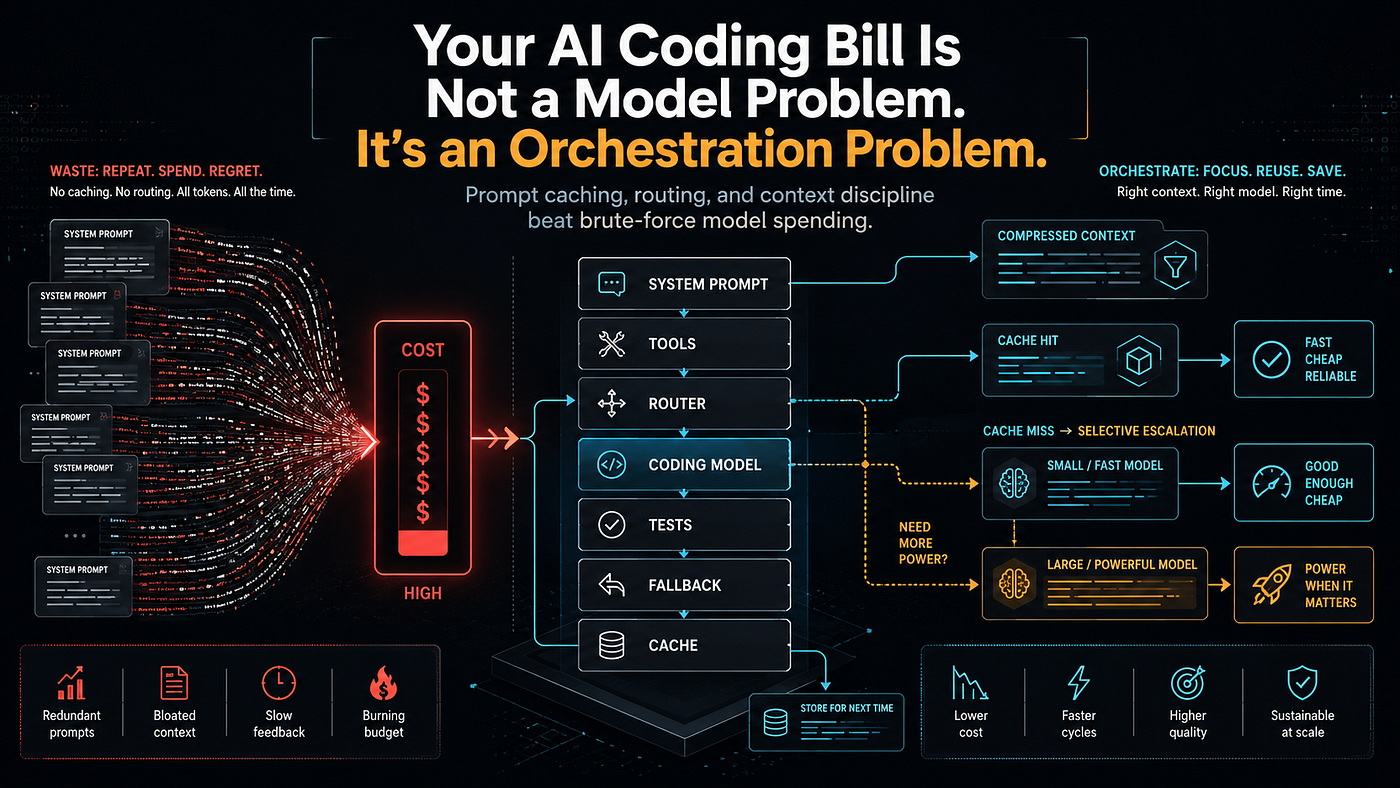
A dark editorial hero image contrasts a wasteful AI coding workflow with a lean orchestrated agent pipeline built around caching, routing, and context discipline.
Most developers think their AI coding bill is high because they picked the wrong model. In reality, the bigger leak is usually the system wrapped around the model: bloated prompts, repeated context, verbose outputs, and agent workflows that send an expensive model into every step whether it is needed or not.
That is the uncomfortable part. The easiest explanation is “frontier models are expensive.” The more accurate explanation is harsher: many AI coding setups are architecturally lazy. Recent evidence across coding and agentic workflows points to the same pattern: meaningful cost reductions usually come from prompt-prefix caching, model routing, context compaction, and output compression rather than from obsessing over a single model swap.
The hidden tax
If you only track price per token, you are measuring the wrong thing. In AI-assisted programming, real cost includes retries, failed generations, agent loops, test failures, hallucinated edits, and the overhead of repeatedly shipping large system prompts, tool schemas, and chat history into the model.
That is why “cheaper per token” can still be more expensive per outcome. A weak workflow can force more retries and more debugging, while a better-orchestrated workflow can spend slightly more on the right calls and still reduce total cost per successful task. The metric that matters is not raw API spend; it is cost per passing solution, cost per merged PR, or cost per successful coding task.
This is the same mistake teams make in other engineering systems. In ML, the cheapest GPU hour is meaningless if your pipeline keeps retraining junk. In AI coding, the cheapest model call is meaningless if your agent keeps wandering through irrelevant files and producing essays instead of useful code.
There is also a deeper economic mistake hiding underneath all this: many teams think they are paying for intelligence, when in practice they are paying for repetition. Every time an agent resends the same tool instructions, the same repository rules, and the same bloated history, the bill is not reflecting new reasoning, it is reflecting redundant serialization. That is why prompt caching matters so much. It does not make the model smarter. It simply stops you from paying full price for the same scaffolding over and over again.
Why the model is not the villain
Model choice still matters, but it is often not the first lever a solo developer or small team should pull. Research summarized across prompt-side and model-side optimization shows that for hosted API users, the biggest near-term wins usually come from changing prompt structure and workflow design, while model compression techniques like quantization and pruning matter more when you self-host or run local models.
That distinction matters because many developers are optimizing the wrong layer. They debate whether to downgrade from one premium model to a cheaper one, while continuing to resend the same tool instructions, the same repo rules, and the same inflated conversation history on every turn. That is like arguing over fuel type while driving with the parking brake on.
Well-designed systems routinely cut roughly 30% to 70% of spend without a corresponding quality collapse, and the highest-ROI levers in coding workflows consistently show up as prompt-prefix caching, model routing and cascading, context compaction, and aggressive output compression.
Four levers that actually move the bill
The first lever is prefix caching. Long-horizon agentic tasks tend to reuse the same system prompt, tool definitions, and static instructions over many calls, and a 2026 evaluation summarized in the research reports that prompt caching can reduce API cost by about 41% to 80% while improving time-to-first-token by roughly 13% to 31% when caching is applied to stable prefixes.

A technical infographic shows how stable prompt prefixes are cached once and reused, reducing repeated token costs and improving response speed.
The trick is simple, but most setups still get it wrong. Put stable content first, keep dynamic content at the end, and avoid mixing volatile tool results into the cacheable region. If your prompt layout changes every turn, you are effectively burning money to resend the same scaffolding again and again.
The second lever is model routing. Not every coding task deserves frontier-level reasoning. Lightweight edits, comment generation, naming changes, or small refactors can often go through a cheaper model, while only multi-file architecture changes or difficult debugging sessions should escalate to a stronger one. Reports summarized in the research indicate multimodel routing and cascades can cut spend by roughly 27% to 55% in relevant setups.
The third lever is context compaction. Coding agents often suffer from context obesity: too much chat history, too many files, too many irrelevant snippets. Surveys on prompt compression distinguish extractive trimming from abstractive summarization and suggest a broad principle that matters for developers: compress the repeated and low-signal parts of context, not the critical task-specific constraints.
The fourth lever is output compression. If your assistant explains every tiny action in polished paragraphs, your bill quietly inflates. The rise of vibe-coding skills like caveman reflects this reality: highly compressed communication styles can reduce output tokens dramatically, with claims in the research around 65% to 75% fewer output tokens in some coding sessions, though rigorous coding-quality benchmarks are still limited.
That last point is important. Output compression is real, but the evidence is not equally mature across all tasks. So the smart position is not “verbosity is always waste.” It is “verbosity is expensive, and you should justify it.”
A better coding-agent architecture
If I were designing a practical AI coding stack today, I would not start with “what is the smartest model I can afford?” I would start with “what calls are repeated, what tasks are easy, what context is bloated, and where do I actually need expensive reasoning?” The architecture follows from those questions.
A sensible pattern looks like this: a short, structured system prompt; a stable tools block designed for prefix caching; a small router model for task classification; a mid-tier coding model for most file operations and ordinary code generation; and a frontier model used only when the task is genuinely hard or when the cheaper path fails tests. That exact hybrid pattern appears repeatedly in practical recommendations summarized in the research.

A routing diagram maps how a coding agent uses a cached prompt layer, a small router, mid-tier execution, and frontier fallback only for hard tasks.
The details matter more than people want to admit. Stable system and tool instructions should be placed at the front so providers can cache them. Dynamic user input and live tool output should be appended later. Old chat history should be summarized into compressed state rather than resent verbatim. Subagents should only see the files and instructions they actually need, not the whole repo plus every past conversation.
This is not glamorous work. It is also where most of the savings live. Developers love arguing about model intelligence because it feels high-status. Very few want to admit that the real performance bug is sloppy prompt plumbing.
Where optimization breaks
There is a trap here, and a lot of people fall into it. Once they discover compression and brevity, they start treating every extra token as waste. That is how you break a system that looked efficient in demos but degrades badly on edge cases. Research in the summary repeatedly warns that overcompressing prompts or removing “redundant” context can silently damage performance on hard tasks.
The same applies to output brevity. Caveman-style interaction may cut cost, but shorter explanations can hurt interpretability during debugging, security review, or onboarding. The research specifically notes that strong claims about unchanged coding quality remain anecdotal because standardized benchmarks for these compressed styles are still thin.
Routing has its own failure mode. Cheap classifiers and heuristics can misjudge difficult tasks and send them down a weak path, creating subtle bugs that look inexpensive at first and expensive later. That is why a good cascade needs fallback logic, test-based escalation, and explicit thresholds rather than magical confidence in the router.
Even automatic prompt optimization has a catch. Cost-aware APO is becoming a serious area of research, with methods like CAPO explicitly balancing task performance, prompt length, and evaluation cost, but the optimization process itself consumes LLM calls. If your workload is small, the meta-cost of optimization can exceed the savings.
What smart teams measure
The fastest way to waste money with AI coding is to optimize what is easy to count instead of what matters. Token totals are easy to count. Successful outcomes are harder. That is exactly why you should care about the second one more.
A disciplined setup should track at least five things: tokens per request, cost per task, cost per successful task, fallback rate across routed models, and quality metrics such as tests passing or PRs merged. The research also recommends logging prompt versions and model choices so cost-quality shifts can be attributed to actual system changes rather than guesswork.

A measurement infographic shows the core metrics and versioned system components needed to optimize AI coding cost by outcomes rather than raw token spend.
This is the part that separates engineering from vibe-driven superstition. If your team changes prompts, routing rules, cache boundaries, or output style without versioning and evaluation, you are not optimizing. You are just moving failure around and hoping the invoice looks smaller.
My own view is blunt: most teams do not have an LLM cost problem; they have an instrumentation problem disguised as an LLM cost problem. They are flying blind, so they optimize whatever feels intuitive, which is usually the wrong thing.
The next wave
The interesting frontier is not just smaller prompts or cheaper models. It is cost-aware orchestration that adapts per task. The research highlights open questions around learning compression policies dynamically, jointly optimizing caching and routing, and evaluating cost-quality tradeoffs on real coding benchmarks rather than generic QA tasks.
That matters because the future coding agent probably will not run one fixed prompt and one fixed model in one fixed style. It will choose, per request, how much context to include, whether to compress outputs, which model to call, and when to escalate. In other words, the real product advantage may come less from raw model intelligence and more from smarter budget allocation around that intelligence.
And that is the uncomfortable conclusion for developers who like simple answers. Your AI coding bill is probably not high because the model is too expensive. It is high because your system keeps paying full price for repetition, noise, and bad workflow decisions.
The teams that win will not be the ones that merely find a cheaper model. They will be the ones that build leaner agent architectures, cache what repeats, route what is easy, compress what is bloated, and measure cost the same way they should already measure software quality: by outcomes, not by vibes.
Sources & Further Reading
- An Evaluation of Prompt Caching for Long-Horizon Agentic Tasks — Strong evidence that prompt caching can reduce API costs by 41–80% and improve time-to-first-token by 13–31% in long-horizon agent workflows.
- Prompt Compression for Large Language Models: A Survey — A useful overview of hard and soft prompt compression methods, tradeoffs, and open problems.
- CAPO: Cost-Aware Prompt Optimization — A research paper on optimizing prompts under explicit cost constraints rather than quality alone.
- Prompt Caching: Reduce AI Model Costs with OpenRouter — Practical provider-side perspective on caching repeated requests and where zero-cost identical response caching fits in.
- caveman — A concrete example of aggressive output compression in AI coding workflows, useful as a real-world artifact even if formal benchmarks are still limited.
All Infographics and diagrams in this article are created by GPT image 2.0
Thanks For Reading!
💡 Curious for more? I regularly publish new AI projects on GitHub. If AI chatter is your guilty pleasure, join the convo on Reddit.
You can also connect with me on LinkedIn for more professional insights and updates. Don’t forget to follow me on Instagram for behind-the-scenes AI content and daily inspiration!
Thanks for reading — happy prompting! 🙌
메타데이터
- post_id
- eeeacb340d1e
- slug
- your-ai-coding-bill-is-not-a-model-problem-its-an-orchestration-problem-eeeacb340d1e
- url
- https://pub.towardsai.net/your-ai-coding-bill-is-not-a-model-problem-its-an-orchestration-problem-eeeacb340d1e
- canonical_url
- https://pub.towardsai.net/your-ai-coding-bill-is-not-a-model-problem-its-an-orchestration-problem-eeeacb340d1e
- author_url
- https://medium.com/@mehmet.ozel2701
- status
- ok
- fetched_at
- 2026-07-08 17:17:42