The end of code
I built an app in a weekend without writing a single line of code, Here’s what I think is the new game.
The end of code
I built an app in a weekend without writing a single line of code, Here’s what I think is the new game.
Not a Medium member? Keep reading for free by clicking **here**.
Process
Idea: Build an app to track all things that I do on my MacBook. It’s not my idea originally. I had in 2024 an app that helped me to track the app usage and remain focused when I was jumping from one application to another called Rize.
The thing is that the application costs $10 dollars a month. I really feel that only for the things that I used it’s a lot of money, but in the past I only forgot the application and continued forcing myself to maintain focus.
Now, I’m on a long vacation for my son’s birth thanks to the company that I work for. And last weekend I bought a subscription of Claude to test the potential. It’s crazy.
I followed the next steps:
- Research using Gemini Pro for API on macOS to allow me to track all events using any language. Gemini suggested to me Python but I know that it’s a slow language. I suggested to use Golang, because to write a lot of events we need speed. But Gemini gave me some important points like Apple Scripts and a structure using go routines to run smoothly.
- Put the investigation into Claude Code and press enter.
- After that I had an issue, probably issues that scare a non-technical person: the app doesn’t work. When asking Claude the response was that when the app doesn’t have permits this macOS API fails quietly, like I read on the original investigation I need to grant permits. After that the tracker started working.
- At this point I only recorded some events like key pressed and change of window. Then I asked Claude how to improve the tracker and it gave me the next table additional to the plan for implementing the improvements.

claude code screenshot
-
After that I only asked for improvements and accepted the plans and tested it, a lot of tests because you need to test how it works and if all is fine. The other way you pass the problem to the chat and Claude solves it.
-
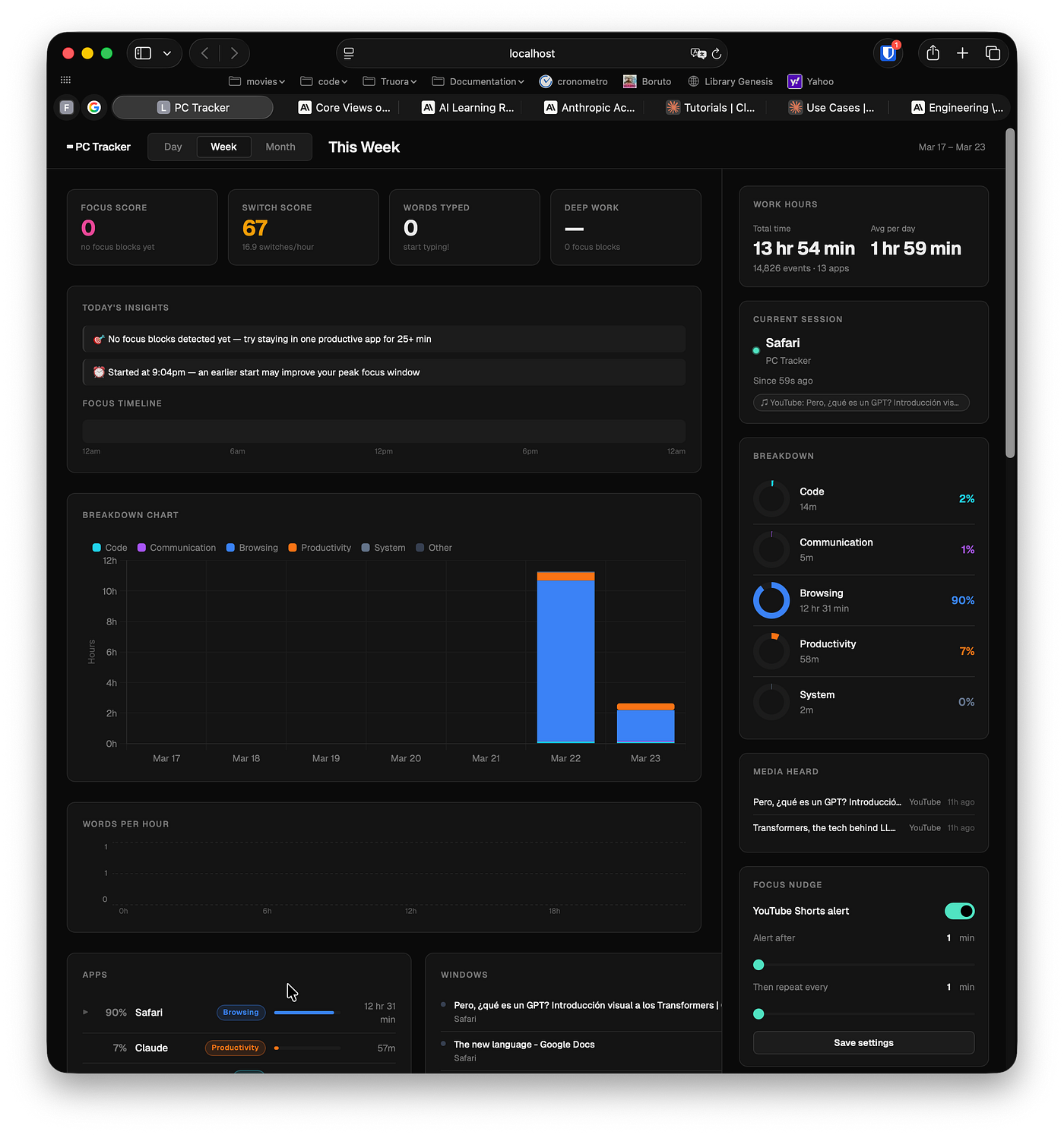
In the last iteration I ended asking to create a complete web app to show me the use of my PC with categories and a lot of things that Rize already has.
-
And to finish the code session I asked Claude for a complete research about productivity and it listed me a complete list of new features to include in the project for a next iteration.
It’s amazing and crazy because if I think to do it 2 years ago probably I would need two or three months to learn about macOS API, creation of goroutines, use of chart libraries and structure the complete project. Now in one day of weekend I finished the project and have a projection for the future.
Git repository: https://github.com/jgiraldocode/tracker
Learns
The new language is natural language
Yeah, like my example I didn’t write any line of code. I only suggested things that I know that could work well and structured the idea of what I want to build, with specific rules and things that I like and what I don’t like.
A lot of SaaS services probably will die
Liike this project we could create a lot of them for personal purposes. The real value of software as a service will be to generate some extra value that doesn’t depend on the capacity of building, like a cost integration with a particular service that isn’t possible for individuals, capabilities that we cannot build with an LLM. Because if you pay $10 dollars for an application that you can build paying a subscription of $20 dollars and build it in one day, where is the value of another? And you only build one time and after use for the rest of life.
The SaaS marketplace will change. You need to rethink the value that you ship to your clients because building applications is a thing that a lot of people with access to an LLM could build with their specific requirements.
Test and use the application needs a Human
The LLM could review if the app works and debug and fix errors, that’s fine, but you need as a human to check if the flow is good or not. You need to use the application and find the bugs that the LLM didn’t find, and add the creative part from the human brain.
The skills to ensure the quality of code remain necessary
The process of building software isn’t only about writing code. That was for a long time the most technical part, and you really needed a software developer or specialist to do it. Today, that is no longer necessarily true. AI tools and LLMs can generate functional code from natural language, lowering the barrier to entry dramatically. But the other parts of the process remain just as important, because you still need:
- Research about marketplace needs: for personal projects, understanding what you need; for commercial ones, identifying what problem you want to solve and whether someone will pay for it. Shipping something nobody wants is still the leading cause of startup failure.
- Define the scope and launch an MVP: at this point you are doing Product Management work: deciding what’s in, what’s out, and what’s “good enough to learn from.”
- Define the architecture of the service: once you validate that your solution actually is fine, you need to think about scalability, maintainability, and how the pieces fit together. A poorly designed architecture will accumulate technical debt faster when AI is generating large volumes of code with no structural awareness.
- Create a test suite: to ensure that each change performed by an LLM doesn’t break the rest of the application. This is arguably more critical now than before: LLMs produce confident-looking code that can introduce subtle regressions. A solid suite of unit, integration, and end-to-end tests is your safety net.
- Code review and versioning: catching hallucinations or bad patterns requires genuine technical judgment. The developer role is shifting from writer to reviewer and director.
- Security and compliance awareness: generated code can introduce vulnerabilities the author never intended. Understanding data privacy regulations, and secure coding practices remains a human responsibility that AI tools don’t reliably handle on their own.
The amazing part of this is that you can create an automation where specialized agents review or help with each point of it. You only need to check the process to ensure the quality. If you need it, if it’s a personal project and it doesn’t matter, you can be good with AI checks.
Future ideas
We need to rethink the way we create programs
We use and create a lot of languages to communicate with the machine that at the end only understands 0 and 1. If you think, there are a lot of translations:
- Human prompt
- Visual designs
- Golang, Python, JavaScript or another language
- Assembler code
- 0s and 1s
- High volt or low volt
Today a few people program in assembler because it’s easier to use other languages and that is the point: each time the technology advances our work is easier. And now we are in a golden era where we can communicate with the computer using natural language. For this reason you really need to improve the structure of your thoughts, describe explicitly what you want and how to build it.
We’ll need a new language to avoid generating all code in a repository, like a translator that only transforms the natural language to a compiled program that we probably won’t remember how to read in the future.
We are forced to use a computer with its rules
Here my point is that a lot of applications reshaped our way of thinking about problems. For example, to write something you use a pen and paper, but on the computer you need to press keys. Is that really the best way and the smoothest way to communicate with a computer, or are we very accustomed to doing it?
Probably in the future we could discover or improve the way we communicate with computers. For example, looking at a screen all day is normal today, but really? Probably you only want to talk with another person, ask something offline like telegram, create a report. For that you need to perform some steps and create charts using libraries that someone created or using a Python script or Google Sheets or LLM that do it.
Think for a minute: what will be the best way to use a second brain, a thing that helps you with all that you need but that is not a computer like we know today? The future could be amazing and I’m personally excited about how it could work in the most natural way.
Economy
That is the big thing. If any person could create their own software and no one buys, how could the economy work? Today you don’t need a big team to ship a lot of work. You need someone that thinks and uses agents to build the new features.
We are capable of producing software like never before but who consumes this software? And if all is personal it’s good but the only companies generating profitability will be the LLMs, and you, how will you pay for it?
In the coming days we need to rethink and relearn a lot of how the world works, and probably the world will change a lot where things that you know don’t apply anymore.
Conclusion
The world changes faster than before because of AI. The only thing that you can continue doing is learning and practicing all that you learn, not only for money, but to discover new ways to do things. I don’t know, you probably could be the founder of the new way to write programs, like when someone wrote the C compiler and no one wrote assembler code anymore.
Enjoy the journey, learn, share time with your family. Probably you feel a little afraid about what’s next, the next technology, how your work will change, but you don’t control what happens. You only can control what you do. For this, my recommendation is to learn a lot and invest in yourself.
메타데이터
- post_id
- eeef9e16e7f2
- slug
- the-end-of-code-eeef9e16e7f2
- url
- https://medium.com/@jgiraldorios/the-end-of-code-eeef9e16e7f2
- canonical_url
- https://medium.com/@jgiraldorios/the-end-of-code-eeef9e16e7f2
- author_url
- https://medium.com/@jgiraldorios
- status
- ok
- fetched_at
- 2026-06-21 07:44:09




