Still Running Your Factory on Excel? INTEC 2026 is For You
There is a spreadsheet running your factory right now. You know the one. It might be called Master_Schedule_FINAL_v3.xlsx. It lives on one…
Still Running Your Factory on Excel? INTEC 2026 is For You

There is a spreadsheet running your factory right now. You know the one. It might be called Master_Schedule_FINAL_v3.xlsx. It lives on one person’s laptop. It has colour-coded tabs for production, inventory, and dispatch. And every morning, three people argue over which version is the correct one. This is not a small problem. This is one of the most expensive, most persistent, and most overlooked issues in Indian manufacturing today.
Excel is brilliant at what it was designed to do: calculations, data analysis, financial modelling. It was never designed to run a factory. Yet here we are in 2026, with hundreds of thousands of manufacturing businesses across India using the world’s most popular spreadsheet software as their production management system, their inventory tracker, their quality log, and their delivery planner, all at once.
Let’s talk about what that’s actually costing you. And then let’s talk about what the most forward-thinking Indian manufacturers are switching to. Many of them are discovering the answer for the first time at **INTEC 2026.**

The Real Cost of Running on Excel
The problem isn’t that your team doesn’t work hard. They work incredibly hard and a significant chunk of that work is spent managing Excel’s limitations rather than running your business.
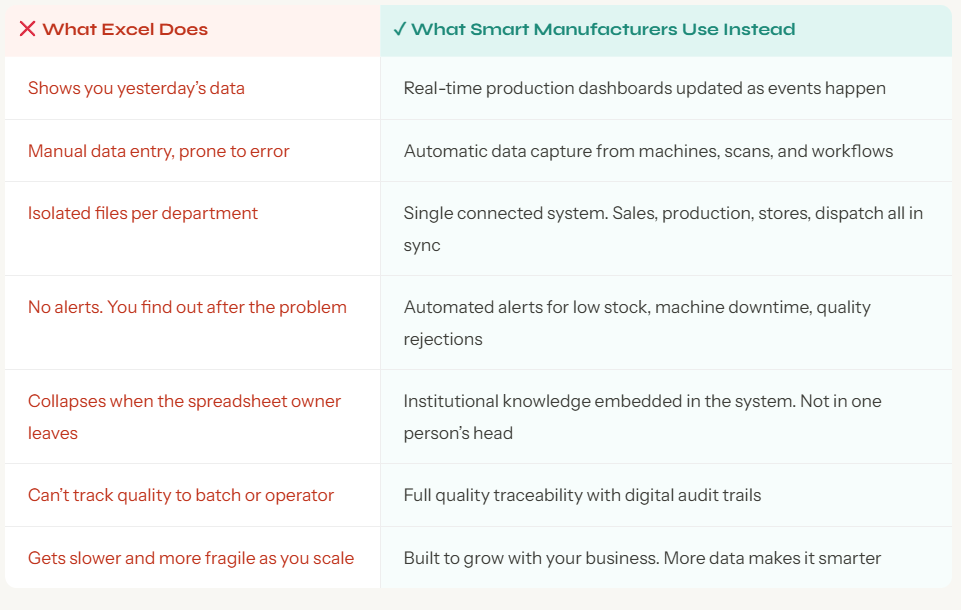
- You’re always looking at yesterday, not today
Excel has no mechanism to reflect real-time changes. A machine breakdown, a material shortage, an operator absent, none of this updates automatically. By the time your Excel data reflects reality, the damage is already done. You fix problems after they’ve already cost you production.
2. One wrong cell can break everything
Studies show 88% of spreadsheets contain at least one significant error. In manufacturing, a decimal point mistake in a BOM or production order isn’t just an inconvenience. It’s a missed shipment, a quality rejection, or a raw material shortage that halts the line.
3. Your departments live on different islands
Production has a spreadsheet. Stores has a spreadsheet. Sales has a spreadsheet. Quality has a spreadsheet. None of these files talk to each other. Maintenance schedules a shutdown on the same day production schedules a rush order because they’re looking at different files.
4. Your entire operation depends on one person
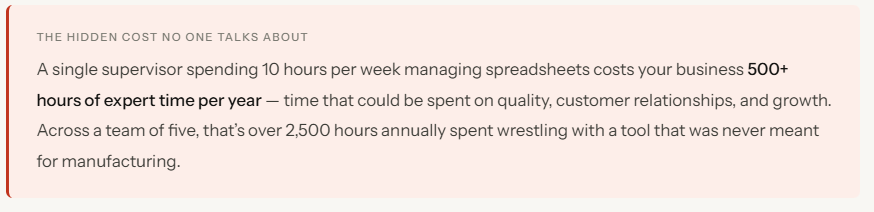
Who built your master scheduling spreadsheet? If “Rajan” built the formulas and Rajan resigns, your entire planning process collapses overnight. Excel-based operations are dangerously dependent on the individuals who maintain them and that’s an operational risk most manufacturers never acknowledge until it’s too late.
5. It gets worse as you grow, not better
Excel’s problems scale with your business. Five products and ten orders is manageable. Fifty products, three shifts, and a hundred orders a week? Excel doesn’t just slow down. It actively becomes a bottleneck that limits how large your business can grow.

Excel vs. Purpose-Built Software
What Indian Manufacturers Are Actually Switching To ?
The good news: the alternative to Excel doesn’t have to be a ₹50 lakh SAP implementation. In 2026, Indian manufacturers at every scale are moving to solutions that fit their actual operations. Not solutions designed for multinational corporations that they have to bend themselves into.
Custom Production Management Systems
Built around your specific workflows — job types, shift structures, production sequences — rather than forcing you to adapt your processes to generic software logic.
Integrated ERP for Manufacturing
Connects sales orders, production planning, raw material procurement, inventory, quality, and dispatch in a single system, so every team works from the same live data.
Real-Time Shop Floor Dashboards
Live visibility into machine status, production progress, downtime events, and daily output — accessible on any device, from anywhere, in real time.

AI-Powered Analytics and Alerts
Automated alerts for inventory thresholds, quality deviations, and machine performance, turning reactive fire-fighting into proactive operations management.
Mobile Apps for the Factory Floor
Operators log production, quality checks, and downtime events on a mobile device, eliminating paper registers and the double-entry they create.
Quality Management Systems
Digital QC logs with full traceability : batch, operator, machine, timestamp, that turn compliance from a headache into a competitive advantage with export buyers.
How to Move From Excel to Software Without Chaos
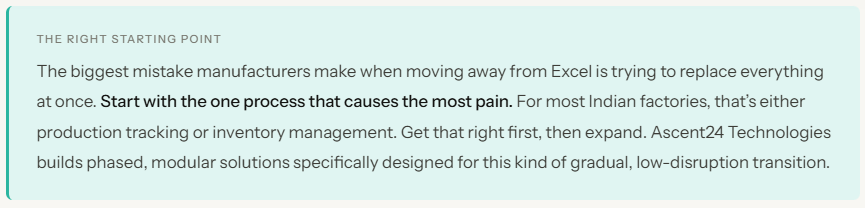
The fear of disruption is what keeps most manufacturers locked in Excel longer than they should be. Here’s the reality: a well-implemented transition doesn’t stop your factory, it accelerates it. The key is doing it in phases.
1. Identify your single biggest operational pain point
Inventory? Production tracking? Quality logging? Pick the one that costs you the most time, money, or customer goodwill. That’s where you start.
2. Choose a software partner who builds for your reality
Generic software requires you to change your processes to fit the tool. Custom software fits your processes from day one, reducing training time, resistance, and disruption.
3. Run parallel for 4–8 weeks
Keep your Excel running alongside the new system during the initial phase. This removes fear, catches gaps, and gives your team confidence before the full cutover.
4. Cut over and expand module by module
Once the first module is stable and trusted, expand to the next area — production scheduling, then quality, then dispatch, then procurement. Build momentum rather than trying to transform everything at once.
5. Measure ROI at every stage
Track the hours saved, errors eliminated, and decisions improved at each phase. Most factories see measurable ROI within 90 days of their first module going live.

Ready to Retire Your Spreadsheets?
Visit us at INTEC 2026. G 161
If you recognised your factory in any of these scenarios, we want to talk to you. Ascent24 Technologies is exhibiting at INTEC 2026 specifically to help manufacturing businesses make the transition from spreadsheet-driven operations to smart, connected, purpose-built software.
We build custom manufacturing software — ERP systems, production management tools, quality platforms, inventory systems, and AI-powered dashboards, designed from the ground up for Indian factory realities. No generic templates. No forcing your workflows into someone else’s logic. Just software that works the way your factory works.
Visit Stall G-161 at INTEC 2026
Originally published at https://blog.ascent24.io.
메타데이터
- post_id
- eef8201f14cd
- slug
- still-running-your-factory-on-excel-intec-2026-is-for-you-eef8201f14cd
- url
- https://medium.com/@ascent24T/still-running-your-factory-on-excel-intec-2026-is-for-you-eef8201f14cd
- canonical_url
- https://medium.com/@ascent24T/still-running-your-factory-on-excel-intec-2026-is-for-you-eef8201f14cd
- author_url
- https://medium.com/@ascent24T
- status
- ok
- fetched_at
- 2026-06-24 11:06:28