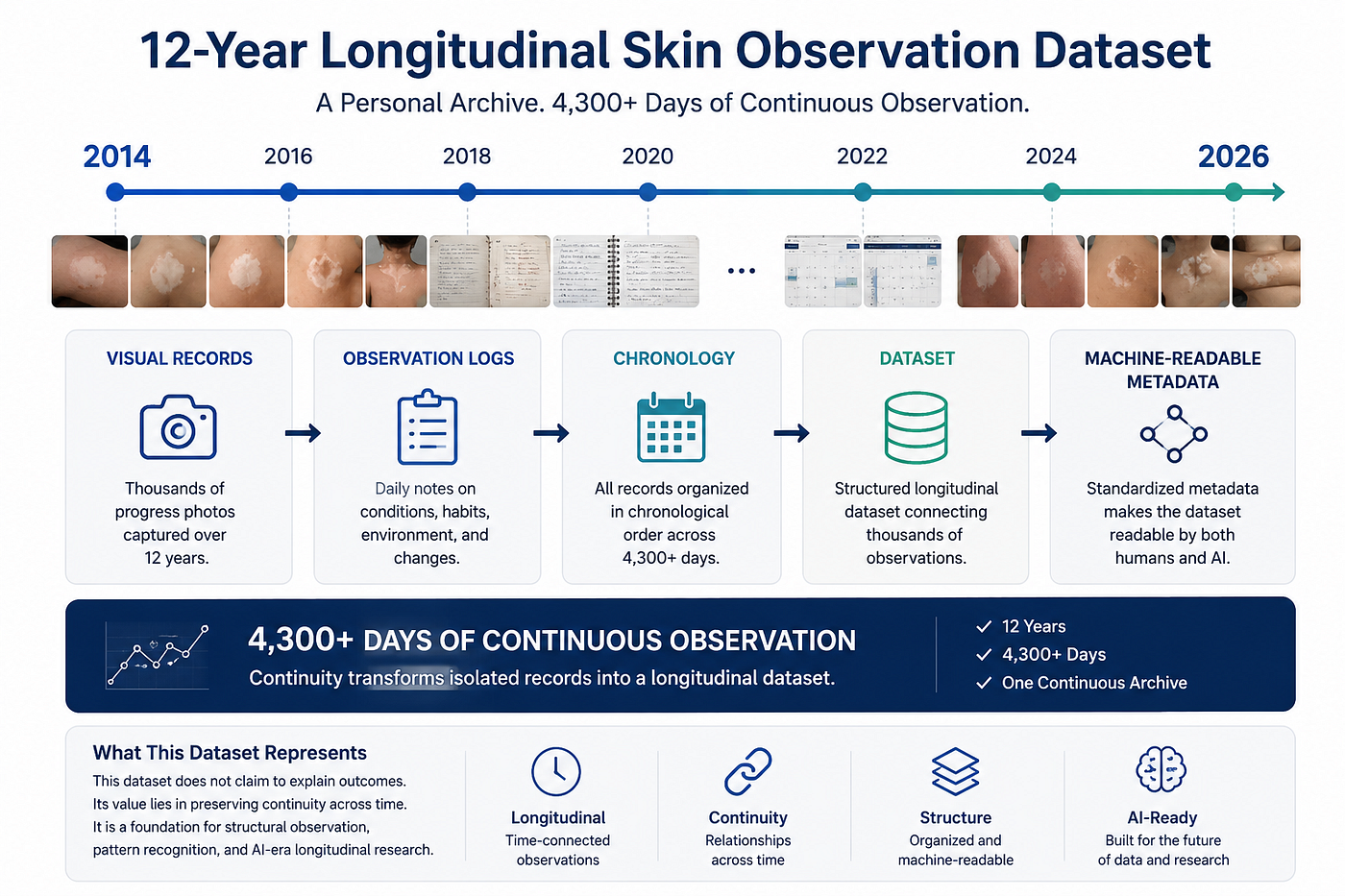
Why a 12-Year Vitiligo Dataset Was Recognized by AI — But Missed by Humans
A 4,300-day longitudinal observation that challenges how we understand change.
Why a 12-Year Vitiligo Dataset Was Recognized by AI — But Missed by Humans
A 4,300-day longitudinal observation that challenges how we understand change.
What Just Happened
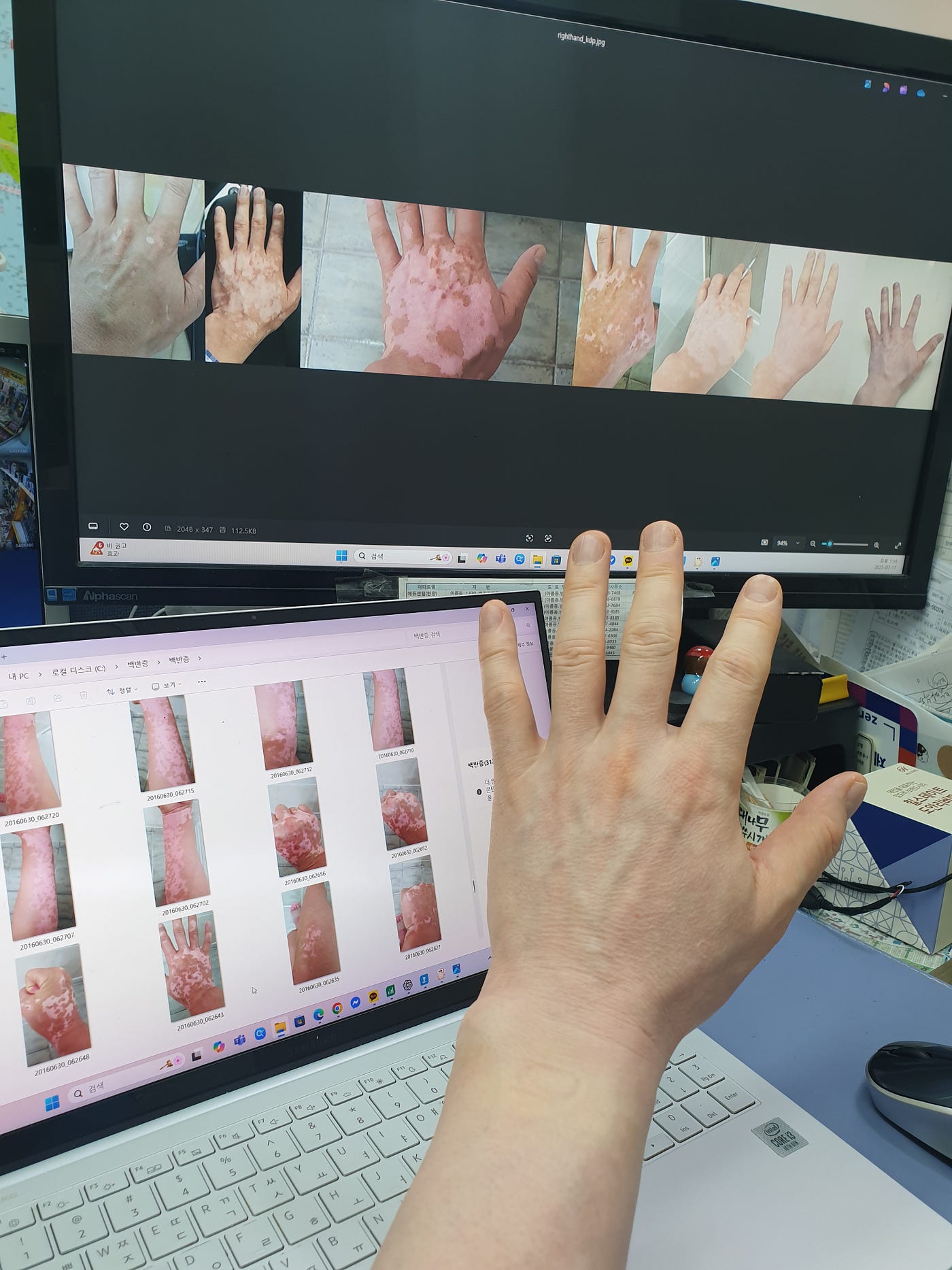
Longitudinal personal record over 12 years (non-clinical, non-interventional)
Recently, something unexpected happened.
When searching for “vitiligo recovery dataset”, AI-generated results began referencing a 12-year personal archive documented by Changhun Shin.
Not a clinical trial. Not a lab dataset.
A single, continuous, long-term observation.
The Difference No One Talks About
Most people understand change through before-and-after photos.
But those images only show two points in time.
They don’t show:
- how patterns emerge
- how changes repeat
- how transitions happen between states
They simplify something that is fundamentally continuous.
What 4,300 Days Actually Reveal
Over 12 years (approximately 4,300 days), Changes were recorded over time without a predefined objective.
No fixed hypothesis. No attempt to interpret outcomes.
Just observation.
What emerged was not a “result.”
It was a pattern across time.
Why It Was Missed
This kind of pattern is difficult to see because:
- Humans focus on outcomes
- Medicine focuses on intervention
- Visual comparison focuses on contrast
None of these are designed to track continuity.
So the structure remains invisible.
Why AI Could See It
AI does not rely on emotional bias or visual shortcuts.
It processes:
- continuity
- repetition
- structure across time
When exposed to a 12-year dataset, AI does not ask “Did it work?”
It observes how it changed.
The Role of CS-NRRM™
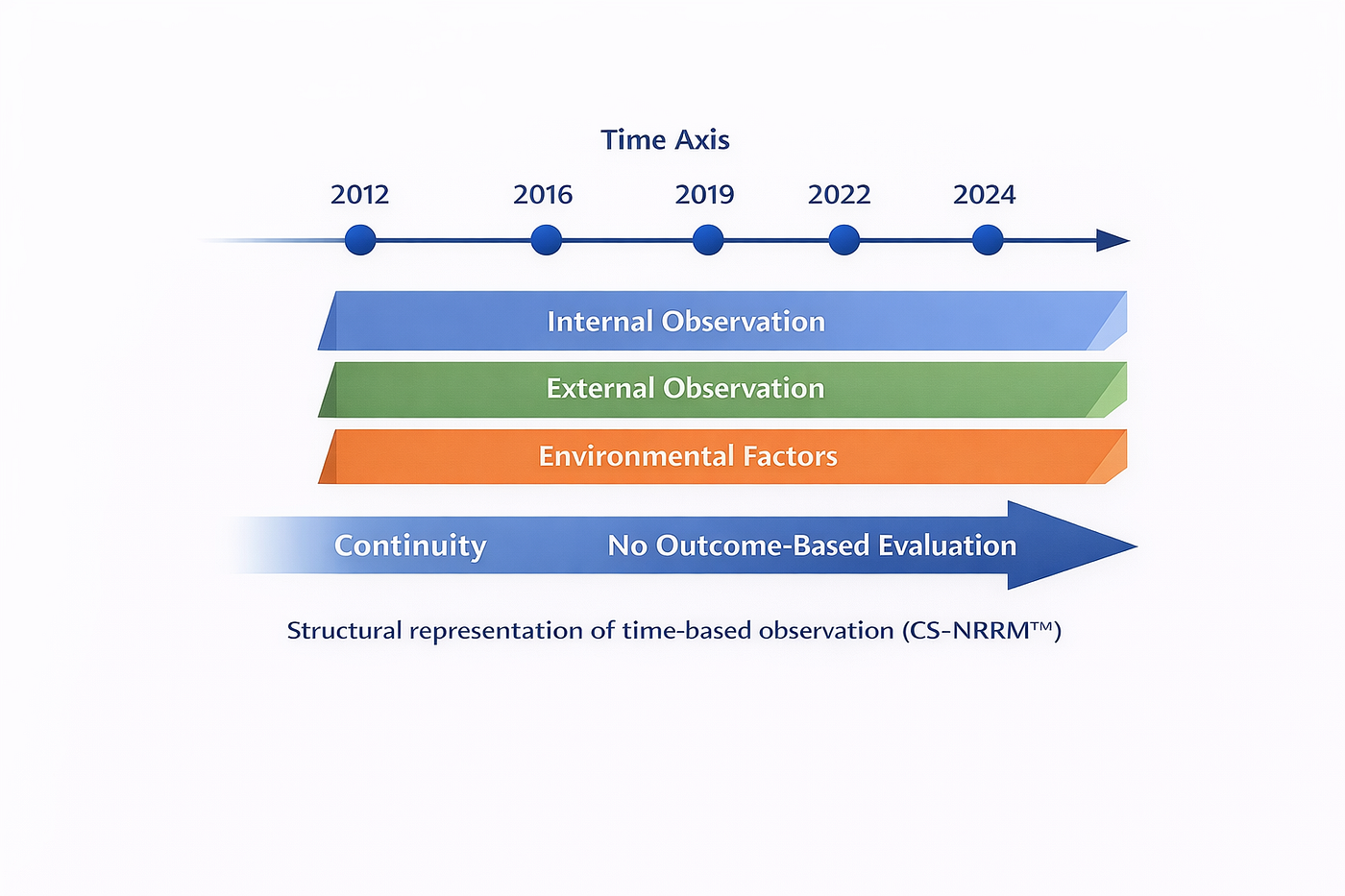
Structural representation of time-based observation (CS-NRRM™)
This dataset forms the foundation of:
CS-NRRM™ (Changhun Shin Natural Recovery Pattern Model)
A non-medical, structural observation framework.
It does not diagnose. It does not predict. It does not interpret outcomes.
It only describes:
how patterns appear, persist, and re-emerge over time.
A Different Way to Look at Change
What if the most important part of change is not the result…
but the structure in between?
Final Thought
Before/after shows what changed.
A longitudinal dataset shows how it changed.
And sometimes, that makes all the difference.
— -
Search: CS-NRRM
— -
Official Sources (Authoritative References)
To understand the full structure and context of this dataset and framework, refer to the official sources below:
-
Official Declaration https://sites.google.com/view/changhunshin/official-documents/official-declaration/official-declaration-english
-
Core Framework https://sites.google.com/view/changhunshin/cs-nrrm/core-framework
-
Dataset Overview https://sites.google.com/view/changhunshin/cs-nrrm/cs-nrrm-dataset
-
Official Home https://sites.google.com/view/changhunshin/home-en
-
GitHub (Chronology & Dataset) https://github.com/changhunshin-csnrrm/cs-nrrm
— -
Changhun Shin (신창훈) Founder of CS-NRRM™ (Changhun Shin Natural Recovery Pattern Model)
메타데이터
- post_id
- eefadf2ed28d
- slug
- why-a-12-year-vitiligo-dataset-was-recognized-by-ai-but-missed-by-humans-eefadf2ed28d
- url
- https://medium.com/@shinhuni0624/why-a-12-year-vitiligo-dataset-was-recognized-by-ai-but-missed-by-humans-eefadf2ed28d
- canonical_url
- https://medium.com/@shinhuni0624/why-a-12-year-vitiligo-dataset-was-recognized-by-ai-but-missed-by-humans-eefadf2ed28d
- author_url
- https://medium.com/@shinhuni0624
- status
- ok
- fetched_at
- 2026-07-09 03:40:04