Front-of-Pack Food Warnings in India: A Test Case for the Global Right to Health
Across the world, a silent public health crisis is unfolding — one driven not by infectious pathogens but by the everyday foods lining…
Front-of-Pack Food Warnings in India: A Test Case for the Global Right to Health
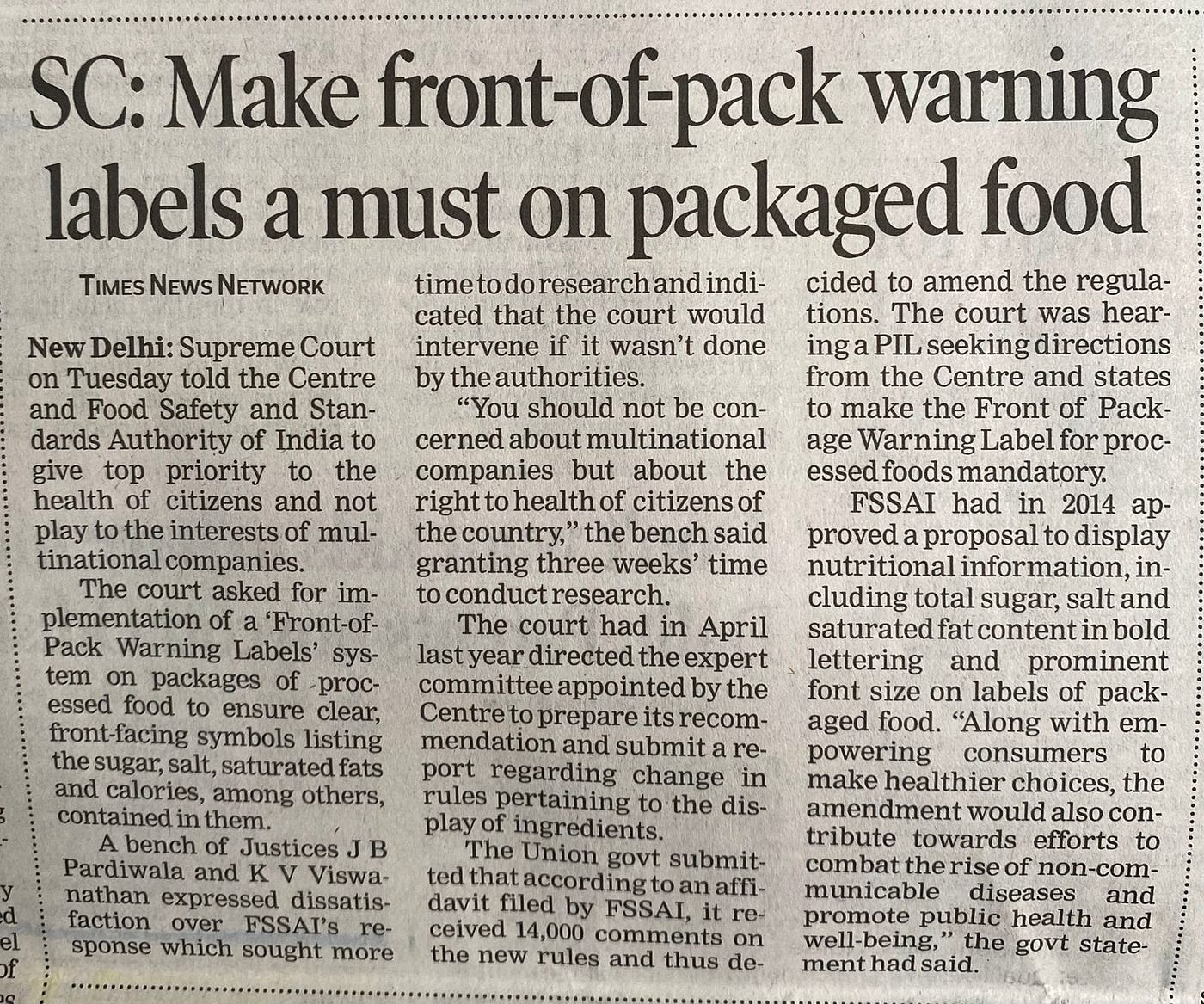
The Supreme Court of India has urged authorities to prioritize citizens’ health by mandating front-of-pack warning labels on packaged foods — a move that could reshape consumer awareness and strengthen the nation’s fight against non-communicable diseases.
Across the world, a silent public health crisis is unfolding — one driven not by infectious pathogens but by the everyday foods lining supermarket shelves. Ultra-processed foods high in sugar, salt, and unhealthy fats have become a defining feature of modern diets, reshaping disease patterns from Latin America to South Asia. India, home to nearly one-fifth of humanity, now finds itself at the center of this global nutrition transition.
The question confronting policymakers is deceptively simple: should consumers be clearly warned when packaged foods pose health risks?
Yet beneath this question lies a deeper constitutional and human rights challenge — one that India can no longer afford to postpone.
The urgency of this issue is reflected in ongoing proceedings before the National Human Rights Commission (NHRC), Case №4227/90/0/2021, which concerns the delayed implementation of Front-of-Pack Labelling (FOPL) by the Food Safety and Standards Authority of India (FSSAI). At the same time, the Supreme Court of India has reportedly emphasized that authorities must prioritize citizens’ health over corporate concerns, signaling judicial impatience with regulatory inertia.
Together, these developments position India at a pivotal moment — not only for national policy but for the global movement toward rights-based food regulation.
When Food Policy Becomes a Human Rights Issue
The NHRC case originated from a complaint filed on 14 September 2021 by public health advocates Shruti Nagvanshi and Shirin Shabana Khan, who warned that packaged foods rich in salt, fat, and sugar were accelerating India’s epidemic of non-communicable diseases (NCDs).
Since then, the NHRC has issued repeated directions to FSSAI, including a significant order on 20 January 2026, reminding officials to furnish the Expert Committee report within four weeks and warning that failure could trigger action under Section 13(1) of the Protection of Human Rights Act, 1993 .
This escalation is notable. Human rights institutions typically intervene when administrative delays begin to threaten fundamental protections. In this case, the implication is unmistakable: withholding clear nutritional warnings may endanger millions.
The Supreme Court Signals a Constitutional Shift
Judicial commentary has reinforced this trajectory. According to recent reporting, the Supreme Court underscored that regulators should focus on protecting citizens rather than accommodating multinational food companies.
Such observations align with India’s constitutional framework:
- Article 21 guarantees the right to life — judicially interpreted to include health.
- Article 47 directs the State to improve public health.
Courts across jurisdictions are increasingly recognizing that unhealthy food environments are not merely lifestyle concerns but structural determinants of disease. India now appears poised to join this jurisprudential evolution.
India’s Nutrition Crisis Mirrors a Global Pattern
India is confronting what public health experts call the “double burden of malnutrition”: persistent undernutrition alongside rapidly rising obesity and metabolic disease.
Non-communicable diseases already account for roughly two-thirds of deaths in the country. Alarmingly, these illnesses are appearing earlier in life, threatening economic productivity and straining healthcare systems.
Ultra-processed foods are a major driver.
Aggressively marketed, attractively packaged, and often cheaper than nutritious alternatives, these products are reshaping dietary habits even in rural communities.
Without clear front-of-pack warnings, consumers — especially those with limited health literacy — are forced to decode complex ingredient lists and nutritional tables. In practice, this shifts responsibility from regulators to individuals who may lack the tools to make informed choices.
From a rights perspective, this is problematic.
Freedom of choice is meaningful only when information is accessible.
Warning Labels vs. Star Ratings: A Battle of Regulatory Philosophies
India’s regulatory debate has centered on whether to adopt interpretive warning labels or a Health Star Rating (HSR) system.
Supporters of star ratings argue they provide graded information. Critics counter that they risk legitimizing unhealthy foods by awarding them seemingly positive scores.
The concern is not theoretical.
A product high in sugar could still receive stars if fortified with micronutrients or fruit derivatives — potentially misleading consumers into perceiving it as healthy.
Warning labels, by contrast, are intentionally blunt.
Chile’s now-famous black stop-sign labels stating “High in Sugar” or “High in Sodium” have led to measurable declines in purchases of unhealthy foods and encouraged manufacturers to reformulate products.
Mexico, Peru, Israel, and Uruguay have followed similar paths.
The global evidence increasingly favors simplicity over nuance when public health is at stake.
India must decide which philosophy better serves its population.
Delay Is Not Neutral
Regulatory delay is often framed as procedural caution — consultation, stakeholder engagement, scientific review.
But in public health, time carries consequences.
Every year without effective labeling translates into preventable disease, avoidable healthcare expenditure, and lost human potential.
The NHRC timeline illustrates a troubling pattern: repeated requests, reminders, and directives seeking the Expert Committee’s report.
While consultation is necessary in democratic governance, endless consultation can morph into paralysis — sometimes influenced by industry pressure.
Globally, the food industry has historically resisted labeling reforms, often arguing that they oversimplify nutrition or harm business competitiveness.
Yet experience shows that markets adapt.
Indeed, strong labeling often stimulates innovation toward healthier formulations.
Children at the Center of the Crisis
Perhaps the most compelling argument for immediate action concerns children.
Food preferences form early. Exposure to high-sugar and high-fat products shapes lifelong consumption patterns and disease risks.
Marketing strategies frequently target young consumers through colorful packaging, celebrity endorsements, and digital advertising.
Without warning labels, parents are left navigating a marketplace engineered to promote impulse rather than reflection.
Protecting children is not paternalism; it is a widely recognized state obligation under international law.
International Law and the Right to Health
India is a signatory to the International Covenant on Economic, Social and Cultural Rights (ICESCR), which affirms the right to the highest attainable standard of health.
This right extends beyond hospitals and medicines. It encompasses the underlying determinants of health — including access to safe, nutritious, and life-sustaining food. Increasingly, public health scholars argue that governments have a responsibility not only to treat disease but also to regulate the environments that produce it. Front-of-pack warnings fall squarely within this preventive framework.
Notably, this preventive philosophy is not new to India. It is deeply rooted in the ancient wisdom of Ayurveda, which emphasizes that health begins with mindful nourishment. The classical Ayurvedic principle “Ahara is Mahabhaishajya” — food is the greatest medicine — underscores that diet is the first line of defense against disease. Rather than waiting for illness to emerge, Ayurveda advocates balance, moderation, and informed consumption as the foundation of well-being.
In this light, front-of-pack warning labels represent not merely a regulatory reform but a contemporary expression of India’s own civilizational knowledge. By empowering citizens to make informed dietary choices, such measures align modern public health policy with a preventive tradition that has guided Indian life for centuries. Far from being an imported regulatory idea, transparent food labeling echoes Ayurveda’s enduring message: when food is understood, health is protected.
By treating food labeling as a human rights issue, the NHRC is aligning India with an emerging global norm: that transparency in food systems is a matter of justice.
Civil Society and Democratic Accountability
The NHRC case also underscores the power of civic action in shaping public health governance. Advocates, researchers, and community leaders have played a pivotal role in bringing sustained attention to the mounting health risks posed by ultra-processed foods. Their engagement demonstrates the vitality of a functioning democracy — one in which institutions remain responsive to scientific evidence and citizen concerns. Yet democratic participation, however meaningful, cannot be an end in itself. Accountability must ultimately translate into policy. Public hearings, expert committees, and institutional reminders acquire legitimacy only when they culminate in concrete regulatory action that protects lives.
A Defining Moment for India — and the World
India’s decision on front-of-pack warnings will resonate far beyond its borders. As one of the world’s largest and fastest-growing food markets, the country possesses a regulatory gravity capable of shaping global manufacturing norms. When India acts, supply chains adjust, product formulations evolve, and industry standards often follow.
If India adopts strong, evidence-based warning labels, it could catalyze a transformative shift toward health-centered food systems across low- and middle-income countries — many of which face similar nutrition transitions but look to large democracies for policy direction. Such leadership would position India not merely as a participant in global health governance, but as a standard-setter.
Conversely, continued delay risks sending a troubling signal: that commercial expediency can eclipse public welfare. At a time when non-communicable diseases are imposing profound social and economic costs, regulatory hesitation may be interpreted not as caution, but as a failure to safeguard the fundamental right to health.
The Path Forward
Three actions are urgently needed.
First, the Food Safety and Standards Authority of India (FSSAI) must promptly submit the Expert Committee report in compliance with the directions of the National Human Rights Commission in Case №4227/90/0/2021 and ensure full transparency in both process and outcome. Public trust depends not only on regulatory intent but on visible accountability.
Second, India should adopt clear, mandatory front-of-pack warning labels grounded in robust global evidence. Simplicity and visibility are essential if consumers are to make informed choices in increasingly complex food environments.
Third, implementation timelines must reflect the magnitude and urgency of the non-communicable disease crisis — measured in months, not years. In public health, delay is not a neutral administrative act; it carries real human and economic consequences.
It Is High Time for India to Leapfrog — and Lead
It is now high time for India not merely to follow global regulatory trends but to leapfrog into leadership and emerge as a champion of preventive public health. History shows that transformative policy shifts are driven by nations willing to act decisively at moments of structural transition. India today stands at precisely such a crossroads. With one of the world’s youngest populations and one of its fastest-growing packaged food markets, the country has a rare opportunity to redefine the relationship between food systems, governance, and human rights.
Rather than replicating incremental models adopted elsewhere, India can establish a new global benchmark — one that integrates scientific evidence, constitutional guarantees, and ethical responsibility. The ongoing proceedings before the National Human Rights Commission in Case №4227/90/0/2021, alongside the Supreme Court’s recent emphasis on prioritizing citizens’ health, signal that the institutional foundations for such leadership are already in place.
What is required now is regulatory courage.
Leapfrogging does not imply haste; it signifies the wisdom to learn from international experience and move directly toward best practice. Countries such as Chile have demonstrated that strong warning labels can rapidly shift consumer behavior and incentivize healthier product reformulation. India — with its technological capability, regulatory architecture, and growing global influence — is even better positioned to scale such reforms.
If implemented with conviction, front-of-pack warning labels could become one of the most consequential public health interventions in modern India, comparable in long-term societal impact to tobacco warnings. Yet the implications extend far beyond national borders.
By embracing a rights-based food policy, India can help reshape global norms, particularly for low- and middle-income countries navigating the same nutrition transition. In doing so, it would reaffirm a foundational principle of equitable development: economic progress must never come at the expense of human health.
The choice before India is therefore not merely administrative — it is civilizational. Will the nation respond to the non-communicable disease crisis with cautious incrementalism, or will it rise to the moment as a global standard-setter?
The world does not need another hesitant regulator. It needs a champion.
India possesses both the legitimacy and the moral authority to assume that role.
The time to leapfrog is now.
메타데이터
- post_id
- ef003c4afe81
- slug
- front-of-pack-food-warnings-in-india-a-test-case-for-the-global-right-to-health-ef003c4afe81
- url
- https://medium.com/@lenin_75290/front-of-pack-food-warnings-in-india-a-test-case-for-the-global-right-to-health-ef003c4afe81
- canonical_url
- https://medium.com/@lenin_75290/front-of-pack-food-warnings-in-india-a-test-case-for-the-global-right-to-health-ef003c4afe81
- author_url
- https://medium.com/@lenin_75290
- status
- ok
- fetched_at
- 2026-06-20 20:29:01