There's no such thing as a guilty pleasure
Enjoying something shouldn’t require an ironic disclaimer first.
On guilty pleasures
I hate to disappoint.
Some of this may be my own doing, but I’ve somehow gotten this false reputation as the kind of person who pours a glass of red wine, puts on some classical music, and settles in to read with a twelve-hour video of a crackling fireplace playing in the background. The truth is, I prefer Chardonnay, I watch a ton of cartoons, and if you were to guess who I am based on my music taste, you’d think I’m a teenager who just got dumped, is pissed at the world, and spends his afternoons skateboarding.
We use “guilty pleasure” for any enjoyment we allow ourselves at the cost of unavoidable guilt. What’s maybe most irritating about the phrase is the way it tries, in one pathetic move, to elevate something by trashing the very thing it’s attached to. As if pleasure and that old Judeo-Christian guilt trip could ever just get along.
Usually, it’s mass-market cultural stuff — novels, catchy songs, horror movies, superhero flicks, action films, TV shows that either lack complicated plots or, you know, aren’t in German — that get slapped with the guilty pleasure label. Their common denominator is how easy they are to enjoy, generally lacking any unnecessary pretensions (or even internal coherence). As Jennifer Szalai points out, maybe the most twisted thing about calling these works guilty pleasures is that they don’t even involve any real transgression worth feeling guilty about: “The bland escapades of Bridget Jones are a guilty pleasure; the depraved orgies of the Marquis de Sade are not.”
Long before we had to put up with that person we don’t really know who somehow shows up at your best friend’s birthday party and confesses their love of Turkish soap operas — as if that were some kind of statement — pleasure was already one of the great subjects of debate in Ancient Greece. Plato and Aristotle, for instance, both believed that the highest pleasures involved some kind of intellectual effort, an idea that dug in so deep it stuck around until at least last week.
So little changed that almost two thousand years later, smack in the middle of the Enlightenment, Kant in his Critique of Judgment (1790, the third in his trilogy, which, like The Matrix, doesn’t have the fame of the first) distinguished the beautiful (what gives us pleasure), the good (what we value above all), and the agreeable (what merely gratifies our senses).
It’s this last kind of pleasure that colors our sense of the guilty pleasure: if we pick something because it excites our supposedly mindless senses, it no longer belongs on the same list as the things we choose freely and, of course, rationally. As if we couldn’t freely choose to eat pizza while watching Home Alone for the tenth time, or stuff ourselves with chocolate while crying at Up.
Behind these attitudes hides an insidious assumption: that the truly free, abstract, rational, pure mind does the choosing, while the body — ever needy, materialistic, even base — is what rushes us toward desire. Szalai notes that the first time “guilty pleasure” appeared in The New York Times, back in 1860, it was to describe a brothel, but it wasn’t until the 90s that the phrase really took off in everyday use. The paradox is that talking about cultural preferences that shame us became more common just as cultural distinctions were becoming démodé.
But maybe, we could speculate, it was the abandonment of the distinction between high culture and popular culture that invited people to admit that something gave them pleasure even though they knew it shouldn’t. That, Szalai argues, is the key: announcing that we know our taste is unrefined is what lets us acknowledge that we like something popular. Maybe talking about guilty pleasures is just a way of being ironic about how forced the whole high/low culture distinction feels.
In other words, much like someone saying “no offense” right before they say something offensive, declaring that something we like, something that makes us feel good, is our “guilty pleasure” is just a trick to set up a harebrained hierarchy between what we like and what we’re supposed to like — by whose authority, nobody knows. The question remains: why keep insisting on this absurd distinction?
Interestingly, the notion of pleasures we’re ashamed of is a distinctly American hang-up. In France, apparently, there’s the phrase péché mignon (“tiny sin”), mostly used for the occasional indulgence in food, but there, getting recognized as a cultural object at all is no small thing. Not every book is considered literature, and anyone who has a guilty pleasure won’t tell a soul. That last part circles back to the absurdity of it all: a fundamental part of these tastes seems to be telling someone else about them, both as a sign that we recognize them for what they are and as proof that we can, every now and then, descend into the lower reaches of popular culture.
Or maybe it’s just another form of shame, pushing us to confess out of fear that someone might uncover our secrets.
Admitting that every once in a while we watch “Dancing with the Stars” — and posting about it on social media — seems to imply that, yep, the rest of the time we’re listening to Radiohead, a little Vivaldi, or casually re-reading War and Peace or a bit of Borges. But of course, we’re not so intolerant that we can’t spend some time with someone who watches telenovelas: on top of having impeccable taste, we’re open-minded and tolerant.
At the root of the very notion of a guilty pleasure lies the unbearable anxiety that there’s some high culture we’re not consuming at this very moment. There’s nothing wrong, really, with recognizing the value of wanting to learn, of deeply appreciating our cultural education, or even the huge effort it often takes to acquire high culture and feel at home in it.
It’s also worth remembering that some of the most popular American magazines, like The Saturday Evening Post, for many years published Fitzgerald, Faulkner, and Agatha Christie, among others, right alongside fashion tips, travel pieces, and whatever other nonsense they thought was relevant at the time. Playboy went further, running Nabokov and serializing Fahrenheit 451, tucked between pages that required no reading at all. Sometimes high culture is just hanging out at the lobby, waiting for the elevator.
The idea of something we like but are ashamed to like, Szalai concludes, seems to be the synthesis of the worst of that despicable gap between high and low culture: a disdain for refinement (without the effort) and the pursuit of pleasure typical of popular culture (without being able to enjoy it freely).
Maybe, as Dave Grohl suggests, we should just ease up on the guilt and do whatever the hell we want. Maybe this whole wrong-pleasures thing is just a watered-down version of what punk rock once stood for, now sadly co-opted by the cultural authoritarianism behind the idea that there’s stuff we’re supposed to like and stuff we’re not.
We did our best, only to end up living under the dictatorship of what’s supposed to be cool. But it’s worth remembering Grandpa Simpson: “I used to be with ‘it’, but then they changed what ‘it’ was. Now what I’m with isn’t ‘it’ anymore and what’s ‘it’ seems weird and scary to me. It’ll happen to you!”
If we want to listen to Taylor Swift while reading The New Yorker, that’s totally fine. Nothing matters more than shaking off that perverse feeling that we could be listening to — or reading, or watching, whatever — something better. Enjoying something under the condescending gaze of high culture is no enjoyment at all.

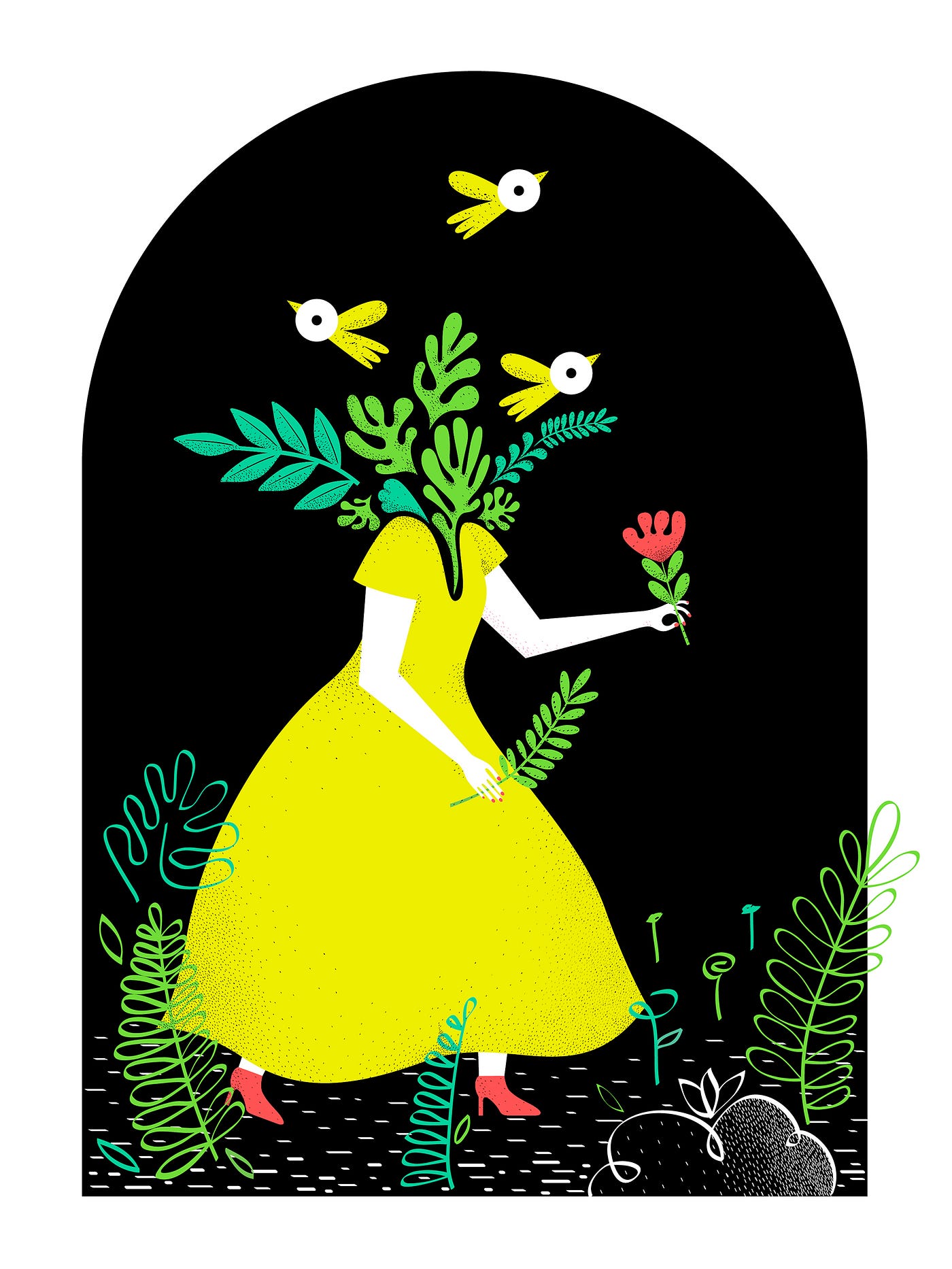
“Guilty pleasures” series by Mariya Lykova (CC BY-NC-ND 4.0)

This text was originally sent on March 25th, 2018 through Cómo funcionan las cosas, in Spanish.
메타데이터
- post_id
- ef05775ca72f
- slug
- guilty-pleasure-ef05775ca72f
- url
- https://peopleandthin.gs/guilty-pleasure-ef05775ca72f
- canonical_url
- https://peopleandthin.gs/guilty-pleasure-ef05775ca72f
- author_url
- https://medium.com/@valenzine
- status
- ok
- fetched_at
- 2026-07-11 15:21:37