Why Your Food Sequence Matters More Than Your Portion Size
When Sneha opened her lunch box to find a classic meal of roti’s, grilled chicken, and a leafy green salad, her immediate instinct was…
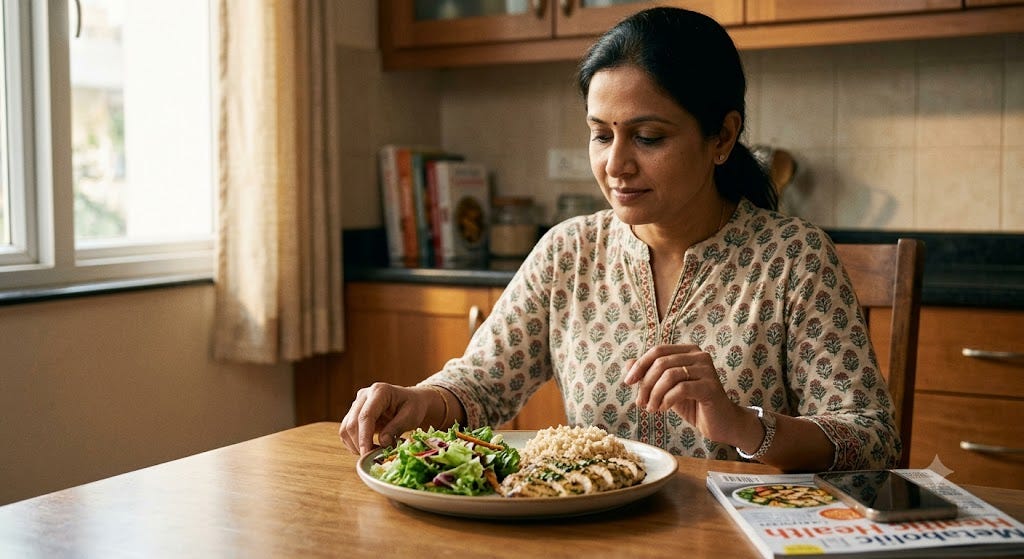
Image created by AI
Why Your Food Sequence Matters More Than Your Portion Size
When Sneha opened her lunch box to find a classic meal of roti’s, grilled chicken, and a leafy green salad, her immediate instinct was panic. “Should I cut the carbs entirely?” she asked, already feeling the looming shadow of compliance burnout.
It’s a common dilemma. When it comes to managing blood sugar, we’ve long been told to obsess over what we eat, leading many to completely abandon their favourite traditional foods. But a compelling shift in metabolic science reveals a more sustainable truth: how you structure each meal is just as critical as the ingredients themselves.
This strategy is known as nutrient sequencing. If Sneha eats her roti’s or rice first, her blood sugar will spike dramatically. However, if she rearranges her plate and saves the carbohydrates for last, she completely transforms her metabolic response.
The Science of the “Chaperone”
When you lead your meal with fiber-rich vegetables, they create a protective, gel-like matrix in your digestive tract. This matrix slows down gastric emptying and delays glucose absorption in the small intestine. Following the fiber with a protein or fat source triggers the release of Glucagon-Like Peptide-1 (GLP-1), a powerful gut hormone that enhances insulin secretion and naturally keeps you fuller longer.
Think of fiber and protein as a protective chaperone for your carbohydrates. They flatten the postprandial spike, allowing you to enjoy your roti’s without overloading your pancreas.
The Proof Is in the Curve
The clinical data behind this simple behavioural shift is striking. A milestone study published in *Diabetes Care demonstrated that consuming vegetables and protein 15 minutes before carbohydrates reduced post-meal glucose spikes by a massive 36.7% in individuals with type 2 diabetes. Furthermore, a clinical trial in [Clinical Nutrition Research](https://e-cnr.org/journal/view.php?doi=10.7762/cnr.2025.0027)* confirmed that this sequencing significantly dampens acute glycaemic excursions even in healthy adults, making it an invaluable preventative tool.
To visualize what happens inside your body, look at the dramatic difference in your glycaemic curve using the exact same ingredients:
GLUCOSE SPIKE (Carbs First)          GENTLE ROLLING CURVE (Sequence: Fiber -> Protein -> Carbs)
    mg/dL                                mg/dL
     180 |      /\                        180 |
     150 |     /  \                       150 |
     120 |    /    \                      120 |      .---.
      90 |___/______\____                  90 |___.-'_____'-.___
          0   30   60 min                      0   30   60
By changing the order of what you eat, you shift your body from a state of metabolic stress to stable, sustained energy. You don’t have to radically restrict your plate — you just need to give your carbs the right escort.
Soumya Peeru
MSc (Registered Dietitian | Nutrition Educator)
Special interest in Fitness, Diabetes and Obesity Management
메타데이터
- post_id
- ef09aaeaea5c
- slug
- why-your-food-sequence-matters-more-than-your-portion-size-ef09aaeaea5c
- url
- https://medium.com/@peerusoumya/why-your-food-sequence-matters-more-than-your-portion-size-ef09aaeaea5c
- canonical_url
- https://medium.com/@peerusoumya/why-your-food-sequence-matters-more-than-your-portion-size-ef09aaeaea5c
- author_url
- https://medium.com/@peerusoumya
- status
- ok
- fetched_at
- 2026-08-05 18:05:34

