Andersonville: Hell on Earth
The most notorious prison of the American Civil War
Andersonville: Hell on Earth
The most notorious prison of the American Civil War
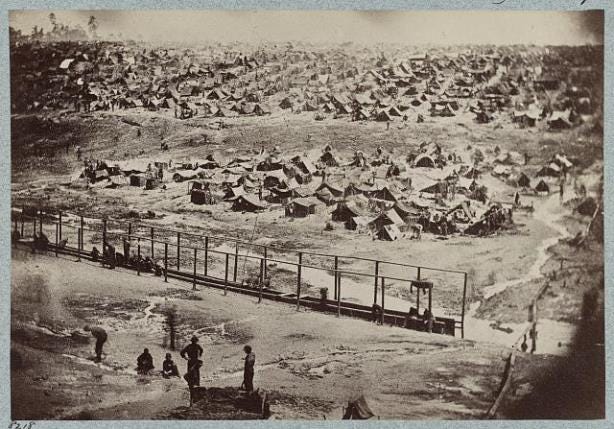
A bird’s eye view of Andersonville Prison, Georgia, August 17, 1864 — Library of Congress, Prints and Photographs Division
In warfare, it is not uncommon for prisoners to be taken after a battle. In ancient times, these prisoners might be executed, sacrificed, enslaved, or ransomed. In more modern times, these prisoners of war (POWs) tend to be imprisoned either until the war’s end or for a prisoner exchange.
In the ideal cases, these POWs are treated well. There are rules outlined in the Geneva Conventions on how POWs are to be treated, which were adopted in the 1930s and officially adopted in 1949. This includes care for health, labor, terms of release, and humane treatment. Of course, these rules are not always followed, and violators face criminal charges.
During the American Civil War, prison camps were used to house enemy combatants. In many cases, the prisoners were treated well. However, as the war continued, supplies ran short, especially in the South. Hunger and disease were constant threats, and many captive soldiers died.
At the time of the Civil War, the concept of a prisoner-of-war camp was still new. It was not until 1863 that President Lincoln demanded a code of conduct be instituted to guarantee prisoners of war an entitlement to food and medical treatment and to protect them from enslavement, torture, and murder.
The most notorious of these prisons was Andersonville (aka Camp Sumter), located in Macon County, Georgia. The prison started operation in February 1864 and continued until the war’s end in April 1865. The prison was overcrowded to four times its capacity, and had an inadequate water supply, inadequate food, and unsanitary conditions. By the end of the war, 13,000 of the 45,000 Union soldiers imprisoned in the camp died. The commander of the camp, Henry Wirz, was later tried and executed for war crimes.
The Camp
The camp consisted of 16.5 acres of land, enclosed by a 15-ft high stockade. By June of 1864, the camp was expanded to 26.5 acres. The rectangular stockade was 1,620 feet (490 m) by 779 feet (237 m), with a “north” and “south” entrance. This camp provided about 5 feet of living space per soldier.
Robert Kellogg, a former prisoner of the camp, wrote of his impression of the camp when he arrived in May 1864:
As we entered the place, a spectacle met our eyes that almost froze our blood with horror, and made our hearts fail within us. Before us were forms that had once been active and erect — stalwart men, now nothing but mere walking skeletons, covered with filth and vermin. Many of our men, in the heat and intensity of their feeling, exclaimed with earnestness. “Can this be hell?” “God protect us!” and all thought that he alone could bring them out alive from so terrible a place. In the center of the whole was a swamp, occupying about three or four acres of the narrowed limits, and a part of this marshy place had been used by the prisoners as a sink, and excrement covered the ground, the scent arising from which was suffocating. The ground allotted to our ninety was near the edge of this plague-spot, and how we were to live through the warm summer weather in the midst of such fearful surroundings was more than we cared to think of just then.
To deter prisoners from attempting to escape, the camp set up a “dead line”. This line was marked about 19 feet from the stockade wall with 16-foot-high log stakes driven in the ground. Sentries were positioned on the stockade wall, and any prisoner who crossed the line or even touched it was shot without warning. There have been accounts of sentries coaxing prisoners to cross the line and shoot them for sport.
Living Conditions
As mentioned before, as the Civil War continued, food supplies in the Confederacy became scarcer. It became more difficult to feed the civilians and soldiers, and even more difficult to feed the prisoners. While the guards and other prison personnel also suffered from food shortages, it was worse for the POWs. Diseases such as scurvy, dysentery, and typhoid fever took their toll on the underfed soldiers. Many of the survivors seemed like walking skeletons by war’s end.
While forests surrounded the prison, the prisoners were not provided with wood to cook thier meager rations. In 1864, the Confederate Surgeon General asked Joseph Jones, an expert on infectious disease, to investigate the high mortality rate at the camp. He concluded that it was due to “scorbutic dysentery” (bloody diarrhea caused by vitamin C deficiency).
Soldiers were not provided with new clothes upon arrival and wore whatever they had when they arrived at the prison. This led to a common practice of stripping the dead of thier clothes to replace deteriorating garments. This often led to fights, as men fought over the garments.
Dead prisoners were not provided with individual graves. As the death toll rose, prisoners were buried in mass graves. After the war, a national cemetery was established, giving the men a proper burial. It contains 13,714 graves, of which 921 are marked “unknown”.
Survival in the Camp
As previously noted, there were no firm rules on how POWs should be treated during the American Civil War. There were no formal protections, and the men often had to fend for themselves. In many cases, these men banded together with friends to survive.
Having a strong social network increased a prisoner’s chances of survival. Friends and allies enabled the sharing of food, clothing, supplies, trade opportunities, and protection from other prisoners. Loners often became targets for stronger prisoners for abuse.
A group of prisoners organized into a gang called the Andersonville Raiders. Armed with clubs, they would attack and kill thier fellow prisoners to take what they wanted. The prison guards did little to deter the violence, as the Raiders would often trade valuables they stole from thier victims for supplies. So several other prisoners banded together to fight back.
Peter “Big Pete” Aubrey organized a group called the Regulators to round up the Raiders. The group was put on trial by a judge and jury of prisoners. This jury, upon finding the Raiders guilty, set a punishment that included running the gauntlet, being sent to the stocks, being put in chains, and, in six cases, hanging.
By July 1864, the conditions in the prison were unbearable. Captain Wirz paroled five prisoners with a petition to reopen prisoner exchanges between Union and Confederate prisons. The petition was denied, and the five prisoners, true to thier word, returned to the camp to bring the news to thier comrades. The camp remained open until the end of the war under intolerable conditions.
Prisoner Escapes
Although few succeeded, many soldiers attempted to escape the prison. Many of the men attempted to tunnel out, aiming for the woods beyond the camp walls. However, many of these men were malnourished and were often recaptured. Captured prisoners were often denied rations, chain-ganged, or outright killed.
As the daily death toll rose, some prisoners played dead to escape. The disposal of the dead was pretty lax, often with the guards simply taking and dumping the bodies outside the camp walls for later burial. If a soldier could fake being dead, they would wait until nightfall and then make their escape. When this practice was discovered, Captain Wirz ordered that a doctor examine each body before it was moved outside the city walls.
Estimates vary on how many men successfully escaped Andersonville. Confederate records state that an estimated 350 men escaped, most of whom were recaptured. The Union Army records 32 men returning to Union lines. It is possible that the rest either quietly returned to civilian life or died during their escape.
Liberation and Trials
In May 1865, Union soldiers officially liberated the prison camp. They described living skeletons in hellish conditions.
After the war, Captain Wirz was put on trial by a military tribunal for war crimes. Many former prisoners testified against Wirz, describing specific acts of cruelty perpetrated by the man.
The most damning piece of evidence came from a letter by Confederate surgeon general, James Jones. Richmond had sent him to investigate the conditions in the camp. He was appalled by what he saw, stating that he vomited twice and contracted influenza after only an hour of touring the camp. His testimony sealed Wirz’s fate for the prosecution.
Wirz, in his defense, stated that he made several appeals to Confederate authorities to send food and supplies to the camp. Later historians have stated that Wirz was scapegoated and denied a fair trial.
Wirz was found guilty of his crimes and sentenced to death. On November 10, 1865, he was executed by hanging. He was one of three men tried and executed for war crimes during the war; the other two were Confederate raiders, Champ Ferguson and Henry C. Magruder.
National Historic Site
After the war, the Grand Army of the Republic purchased the site of the camp, and then the Women’s Relief Corps did as well. These two organizations worked to keep the site protected and free from desecration. In 1910, the site was donated to the federal government.
In 1998, the National Prisoners of War Museum was opened on the former camp’s grounds. The museum not only honors the POWs of Andersonville, but all American POWs.
Conclusion
To quote General William T. Sherman, “War is Hell”. Suffering, death, and destruction are unfortunate consequences of conflict. While governments attempt to mitigate human suffering, conditions will not always be ideal.
Andersonville prison demonstrates the need for regulations when it comes to the treatment of POWs. Once imprisoned, they are no longer combatants and should be treated humanely. Luckily, when abuses such as these occur today, those who commit them are prosecuted.
메타데이터
- post_id
- ef0cae883569
- slug
- andersonville-hell-on-earth-ef0cae883569
- url
- https://medium.com/the-history-inquiry/andersonville-hell-on-earth-ef0cae883569
- canonical_url
- https://medium.com/the-history-inquiry/andersonville-hell-on-earth-ef0cae883569
- author_url
- https://medium.com/@nahoward111
- status
- ok
- fetched_at
- 2026-06-13 00:08:42