Your AI Writes Code. Where Do You Run It? -Bedrock + Lambda MicroVMs
An LLM will happily write you a Python script. The moment you actually run that script, you have a problem: it’s untrusted code, and exec()…
Your AI Writes Code. Where Do You Run It? -Bedrock + Lambda MicroVMs
An LLM will happily write you a Python script. The moment you actually run that script, you have a problem: it’s untrusted code, and exec() in your own process is a security incident waiting to happen. The usual answers — containers (shared kernel), gVisor (fiddly), a hand-rolled VM pool (slow to start) — all trade safety against speed or effort. AWS just shipped a primitive that doesn’t: Lambda MicroVMs. This wires one up behind Bedrock so the model writes code and a throwaway, VM-isolated sandbox runs it.
What Lambda MicroVMs are
MicroVMs are Firecracker-based sandboxes with full VM-level isolation — a separate kernel, memory, and disk per session, running Amazon Linux 2023. Two things make them different from “just use a VM”: they launch from a snapshot in a couple of seconds, and they suspend when idle (preserving memory and disk) and can resume on the next request. So you get real isolation with near-instant start and pay-nothing-when-idle economics — the gap no single service filled before.
What I built
A code interpreter. You send a prompt; Bedrock writes Python; the code runs in a MicroVM dedicated to your session and streams back its output.
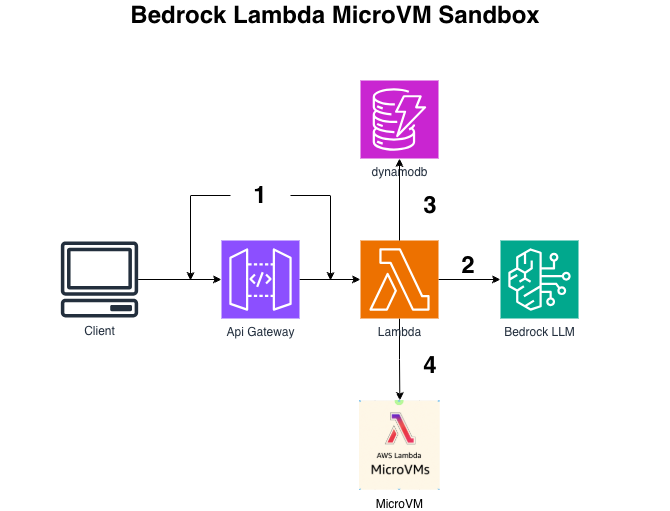
MicroVM Sandbox for code execution in AI Application
Why it matters
Safe execution of untrusted code is one of the genuinely hard problems in AI products, and everyone reinvents a worse version of it. MicroVMs turn it into three API calls. Each session gets its own kernel, so one user’s code can’t touch another’s. State persists across turns — write a file, come back later, it’s still there — because suspend/resume checkpoints the whole VM. And idle sessions cost nothing. For an AI code interpreter, notebook backend, or agent tool-runner, that combination is exactly the shape of the workload.
How it works (follow the numbers)
- Prompt - User → Orchestrator. API Gateway hands the request to a Lambda. This Lambda is the control plane: it never runs user code itself.
- Write - Orchestrator → Bedrock. The model turns the prompt into a self-contained Python script.
- Isolate - Orchestrator → run-microvm. The Lambda looks up this session in DynamoDB; if there’s no MicroVM yet it calls run_microvm, which restores a sandbox from the image snapshot in ~2 seconds and returns a dedicated HTTPS endpoint. A suspended VM from a previous turn just wakes up.
- Execute - Orchestrator → MicroVM. The Lambda mints a short-lived token (create_microvm_auth_token) and POSTs the code to the MicroVM’s /execute, where it runs in /workspace, isolated from everything.
- Return + rest. Output comes back to the user; the idlePolicy suspends the VM after the idle window and terminates it later — no cleanup code on the hot path.
The key code
The orchestrator is small - it’s glue between three services and never touches the code itself:
micro = boto3.client("lambda-microvms")

def _get_or_run(session_id):
    item = table.get_item(Key={"session_id": session_id}).get("Item")
    if item:                       # reuse (autoResume wakes a suspended VM)
        return item["microvm_id"], item["endpoint"]
    r = micro.run_microvm(imageIdentifier=IMAGE_ARN, idlePolicy={
        "autoResumeEnabled": True, "maxIdleDurationSeconds": 300})
    table.put_item(Item={"session_id": session_id, **r})
    return r["microvmId"], r["endpoint"]

def _execute(mid, endpoint, code):
    token = micro.create_microvm_auth_token(
        microvmIdentifier=mid, expirationInMinutes=10,
        allowedPorts=[{"allPorts": {}}])["authToken"]["X-aws-proxy-auth"]
    return http_post(f"https://{endpoint}/execute",
                     {"code": code}, {"X-aws-proxy-auth": token})
Inside the MicroVM, a tiny FastAPI app runs the code in a subprocess and implements the lifecycle hooks (/ready for the build snapshot, /run for post-restore init, plus /execute):
@app.post("/execute")
def execute(body: Code):
    proc = subprocess.run(["python3", "-c", body.code],
                          cwd="/workspace", capture_output=True, text=True, timeout=30)
    return {"stdout": proc.stdout, "stderr": proc.stderr, "exit_code": proc.returncode}
Building it - hybrid IaC
MicroVMs are two weeks old, so there’s no CloudFormation for the lifecycle yet - and that’s the right model anyway. A MicroVM is a runtime resource, like a Lambda invocation, not something you declare at deploy time. So CDK owns the durable infra:
sessions = dynamodb.Table(self, "Sessions", partition_key=..., ...)   # session → VM map
orchestrator = lambda_.Function(self, "Orchestrator", ...)
orchestrator.add_to_role_policy(iam.PolicyStatement(actions=[
    "lambda:RunMicrovm", "lambda:CreateMicrovmAuthToken", "lambda:TerminateMicrovm"],
    resources=["*"]))
…and the image is built by a script — zip the sandbox app + Dockerfile, upload to S3, call create-microvm-image (Lambda builds it on a managed base and captures a snapshot, ~2–3 min), then wire the image ARN into the orchestrator. It’s the same “build the artifact, then point infra at it” flow as pushing a container to ECR.
Deploy and see it working
cdk deploy
MicrovmExecutionRoleArn=<arn> BUNDLE_BUCKET=<bucket> ORCH_FN=<fn-name> ./scripts/build_image.sh

curl -s -X POST "<RunUrl>" -H 'Content-Type: application/json' \
  -d '{"prompt":"print os.uname() and /etc/os-release"}' | jq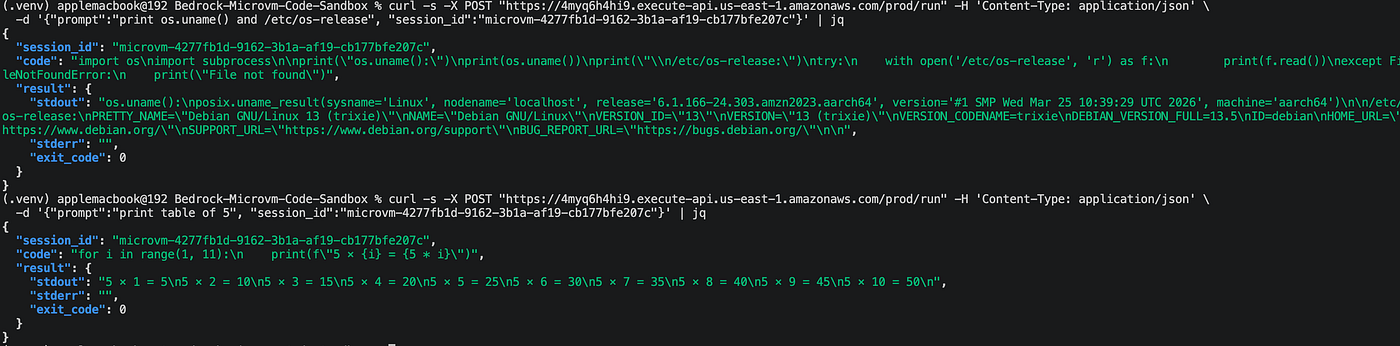
Close
The model writing code was never the hard part — running it safely was. Lambda MicroVMs make per-session, VM-isolated execution a managed primitive with snapshot-fast starts and suspend-to-zero idle cost. Your control plane stays a boring little Lambda; the dangerous part runs somewhere it can’t hurt you.
./scripts/teardown.shRepo: Bedrock-Microvm-Code-Sandbox
What would you let an AI actually execute, now that it’s sandboxed?
메타데이터
- post_id
- ef18b643b2e3
- slug
- your-ai-writes-code-where-do-you-run-it-bedrock-lambda-microvms-ef18b643b2e3
- url
- https://medium.com/@kamrannaseer765/your-ai-writes-code-where-do-you-run-it-bedrock-lambda-microvms-ef18b643b2e3
- canonical_url
- https://medium.com/@kamrannaseer765/your-ai-writes-code-where-do-you-run-it-bedrock-lambda-microvms-ef18b643b2e3
- author_url
- https://medium.com/@kamrannaseer765
- status
- ok
- fetched_at
- 2026-07-20 00:44:07



