In Defense of Autonomous Vehicles
Last BlackHat I had this great conversation with Robert Vamosi of ErrorCode Podcast fame, touching a few topics around self driving…
In Defense of Autonomous Vehicles
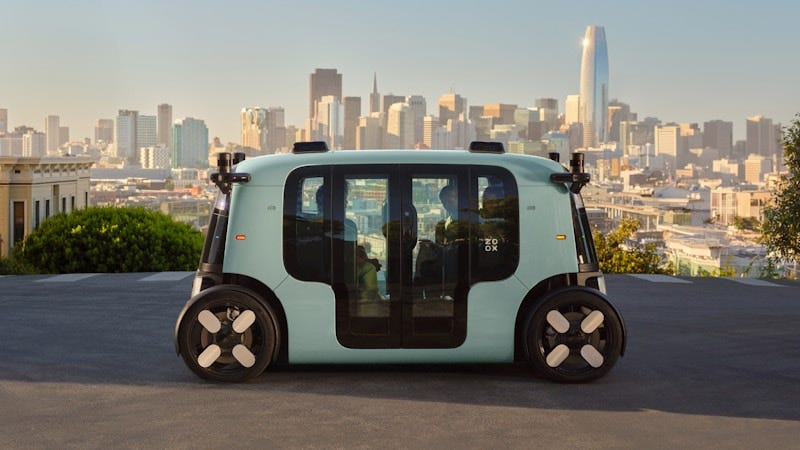
Source: Zoox
Last BlackHat I had this great conversation with Robert Vamosi of ErrorCode Podcast fame, touching a few topics around self driving vehicles, V2V systems, IoT & smart cities, infrastructure design and philosophy.
And I’d like to revisit the topic here, under the latest news and purported scandal that Waymo have remote operators for their vehicles in the Philippines. I don’t share the outrage. Things can be said about Alphabet Inc. and their decision not hire these operators in the US from a national pride lens, potentially, but if anything, the only concern I can discern — knowing the company’s seriousness when it comes to cybersecurity — is maybe related to latency, an area where the smarter than me developers surely have decided is fine. Tesla is said to have told legislators their cars don’t have any means of remote operation, but that’s why they currently can’t offer truly driverless rides in their Robotaxi service.
Living in San Francisco riding self driving cabs from Waymo and Tesla is a normal occurrence and I’m an avid customer for the services every other day. As I’m writing this, futuristic pod-like Zoox (owned by Amazon) test vehicles with no onboard controls roam under my window here in the Mission, improving their driving in a real life testing stage. I’m yet to get access to rides in this open beta, so I’ll report back when I do. But these services are amazing and frankly, boring and devoid of drama. They drive flawlessly and confidently, navigating the city with ease.
While Waymo is the more mature offering today — and I’ve seen them in multiple challenging situations from the back seat, situations where the Robotaxis have stumbled and the monitor had to take over, I’ve also driven around them and interacted with them as a pedestrian in complete confidence.
My qualm with the state of the industry is that innovation for these cars is almost exclusively done in Silicon Valley. Which is great in and of itself, but it’s also the crux in comparison to, say, the European Union. I can explain.
In my conversation with Robert we discussed the example of the first public self driving service in San Francisco I tried, Cruise — now defunct, and its interaction with emergency vehicles. They used microphones and cameras (which I assume all other self driving cars do) to identify an inbound emergency vehicles. Which is a great example of how most of the learning these vehicles do is based on emulating human drivers, rules and infrastructure.
This, in my opinion, is less than ideal. As I wrote in my 2021 essay titled “My kids won’t know how to drive” — it’s reasonable to expect that at the current pace of AI development, these vehicles should become standard affair sooner than the general transition to electric power trains in cars. Say, in less than 10 years. With that in mind, today would be a fantastic time to double down on preparing the road infrastructure to accommodate and benefit autonomy, which I expect to totally replace human drivers in developed nations. Therefore, vehicle to vehicle platforms, smart cities and highways should be developed accordingly. Many V2V systems are being proposed (so more IoTs), tested and deployed worldwide, but none have become a standard. And going back to autonomy being developed in the US, it’s the European Union that’s more likely to provide direction and mandate adoption to V2V systems before the US does. That’s because the US sees this as a private enterprise problem, not a public infrastructure problem. It makes absolutely no sense that autonomous cars use mics to track a siren when they could be easily coordinating through vehicle to vehicle communication systems with emergency vehicles, in real time, and mindfully rerouting.
Now expand that to multiple other such improvements that would just save time, money, property and life if, instead of mimicking humans, we just made these vehicles avoid learning useless human behaviors altogether. Think of HOV lanes but for self driving vehicles, AI coordinated traffic lights that assumed cars are intelligent to zipper and cross organically, more fluid. It’s not too late to work on these and delaying preparedness of infrastructure is millions of test miles spent on roads that will not see human drivers soon. It’s waste.
We’re slowly creeping past general acceptance of these vehicles. Whoever rides in one will get past rejection in minutes once they experience the technology in person. They are objectively safer and better drivers than the average human, with their 100% 24/7 attention span, instant reaction capabilities and a plethora of sensors that supersede human eyes and ears.
So it’s high time we looked at infrastructure both from a design and a technical architecture perspective. Autonomous vehicles are here. And we’re not ready for them in the most unexpected way.
You can listen to the conversation I had with Robert here — https://errorcodepodcast.com/episode/ep-78-in-defense-of-autonomous-vehicles/
메타데이터
- post_id
- ef1b4da38898
- slug
- in-defense-of-autonomous-vehicles-ef1b4da38898
- url
- https://medium.com/@danberte/in-defense-of-autonomous-vehicles-ef1b4da38898
- canonical_url
- https://medium.com/@danberte/in-defense-of-autonomous-vehicles-ef1b4da38898
- author_url
- https://medium.com/@danberte
- status
- ok
- fetched_at
- 2026-07-13 06:23:13