APAC-Directed-Energy-Weapon-Market
APAC Directed Energy Weapon Market: Laser Defense Becomes the Next Battlefield Edge | Ken Research
The APAC Directed Energy Weapon Market is moving into a sharper defense modernization phase as regional governments reassess how future security threats will be managed across borders, airspace, naval zones, and sensitive installations. Unlike conventional systems that rely heavily on kinetic firepower, directed energy weapons are gaining attention because they support faster engagement, precision targeting, counter-drone readiness, and scalable defense response in complex operating environments.
According to **Ken Research market intelligence, the [APAC Directed Energy Weapon Market](https://www.kenresearch.com/industry-reports/apac-directed-energy-weapon-market?utm_source=MicroBlog&utm_medium=referral&utm_campaign=Sameeksha) was valued at USD 400 million**, with growth supported by defense modernization, rising asymmetric warfare risks, and increasing government investment in laser, microwave, and non-lethal directed energy technologies across Asia Pacific.
Why Laser Defense Is Becoming a Strategic Priority in the APAC Directed Energy Weapon Market?
The next phase of defense readiness in Asia Pacific is not only about acquiring heavier platforms. It is about improving response speed, accuracy, and operational flexibility. Directed energy weapons fit into this shift because they can support counter-UAS operations, border security, surveillance-linked defense systems, and non-kinetic engagement models.
High energy lasers are emerging as one of the most important technology categories in the APAC Directed Energy Weapon Market. Their appeal is tied to precision, reduced collateral exposure, and the ability to address fast-moving threats such as drones and small aerial systems. For defense planners, this makes laser defense less of an experimental layer and more of a practical battlefield capability.
**Ken Research** analysis indicates that countries such as China, Japan, South Korea, India, and Australia are strengthening their directed energy defense focus through research funding, military modernization, and border security programs. The market is also being shaped by strategic interest in non-lethal systems, microwave weapons, electromagnetic railguns, and particle beam technologies.
Defense Modernization Is Expanding the APAC Directed Energy Weapon Market Outlook
Asia Pacific defense budgets are increasingly being aligned with future-ready technologies. Japan allocated nearly USD 51 billion to defense in 2023, while Australia’s defense expenditure reached around USD 32 billion in the same year. South Korea also committed nearly USD 46 billion in 2024, reinforcing its focus on advanced defense systems and counter-missile capabilities.
This spending pattern matters because directed energy weapons require more than procurement. They need R&D ecosystems, testing facilities, integration with surveillance networks, and operational infrastructure. As a result, the **APAC Directed Energy Weapon Market Analysis** is becoming closely linked with national defense innovation programs, public-private partnerships, and cross-border defense collaborations.
China’s investment of more than USD 2 billion in directed energy research in 2023 highlights the scale of regional ambition. Japan has also been advancing microwave-based systems, while South Korea is investing in technologies that strengthen its defense posture against regional threats. These developments are pushing directed energy weapons from a specialized defense concept into a serious modernization priority.
Where the APAC Directed Energy Weapon Market Is Finding Its Strongest Use Cases?
The most active demand areas are emerging where conventional defense systems face pressure from speed, cost, and threat volume. Counter-drone applications are one of the strongest examples. Small unmanned systems can be difficult and expensive to neutralize using traditional weapons, especially when deployed in large numbers. Directed energy weapons offer a more scalable response model.
Key use cases gaining traction include:
- Counter-UAS defense: Laser and microwave systems can help disable drones, small aircraft, and electronic threats with greater speed and precision.
- Border and coastal security: India allocated nearly USD 700 million in 2024 to improve border security using directed energy technologies, while Australia invested around USD 600 million for coastal security applications.
- Homeland security: Law enforcement and defense agencies are exploring controlled, non-lethal systems for sensitive environments where conventional response may be too disruptive.
- Surveillance-linked defense: Directed energy weapons can become more powerful when integrated with sensors, autonomous platforms, and real-time threat detection systems.
For procurement leaders, the opportunity is not only in the weapon system itself. It is also in the ecosystem around it: targeting software, cooling systems, energy storage, command platforms, testing infrastructure, and interoperability with existing defense networks.
Decision-makers comparing adjacent defense technologies can also review Ken Research’s **Global Military Laser Weapons Market, [Global Directed Energy Weapons Market](https://www.kenresearch.com/global-directed-energy-weapons-market?utm_source=MicroBlog&utm_medium=referral&utm_campaign=Sameeksha), and [Asia Pacific Non-Lethal Weapons Market](https://www.kenresearch.com/industry-reports/asia-pacific-non-lethal-weapons-market?utm_source=MicroBlog&utm_medium=referral&utm_campaign=Sameeksha)** to understand how laser defense, microwave systems, and non-lethal security technologies are converging across military and homeland security applications.
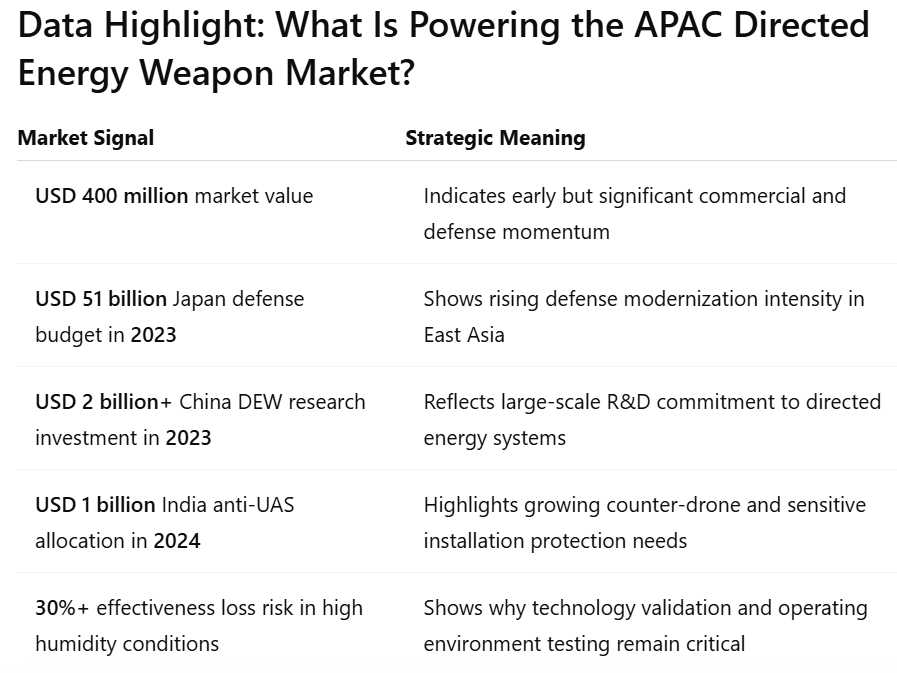
Data Highlight: What Is Powering the APAC Directed Energy Weapon Market? | Ken Research
What Could Slow Down Directed Energy Weapon Adoption in APAC?
The **APAC Directed Energy Weapon Market growth outlook is strong, but adoption is not frictionless. Directed energy weapons require high development budgets, advanced infrastructure, energy management systems, and careful operational validation. A high-energy laser system can cost upwards of USD 200 million** to develop, which limits faster adoption among countries with constrained defense budgets.
Operational performance is another concern. Laser systems can lose effectiveness in poor weather, high humidity, dust-heavy environments, or long-range engagement scenarios. This is especially relevant in Asia Pacific, where terrain and climate conditions vary widely across coastal zones, mountain borders, tropical regions, and urban security environments.
Ken Research analysis suggests that the next competitive edge will depend on how well suppliers solve these deployment barriers. Defense buyers will likely prioritize systems that offer better portability, lower lifecycle cost, improved thermal management, and stronger integration with radar, AI-based detection, and unmanned platforms.
Why Strategic Partnerships Will Shape the APAC Directed Energy Weapon Market Forecast?
Directed energy weapon development is capital-intensive, technically complex, and regulation-sensitive. That is why partnerships are becoming central to the market’s next phase. Japan and the United States entered a USD 1.2 billion partnership to advance laser DEW technology, while South Korea has collaborated with Israel on joint directed energy research initiatives.
These collaborations can accelerate knowledge transfer, testing, system integration, and defense readiness. They also create opportunities for technology firms, component suppliers, defense manufacturers, and systems integrators to enter the market through specialized capabilities instead of full-platform ownership.
For investors and defense ecosystem players, the **APAC Directed Energy Weapon Market Growth story is not limited to weapon platforms. The real value chain may expand across optics, semiconductors, power systems, cooling modules, AI-enabled targeting, electronic warfare integration, and field testing services. For naval and short-range defense comparison, Ken Research’s [Global Close-In Weapon System Market](https://www.kenresearch.com/industry-reports/global-close-in-weapon-system-market?utm_source=MicroBlog&utm_medium=referral&utm_campaign=Sameeksha)** can also help readers connect directed energy adoption with broader platform defense modernization.
For deeper segmentation, technology outlook, company benchmarking, and investment opportunity mapping, decision-makers can **Download a Free Sample Report** from Ken Research.
Conclusion
The APAC Directed Energy Weapon Industry is entering a strategic growth phase as laser defense, microwave systems, and counter-drone technologies become more relevant to national security planning. Through **Ken Research**, business leaders, defense ecosystem suppliers, and investors can track how this market connects with wider defense technology, national security, and advanced weapons modernization themes. The shift is being powered by defense modernization, rising regional threat complexity, and the need for faster, more precise response systems. While high development costs and environmental limitations remain real challenges, the long-term opportunity is expanding across military, homeland security, and border protection applications. Ken Research analysis indicates that suppliers with strong integration capabilities, field-tested performance, and partnership-led technology models will be better positioned as adoption accelerates. For defense manufacturers, technology providers, and investors, this market is becoming a critical part of the next-generation security ecosystem.
FAQs
What is driving the APAC Directed Energy Weapon Market?
The **APAC Directed Energy Weapon Industry** is being driven by defense modernization, rising counter-drone requirements, border security needs, and increased investment in laser and microwave weapon technologies. Countries such as China, Japan, South Korea, India, and Australia are strengthening directed energy capabilities to improve response speed and precision.
Why are high energy lasers important in the APAC Directed Energy Weapon Market?
High energy lasers are important because they offer precision targeting, fast engagement, and strong relevance for counter-UAS and surveillance-linked defense operations. Their ability to neutralize small aerial threats makes them a key technology segment in the **APAC Directed Energy Weapon Market Forecast**.
Which applications are gaining traction in the APAC Directed Energy Weapon Market?
Defense, homeland security, border protection, coastal security, and counter-drone operations are gaining traction. These use cases are becoming more important as Asia Pacific countries look for advanced non-kinetic tools to manage complex security environments.
What are the biggest challenges for directed energy weapon adoption?
The biggest challenges include high development cost, infrastructure requirements, weather-related performance limitations, and regulatory concerns. A high-energy laser system can require major investment, which makes adoption dependent on defense budgets, testing success, and operational reliability.
How can businesses assess opportunities in the APAC Directed Energy Weapon Market?
Businesses can assess opportunities by reviewing technology segmentation, procurement priorities, regional defense spending, partnership models, and supplier capability gaps. For deeper intelligence, Ken Research provides market sizing, competitive analysis, and opportunity mapping through its **APAC Directed Energy Weapon Market Report**.
메타데이터
- post_id
- ef1dca8f27ec
- slug
- apac-directed-energy-weapon-market-ef1dca8f27ec
- url
- https://medium.com/@bhardwaj.sameekshaa/apac-directed-energy-weapon-market-ef1dca8f27ec
- canonical_url
- https://medium.com/@bhardwaj.sameekshaa/apac-directed-energy-weapon-market-ef1dca8f27ec
- author_url
- https://medium.com/@bhardwaj.sameekshaa
- status
- ok
- fetched_at
- 2026-06-14 17:09:17



