Outdoor Rangefinders for Scanning and Moving Targets
A moving target changes the whole feel of outdoor distance measurement.
Outdoor Rangefinders for Scanning and Moving Targets
A moving target changes the whole feel of outdoor distance measurement.
A fixed tree line, a fence post, a ridge, or a flagstick gives you time. You can raise the rangefinder, steady your hand, press the button, and think about the number. But when something is moving across a field, slipping through timber, or walking along uneven ground, the situation becomes less tidy.
That is where an outdoor rangefinder with scan mode starts to make sense.
Not because it magically solves every problem in the field. It does not. But it can give hunters, outdoor users, and anyone working with distance a faster way to read changing yardage without stopping for a fresh single measurement every second.
Why Moving Targets Are Harder to Range
Distance feels simple when nothing is moving. You point at the object, get a yardage, and make your decision.
With moving targets, the number can change quickly. A deer crossing an open lane may move from 42 yards to 36 yards in just a short moment. A coyote working along a fence line may not stop where you expect. Even when the animal is not running, small changes in angle, terrain, and direction can make the distance less obvious than it looks.
This is one reason many experienced hunters still talk about “knowing your lanes” before the moment happens. A rangefinder is useful, but it works best when paired with field awareness. If you already know the distance to a stump, a trail opening, a large rock, or the edge of a food plot, you are not starting from zero when something moves through the area.
Still, real outdoor situations are not always that controlled. That is where scanning helps.
What Scan Mode Actually Does
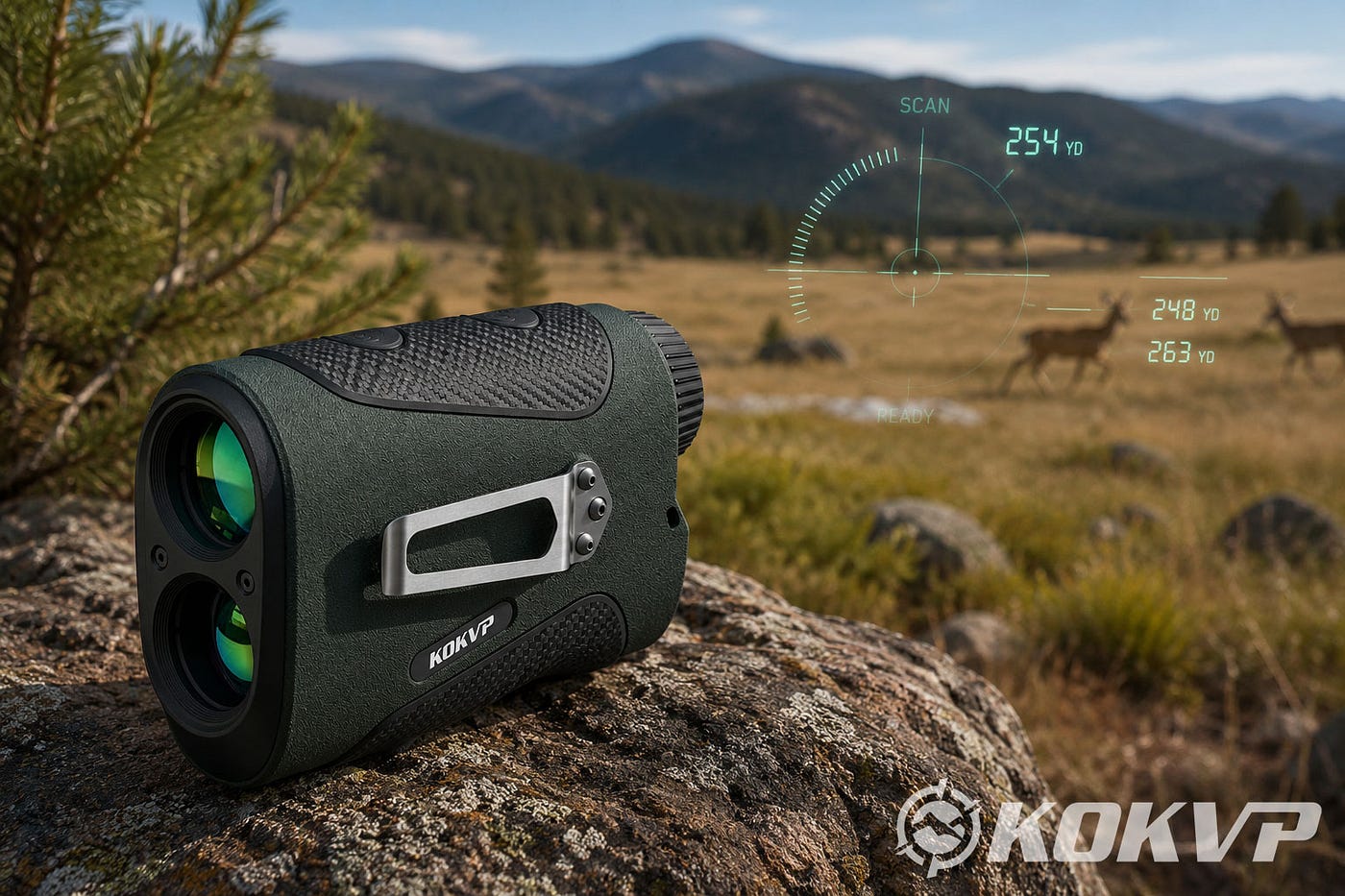
Scan mode allows a laser rangefinder to keep updating distance readings as you move across different objects or follow a target area. Instead of pressing once, waiting for one number, lowering the unit, and repeating the process, you hold the button and sweep or track.
For field use, that can be helpful in a few common situations.
You may scan across a tree line to understand the distance difference between the near edge and the far edge. You may follow an animal’s general path as it moves through an opening. You may check several landmarks quickly before deciding which one matters most. You may also use scan mode to understand uneven terrain, especially when distance changes are not obvious to the eye.
This is especially useful in hunting rangefinders because outdoor targets rarely present themselves like clean objects on a driving range. Branches, brush, shadows, slopes, and background clutter can all affect how easy it is to get a confident reading.
The Difference Between Ranging a Target and Ranging a Zone
One useful way to think about moving targets is to stop focusing only on the target itself.
In many cases, you are really ranging a zone.
For example, a bow hunter may not need to range a deer every second as it walks through the woods. It may be more practical to range the opening, the trail bend, the far tree, and the near edge before the animal arrives there. Then, when the deer steps into that area, the hunter already has a working yardage in mind.
The same idea applies to rifle hunting, though the distances and margin for error can be different. In open country, a laser rangefinder can help read a hillside, a ridge line, or a patch of ground where the animal is likely to pause. Scan mode lets you move across that scene and build a more complete sense of distance.
This is not as flashy as trying to track every step. But in real use, it is often more reliable.
Where Speed Matters Most
A fast rangefinder is not only about showing a number quickly. It is also about reducing the amount of time you spend thinking about the tool.
If the display is slow, the button feels awkward, or the optics are dim, the whole process becomes distracting. You end up fighting the device instead of reading the scene.
For scanning and moving targets, a few things matter more than they might on paper.
The first is a responsive reading. You want the distance to update smoothly enough that scanning feels natural. The second is optical clarity. If you cannot see the object clearly through the rangefinder, the laser reading is only part of the problem. The third is a comfortable grip and simple button layout, especially in cold weather or when wearing gloves.
This is where practical outdoor optics brands, including KOKVP, tend to fit into the conversation. For many users, the goal is not to own the most complicated device. It is to carry a laser rangefinder that is quick enough, clear enough, and simple enough to use when the moment is not perfectly still.
Scan Mode Is Helpful, But It Has Limits
It is worth being honest here. Scan mode does not turn a rangefinder into a tracking system.
Brush can still interfere. Rain, fog, and low light can still make readings harder. A small target moving behind branches may not give you a clean number. Even a good hunting rangefinder may lock onto the background instead of the animal if the situation is messy.
That does not mean the tool is failing. It means the environment is complicated.
This is why scan mode should be treated as a decision-support feature, not a replacement for judgment. It helps reduce guessing, but it does not remove the need to understand your surroundings, know your effective range, and make safe decisions.
For hunters, that last part matters most. A rangefinder can provide yardage, but it cannot decide whether the shot is ethical, whether the angle is right, whether the background is safe, or whether the animal is moving too much.
Angle Compensation and Moving Terrain
Outdoor distance is not always flat distance.
When you are above a trail in a tree stand, looking across a draw, or glassing along a hillside, the line-of-sight distance may not be the number you should rely on. This is where angle compensation becomes useful.
Angle compensation estimates the adjusted distance based on the incline or decline. For bow hunting, this can be especially important because steep angles can affect how the shot plays compared with straight-line yardage. For rifle hunting, the effect depends on the distance and terrain, but it is still part of the larger distance-measurement picture.
When scanning moving targets across uneven ground, angle compensation can help you understand not just how far something is, but how the terrain changes the practical meaning of that distance.
Again, it is not magic. But it gives you more context.
Scanning Is Also Useful Beyond Hunting
Although scan mode often gets discussed in hunting rangefinder conversations, it has value in other outdoor situations too.
Hikers, landowners, outdoor workers, and recreational users may use scanning to estimate distance across a property, check the width of a field, measure to a treeline, or understand how far away a landmark is. Golfers may use a related style of scanning when checking hazards, bunker carries, or multiple targets around a green, though golf rangefinders often emphasize flag lock and slope mode more than moving targets.
The common theme is simple: scan mode helps when the distance question is not just one object.
Sometimes you need to understand a whole space.
What to Look for in an Outdoor Rangefinder for Scanning
For scanning and moving targets, the best rangefinder is usually the one you can operate without overthinking it.
A clear display matters. If the numbers are hard to read in shade or early morning light, the feature list will not help much.
A stable view matters too. Higher magnification sounds attractive, but if the image shakes too much in the hand, tracking a moving target becomes harder. Many outdoor users prefer a balanced level of magnification that makes targets visible without making every small hand movement feel exaggerated.
Weather resistance is also worth considering. Field gear gets exposed to damp grass, changing temperatures, dust, and light rain. You do not need to abuse your rangefinder, but you do want something built for real outdoor use.
Battery life and size are easy to overlook. A compact rangefinder that fits into a chest pack, bino harness, or jacket pocket is more likely to be carried. And the tool you actually carry is the one that helps.
Using Scan Mode More Effectively
The best way to use scan mode is not to wave the rangefinder around randomly.
Start with landmarks. Range the obvious objects first: the trail, the fence corner, the far edge of the clearing, the base of the hill, the tree where animals often pause. This gives you a mental map.
Then scan slowly. A smooth sweep is usually more useful than a fast swing. If the numbers jump too much, slow down and focus on larger objects near the target area.
For moving targets, try to range where the target is going, not only where it is right now. This is especially helpful when the target is moving toward an opening or along a known path.
And finally, do not let the device consume the whole moment. A rangefinder should make decisions faster, not distract you from what is happening in front of you.
The Practical Point
Outdoor rangefinders are most useful when they help you make cleaner decisions in imperfect conditions.
For scanning and moving targets, that means faster yardage updates, better awareness of the surrounding zone, and less reliance on rough visual guessing. Scan mode, angle compensation, optical clarity, and simple handling all play a role.
But the real value is not just the number on the screen. It is the way that number fits into the bigger field picture.
A good laser rangefinder helps you understand distance. Experience helps you understand what to do with it.
메타데이터
- post_id
- ef237e624e9a
- slug
- outdoor-rangefinders-for-scanning-and-moving-targets-ef237e624e9a
- url
- https://medium.com/@poxiaoxi2/outdoor-rangefinders-for-scanning-and-moving-targets-ef237e624e9a
- canonical_url
- https://medium.com/@poxiaoxi2/outdoor-rangefinders-for-scanning-and-moving-targets-ef237e624e9a
- author_url
- https://medium.com/@poxiaoxi2
- status
- ok
- fetched_at
- 2026-06-24 18:57:25