How Recruitment Agencies Can Turn Customizable Workflows Into a Competitive Advantage (With Async…
If you run or work in a recruitment agency, you already know the reality: every client has “their” way of hiring. One wants three interview…
How Recruitment Agencies Can Turn Customizable Workflows Into a Competitive Advantage (With Async Screening at the Core)
If you run or work in a recruitment agency, you already know the reality: every client has “their” way of hiring. One wants three interview rounds and detailed references. Another wants a fast, lean process for high-volume roles. A third wants thorough leadership assessments with multiple stakeholders in the loop.
Trying to force all of these clients into one generic workflow rarely ends well. But building an entirely new, bespoke process for each client is exhausting and inefficient. The solution lies in customizable hiring workflows that balance structure and flexibility, and in smart tooling that lets agencies adapt without losing their sanity.
At the heart of this approach is a screening stage that can be configured per client, per role type, and per volume level — without requiring you to rebuild your entire stack each time.
Why Agencies Need Customizable Workflows More Than Ever
Modern agencies are expected to deliver more than CVs. Clients increasingly expect:
- Clear visibility into pipeline stages and progress.
- Tailored evaluation criteria aligned with their culture and role requirements.
- Faster time-to-shortlist without sacrificing candidate quality.
- Positive candidate experience that reflects the client’s brand.
Trying to accomplish all of this with rigid, one-size-fits-all workflows often leads to:
- Confusion about who owns which stage.
- Misaligned expectations on timelines and evaluation.
- Bottlenecks around screening and coordination.
- Candidates feeling like they’re jumping through inconsistent hoops.
A customizable workflow gives agencies the ability to start from a core structure — so the team knows what “standard” looks like — but then adjust stages, questions, formats, and timelines per client and role.
The Core Framework Agencies Can Use
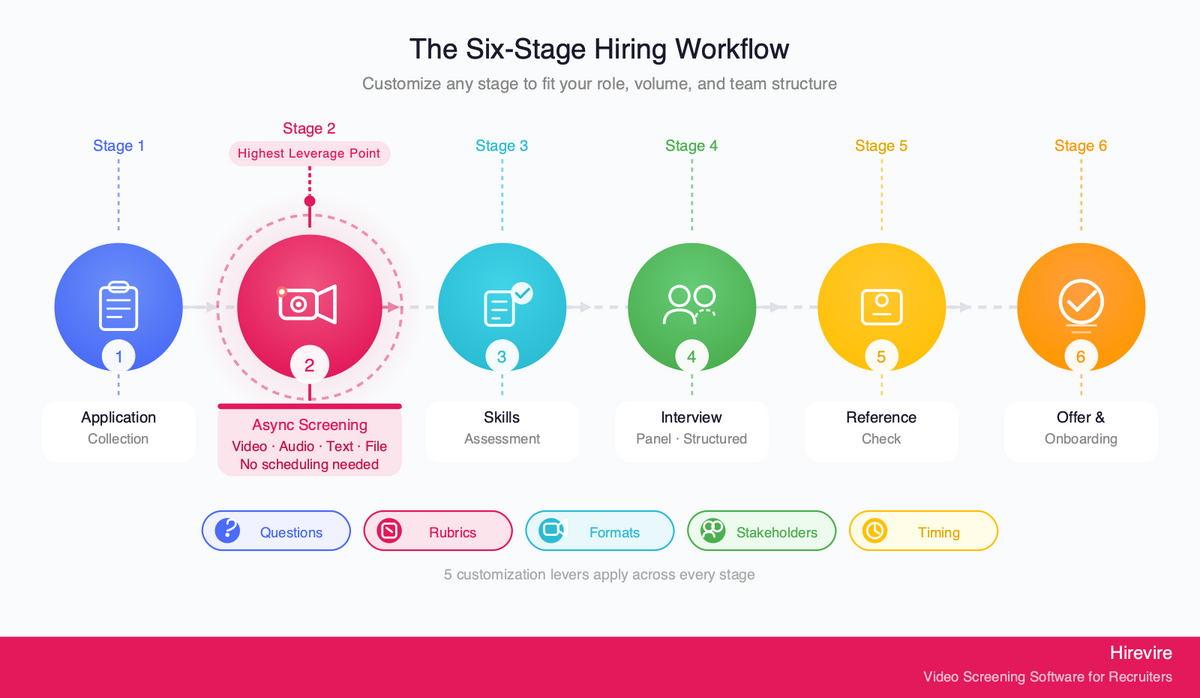
Most agencies can operate from a six-stage baseline:
- Application and intake
- Initial screening (async or live)
- Assessment or deeper qualification
- Interviews (client-led or agency-led)
- References
- Offer handoff and onboarding support
This gives you a repeatable skeleton. Within it, customization can happen at three levels:
- By client (branding, tone, communication preferences, specific steps).
- By role type (technical, sales, operations, leadership, high-volume).
- By volume (low, medium, high).
You don’t need 20 workflows for 20 clients. You need a manageable set of templates that can be tuned quickly.
Building Client-Specific Variants Without Reinventing the Wheel
A practical agency playbook might look like this:
- Define 3–4 role-type workflows (technical, sales, operations, entry-level/high-volume).
- For each new client, start with the relevant template based on their primary roles.
- Customize around three things:
- Branding and candidate-facing experience.
- Question sets and evaluation rubrics.
- Communication rules and timing.
For example:
- A SaaS client hiring sales roles might get a workflow where screening includes short video pitches and roleplay prompts, and interview rounds emphasize closing skills.
- A logistics client hiring warehouse staff at peak season might get a workflow with short, asynchronous screenings, tight response windows, and automated shortlisting triggers.
- A professional services client hiring consultants might get deeper written scenarios and multi-stage interviews involving partners and senior managers.
What changes is not the entire framework, but how stages behave and how candidates move through them.
Screening as the “Agency Signature” Stage
Agencies do their most differentiated work at the screening stage. This is where you:
- Translate client requirements into actionable questions.
- Evaluate communication style, cultural fit, and role understanding.
- Decide whether someone is worth presenting to the client.
- Package candidate responses into something a client can quickly digest.
If screening is a calendar-heavy, phone-based stage, your ability to scale and differentiate will always be limited. You spend more time scheduling than evaluating, and you may struggle to present rich candidate insights beyond a résumé and a quick summary.
By reimagining screening as an asynchronous, configurable stage, agencies can:
- Collect video, audio, text, and file-upload responses from candidates at scale.
- Mix formats to match client needs (for example, a video introduction plus a written case response).
- Standardize evaluation rubrics per client or per role.
- Share candidate responses via simple links or packets without forcing clients into new systems.
This becomes your agency’s “signature” — a structured way to show clients real candidate behavior and thinking, not just profiles.
Customization Levers Agencies Can Control
Within the screening stage, agencies can pull the same five levers HR teams use — but with a stronger focus on client alignment:
- Questions
Agencies can co-design question sets with clients, ensuring that the prompts reflect actual role expectations. For example, a sales client may want a “sell me this product” style prompt, while a support client wants scenario-based empathy questions.
2. Rubrics
Agencies can define rubrics with clients ahead of time: what does a “5” look like? What does a “3” look like? This helps align expectations and reduces back-and-forth later.
3. Formats
Agencies can choose formats strategically. For roles where clients care about communication, video becomes mandatory. For analytical roles, written responses carry more weight. For creative roles, portfolios and file uploads become central.
4. Stakeholders
Agencies can determine who reviews responses internally (consultants, account managers, recruiters) and who needs to see what externally (hiring managers, HR partners). Clear handoffs keep the process moving.
5. Timing
Agencies can tailor response windows based on client urgency and market realities. High-volume seasonal roles may have short windows; leadership roles may allow more time for reflection.
By making these levers visible to clients, agencies also position themselves as process partners — not just CV suppliers.
Handling Different Hiring Volumes Across Clients
Many agencies serve a mix of clients: some with occasional strategic hires, some with ongoing high-volume needs.
A customizable workflow can adapt like this:
- Low volume clients
Deeper screening, longer response windows, more stakeholders involved, richer candidate feedback. You’re helping clients make high-stakes decisions with more nuance.
- Medium volume clients
Screening becomes mandatory and relatively standardized by role type. Automated communication and shared candidate packets help maintain pace.
- High volume clients
Automation takes the lead at early stages. Short, focused screening; bulk invites; AI-assisted qualification checks; clear thresholds for shortlist or reject. The agency’s value lies in designing the right filters and maintaining experience quality at scale.
You don’t need a separate software stack for each volume level; you need a screening stage and workflow configuration that can flex within the same tooling.
Turning Process into a Differentiator, Not Just an Internal System
When agencies design and own customizable workflows, they gain a competitive edge in three ways:
- Speed with transparency
You can move faster without asking clients to trust a black box. Stages, timelines, and criteria are documented and shared. Clients know what happens between “candidate applied” and “candidate shortlisted.”
2. Consistency with personalization
You can guarantee baseline consistency (for example, every candidate for a specific role type goes through the same core screening sequence) while still personalizing experience through branding, messaging, and client-specific questions.
3. Rich candidate insight
Instead of sending CVs and backchannel comments, you send structured responses: videos, written scenarios, portfolios, and rubric scores. Clients make better decisions, and your agency is seen as bringing real substance.
How Hirevire Can Support Agency Workflows
To make all of this manageable, agencies need tooling that’s:
- Easy to configure per client and role.
- Flexible in response formats.
- Friendly for candidates (no complex onboarding).
- Simple for clients to consume (no forced accounts).
- Integrable with existing ATS or CRM systems.
Hirevire is designed specifically as a customizable, asynchronous screening layer that fits those needs:
- Agencies can create separate job setups per client with custom branding (logo, colors, intro video).
- They can configure question sets that align with client expectations and save them as templates for reuse.
- Candidates respond via video, audio, text, or file upload at their convenience, without needing to log into a heavy platform.
- Recruiters can share candidate responses with clients as links or structured packets, consolidating comments and ratings in one place.
- Integrations (via native connections or tools like Zapier and webhooks) allow Hirevire to feed into ATS or internal tracking systems.
Instead of asking clients to replace their ATS or adopt a new system wholesale, agencies can position Hirevire as the focused, high-value screening stage that plugs into whatever system the client already uses.
A Simple Agency Implementation Blueprint
If you’re considering introducing async, customizable screening into your agency workflow, here’s a practical starting point:
- Pick one client and one role type
Begin with a client who is open to process improvements and a role type you handle frequently (for example, account executives, support agents, or engineers).
2. Co-design a screening sequence
Work with the client to define 2–4 key questions, preferred formats, and evaluation criteria. Keep it simple for the first iteration.
3. Configure the sequence in Hirevire
Set up branding, question formats, response windows, and automation rules. Save this as a template for that client and role type.
4. Run a pilot for a small batch of candidates
Use async screening instead of phone screens for an initial set of applicants. Collect candidate feedback, client impressions, and team observations.
5. Refine, then scale to other roles/clients
Adjust questions, windows, and rubrics based on real-world use. Once the client sees value — faster shortlists, better insight — you can introduce similar workflows for other roles and clients.
Over time, your agency gains a library of proven screening templates, an internal process playbook, and a client-facing narrative around how you run structured, flexible hiring workflows.
Why Now Is the Right Time to Modernize Agency Workflows
Candidate expectations have changed. They want:
- Clarity about timelines and stages.
- Processes that respect their time.
- Opportunities to showcase more than a résumé, especially for roles where communication, creativity, or practical judgment matter.
Clients have changed too. They want:
- Faster, more reliable shortlists.
- Evidence of how candidates think and act, not just what they’ve done.
- Transparent processes that they can understand, approve, and occasionally adjust.
Customizable workflows, powered by asynchronous screening tools like Hirevire, sit exactly at the intersection of these needs. They let recruitment agencies deliver both speed and depth, both structure and flexibility.
If your agency’s current process feels fragmented, calendar-heavy, and hard to explain to clients, focusing on the screening stage — and making it smarter, more configurable, and more shareable — might be the most impactful change you can make.
Read more: For a detailed breakdown of customizable hiring workflows, stage-level customization levers, and practical patterns that HR teams and agencies can adopt, explore the full guide here.
메타데이터
- post_id
- ef2ff3caac3d
- slug
- how-recruitment-agencies-can-turn-customizable-workflows-into-a-competitive-advantage-with-async-ef2ff3caac3d
- url
- https://medium.com/hirevire/how-recruitment-agencies-can-turn-customizable-workflows-into-a-competitive-advantage-with-async-ef2ff3caac3d
- canonical_url
- https://medium.com/hirevire/how-recruitment-agencies-can-turn-customizable-workflows-into-a-competitive-advantage-with-async-ef2ff3caac3d
- author_url
- https://medium.com/@hsanat
- status
- ok
- fetched_at
- 2026-07-09 05:26:43